Thor was the thunder-god of the Norse, the mightiest warrior of the Aesir and the great defender of both gods and mankind against the giants — red-bearded, enormously strong, wielder of the hammer Mjölnir, and the most beloved of all the gods to the common people of the Viking age. Where his father Odin was the god of kings, poets and the cunning few, Thor was the god of the farmer and the sailor, the protector who stood between the world and the forces of chaos.
The Thunderer
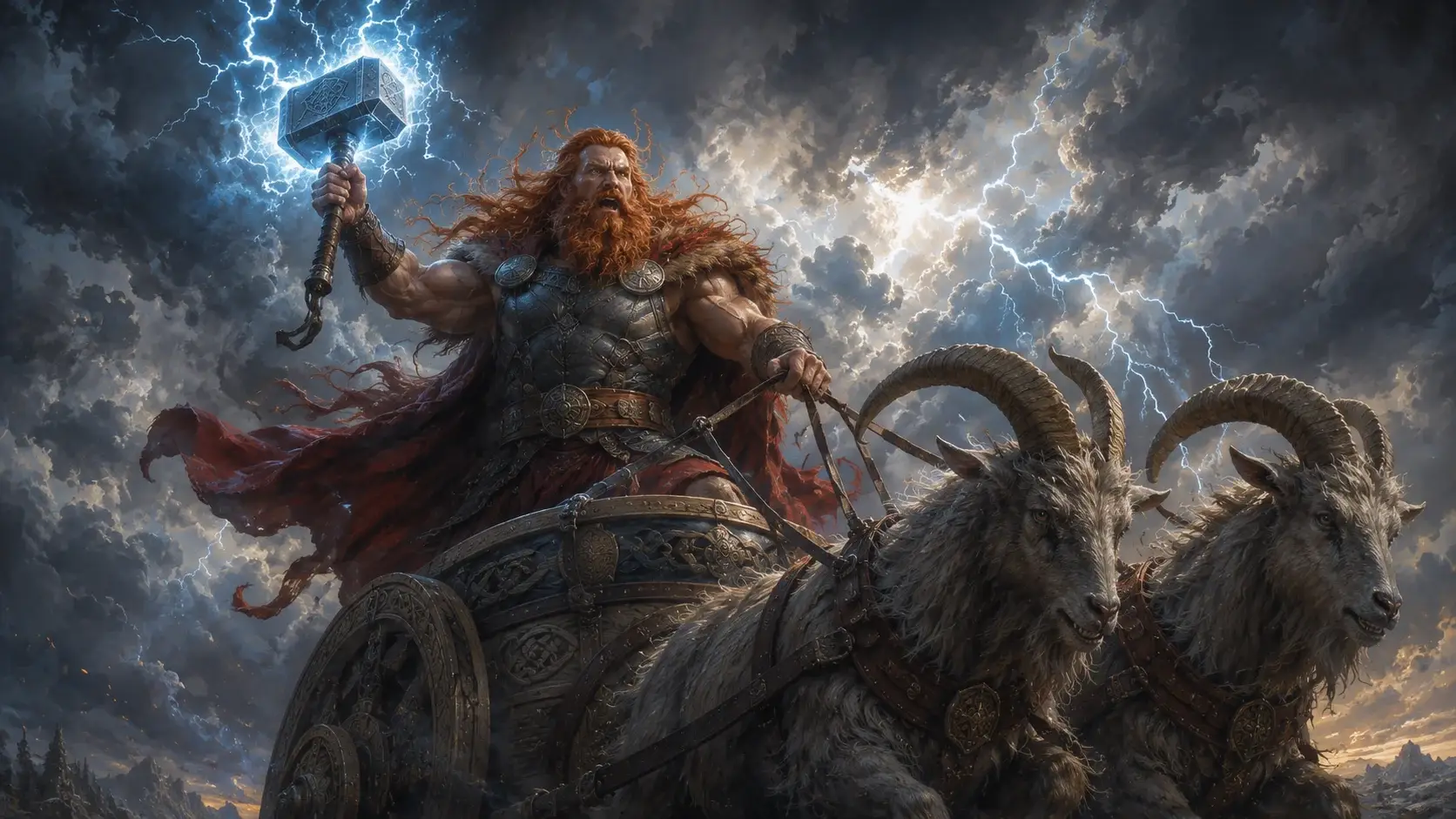
Thor (Old Norse &Th;órr; the same god the continental Germans called Donar, “thunder”) was a son of Odin and the earth-goddess Jord, and the strongest of all the gods. He was the god of thunder, lightning, storms and the sky, and the bringer of the rains that made the crops grow — so that he was at once a god of awesome power and a god of fertility and protection. He was imagined as a huge, red-bearded man of vast appetite and quick temper, riding across the heavens in a chariot drawn by two goats, Tanngrisnir and Tanngnjóstr, whose passage made the thunder roll. The very days of our week remember him: Thursday is “Thor's day.”
Mjolnir, the Hammer
Thor's great weapon was the hammer Mjölnir, forged by the dwarves, which never missed its mark and always returned to his hand when thrown. With it he was the unstoppable champion of the gods, the slayer of giants and the bane of the great serpent. He also wore a belt of strength, Megingjörð, which doubled his already immense power, and iron gloves to grip the hammer's short handle. Mjolnir was more than a weapon: it was a sacred symbol of protection and blessing, used to hallow marriages and funerals, and Vikings wore it as an amulet against harm — the great hammer that warded off the chaos of the giants.
The Foe of the Giants
Thor's endless task was to defend Asgard and Midgard against the jötnar (giants), the forces of chaos that forever threatened to overwhelm the ordered world. The myths are full of his journeys into the giants' lands and his battles with their champions: he crushed the skull of the giant Hrungnir; he fished for the world-serpent itself from the boat of the giant Hymir, hauling up Jörmungandr on his line; he was tricked and tested in the hall of Utgarða-Loki, where he wrestled old age itself and tried to drain the sea. Again and again, often with the trickster Loki as his uneasy companion, Thor was the muscle that kept the giants at bay.
The Theft of the Hammer
In one of the most beloved and comic of the myths, the giant Thrym stole Mjölnir and demanded the goddess Freya as his bride in ransom. The solution was for Thor himself to dress as the bride, veiled, with Loki as his bridesmaid — and when the hammer was brought out to bless the wedding, Thor seized it and slaughtered the whole giant hall. The tale shows the other side of the thunder-god: not only awesome but earthy, robust and the hero of a good rough joke.
The Doom at Ragnarok
At Ragnarök, the end of the world, Thor is fated to meet his greatest enemy at last: the world-serpent Jörmungandr, the monstrous child of Loki that encircles the earth. The two will destroy each other — Thor will slay the serpent with his hammer, but will be able to stagger only nine steps before falling dead from its venom. Thus the mightiest defender of the world dies defending it to the very end, killing the great enemy with his last strength. Thor endures as the very image of protective strength, the people's god who stood guard over the world; his hammer remains one of the most powerful and beloved symbols of the entire Norse age.
The hammer that warded the world from chaos struck down the world-serpent at the last — and its bearer walked nine steps and fell, having defended the earth to his final breath.
The Forging of Mjölnir
The hammer itself has an origin story, and it begins with mischief rather than war. One night the trickster Loki cut off the golden hair of Thor's wife Sif as a prank while she slept — an act serious enough that Thor threatened to break every bone in the trickster's body unless he made it right. Loki fled to the dwarves, the sons of Ivaldi, who spun Sif new hair out of real gold that would take root and grow like living hair, and threw in two further wonders besides: the ship Skíðblaðnir, which folded up like cloth yet always found a fair wind, and the spear Gungnir, which never stopped in its thrust. Flushed with the dwarves' skill, Loki then wagered his own head with two brother-smiths, Brokkr and Sindri, betting they could not outdo what had already been made. Frightened he might lose, Loki turned himself into a fly and bit Brokkr on the eyelid as he worked the bellows for the third and finest treasure — and the blood running into the dwarf's eye made him let go of the bellows for one instant too long. The hammer came out of the forge perfect in every way but one: its handle was too short. The gods judged it the greatest of all the gifts regardless, since it alone could hold the frost-giants back, and Loki lost his wager — though he kept his head by pointing out that no one had bargained for his neck, and had to settle for having his lips stitched shut instead. Mjölnir's short haft, so the story explains, is the permanent scar of a bet the trickster very nearly won.
Sif, and the Sons Who Would Inherit the Hammer
Sif herself is a shadowy figure beside her husband, remembered chiefly for that gleaming hair. The marriage produced a daughter, Þrúðr (“Strength”), whose very name reads as a description of her father rather than a character in her own right. Thor's most famous son, however, came from elsewhere: the giantess Járnsaxa bore him Magni, “Mighty”, and the story of Magni's first appearance is one of the strangest in the whole cycle. Immediately after Thor's duel with the giant Hrungnir, the god lay pinned beneath the giant's enormous stone leg, and not one of the assembled gods could shift it — until three-night-old Magni strolled over and lifted it off, remarking that he was sorry to have arrived too late to finish the giant off with his fist. Thor rewarded the infant on the spot with Hrungnir's horse Gullfaxi, a gift that irritated Odin, who thought so fine an animal should have come to him rather than to a giantess's son. A second son, Móði (“Wrath”), is little more than a name paired with his brother's, but the pairing matters: the poem Vafþrúðnismál states outright that when Thor's fighting is finally over, it is Móði and Magni who will possess Mjölnir afterward — the hammer outliving the god who swung it.
Thjalfi and Roskva, the Farmer's Children
Thor did not always travel alone. On the road toward the giants' realm, he once stopped for the night at a poor farmer's house and, in payment for their lodging, slaughtered and cooked his own goats, sharing the meat with the household on one condition — that no one crack the bones for their marrow. The farmer's son, unable to resist, split a thighbone open with his knife. In the morning Thor raised the hammer over the goats' hides and bones and hallowed them back to life — both goats rose, but one stood lame in a hind leg from that day on. Furious, Thor was appeased only when the terrified farmer handed over his two children, Thjalfi and Roskva, to serve the god from then on. Thjalfi became Thor's constant companion on the journeys that follow into the giants' country, and in the hall of Utgarða-Loki he ran three footraces against a competitor who turned out, once the contest was already lost, to be Thought itself — a defeat built on exactly the same joke as Thor's own famously outmatched feats of strength in that same hall. The lame goat stayed part of the household ever after: a small, permanent reminder of a rule broken at the dinner table.
The Journey to Geirröðr's Hall
Loki did not usually endanger Thor on purpose, but he did once, to save his own skin. Caught spying in the shape of a falcon by the giant Geirröðr, Loki bought his freedom by swearing to lure Thor into the giant's hall without his hammer, his belt of strength, or his iron gloves. Thor went anyway, trusting his companion, and the two broke their journey at the home of a giantess named Gríðr, who was no friend to her own kind: she warned Thor exactly what waited for him and lent him her own belt, her own gloves, and a staff called Gríðarvölr to make up for the weapons he had left behind. The loan was needed at once. Fording the river Vimur, Thor felt the water rising around him with unnatural speed and traced it upstream to Geirröðr's daughter Gjálp, standing astride the current and swelling it with her own body; he drove her off with a thrown stone and the remark that a river must be stopped at its source, then hauled himself out on the far bank by grabbing hold of a rowan tree, said ever after to be “Thor's salvation.” Inside the hall, seated in a place of honour, he felt his chair suddenly heave toward the rafters and rammed the borrowed staff against the roof-beam, shoving down with all his strength — two broken backs answered him from underneath, Gjálp and her sister Greip had been lifting the chair to crush him. Geirröðr himself ended the contest by flinging a white-hot iron bar across the hall; Thor caught it in the borrowed gloves and hurled it straight back through the pillar the giant was cowering behind, killing him outright. He arrived at that door with nothing of his own but his name, and left having beaten three of them with a borrowed belt, borrowed gloves and someone else's stick.
The God the Farmers Prayed To
What makes Thor's popularity unusual is that it can be measured rather than merely asserted. The eleventh-century chronicler Adam of Bremen, describing the great temple at Uppsala in Sweden, placed an image of Thor in the seat of honour at the centre of the hall, with Odin and Freyr on either side, and recorded that it was Thor of the three who was appealed to when plague or famine threatened — the god ordinary people turned to when the harvest itself was at stake. The Icelandic Landnámabók, the Book of Settlements, is thick with settlers bearing Thor-compounded names — Þórólfr, Þorsteinn, Þorgrímr — a habit of naming children after the god that has no real equivalent for Odin, whose name is vanishingly rare in Norse personal names. And several Danish and Swedish runestones close with the same short carved formula, Þórr vígi: may Thor hallow these runes, or on other stones this monument. That is a working prayer cut into rock, not a literary flourish — the request of someone who expected to be heard.
The Hammer and the Cross
The hammer amulet took on a sharper meaning once Christian missionaries began working through Scandinavia in earnest. Wearing Mjölnir became, for a while, a small act of religious loyalty — a visible answer to the cross now appearing on the necks of neighbours and kings. The clearest evidence of how close the two symbols sat is a Viking-Age soapstone jewellery mould found in Denmark, cut with cavities side by side: one shaped as a cross, the other as a hammer, so that the same craftsman, the same molten silver and the same afternoon's work could supply either faith depending on the customer walking through the door. Whatever that smith privately believed, his mould is a fair picture of how a conversion actually proceeds — not in a single afternoon of conviction, but with the old protector and the new one held in the same pair of hands for a generation while everyone works out which way the century is going.
Thunor, Donar, and Thor's Name Across the Germanic World
The Norse Thor and the continental Donar are two branches of one much older Germanic thunder-god, and the family resemblance is easiest to see in what the other Germanic peoples left behind. The Anglo-Saxons called him Thunor, and he survives on the map of England in place names that mark his old cult sites — Thundersley in Essex, “Thunor's grove,” and Thursley and Thunderfield in Surrey. The ninth-century Old Saxon Baptismal Vow, the formula a convert had to recite to renounce the old gods before baptism, names him outright as Thunaer, alongside Woden and Saxnot, as one of the three powers a Christian was required to formally abandon — a god important enough to be forbidden by name. A mountain in the German Palatinate is still called Donnersberg, “Thunder Mountain.”
The weekday everyone knows is the residue of the same identification, and the mechanism behind it is worth seeing. Latin named the fifth day of the week for Jupiter, dies Iovis; when Germanic speakers adopted the seven-day week they did not translate the Roman sky-god at all but substituted their own thunderer for him — Old English Þunresdæg, Old Norse Þórsdagr, German Donnerstag, each of them a deliberate swap rather than a borrowing. The habit followed the Norse wherever they settled: the Faroese capital is Tórshavn, “Thor's harbour,” and a stretch of Icelandic highland is still called Þórsmörk, “Thor's wood.” Few figures in the Germanic world left so consistent a footprint across so many centuries and so many separate, mutually unintelligible languages.
Why the Farmer's God Endures
Thor's staying power has a simple engine underneath the poetry: he is the god of the problem that never goes away. Weather ruins harvests, storms sink ships, and the world outside the fence line is always, in some form, full of giants — hostile, chaotic, indifferent to human plans. Odin offers wisdom and Freyr offers plenty, but Thor offers the one thing a frightened, working population wants most: somebody enormously strong standing between them and the dark. That is likely why his myths are so often funny as well as violent — outrun by Thought, tricked into wrestling an old foster-mother, walking into a giant's hall with nothing but a borrowed belt — because a protector who can also be laughed at is a protector who belongs to the people rather than to an elite. The same appeal helps explain why a thunder-god this old survived the conversion longer, and more visibly, than almost any other figure in the pantheon, and why a hammer-shaped pendant, once a rural farmer's insurance against a ruined summer, is now stamped on rings, key-chains and film posters around the world. The anxiety Thor was built to answer — that the sky might turn on you, and that something has to be strong enough to stand in the way — never really went away; it just stopped being about crops.
Sources & traditions
- EncyclopediaWikipedia — Thor
- TraditionNorse texts, inscriptions and later retellings (Scandinavia)
Myths change from area to area and from time to time. This chronicle follows the most widely told versions; tellings in other villages, regions and eras may differ.