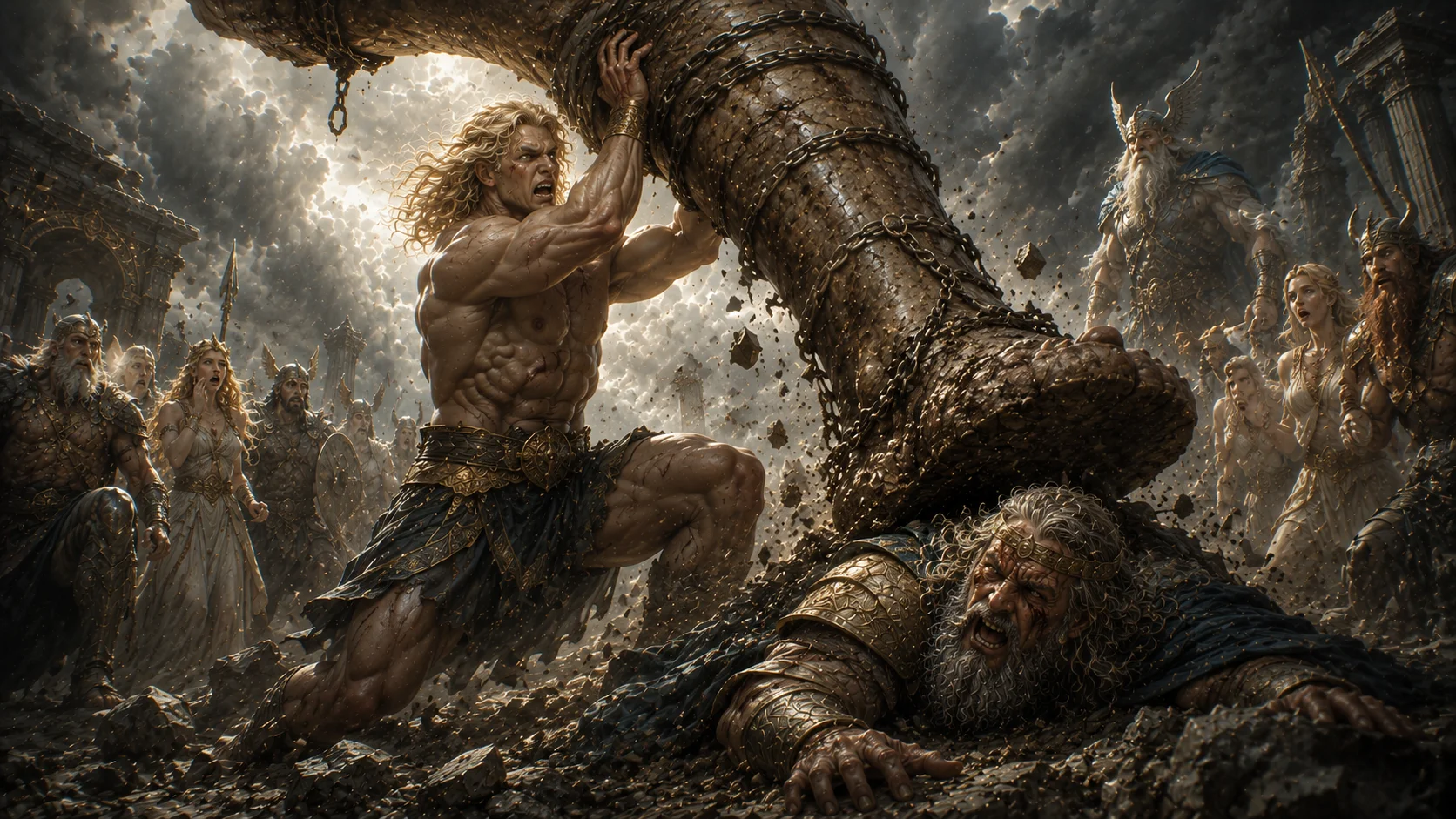
Magni was the Norse god of strength — a son of Thor so mighty that, while still a child of three nights old, he alone could lift the leg of a fallen giant off his pinned father. His very name means “strength,” and he is fated, with his brother Modi, to inherit Thor's great hammer and survive into the new world after Ragnarök.
The Mighty Child
Magni (Old Norse Magni, “the mighty,” “strength”) was a son of Thor by the giantess Járnsaxa, and from his birth he embodied the sheer physical power of his father, the strongest of the gods. His strength was prodigious and precocious, the inherited might of the thunder-god distilled into a single attribute — for where Thor was a god of many aspects, Magni was strength itself, the next generation's vessel of the power that defended gods and men against the giants.
The Lifting of Hrungnir's Leg
Magni's great deed came when he was astonishingly young. After Thor slew the giant Hrungnir in single combat, the dead giant fell with one enormous leg pinning Thor to the ground, and the mightiest of the gods lay trapped, unable to free himself, while the other gods tried and failed to lift the colossal limb. Then came Magni — only three nights old — who took hold of the giant's leg and heaved it off his father with ease, freeing Thor where all the grown gods had failed. Thor, amazed and proud, praised his infant son and gave him the giant's great horse Gullfaxi (“golden-mane”) as a reward — to Odin's displeasure, for the All-Father felt the prize should have been his. The deed marked Magni at once as a worthy heir to his father's strength.
The Heir of the Hammer
Magni's destiny lies beyond the end of the world. It is foretold that at Ragnarök, when Thor falls slaying the world-serpent and the old gods perish, Magni and his brother Modi will be among the survivors — and that they will inherit Mjölnir, their father's mighty hammer, carrying it into the new and cleansed world that rises from the ruins. Thus the great weapon that defended the gods does not perish with Thor but passes to his strong sons, who will bear it in the age to come.
The Strength That Survives
Magni endures as the personification of strength and the heir of Thor — the prodigiously mighty child who freed his trapped father, the son who carries the thunder-god's power into the future. He embodies the Norse hope woven into the doom of Ragnarök: that strength itself does not die with the old world, that the hammer that warded off chaos will be borne again by a new generation, and that the might of Thor lives on in his sons after the gods themselves have fallen.
At three nights old he lifted a dead giant's leg off his pinned father when all the grown gods had failed — and after the world ends, he and his brother will carry their father's hammer into the age reborn.
Two Threads of Attestation
Strip away the certainty of a familiar story and Magni turns out to rest on remarkably little parchment — two threads, spun centuries apart, that a modern reader only ever meets as one continuous myth. The prophecy that he and his brother will inherit Mjölnir comes from the Eddic poem Vafþrúðnismál, a work whose roots are generally thought to reach back into the pagan period, before Iceland's conversion around the year 1000. The far more vivid tale of the infant Magni lifting Hrungnir's leg, by contrast, survives only in Snorri Sturluson's Skáldskaparmál, composed around 1220 — a Christian scholar's prose handbook, written to preserve and explain the kennings of long-dead skalds rather than to record a living cult. The son who will outlive the gods, in other words, rests on older testimony than the child who first proved his strength: the ending of the story was on record before literature supplied the episode that earned it.
The Word Inside the Name
Say Magni's name in Old Norse and you are pronouncing an abstract noun before you are naming a god: magn, “power” or “might,” a root that survives in modern Icelandic magnaður (“powerful, intensified”) and, more distantly, in the English fossil phrase might and main — where “main” descends from Old English mægen, “strength,” the cousin of Old Norse megin. It is tempting to connect all of this to Latin magnus, “great,” and casual etymologies often do, but the resemblance is an accident of sound. The Germanic word descends from a root meaning “to be able, to have power”; magnus belongs to a separate root meaning “great,” the one that also produced Greek megas. Magni's name borrowed no prestige from Rome. It grew from purely Germanic soil, which makes it the blunter of the two: a Norse audience heard nothing but the word “Strength” when they heard him named.
Two Households Under One Father
Magni did not grow up an only child. Where Snorri lists the correct poetic ways to refer to Thor, he calls him “father of Magni, Móði and Þrúðr.” Móði's name comes from the same emotional register as his brother's: móðr means wrath, fury, fierce battle-temper, so the pair read almost as a matched set of warrior virtues, Strength and Fury. Þrúðr — “Might,” a third abstraction turned into offspring — belonged to the other household: the same handbook's kennings for the goddess Sif name her “mother of Þrúðr” and, in the same breath, “rival of Járnsaxa.” That one word does more work than any narrative could, placing Thor's giantess and Thor's wife in open competition and making Magni the child of the losing side of it. Worth noting, too, that only Magni is ever actually named as Járnsaxa's son in the sources; Móði's mother is nowhere recorded, and the modern habit of calling the two full brothers is an inference rather than a text. What the sources do give is a family straddling the very boundary Thor's hammer existed to defend — a son by a giantess growing up in the shadow of a daughter by a goddess.
The Company That Outlives the Gods
Magni and Móði do not inherit the ruined world alone. Norse eschatology is oddly specific about who gets to walk out of its ending. Alongside Thor's two sons carrying Mjölnir, Odin's sons Víðarr and Váli live to see the new dawn — Víðarr because he kills the wolf Fenrir in the very hour Fenrir kills his father, avenging Odin almost before the grief can land. Baldr, killed long before Ragnarök arrives, comes back up out of Hel together with Höðr, the blind brother whose hand threw the killing shot; the sources have the two of them sitting down afterwards and talking over the old lore, the grudge simply spent. And beyond the gods entirely, a single human pair, Líf and Lífþrasir, wait out the fire hidden in a wood the poem calls Hoddmímis holt — often taken to be Yggdrasil itself, though the text never says so — and from them the world is repeopled. Set against that list, Magni's survival stops looking like a lucky exception and starts looking like part of a design: Ragnarök is less an annihilation than a controlled burn, seeded in advance with just enough continuity — a hammer, an avenger, a reconciliation, two people in a tree — to regrow a world from its own ashes.
A God With No Temple
For all his weight in the story, Magni left almost no mark on the ground. Thor's cult is written into the Scandinavian landscape itself: place names carrying his name run from Norway and Sweden through Denmark to Iceland and the Faroes, where Tórshavn — Thor's harbour — is still the capital. The hammer pendants pulled from graves and hoards were worn as real protective amulets by real people, who also named their children Þorsteinn and Þorgerðr after him. Magni supplies none of that: no shrine, no place-name, no cult object anyone has been able to attach to him. That silence is not proof he went entirely unhonoured — the surviving record of pre-Christian Scandinavia is thin enough that absence of evidence proves very little on its own — but it does suggest a figure whose work was always literary and theological rather than devotional. He is an answer to a question, not a recipient of prayer: what happens to strength when the strongest god dies?
Magni Reborn as a Rival
Magni's most visible modern afterlife has nothing to do with inheritance at all. In the 2018 video game God of War, Magni and Móði appear as Thor's brash, overconfident sons, sent to prove themselves against the newly arrived Kratos and his son Atreus — and this Magni dies in the very confrontation his mythic self was promised he would survive. It is a small, telling piece of adaptation: modern storytellers kept the prodigious strength and the family pride, the two traits that made him memorable in the first place, and discarded the one thing the old sources actually guaranteed him — that he would still be standing when everything else was gone.
Why the Hammer Had to Pass to a Son
There is a reason the myth insists that Mjölnir is inherited rather than simply remade. Norse society ran on inheritance through the male line: land, weapons, rank and reputation passed from father to son as the ordinary mechanism by which a family's standing survived the death of its head, and a warrior's own weapon was among the most freighted objects he owned — the sagas are full of named blades handed down and remembered by name. A hammer that vanished with Thor and reappeared from nowhere in the new world would describe a different kind of universe, one where power resets to zero and every generation begins from scratch. A hammer that passes specifically to Thor's own sons describes the world a Norse audience expected to live in, where a man inherits his father's tools along with his father's obligations. Magni's destiny is Ragnarök translated into the terms of ordinary succession — proof, dressed as prophecy, that when the father falls the son is there to pick up what he was carrying.
Sources & traditions
- EncyclopediaWikipedia — Móði and Magni
- TraditionNorse texts, inscriptions and later retellings (Scandinavia)
Myths change from area to area and from time to time. This chronicle follows the most widely told versions; tellings in other villages, regions and eras may differ.