The Troll is one of the most enduring creatures of Norse and Scandinavian folklore — a being of the wild mountains, forests and caves, often huge, ugly and dangerous, slow-witted yet immensely strong, and famously turned to stone by the light of the sun. From the saga-age to the modern day, trolls have haunted the lonely places of the north as the embodiment of the wild, hostile world beyond the safety of human settlement.
The Folk of the Wild
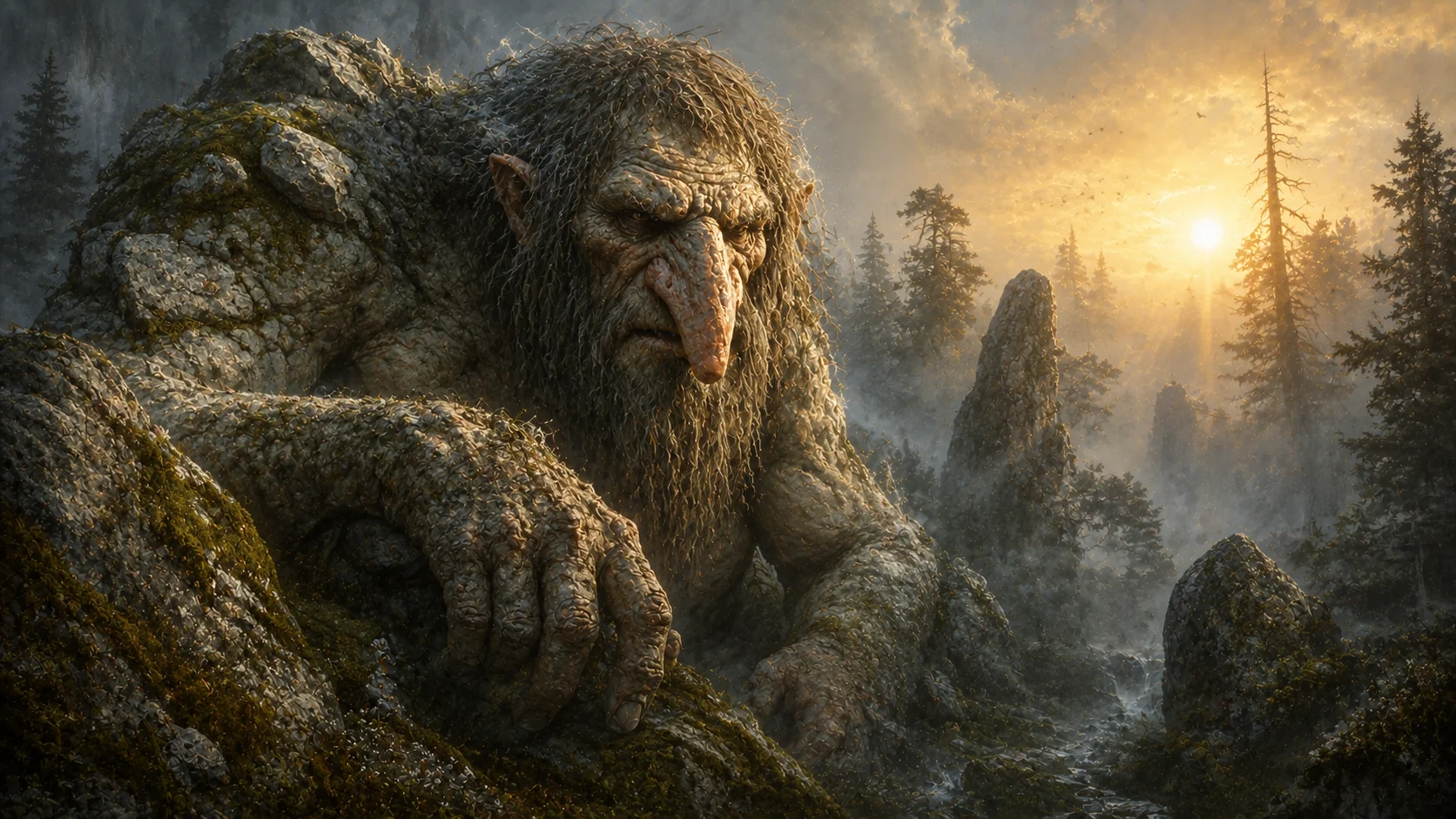
The Troll (Old Norse troll) is a creature of the uninhabited wilderness — the mountains, the deep forests, the caves and the rocky wastes of Scandinavia. In the older Norse sources the word could be used broadly for various malevolent or supernatural beings, overlapping with the giants (jötnar); in later folklore the troll became a more distinct figure. Trolls were generally imagined as large, ugly and brutish — often huge and grotesque, with great noses, shaggy hair and a fearsome aspect — though some traditions also told of smaller, more goblin-like trolls. They were strong beyond human measure but often slow-witted, dwelling apart from humankind in the wild places, hostile to the world of men.
The Enemies of Heroes
In the sagas, trolls were dangerous foes that heroes had to overcome — great troll-women and troll-men who dwelt in caves and behind waterfalls, who might carry off livestock or people, and who tested the strength and courage of any warrior who ventured into their domain. To wrestle and slay a troll was a mark of heroism. Trolls hoarded treasure, guarded lonely places, and embodied the brute hostility of the untamed land — the dangers that lurked beyond the farm and the hall, in the dark forests and the high fells where men did not belong.
Turned to Stone by the Sun
One of the most famous and enduring traits of the troll is its fatal vulnerability to sunlight: a troll caught above ground when the sun rises is turned instantly to stone. This belief, shared with the dwarves, gave rise to countless folk-tales explaining strange rock formations, standing stones and craggy peaks as trolls petrified by the dawn — the stony remains of monsters caught out by the rising sun. The image of the troll frozen forever into stone, a boulder or a crag that was once a living monster, is one of the most beloved in all Scandinavian folklore, written across the very landscape of the north.
The Spirit of the Wild North
The Troll endures as one of the most iconic creatures of Norse and Scandinavian tradition — the brutish, immensely strong dweller of the wild mountains and forests, the enemy of heroes, the hoarder of the lonely places, the monster turned to stone by the sun. From the sagas to modern fairy-tale, fantasy and folklore, trolls have remained a vivid presence, embodying the ancient northern sense of the wilderness as a place of danger and the supernatural — and the enduring idea that the wild crags and standing stones of the land are the petrified bones of monsters caught by the dawn.
Huge, ugly and immensely strong, the troll haunts the wild mountains and forests of the north — and many a strange crag is said to be a troll, caught above ground and turned to stone by the rising sun.
Trolldómr: A Word That Once Meant Magic
Long before troll meant a shape, it meant a threat you could not see coming. In the oldest Old Norse usage the word was not primarily about size or ugliness at all — it named an uncanny, malevolent supernatural power, closely bound to the noun trolldómr, “sorcery” or “witchcraft.” A troll, in this older sense, was as much a worker of dark magic as a lumbering brute; the word could brush up against ghosts, curses and outlawed magic-workers alike, anything operating outside the ordered world of farm, law and church. Only gradually, as the sagas gave way to the folk-tales collected across Scandinavia in the nineteenth century, did troll settle into the single meaning familiar today: the huge, slow-witted creature of mountain and forest. The older sense never fully vanished — it survives in the modern Scandinavian word for witchcraft, trolldom, and in the lingering suspicion, present in nearly every troll story, that these are creatures of an older and stranger order than their bulk suggests.
Grýla, the Troll-Mother Who Eats at Christmas
Icelandic tradition gave the troll its most vivid living descendant in Grýla, a monstrous troll-woman said to descend from the mountains in search of misbehaving children, whom she carries off in a sack to boil in her pot. Grýla is attested in Icelandic sources as far back as the thirteenth century, though her strong association with Christmas — and with the Jólasveinar, the thirteen mischievous Yule Lads said to be her sons, and the Jólaköttur, the Yule Cat said to devour anyone who has not received new clothes before the holiday — was built up over centuries of retelling. Where the sagas made trolls the enemies of wandering heroes, Grýla turned the same figure into a domestic threat, invoked to keep children well-behaved through the long dark of the Icelandic winter. The troll's terror, in her case, was never confined to the mountain pass; it followed families home and sat by the hearth.
The Troll Who Hurled a Boulder at the Church
Across Norway, Sweden and Denmark, a whole class of local legend explains a particular hill, boulder or crag with the same story: a troll, enraged at the sound of church bells or at the sight of a new church rising on its old territory, hurled a great stone at the building — and missed, leaving the stone exactly where it fell. Church bells recur constantly in troll-belief as a weapon in themselves: trolls are said to flee the sound outright, unable to bear it, and the building of a church was widely told as the moment a district's trolls packed up and withdrew deeper into the wilderness for good. Read plainly, the motif is folk memory of Christianisation — the troll standing in for the old, pre-Christian order of the land, driven back mile by mile as churches multiplied, its last resistance frozen forever into the boulders still pointed out today as evidence.
Tails, Extra Heads and a Nose for Blood
Folk storytellers gave the troll a recognisable body to match its temperament. Many Norwegian and Swedish tales equip trolls with a tail, a detail the nineteenth-century illustrators of the folk-tale collections seized on and made permanent in the popular image of the creature. Others are drawn with three, six or nine heads, a multiplication of ugliness rather than of intellect, since extra heads in these tales rarely make a troll cleverer, only harder for a hero to finish off. Trolls are also credited with a keen and specific sense of smell: a troll will break off mid-sentence, sniff the air, and announce that it smells the blood of a Christian man — the household's warning that the story's hero is about to be discovered.
The Old Man of the Mountain, on Page and Stage
The nineteenth-century folklorists Peter Christen Asbjørnsen and Jørgen Moe gathered dozens of Norwegian troll tales into print, fixing for good the image of the troll waiting under a bridge to challenge travellers — the troll of The Three Billy Goats Gruff — and of trolls guarding remote castles and mountain halls in tales such as Soria Moria Castle. The troll's grandest stage appearance came from the same national revival: in Henrik Ibsen's Peer Gynt, published in 1867, Peer stumbles into the hall of Dovregubben, the Old Man of the Dovre mountains, and is pressed by a court of trolls to abandon his humanity and become one of them. Edvard Grieg's incidental music for the play gave that scene “In the Hall of the Mountain King,” which has carried the troll further into the world's ear than any folk-tale ever did.
Mountain Names, Cold Iron and a Word Borrowed Twice
The troll's presence is written directly onto the Scandinavian map: Trolltunga, “the troll's tongue,” a slab of rock jutting over a lake in western Norway; Trollstigen, “the trolls' ladder,” a road of hairpin bends climbing a mountain wall; and Trollhättan in Sweden, beside its great falls. Against the creatures themselves the old defence was iron and steel: a knife or a pair of scissors laid in a cradle, or a nail carried in a pocket, was a common safeguard against trolls and the other beings said to move about after dark. The creature's afterlife in fiction runs from J. R. R. Tolkien, who gave the trolls of The Hobbit the same fatal weakness to sunlight as their Norse originals, to the 2010 Norwegian film Trollhunter, which restaged the old beliefs — the nose for Christian blood, the killing power of light — as the working rules of a modern monster hunt. One further twist belongs to language rather than legend: the “internet troll” is generally traced by etymologists not to this creature at all but to trolling, a fishing technique of trailing bait behind a moving boat — a coincidence of English homophones that has nonetheless pulled the old Norse monster into an entirely new kind of story.
Sources & traditions
- EncyclopediaWikipedia — Troll
- TraditionNorse texts, inscriptions and later retellings (Scandinavia)
Myths change from area to area and from time to time. This chronicle follows the most widely told versions; tellings in other villages, regions and eras may differ.