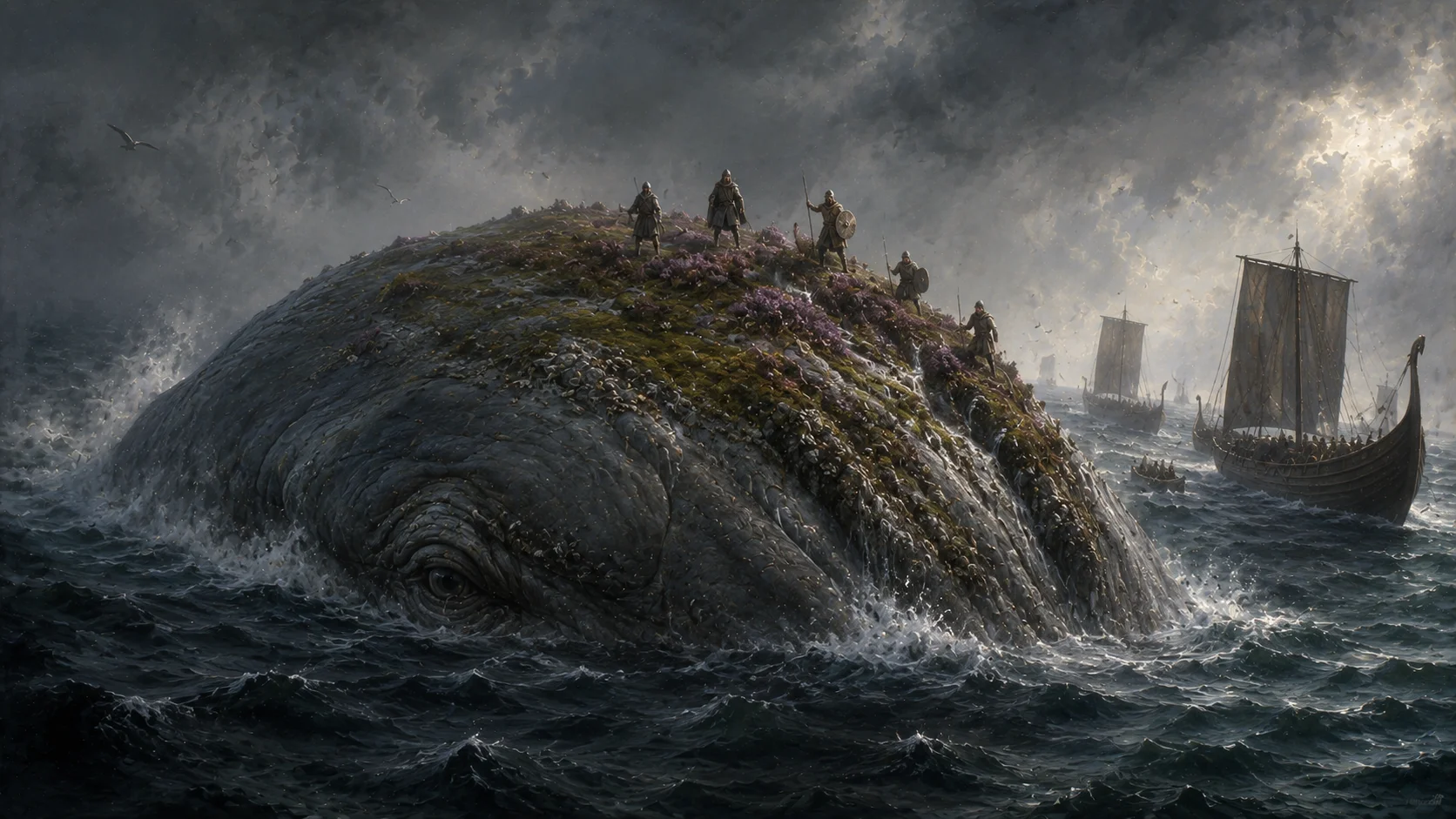
Five men climb down into the ship's boat. Ahead of them, low and green-brown against the grey Greenland Sea, lies what every eye on board has already agreed to call an island — heather spreading across its back the way heather spreads across any hillside in the north, the kind of ground a sailor's feet ache to stand on after weeks of nothing underfoot but planking. They row toward it. And before the boat closes the distance, the island is gone. Not sinking like a wreck, not capsizing — simply withdrawn, the way a held breath is finally let out, and the sea closes flat over the place where solid ground had been a moment before.
Heather-Back
The name is the whole description. Lyngbakr is Old Norse for "heather-back" — lyng, heather, and bak, back — and it names the creature by the single detail that made it lethal: a spine broad enough, and still enough, to carry a covering of heather like any hillside in Norway or Iceland. There is no ambiguity in the etymology and no argument among those who have studied it. The name is not a title or an epithet layered on afterward; it is a plain, functional description of what sailors reported seeing — a whale's back overgrown as if it had stood exposed to weather and seed for years, long enough to earn a covering no ship's hull ever gets.
That plainness matters. Norse saga-tellers were not shy about grand names — trolls, giants, and monsters elsewhere carry titles built from violence or dread. Lyngbakr's name carries neither. It is named the way a landmark is named, and that is exactly the point: the creature's entire danger lies in being mistaken for a landmark.
Two Rocks, Then an Island
Lyngbakr's only appearance in surviving Norse literature comes in Örvar-Odds saga — the legendary saga of Arrow-Odd — a fornaldarsaga most likely composed in the thirteenth century and set in a half-remembered, pseudo-historical Viking Age. Örvar-Oddr and his crew are sailing through the Greenland Sea on a mission of vengeance, hunting the troll Ögmundr Eythjófsbani, also called Ögmundr Floki. It is in the middle of that pursuit, far from any known shore, that the sea produces its first warning: two rocks, rising abruptly from open water where no rocks belonged.
The crew sails on. Some time later they pass what looks unmistakably like land — a large island, its surface grown over with heather, sitting where the charts and every sailor's expectation said there should be nothing but sea. Curiosity does what curiosity always does in these stories. Oddr turns the ship back toward it and sends five men ashore to investigate.
They do not reach it. Before the boat completes its approach, the island vanishes beneath the surface — and with it, the two rocks the crew had passed earlier vanish as well. Nothing is broken, nothing capsizes; the "land" is simply no longer there, and the sea is unbroken water where solid ground had stood only moments before.
Vignir's Warning
What makes the episode work as a story, rather than merely a strange sighting, is that someone on the ship understands what has happened. Vignir, Oddr's companion, explains it to him afterward: what the crew took for two rocks and later for a heather-grown island were never land at all. They were two sea-monsters — Lyngbakr, which Vignir names as the greatest whale in the world, and Hafgufa, its companion in the sighting. Had the men reached the "island" before it submerged, Vignir tells Oddr plainly, they would certainly have drowned.
It is a small moment, structurally, but it carries the weight of the whole episode. The saga does not dramatize a fight, a wound, or a chase — Lyngbakr is never engaged, never pursued, never even fully seen. The entire danger is conveyed after the fact, through one character's recognition of what the crew narrowly escaped without knowing it. Discernment, not combat, is the saga's answer to the monster: the peril was real and lethal, and the only thing that mattered was not stepping onto it before it sank.
What the crew had sailed past as rock, and passed again as island, had been the greatest whale in the world all along — and landing on it any sooner, Vignir told Oddr, would certainly have drowned them.
The Greatest Whale in the World
The saga is specific about what kind of creature Lyngbakr is, and the specificity is easy to miss. It is not called a serpent, a turtle, or a generic sea-monster — it is described as a whale, and not merely a whale but the greatest whale in the world, vast beyond any ordinary creature a Norse sailor might expect to see breach or sound in the open ocean. To a medieval audience that lived by whale-lore as much as by monster-lore — that knew whales as real, enormous, unpredictable neighbors of every long sea voyage — that description did something particular. It did not ask listeners to imagine a fantastical beast unlike anything in nature. It asked them to imagine a whale so large that the ordinary rules of scale broke down entirely: large enough to be paced for a hillside, large enough to grow a garden on its back and fool a trained crew's eyes.
That is a different kind of horror than a dragon or a giant offers. A dragon is other. A whale that size is not other — it is the familiar made incomprehensibly large, the known creature of the sea stretched past the point where a sailor's instincts can still read it correctly.
A Paired Sighting
Lyngbakr does not appear alone in the saga, and that pairing is deliberate. The same passage that gives Lyngbakr its single scene also introduces Hafgufa — "sea-mist" — first sighted as those two anomalous rocks before the heather-covered island comes into view. The saga presents the two sightings as a sequence building toward the same revelation: first an unexplained anomaly, then a more convincing and more tempting deception, both explained together, in a single breath, by Vignir. Hafgufa has a second, fuller life beyond this saga scene — the thirteenth-century Norwegian text Konungs skuggsjá, the King's Mirror, composed for or around King Hákon Hákonarson, describes it separately and at greater length, including an account of how it is said to feed. Lyngbakr has no such second attestation. Its entire textual existence is this one sighting, this one explanation, this one narrow escape.
That asymmetry is worth sitting with. Hafgufa grew, across two independent sources, into something closer to a described creature with habits and behavior. Lyngbakr stayed exactly the size of the one scene it was given — a single, complete, self-contained warning, never elaborated on again by any surviving Norse hand.
A Figure Without Genealogy
Norse mythology is, on the whole, a genealogical mythology. Its great monsters come with parentage and consequence attached: Jörmungandr is Loki's child, cast into the sea by Odin, fated to rise against Thor at Ragnarök. Fenrir has a father, a binding, a prophecy. Lyngbakr has none of this. No source names its parents. No god binds it, fights it, or is destined to face it. It carries no place in the sequence of events leading to Ragnarök and no role in the fates of the Aesir or Vanir. It is, in the saga's own terms, simply a vast whale that sailors mistook for an island — a hazard of a particular sea, encountered once, by one crew, on one voyage.
That absence of genealogy is itself informative. It marks Lyngbakr as belonging to a different register of Norse storytelling than the cosmological myths of the Eddas — closer to a sailor's traveler's tale, the kind that circulates about a specific stretch of water, than to a myth explaining the shape and fate of the world.
Missing from the Eddas
It is worth stating plainly what the sources do not say, because the gap is as informative as the attestation. Lyngbakr appears in neither the Poetic Edda nor the narrative core of Snorri Sturluson's Prose Edda — it plays no part in Gylfaginning's account of the gods and the world's shape, nor in the main narrative of Skáldskaparmál. Its entire surviving existence is confined to the saga literature: one scene, in one fornaldarsaga, about one voyage. It has never been fought by a god, never named in a list of Ragnarök's combatants, never given a place among the cosmological monsters that structure the Norse understanding of the world's end. Where Jörmungandr is myth, Lyngbakr is closer to legend and folk-report — a creature that belongs to the sea sailors actually crossed, not to the sea that encircled the world in the poets' cosmology.
The Island That Drowns You
Lyngbakr belongs to a motif that recurs across seafaring cultures wherever people have trusted the horizon and been wrong to: the living island, the creature so vast it is mistaken for solid ground, which submerges once trust has been placed upon it. The Greek Aspidochelone carries the same trick, and so does the Arabic Zaratan, and the Norse Hafgufa beside its own companion Lyngbakr — the same fear, wearing different names in different waters, specific to people whose survival depends on correctly reading the difference between land and not-land, and who know that the sea offers no natural landmark to check that judgment against. Lyngbakr is one instance of that widespread and much-feared shape, distinguished from its cousins mainly by what it is made of: not a shell, not a serpent's coil, but a whale's back grown over with heather, patient enough and still enough to hold a garden.
The resemblance between Lyngbakr and these other island-mimicking sea-creatures found elsewhere in medieval and near-eastern literature is a connection modern readers and scholars draw by comparison — a typological kinship of motif, not a claim that one story borrowed from another. No text says Lyngbakr descends from any foreign tradition, and none needs to: the fear that produces this figure is common to anyone who has ever sailed out of sight of known coastline and needed, urgently, to be right about what they were looking at.
The One Scene That Survives
What is striking, reading the saga account straight through, is how little Lyngbakr actually does. It does not attack. It does not pursue. It is not fought, wounded, or killed, and no version of the story gives it a death, a name bestowed by a god, or a second appearance anywhere else in the sagas. Its entire recorded existence consists of being seen, being nearly landed on, and vanishing — three verbs, no violence, and yet the saga treats the encounter as one of the most dangerous moments of the entire voyage, because the danger was never about combat. It was about correctly reading what was in front of them before it was too late to matter.
In a body of literature full of dragons that must be slain and giants that must be outwitted in contests of strength or riddles, Lyngbakr asks nothing of its witnesses except that they see clearly — and it is the one character who does, Vignir, who turns a near-catastrophe into a story worth telling at all.
What the North Remembers
Lyngbakr has a small afterlife beyond its saga origin — most visibly as a named point of reference in the 2022 video game God of War Ragnarök, which draws, loosely, on the medieval name for its own sea-creature content. That afterlife is modest compared to some other figures of Norse legend, and appropriately so: a creature whose entire original text is a single scene of nearly-drowning was never going to accumulate the elaborated backstory that gods and named monsters with genealogies acquire. What has survived instead is the shape of the warning itself — heather-grown ground that isn't ground, an island that is patient and still only until it isn't.
The saga never tells us what became of Lyngbakr after that one sighting. It does not need to. The creature's entire purpose in the story is to have been there once, to have almost claimed five lives, and to remind anyone who hears the tale afterward that the emptiest-looking sea can still contain something large enough to be mistaken for land — and patient enough to let you believe it, right up until the moment you would have stepped ashore.
Sources & traditions
- EncyclopediaWikipedia — Lyngbakr
- TraditionNorse texts, inscriptions and later retellings (Scandinavia)
Myths change from area to area and from time to time. This chronicle follows the most widely told versions; tellings in other villages, regions and eras may differ.