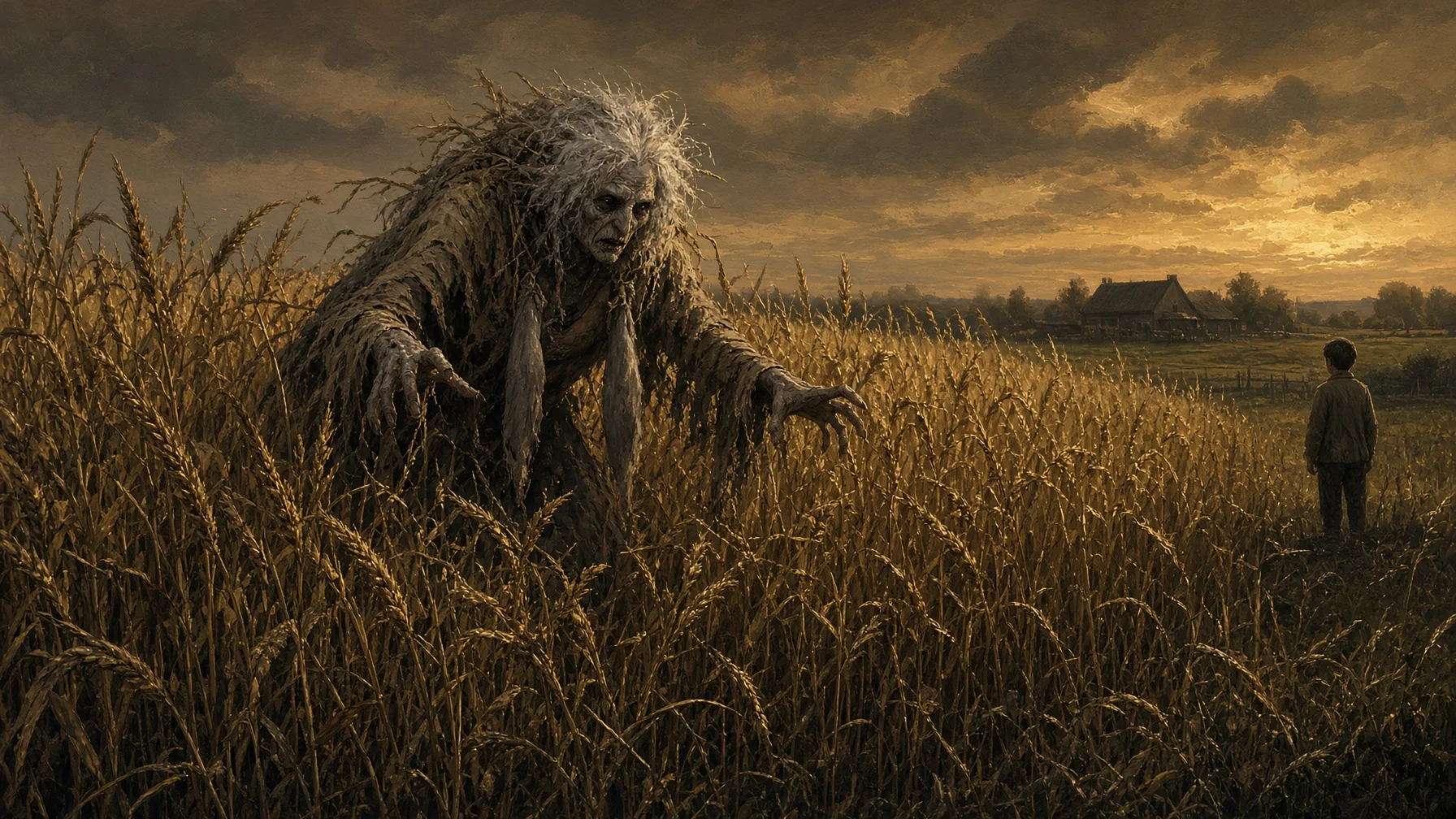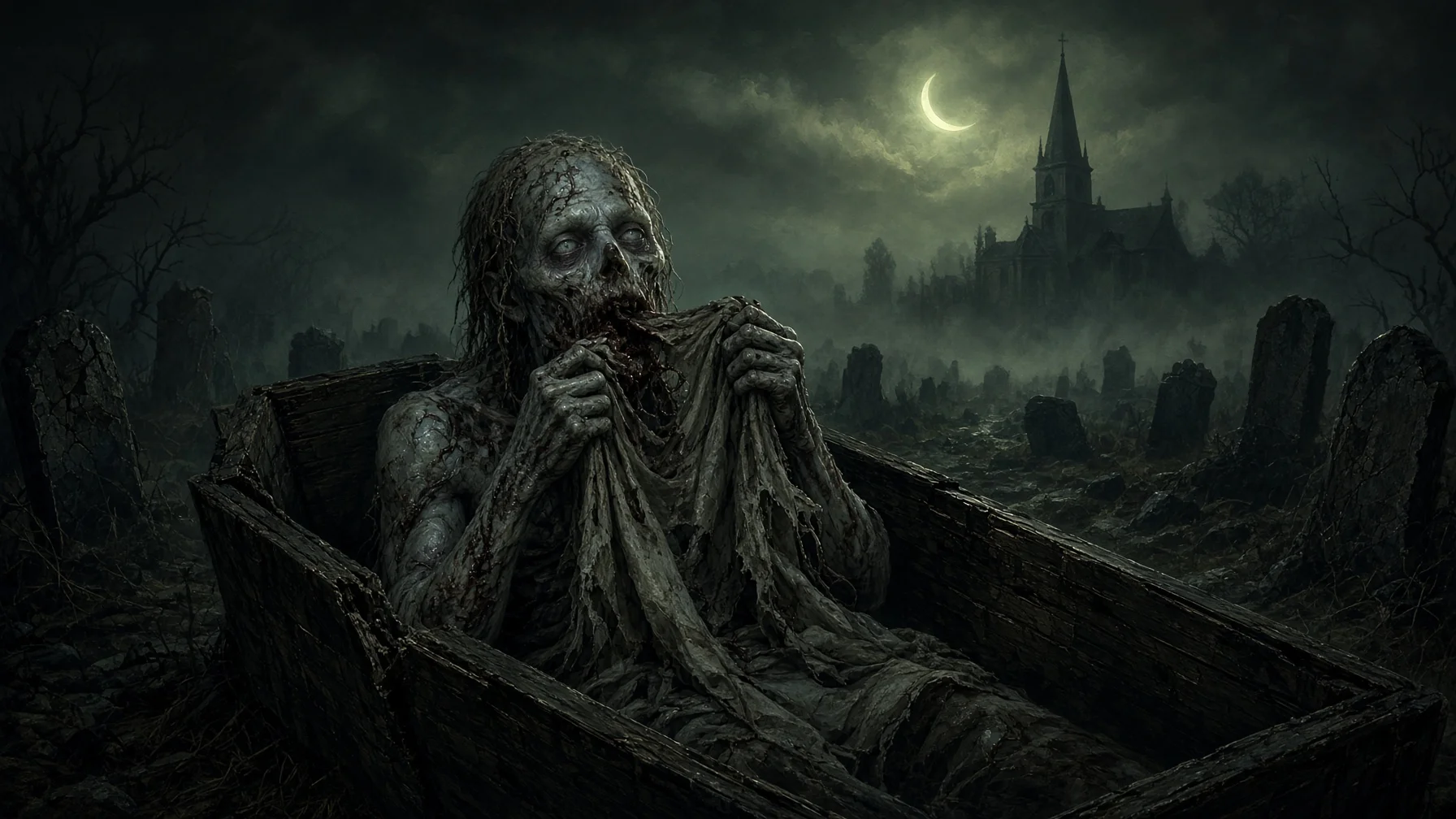
The Nachzehrer — the "after-devourer" — is one of the quieter horrors of Germanic and North-Central European folklore, quieter not because it is gentler but because it never has to leave the ground to do its work. Where the vampire proper rises, walks, and hunts, the Nachzehrer stays exactly where it was laid, in the dark of its own coffin, and reaches its family through the grave itself. It gnaws its burial shroud. It gnaws its own flesh. And with every motion of its jaw, somewhere above ground, a living relative grows weaker, until the household empties one bed at a time.
The Grave That Feeds Itself
At the center of the belief sits a single, unsettling image: the corpse, alone in the earth, chewing. Not chewing outward through the coffin lid, not chewing toward the world of the living, but chewing on itself — the linen it was wrapped in, then its own hands, its own flesh. Communities who held this belief did not imagine a monster stalking the night roads. They imagined something worse in its way: a horror that required no roads at all, that could do its damage without ever stirring the soil above it. The threat was not what might come out of the ground. It was what was already happening beneath it, unseen, ongoing, and — until someone acted — unstoppable.
Pomerania and Silesia: A Border Belief
The Nachzehrer belongs most firmly to Pomerania and Silesia, the long, contested belt of territory where German-speaking and Slavic-speaking communities lived close enough to trade not just goods but ghosts. This is not incidental to the belief; it is part of its shape. The Nachzehrer sits in a cultural seam, drawing on the same deep well of shroud-eater and corpse-eater imagery that fed Slavic revenant traditions further east, while taking its particular German form, its particular name, and its own emphasis in villages that were unmistakably German in language and custom. Folklorists who trace these ideas across the region find not a single origin point but a slow, centuries-long bleed of motif across a border that was never as solid as any map drew it.
How a Corpse Becomes a Nachzehrer
Nobody was thought to choose this fate, and nobody was thought to escape it by living well. A number of circumstances, mostly outside anyone's control, marked a body as a likely candidate before it was even cold. A death by suicide was one of the surest signs — a life ended by its own hand was believed to unsettle whatever process let a soul depart cleanly. Being the first person in a household or village to die during an epidemic was another: the community's fear needed somewhere to land, and the first grave was the obvious place to look when the second, third, and fourth deaths followed in quick succession. A child born with a caul — the amniotic membrane still clinging to the head at birth — or born already possessing teeth, was marked from the very start of life as unusual in a way that folk memory did not forget by the time of death. And an improper burial — rites skipped, hurried, or performed wrong under the pressure of a crisis — was enough on its own to leave a corpse without whatever protection a full and correct funeral was thought to provide.
None of these causes required malice from the dead person while they lived. That is part of what made the belief so unforgiving: a devout, well-liked neighbor who happened to die first in a bad season, or who was buried in haste because the ground was frozen and the priest was three villages away, could still be suspected of feeding on the family they had left behind.
The Shroud Between the Teeth
The defining, inescapable image of the Nachzehrer is the act of self-consumption. In the enclosed dark of the coffin, the corpse was believed to begin working at its own burial shroud — the linen wrapping that every proper burial provided — tearing and swallowing it by inches. When the shroud was gone, or alongside it, the corpse turned to its own body: fingers, hands, the flesh nearest its mouth. This was not decay as villagers understood ordinary decay. It was appetite. A body that ordinary decomposition would simply return to the earth was, in this belief, instead actively consuming itself, and that act of consumption was never neutral. It was the engine that drove everything else the Nachzehrer was feared for.
A Bite Felt Miles Away
The mechanism folklore assigned to the Nachzehrer's harm is startlingly direct: each bite the corpse took of its shroud or its own flesh was believed to correspond, cause and effect, to a living relative sickening. Family members did not need to visit the grave, sleep near it, or have any contact with the body at all. The connection worked at a distance, through kinship itself, as though blood tied the living to the dead in a channel the grave could not sever. A household watching its members fall ill and die in succession — a pattern epidemic disease produces on its own, with grim reliability — had, in this framework, a clear and terrible explanation. Somewhere in the churchyard, a jaw was still moving.
This is also where the belief reveals what it was actually built to do. Long before germ theory offered any account of contagion, a community faced with clustered household deaths needed some way to make sense of what looked like deliberate, patterned harm rather than blind misfortune. The Nachzehrer supplied an agent, a cause, and — crucially — a place to direct action. Where an invisible microbe offers nothing to dig up, a corpse in a marked grave offers everything.
Why It Does Not Walk
Here the Nachzehrer parts ways most clearly from the vampire of Balkan and Slavic tradition, and from the literary vampire that grew out of those southern cases. The classic revenant of Serbian and neighboring traditions leaves its grave: it walks the village at night, appears at the doors of the living, is seen on the road. The Nachzehrer, in its most consistent form, does none of this. It stays. The harm travels; the body does not. This single distinction — passive at the grave rather than active in the world — is treated by folklorists as the Nachzehrer's most important defining feature, the detail that keeps it a distinct figure rather than simply a regional name for the same wandering vampire found further south and east.
It should be said plainly that this point was never universally settled even within the tradition itself. Regional tellings disagree, some describing a Nachzehrer that can, under certain conditions, also rise and roam like its more famous southern cousin. This inconsistency is not a flaw to be smoothed over; it is an honest feature of oral tradition carried across generations and villages without a central authority to standardize it. The predominant, defining version keeps the corpse in the ground. Others did not always agree.
Nachtzehrer: One Belief, Two Tongues
Anyone tracing this figure through older sources will quickly meet its close cousin, the Nachtzehrer — a name close enough to be, in most contexts, simply the same belief spoken in a different corner of the German-speaking world. The variation reflects Low German, or Plattdeutsch, dialectal differences rather than a distinct set of traits or a separate origin. In practice the two names are often used interchangeably in the folklore record, describing the same shroud-chewing, family-draining corpse under regional pronunciation. Where sources do draw a distinction, it tends to be local emphasis rather than a fundamentally different creature — a reminder that folk belief travels by speech long before it travels by print, picking up the accent of whatever village is doing the telling.
Reading the Dead: The Signs of Suspicion
Suspicion did not usually wait for a second or third death. Exhumation — the literal act of opening a grave to examine the body — was the community's method of confirming what illness in the household had already suggested. What villagers looked for, and what they were prepared to interpret as confirmation, mirrors what archaeologists studying so-called "deviant burials" across this region have since uncovered in the ground: bodies buried in ways that plainly depart from ordinary Christian practice of the period. A skeleton found face-down. A stone or brick wedged deliberately against the jaw. A skull separated from its body. These are not accidents of time or soil disturbance; they are the physical record of communities acting, with real tools and real conviction, on a belief that has otherwise survived only in stories and court records. The archaeology does not prove the Nachzehrer walked. It proves, unmistakably, that people believed something like it might, and buried their dead accordingly.
The Coin, the Stone, the Silence
Before exhumation became necessary, prevention was preferred, and it began at the funeral itself. Placing a coin or a small stone in the mouth of the corpse was among the most common measures — an object wedged between the jaws with the specific purpose of obstructing the very motion the Nachzehrer needed to chew. A mouth that cannot close on cloth or flesh cannot begin the process that endangers everyone still living. The logic is almost mechanical: block the bite, and the harm has nowhere to start.
Face Down, Chin on Brick
A second family of measures worked on the body's position rather than its mouth alone. Burying a suspected corpse face-down was believed to redirect any attempt to gnaw or rise downward into the earth rather than upward toward the world of the living — a corpse digging the wrong way does no one any harm. Bracing the chin against a brick placed in the coffin served a similar purpose to the coin, holding the jaw in a position that made the feared motion difficult or impossible. None of these measures required violence to the body. They were quiet, almost domestic adjustments made at the graveside, the kind of small precaution a family could take without ever openly accusing their own dead of anything.
When Persuasion Fails: The Final Blow
When milder measures had already failed — when the household kept sickening despite a coin in the mouth or a body laid face-down — the response escalated to something final: decapitation, or driving a stake through the body. These were not first resorts. They were what a frightened, grieving community turned to only after gentler precautions seemed to have done nothing, and after illness had gone on long enough that doubt had curdled into certainty. It is worth remembering what such an act actually was for the people performing it: not an assault on a monster in any literal sense, but the reopening of a beloved grave, the disturbance of a body that had, in life, likely been a parent, a spouse, a child. The folklore asked a great deal of the living in the name of protecting the living.
The Spade That Confirms the Fear
The physical evidence recovered from graves across the Pomeranian and Silesian countryside — and the wider zone of overlapping German and Slavic belief around it — gives this tradition a weight that pure storytelling cannot. Deviant burials showing decapitation, staking, and unusual positioning are not rare curiosities but a recurring pattern, one that lines up with the documented anti-revenant practices folklorists have recorded in the same regions. The eighteenth century produced its own wave of formal "vampire panics" across Germany, Prussia, and neighboring Slavic lands — cases distinct from, but clearly related to, the more internationally famous Serbian incidents of the same century that would eventually shape the literary vampire the wider world came to know. In the German and Prussian cases, it is the Nachzehrer's particular logic — sickness spreading from a grave that never opens on its own — that most often sits behind the exhumations, rather than the roaming, blood-drinking figure of the southern accounts.
Plague Without a Name
It bears repeating, because it is the heart of why this belief existed at all: the Nachzehrer is, at its root, a pre-scientific explanation for contagion. A village struck by plague, dysentery, or any of the era's unnamed fevers had no concept of a pathogen passing person to person through water, air, or touch. What it did have was an observable pattern — one death, then a cluster of deaths in the same household or the same street, radiating outward from a single point. The Nachzehrer gave that pattern a face, a cause, and a location. It let a community that could not test water or trace infection instead point a spade at a specific grave and feel, for a moment, that the crisis had an origin that could be addressed. That the belief was medically wrong does not make it socially or emotionally meaningless; it was the best framework people had for a genuinely terrifying and genuinely real phenomenon — households dying together — and it deserves to be understood on those terms rather than dismissed as mere superstition.
The Wiedergänger Family
Folklorists place the Nachzehrer within the broader category of the Wiedergänger — literally "one who walks again" — the general German term for any revenant, any dead person whose death did not fully end their presence among the living. The Wiedergänger category is wide, covering figures with very different behaviors and very different threats. Within that family, the Nachzehrer is a specific causal and behavioral variant: defined by its shroud-and-flesh-eating cause of harm, defined by its typically grave-bound passivity, and defined by the particular household-draining mechanism that sets it apart from other kinds of walking dead recorded under the same umbrella term. Understanding the Nachzehrer as one branch of a larger tree, rather than as folklore's only answer to death and dread, helps keep its specific traits from blurring into every other regional revenant it is sometimes carelessly grouped with.
A Legacy Borrowed and Misread
In the centuries since, the Nachzehrer has left a real mark on popular culture's idea of a "Germanic vampire" — a shorthand that shows up in fiction, games, and casual retellings whenever a story wants a vampire with a German name and a German setting. That popular shorthand, however, tends to erase exactly the distinctions that make the Nachzehrer worth knowing in its own right. It is not the Balkan or Slavic-derived figure that shaped Bram Stoker's Dracula and the literary vampire tradition that followed; it does not hunt, does not walk abroad, does not seek blood in the way that tradition's descendants do. Treating it as simply "the German vampire" flattens a distinct, regionally rooted belief — one built around a grave that never opens, a family that sickens without warning, and a community that could only fight back with a coin, a brick, and, when all else failed, a spade — into a costume borrowed from somewhere else entirely. The Nachzehrer earned its place in the historical record on its own terms, and it is worth remembering on those terms: not as a walking horror, but as a stillness in the churchyard that an entire village once had every reason to fear.
Sources & traditions
- EncyclopediaWikipedia — Nachzehrer
- TraditionGermanic texts, inscriptions and later retellings (Germany)
Myths change from area to area and from time to time. This chronicle follows the most widely told versions; tellings in other villages, regions and eras may differ.