Along the lonely stretches of German-speaking countryside — the crossroads where two field paths cross with no lantern, the humpbacked bridge over a black stream, the forest track that runs an hour past the last farmhouse — travelers once feared a very particular kind of night. Not wolves, not bandits, but something that waited to climb onto their backs. It was known as the Aufhocker, and its name comes straight from what it does: aufhocken, to hop or climb up onto. That single verb is the whole legend in miniature — a small, unremarkable shape springing onto a lone walker's shoulders in the dark, and refusing to let go.
A Name That Describes the Attack Itself
Few folkloric beings are named so literally. Where other legendary creatures carry names describing their appearance, their origin, or the place they haunt, the Aufhocker is named for the single action that defines it. Regional dialects gave it other faces — Aufhocke and Aufhäuser as general variants, Huckup and Hakelmann specifically in Lower Saxony and Westphalia, Bockmann wherever the goat-shaped form predominated — but every name in every region circles back to the same core image: a weight, suddenly and unwantedly upon you, acquired by force rather than invitation.
Deutsche Sagen and the Documented Fear
The Aufhocker is not a fragment of half-remembered village gossip; it is a documented figure of Central European folklore, recorded extensively in collections such as the Grimm brothers' Deutsche Sagen (1816–1818). Nineteenth-century folklorists, including Karl Ernst Haas, classified it among the Wegegeister — the "path spirits" or road-ghosts — a category that also holds the flickering, misleading Irrlicht and the pursuing Nachtjäger. All of them belong to the broader genre folklorists call nachtgeist, or night-demon encounters, tied to the same terrain of danger: the road at night, walked alone, far from any door that can be barred. The pattern is not unique to German lands — the English Hedley Kow and various Slavic road-spirits work the same fear from the same premise.
The Shape of an Ordinary Animal
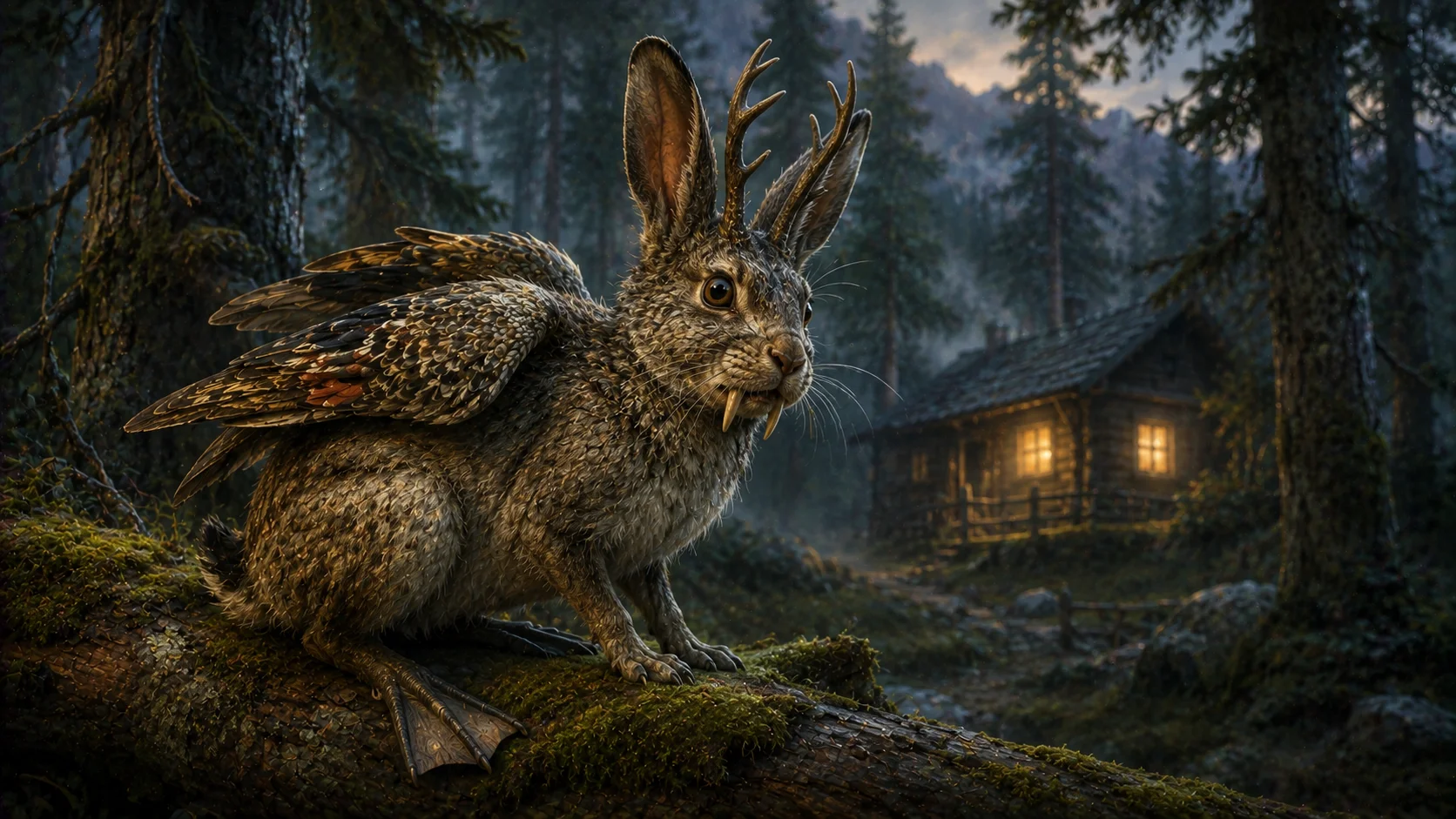
What makes the Aufhocker unsettling rather than simply monstrous is its disguise. It does not announce itself as a demon. It appears as something a traveler would barely notice — a small black or grey dog trotting along the verge, a cat slipping out of the hedgerow, a goat standing where no goat should be, or sometimes nothing more than an abandoned sack lying in the road. The horror is not in the shape but in what the shape conceals. A tired traveler, glimpsing something small and animal-shaped in the dark, has no reason to run.
The Leap and the First Weight
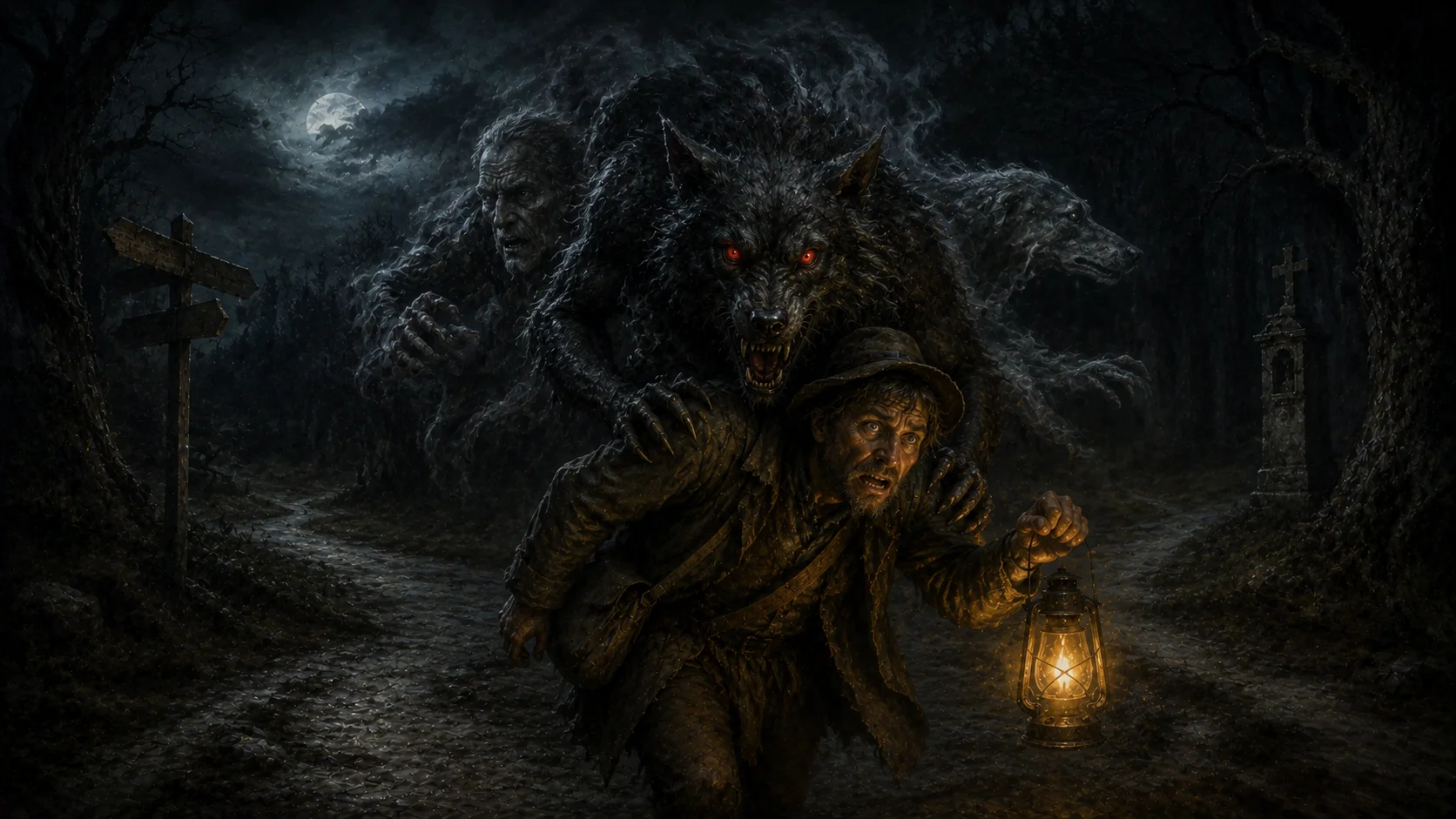
The attack always follows the same pattern. The small creature waits until the traveler draws close — at a crossroads, on a bridge, deep on a forest path — and then springs, landing on the shoulders or back as though it were the most natural thing in the world for a stray dog or cat to do. At first it may weigh almost nothing at all. That is the trap. The victim, startled but not yet afraid, keeps walking, perhaps trying to shrug the animal off, perhaps simply enduring it for a few more steps toward home.
Heavier With Every Step
Those few more steps are where the Aufhocker reveals itself. The longer the journey continues, the heavier the creature becomes — not gradually in the way a tired arm feels heavier, but disproportionately, unnaturally, as though gravity itself were being weaponized. Folklorist accounts are specific on this point: victims described a creature no larger than a cat feeling "heavier than a sack of grain," or "like carrying a full-grown man." The mismatch between what the eye sees and what the body feels is the entire terror of the tale — proof, to those who told it, that nothing natural could weigh so much.
Collapse, Suffocation, and the Roads That Remember
Left unchecked, the burden could crush a traveler to exhaustion or worse — some tellings describe victims driven to their knees, others describe the creature's grip tightening toward the throat. In this the Aufhocker stands close to its cousin the Mahr or Alp, the night-hag that presses down on sleepers' chests indoors; the Aufhocker is its outdoor twin, the same folk-psychological image of oppressive, suffocating weight, moved from the bedroom to the open road. Some hauntings were even said to belong to a single place — a particular bridge, a hollow tree, a crossroads where a violent death or an unmarked burial had once occurred — making the danger site-specific rather than a hazard of the night in general.
The Devil's Shape, or a Soul Without Rest
Village storytellers disagreed, as storytellers do, about what exactly rode a victim's back. Some named it plainly as a shape taken by the Devil, testing or punishing the unwary. Others believed it to be a wandering evil spirit with no particular history. And others still identified it as something sadder: the restless soul of a person who had died unshriven, or by violence, denied proper burial and proper rites, and condemned to haunt the roads until something released it. This third reading ties the Aufhocker into a much wider Central European current of belief — the unquiet dead who cannot leave the paths the living still walk.
Thresholds, Bells, and the Sign of the Cross
Every version of the legend agrees on one mercy: the burden does not last forever, and it cannot follow past certain boundaries. The Aufhocker was said to vanish the instant its victim reached a threshold — the doorway of their own house, the porch of a church, or the far bank of running water, an old and widespread belief that malevolent spirits cannot cross flowing streams. In Bavaria and Austria, the faithful told of another release: prayer, the invocation of God's name or a saint's, or the simple sign of the cross, laid like a much older pagan road-fear beneath a newer Christian one.
Iron, Naming, and Fighting Back
Not every escape was passive. In Rhineland and Hessian tellings, a traveler with nerve enough could fight the Aufhocker directly — by naming it aloud, which folklore across the Germanic world holds as a way of stripping a spirit of its power, or by striking back at it with iron, the same metal long believed to burn and repel fae and demonic things alike. Reaching consecrated ground worked just as well. These variants gave the tale a rare note of agency: the Aufhocker could be endured, prayed away, or beaten — a traveler was never entirely without recourse.
A Warning Told at the Tavern Door
Beneath the demonology sits a plainly practical purpose. The Aufhocker legend discouraged exactly the behavior most likely to get a real traveler killed or lost on real roads: walking home alone, late, especially after drinking. An intoxicated villager stumbling back from the tavern was considered the Aufhocker's ideal victim — slower, less steady, less able to reach a threshold in time. The moral was never subtle, and it did not need to be. Stay off the road at night. Do not walk it drunk. Do not walk it alone.
Cousins Across the Folklore Map
The Aufhocker did not haunt German roads in isolation. English folklore tells of the shapeshifting Hedley Kow playing similar tricks on lone travelers; Slavic tradition has its own road-spirits waiting at crossroads; Welsh tales of the Ellyllon and Scandinavian legend both include the same peculiar detail of a creature that grows heavier the longer it is carried, rather than simply attacking outright. Comparative folklorists read this recurrence as evidence of something close to a pan-European or Indo-European narrative pattern — the fear of solitary travel, given a body, and set loose on the exact roads that most needed avoiding after dark.
What the Weight Really Meant
Modern folklore scholarship reads the Aufhocker less as literal demonology and more as a psychological truth wearing a monster's shape. Pre-industrial travel on foot, alone, through unlit countryside, was genuinely exhausting and genuinely dangerous — fatigue, fear, the ache of a long road with no company, all pressing down at once. The Aufhocker gave that formless burden a shape a village could name, warn its children about, and eventually laugh off safely once the church bell rang or the doorway was reached. It turned the felt weight of dread into a creature small enough to describe and, just barely, large enough to explain why the walk home had felt unbearable.
Sources & traditions
- EncyclopediaWikipedia — Aufhocker
- TraditionGermanic texts, inscriptions and later retellings (Germany)
Myths change from area to area and from time to time. This chronicle follows the most widely told versions; tellings in other villages, regions and eras may differ.