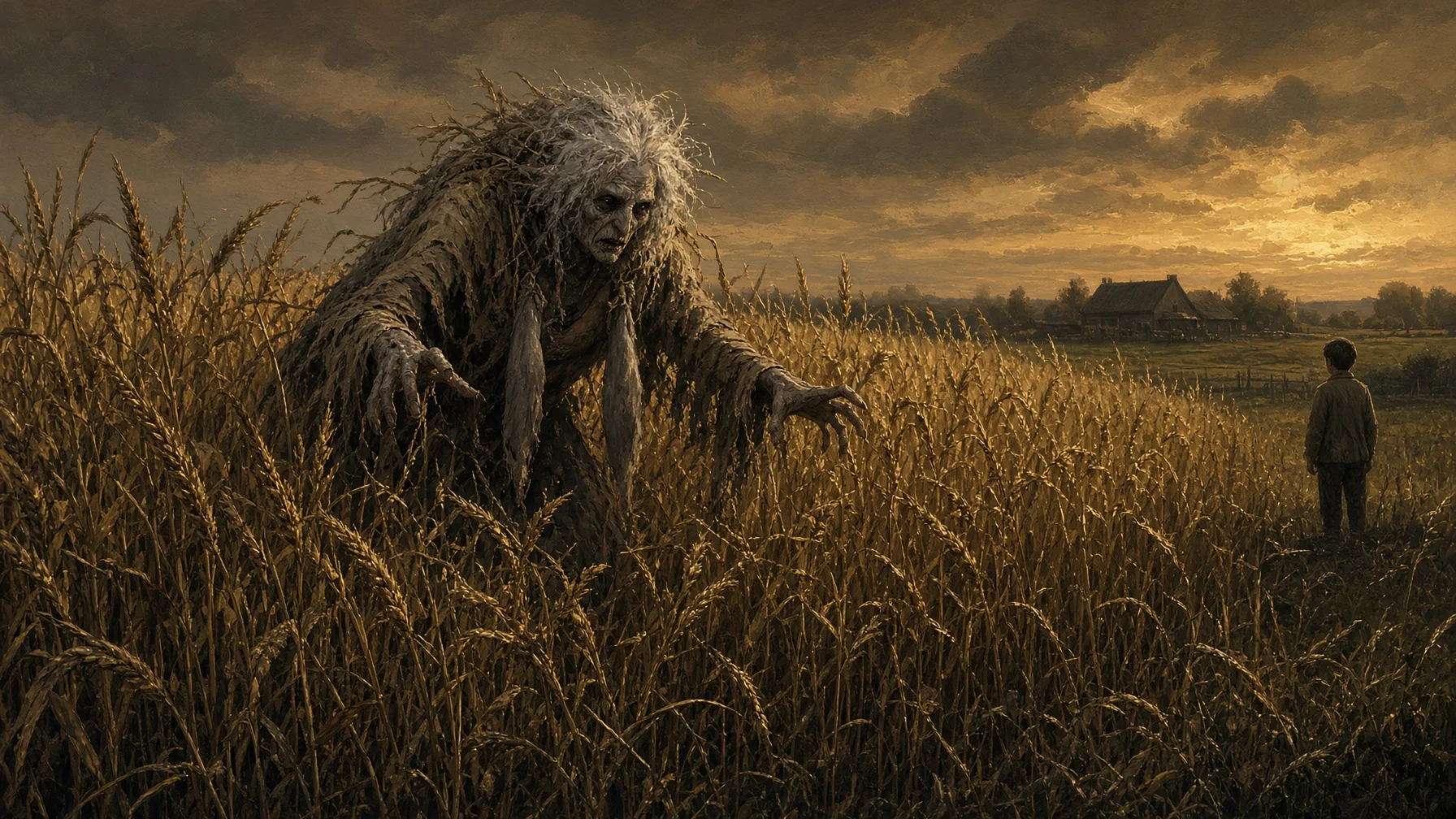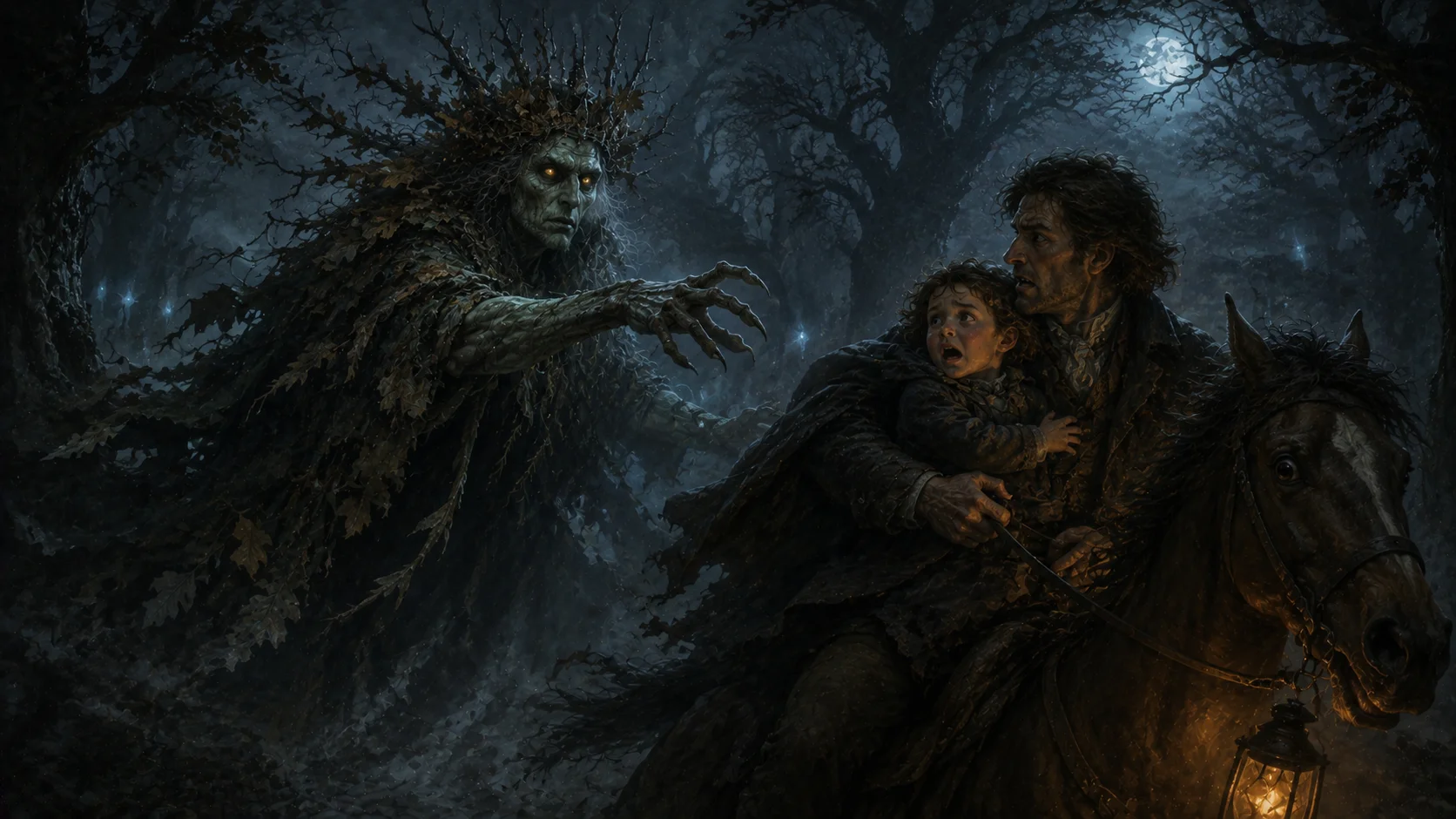
Along the forest roads of the German-speaking world rides a fear older than the borders drawn around it: the Erlking, Erlkönig, a shadowed and crowned figure who comes for the sick, the young, and the unwary traveler caught outdoors when the light fails. He does not attack. He invites. He speaks softly, promises games and gold, and by the time a mortal understands what has been offered, it is already too late to refuse it.
A King Born of a Mistranslation
The Erlking's very name carries the fingerprint of an accident. The figure is not originally German at all, but Scandinavian — the Danish "elverkonge" or "ellekonge," the elf-king, ruler of the elle-folk who haunted forests and riverbanks. When the poet and philosopher Johann Gottfried Herder translated a Danish ballad into German in 1778 under the title "Erlkönigs Tochter," he rendered "elle" — elf — as the German "Erle," meaning alder tree. An elf-king became, through one small slip of the tongue, an alder-king. The mistake stuck. It was memorable, it was strange, and within a few years it would be carried into the most famous ballad in the German language, fixing forever a name that never quite meant what it seemed to mean.
The Elf-Folk of the Northern Forests
Before Herder ever touched pen to paper, the elle-folk already belonged to a long Scandinavian tradition of forest spirits who lured travelers into their company. Danish and Norwegian folklore told of the elverkonge and his daughters, the elvermøer, elf-maidens who danced in mist and moonlight at the forest's edge, especially at dusk, when the boundary between the human world and the spirit world was said to thin. To see them dance, to speak with them, or worse, to dance with them, was to invite madness or death. Looking directly upon the elf-king or his daughters was itself a kind of trespass, an act with consequences a mortal could not undo. This is the deep root beneath the German legend: a king who rules not a court of men but a threshold, and who claims those who cross it.
Elveskud: The Ballad Beneath the Ballad
Herder's 1778 translation did not spring from nothing. It was adapted from "Elveskud," or "Elf-Shot," a medieval folk ballad known across Denmark, Sweden, and Norway in many variants stretching back to at least the sixteenth century. These ballads told, in their older forms, of a young man or woman waylaid by the elf-folk on the eve of a wedding or a journey, struck down or driven mad by the encounter. Herder's German rendering compressed and transformed this inheritance, but the bones remained: a supernatural figure of the wild, a fatal invitation, and a mortal who cannot simply walk away.
Goethe and the Ballad That Would Not Be Forgotten
It was Johann Wolfgang von Goethe who, in 1782, gave the Erlking its enduring literary form. His ballad "Erlkönig" is spare and terrible: a father rides through the night, his sick child held close in his arms. The wind rushes past. The child cries out — the Erlking is here, speaking to him, promising him games, promising him golden robes, promising him the company of his daughters, who wait to sing him to sleep. The father, riding hard, hears only the wind in dry leaves, sees only mist over the meadow, the grey shapes of old willows. He reassures his son again and again. By the time they reach home, the child is dead in his arms.
A Question the Poem Refuses to Answer
What makes Goethe's ballad endure is exactly what it withholds. Is the Erlking real, a genuine intrusion of the supernatural into the natural world, or is he the fevered hallucination of a dying child, a delirium given voice and shape by terror and by illness? Goethe never resolves it, and generations of readers have found the poem more frightening, not less, for that refusal. Read one way, it is a ghost story: a death-spirit who claims what is owed him. Read the other way, it is something quieter and just as devastating: a portrait of childhood fever, of a father's helplessness, of a parent who cannot see the danger his child is already inside of. The forest, in either reading, is not safe once the sun goes down.
The Realm of Golden Robes and Dancing Daughters
Central to the Erlking's power is the beauty of what he offers. He does not threaten the child; he seduces him, describing flowered meadows, dancing, songs, robes woven of gold, and daughters who will rock him gently through the night. This is the oldest trick attributed to the fair folk across the whole northern European tradition: the promised realm is lovely precisely because loveliness disarms suspicion. The golden and the green conceal the fatal. It is a warning encoded directly into the aesthetics of the poem — that the loveliest invitation heard at dusk, from something that should not be able to speak to you at all, is the one to refuse.
Hoofbeats in Triplets: Schubert's Setting
In 1815, an eighteen-year-old composer named Franz Schubert set Goethe's poem to music, and his lied "Erlkönig," catalogued as D. 328, remains one of the most performed and most studied art songs in the classical repertoire. Schubert's piano part drives forward in relentless triplet figures meant to evoke the hoofbeats of the father's galloping horse, a sound that never lets up, that mirrors the child's rising panic and the father's futile urgency. A single singer must voice four distinct characters — narrator, father, child, and the Erlking himself — shifting register and tone within a few minutes of music, so that the listener feels the child's terror escalate against the father's increasingly strained reassurance. Schubert was not the only composer drawn to the text; Carl Loewe produced his own setting of the same Goethe ballad in 1818, and the poem has continued to draw musicians and illustrators toward it ever since. Few pairings of poem and music have fused so completely in the public imagination as this one.
A Composite Spirit, Not an Ancient God
It is tempting to reach for the Erlking as a straightforward survival of pre-Christian Germanic religion, a forest-god demoted to folklore. The evidence does not support so clean a story. There is no directly attested pagan deity by this name in the Germanic record; the Erlking as he is known today is better understood as a folkloric and literary composite, built from older Scandinavian death and nature spirits, refracted through Herder's mistranslation, and then fixed permanently into shape by Goethe's pen. That does not make him any less real as a figure of belief and dread — only that his particular crowned silhouette, cloak and all, is a product of eighteenth-century literary culture working with much older, looser folk material, rather than a single ancient cult handed down unbroken.
Cousins in the Twilight Wood
The Erlking does not stand alone in the European imagination of the deadly forest spirit. He has kin: the Slavic Leshy, guardian and trickster of the woodland who leads travelers astray; the Scandinavian Huldra, alluring and dangerous in equal measure; and a broader continental tradition of beings who haunt liminal, wild places and claim those who linger too long after dark. What sets the Erlking apart from these relatives is not his nature but his fate: where the Leshy and the Huldra remained largely oral, regional, living folklore, the Erlking was seized by two towering figures of German art — one a poet, one a composer — and driven into the permanent record of Western literature and music. He is, in that sense, the most famous of his kind precisely because he stopped being only folklore.
Dusk, the Forest, and the Thin Places
Every element of the Erlking's legend insists on the same setting: the forest, and the specific, narrow window of dusk sliding into night. This is not incidental scenery. In the broader Germanic and Scandinavian folk imagination, forests were understood as spaces where the human world and the spirit world pressed close against one another, and twilight was the hour when the seam between them opened widest. A rider caught on the road as the light failed was not merely inconvenienced; he was exposed, in a way that daylight and open ground did not permit. The Erlking's dominion over this threshold hour is what makes him, in the end, less a monster to be fought than a danger to be avoided altogether — the lesson of the ballad is not that the father fought and lost, but that he did not believe soon enough that there was anything there to fight.
A Figure That Refused to Fade
Two and a half centuries after Herder's mistranslation and Goethe's ballad, the Erlking still rides through the popular imagination — in concert halls where Schubert's lied is performed, in illustrations of the crowned figure reaching from the mist, in the fantasy and horror fiction that continues to borrow his silhouette as shorthand for the beautiful, seductive, and fatal side of the wild. He endures not because his origins are simple, but because they are not: a Danish elf-king, a philologist's small error, a poet's unresolved ambiguity, and a teenage composer's galloping piano, all folded together into a single figure who still, convincingly, asks a frightened child to come and dance.
Sources & traditions
- EncyclopediaWikipedia — Erlking
- TraditionGermanic texts, inscriptions and later retellings (Germany)
Myths change from area to area and from time to time. This chronicle follows the most widely told versions; tellings in other villages, regions and eras may differ.