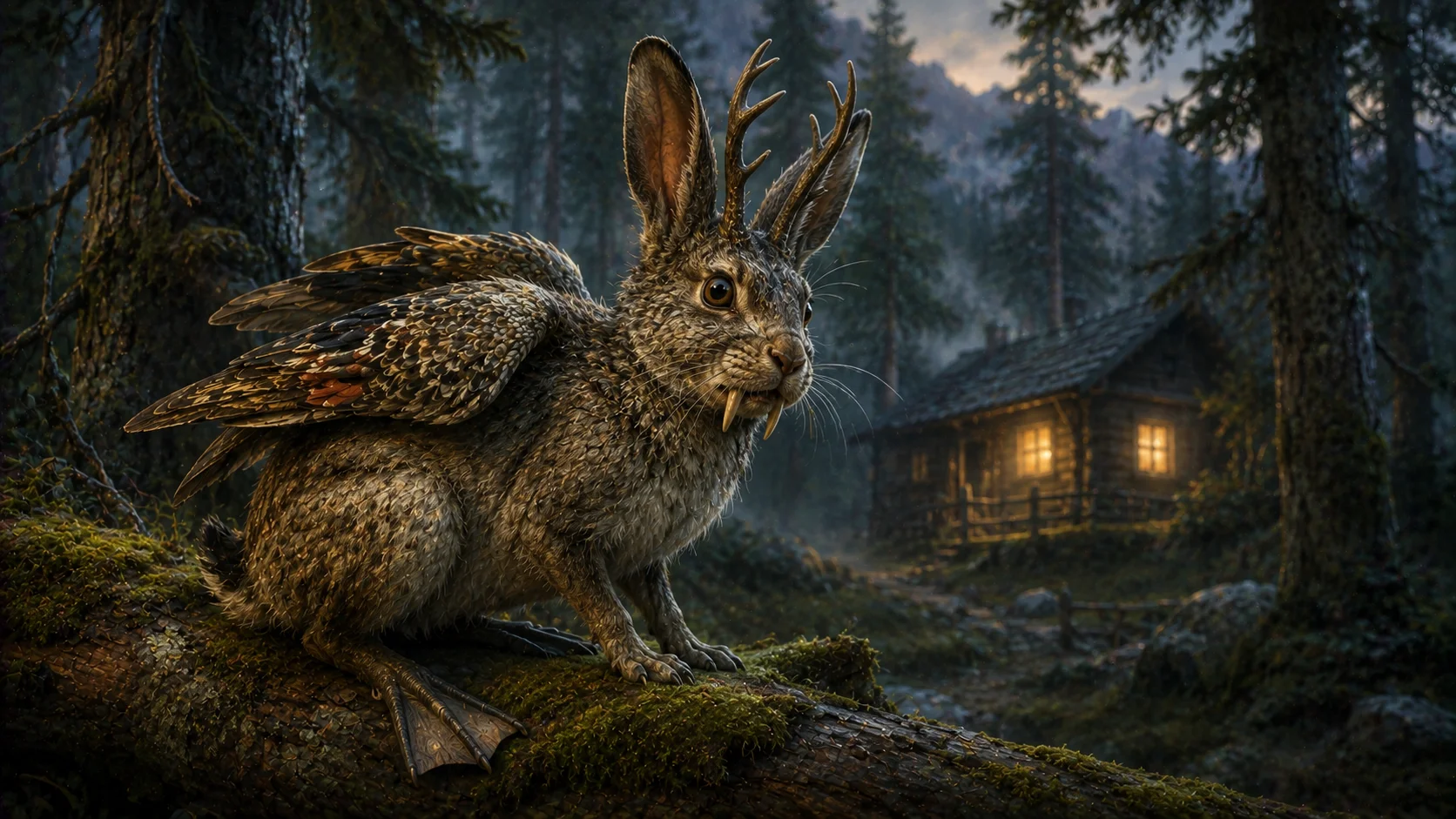
The Wolpertinger is a legendary Bavarian chimerical creature — a small woodland mammal, usually a hare or squirrel, fitted out with antlers, wings, fangs, and sometimes the webbed feet of a duck. It is the best-known member of a wider Central European tradition of composite "hoax animals" invented and then lovingly maintained by taxidermists, innkeepers, and tourism boards, and it remains one of the most commercially visible and cheerfully embraced pieces of Bavarian folk culture alive today.
A Body Built From Borrowed Parts
No single Wolpertinger looks like any other, and that is by design rather than accident. The creature's defining trait is a small mammalian body — hare or squirrel most commonly — onto which a maker grafts whatever combination of extra parts strikes their fancy: antlers lifted from a deer or roebuck, a pair of feathered wings, small fangs bared from the mouth, or the flat webbed feet of a duck in place of the animal's natural paws. There is no canonical Wolpertinger silhouette, no single correct arrangement of horns and wings that folklorists point to as the "true" form. Different regions and different individual craftsmen deliberately vary the recipe, and that variability is itself part of the tradition — every workshop's Wolpertinger is a fresh act of invention built from the same small palette of borrowed animal features.
An Uncertain Name From an Uncertain Place
The origin of the name itself is unsettled, and honest accounts of the creature say so plainly rather than manufacturing a tidy etymology. The most commonly floated derivation ties it to the Bavarian town of Wolterdingen or a similarly shaped place-name, but this remains a proposal rather than a settled fact, and the word's roots are treated by those who study it as genuinely uncertain. That ambiguity sits comfortably with a creature whose entire identity is improvisational — a name whose history is a little unclear suits a beast whose body has never been standardized either.
The Taxidermist's Workshop as Birthplace
Where the Wolpertinger truly lives is not in oral legend passed down at firesides but in the taxidermist's workshop. Stuffed "specimens" — actual mounted composite bodies assembled from real animal parts — have been displayed since at least the nineteenth century, and this practice of physical construction is central to what the creature is. Munich's Deutsches Jagd- und Fischereimuseum, the German Hunting and Fishing Museum, has notably held such specimens, giving the Wolpertinger a foothold in an institution devoted to serious hunting culture even as the creature itself carries no weight of real fear or genuine belief. The mounted Wolpertinger is less a claimed biological specimen than a craft object, a small monument to the taxidermist's willingness to have fun with the tools of a serious trade.
A Night Hunt With a Sack and a Lantern
The Wolpertinger's primary living tradition today is not a story told about the past but an activity performed in the present: the practical joke of the nocturnal hunt. Visitors, often tourists new to the Bavarian countryside, are sent out after dark equipped with a sack and a lantern and instructed in the proper technique for catching one — techniques that inevitably lead nowhere, since the joke's entire mechanism depends on the initiate not yet knowing that. This is a tourist-trap ritual in the most literal and affectionate sense, performed again and again for each new audience, and it is this living performance — rather than any inherited legend of the creature actually stalking the forests — that keeps the Wolpertinger genuinely active as folklore rather than merely preserved as a museum piece.
Comic Cousin, Not Comic Original
The Wolpertinger belongs to a recognizable family of Central European fabulous taxidermy hoax animals, and it is best understood as the most famous member of a set rather than as a singular invention. The American jackalope follows the identical formula of an ordinary small animal augmented with antlers. The Alpine Raurackl and the Swiss Dahu occupy their own regional niches with their own particular twists on the composite-creature joke. Closest of all in spirit and geography is the Palatinate's Elwetritsch, a parallel hoax creature from a neighboring German cultural region that performs much the same comic function for its own local identity. What distinguishes the Wolpertinger from the Elwetritsch is not the underlying joke — which the two traditions essentially share — but the specific regional identity each is bound to. The Wolpertinger is Bavarian and Alpine through and through, tied to the particular flavor of rural Bavarian humor and hunting culture, and it is not interchangeable with its Palatinate cousin despite the family resemblance.
Whimsy Without Fear
It is worth stating plainly what the Wolpertinger is not, because so many of the world's composite and monstrous creatures carry a history of genuine dread that this one conspicuously lacks. There is no attested history of real feared belief attached to the Wolpertinger, no folk memory of villagers barring their doors against it, and no tradition of protective countermeasures or apotropaic ritual built up around keeping it at bay. It has always been comic and legendary rather than threatening — a beast invented to be laughed at and hunted for sport rather than warded off. This is part of what makes the Wolpertinger such a comfortable emblem for tourism and regional branding: it carries all the visual drama of a composite monster with none of the darker cultural weight that would make its commercial use feel uneasy.
Echoes of the Cabinet of Curiosities
Some folklorists trace the Wolpertinger's deeper roots back further than nineteenth-century tourism, connecting it to a long European history of composite-animal taxidermy curiosities that predates organized tourist culture by centuries. The cabinet of curiosities, the private collection of oddities assembled by early modern naturalists and nobles, had its own tradition of constructed marvels — animals stitched together from parts to produce something that looked like it might have wandered out of a bestiary. Under this reading, the Wolpertinger is not a wholly modern invention conjured for postcards but a regional Bavarian expression of a much older European fascination with the constructed, the composite, and the deliberately impossible animal body.
Kinship With Older, Graver Hybrids
Structurally, the Wolpertinger sits in the same broad family as much older and far more solemn mixed-animal beings found across Germanic myth and heraldry — creatures like the griffin, whose combination of eagle and lion carried real symbolic and even political weight for centuries. The Wolpertinger borrows the same basic grammar of hybridity, stitching together parts from different animals into one impossible body, but it does so in a comparatively modern register. Where the griffin descends from serious mythological and heraldic tradition stretching back into antiquity, the Wolpertinger is understood as an early modern to nineteenth-century folk-humor construction — a knowing, playful echo of that older hybrid-creature grammar rather than a continuation of its solemnity.
A Postcard-Ready Piece of Bavaria
Few pieces of regional folklore anywhere have been as thoroughly and successfully commercialized as the Wolpertinger. Figurines sit on shop shelves throughout Bavaria, postcards carry its image to visitors' homes, and a wide range of merchandise trades on its instantly recognizable silhouette of antlers and wings sprouting from a small furred body. This commercial visibility is not a corruption of some purer original folk tradition but essentially continuous with how the Wolpertinger has always worked — a creature built for display, sold on its charm, and sustained by the very tourist economy that keeps sending visitors out into the dark with sacks and lanterns.
A Beast for the Screen and the Bestiary
The Wolpertinger's reach now extends well past Bavaria's own borders through modern popular culture. It turns up in video games as a recognizable fantasy creature type, appears in illustrated bestiaries alongside far more ancient and serious mythological beings, and continues to serve tourism branding as an easy visual shorthand for Bavarian whimsy. Each of these appearances trades on the same qualities that made the creature durable in the first place: an instantly readable silhouette, no attached menace, and an origin story charming enough to explain in a single sentence to someone who has never heard of it.
Guarded by Museums and Tourism Boards
Far from fading into a forgotten curiosity, the Wolpertinger is actively maintained as intangible cultural heritage by Bavarian tourism boards and museums, who treat it as a genuine and worthwhile piece of regional identity rather than a throwaway gimmick. This stewardship ties the creature explicitly to Bavaria's hunting culture and to the particular strain of rural humor that produced it in the first place, ensuring that the mounted specimens in institutions like Munich's hunting and fishing museum are understood as heritage objects worth preserving, not merely novelty items gathering dust. The night hunts continue, the figurines keep selling, and the taxidermists keep assembling new specimens, each one a fresh, unrepeatable combination of borrowed parts in service of a tradition that has never needed a fixed form to stay alive.
Sources & traditions
- EncyclopediaWikipedia — Wolpertinger
- TraditionGermanic texts, inscriptions and later retellings (Germany)
Myths change from area to area and from time to time. This chronicle follows the most widely told versions; tellings in other villages, regions and eras may differ.