In the sun-warmed vineyards and beech forests of the Palatinate, where the hills roll down toward the Weinstraße and the wine casks rest deep in cellar dark, the people tell of a creature that is neither quite bird nor quite spirit: the Elwetritsch. It is a shy, small thing, they say, rarely glimpsed and never quite caught, and its story has become one of the most cherished pieces of living folklore in southwestern Germany.
An Elf Wearing Feathers
The name itself is a small poem. In the Palatine dialect, 'Elwe' reaches back to the same root as the standard German 'Elfe' — an elf, a diminutive being of the old Germanic imagination, cousin to the álfar of Norse tradition and kin, however distantly, to the broader Elfen and Elben who populate the region's older tales. 'Tritsch', or 'Trische' in some tellings, is simple dialect for a hen. Put together, Elwetritsch means, roughly and rather wonderfully, 'elf-chicken'. It is a name that tells you exactly what to expect and still fails to prepare you for the sight of one, at least as the old storytellers describe it.
This is not a creature born from dread. Unlike so many elves, kobolds, and wandering spirits in Germanic folklore, who might curse a household or lead a traveler astray out of malice, the Elwetritsch carries no menace at all. It belongs instead to a gentler category of legend — the Fabeltier, the fabulous beast — conceived not to frighten but to delight, to puzzle, and above all, to be laughed about over a glass of Palatine wine.
Feathers, Fangs, and a Fox's Tail
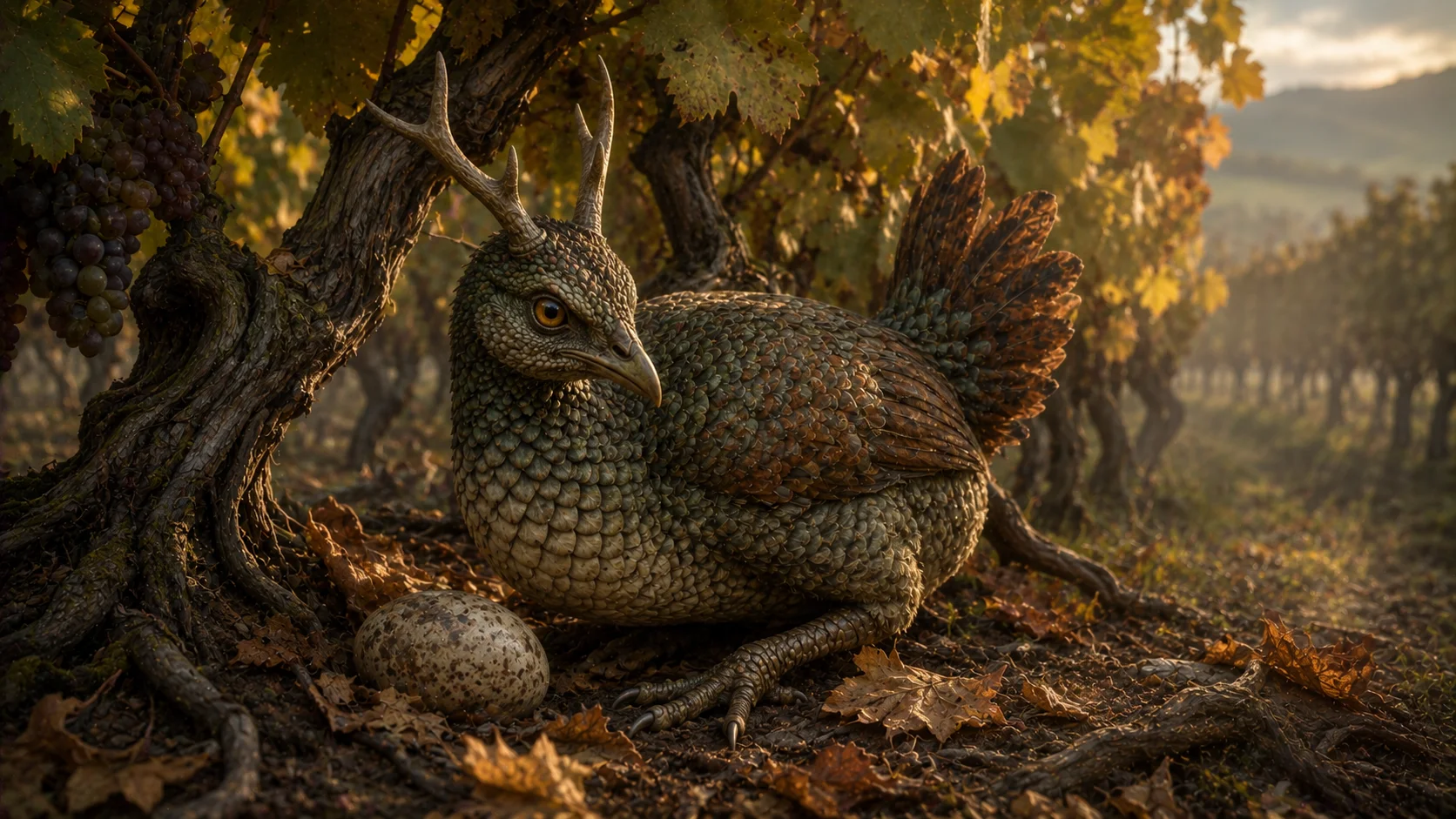
Ask three people in Neustadt an der Weinstraße what an Elwetritsch looks like and you may get three answers, each confident, each slightly different — which is exactly how folklore is supposed to work. The common thread is a body built along the lines of a barnyard hen: real plumage, a rounded chicken's build, and a bird's watchful, darting manner. But the resemblance to an ordinary hen ends quickly. Its legs are said to be spindly and stilt-like, oddly delicate beneath that solid feathered body, giving the creature an ungainly, almost comic gait when it is imagined moving through the underbrush.
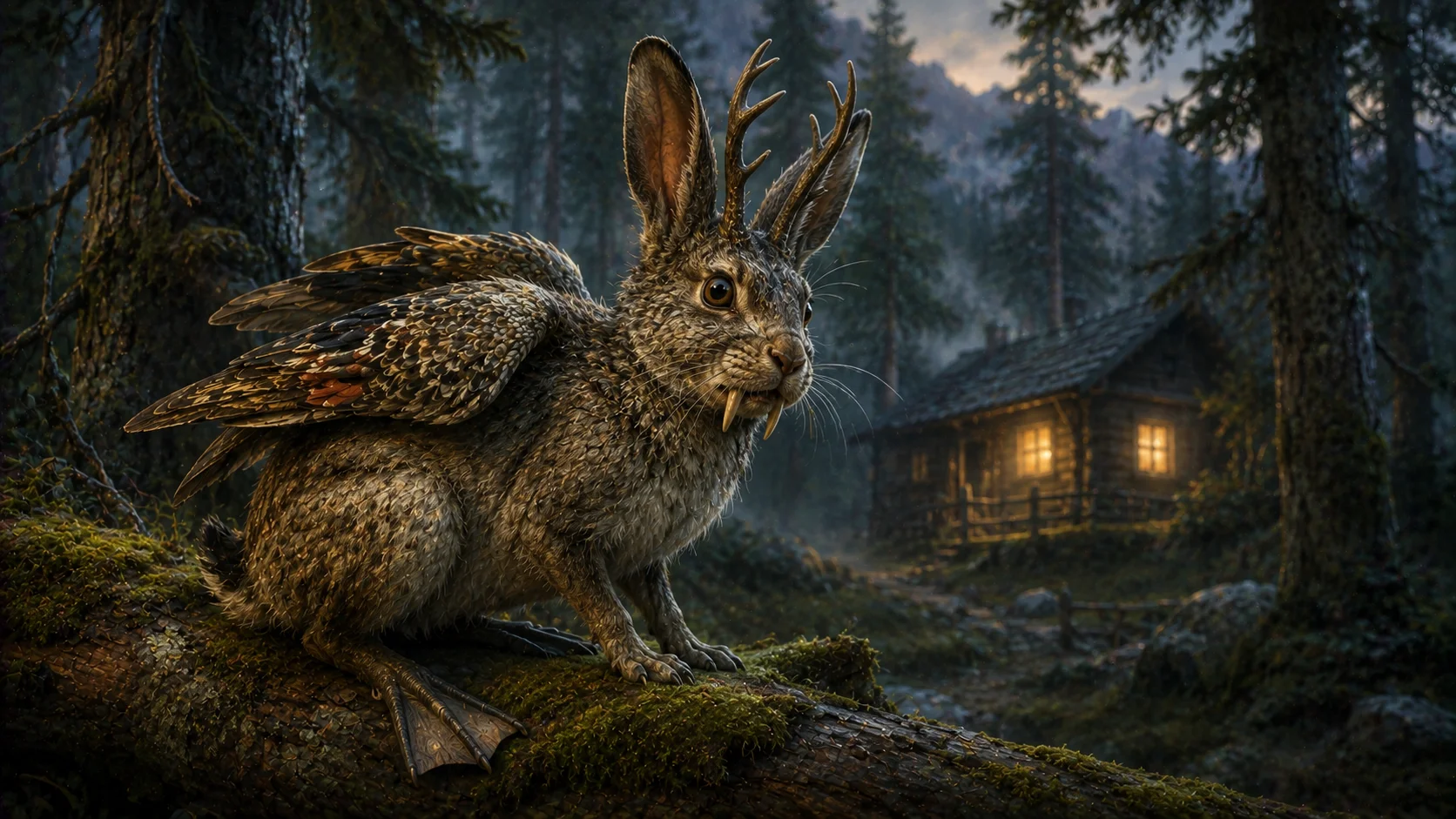
Then come the details that push it firmly into the realm of the fantastic. Many descriptions give it small fangs or a beak-like snout, sharper and stranger than any true bird's. The females, in the most vivid tellings, trail a long tail — fox-like or curling — quite unlike anything a hen would ever grow. The males, for their part, are often given small antlers or horns, a rustic echo of the stag and the roebuck that share their forest home. Regional variants across the wider Palatinate, and into neighboring parts of Rhineland-Palatinate and Saarland, differ on the finer points — how long the tail, whether horns appear at all — but the creature is recognizably the same wherever it is told, a hybrid stitched together from the barnyard and the wild wood.
Nesting in the Pfälzerwald
Elwetritschen are woodland creatures by nature, said to favor the dense forests, vineyard-covered hillsides, and thick hedgerows of the Palatinate. The wooded slopes of the Pfälzerwald near Neustadt an der Weinstraße are their especially beloved haunt, where the trees grow close and the underbrush offers exactly the kind of tangled cover a shy, secretive animal would need. There, tradition holds, they build their nests after dark, tucked low where no ordinary hunter would think to look.
This nocturnal, elusive habit is central to everything else about the legend. An Elwetritsch is, by definition, a creature that is almost never actually seen — which is precisely what makes it such perfect material for a story, and an even more perfect subject for a prank.
The Night the Sack Stayed Empty
No account of the Elwetritsch is complete without its most famous ritual: the Elwetritschenjagd, the Elwetritsch hunt. It unfolds like this. A newcomer to the region — a young apprentice, a visiting student, an unsuspecting tourist eager to prove their mettle — is told, with perfect seriousness, that the forest holds a rare and shy creature well worth catching. All that's needed is patience, a lantern, and a sack held open at the ready.
The local guides lead their guest deep into the trees at night, position them in a likely clearing, and explain the plan: the others will circle around and drive the Elwetritsch toward the waiting sack. The newcomer need only stand still, hold the bag open, and wait. And so they wait — while the pranksters, laughing quietly, slip away and leave them alone in the dark for however long the joke can be sustained, watching for a creature that was never going to come.
It is initiation dressed up as zoology, a rite of passage as much as a joke, and it has served that purpose for generations. Local folk etymology sometimes dresses the tale up further still, with tellings of a clever vintner or hunter who once claimed to have actually captured an Elwetritsch — a boastful cover story, perhaps, for a hunting trip that came home empty-handed, but repeated often enough to become part of the legend's own texture.
A Family of Invented Beasts
The Elwetritsch does not stand alone. It belongs to a wider and delightfully international family of creatures invented specifically to be hunted by the gullible: the jackalope of the American West, the antlered Wolpertinger of Bavaria and the Alps, the improbable wild haggis said to roam the Scottish hills, and Scandinavia's Skvader. Closer to home, Central European ethnography of the nineteenth and twentieth centuries recorded siblings like the Rasselbock and the Dilldapp, other 'Wilde Tiere', wild fabulous animals, used in exactly the same spirit for oral storytelling and for teaching newcomers and apprentices a lesson in humility, laughter, and belonging.
What unites this whole family is not cruelty but craft: each creature is constructed just plausibly enough — a real animal's body crossed with an impossible feature — to make the hunt worth attempting, and the joke worth telling for a hundred years afterward. None of them, the Elwetritsch included, was ever meant to be mistaken for a genuine nature-spirit; the whole point of the prank depends on the creature being an invention, not a belief.
The Bronze Hen of Neustadt
Nowhere is the Elwetritsch more at home than in Neustadt an der Weinstraße, where it has become nothing less than the city's official mascot. Its image appears everywhere the town puts its best foot forward, and nowhere more than during the Wurstmarkt, the enormous annual wine festival held in Neustadt that is, by reputation, the largest wine festival in the world. Elwetritsch imagery and merchandise are woven through the celebration, turning a shy imaginary hen into one of the liveliest emblems of Palatine festivity.
The town's devotion is cast in bronze as well as told in stories. The Elwedritschebrunnen, a well-loved fountain and statue in Neustadt, depicts the creature in full — hen's body, characteristic long tail, and all — and has become a civic landmark in its own right, a favorite stop for photographs and a physical anchor for a legend that might otherwise live only in the telling.
A Regional Emblem of Wit and Welcome
Beyond the festival grounds and the fountain's shadow, the Elwetritsch has settled comfortably into the commercial and civic life of the whole Palatinate. Local breweries, wine labels, restaurants, and souvenir shops across the region have adopted it as a kind of regional signature, a shorthand for Palatine wit, hospitality, and rustic charm. To see an Elwetritsch on a label or a shop sign is to be told, in effect, that you have arrived somewhere that takes its wine seriously and its humor even more so.
A Legend That Lives in the Telling
Few today would claim to genuinely believe a horned, fox-tailed hen nests in the Pfälzerwald's underbrush. The Elwetritsch survives instead through tourism, festival culture, and the enduring pleasure of local storytelling — a piece of living folk humor rather than an active supernatural belief. That, in its own way, is exactly what has kept it so vividly alive. A creature that demanded belief might eventually be argued out of existence; a creature that only ever asked to be enjoyed can be handed down, generation after generation, without ever losing its charm.
In that sense the Elwetritsch shares something with its wider family of invented, hunted beasts — the jackalope, the wild haggis, the Skvader, and its closest cousin the Wolpertinger, all catalogued together not as true nature-spirits but as fabulous hoax-creatures, dreamed up for the pleasure of the hunt and the laugh that follows it. It endures not because anyone insists it is real, but because a region has decided, warmly and deliberately, that it is theirs — an elf-chicken standing guard over the vineyards, the hunt, and the laughter of Neustadt an der Weinstraße.
Sources & traditions
- EncyclopediaWikipedia — Elwetritsch
- TraditionGermanic texts, inscriptions and later retellings (Germany)
Myths change from area to area and from time to time. This chronicle follows the most widely told versions; tellings in other villages, regions and eras may differ.