In the folklore of the German-speaking lands, few household spirits are remembered with as much affection as the Heinzelmännchen — the small, gnome-like helpers said to have once kept the city of Cologne running while its people slept. Known collectively in German as Hausgeister (house spirits) or Wichtelmänner, they belong to a wide and ancient family of Central and Northern European domestic spirits, cousins in spirit to the Kobold, the Wichtel, and the Scandinavian Nisse and Tomte, all of whom share a single defining bargain: they labor for a household in secret, asking nothing in return but to be left unseen and undisturbed.
A Name Built from Affection
The name Heinzelmännchen is itself a small act of folk tenderness. It combines "Heinzel," a diminutive or pet form related to the common German given name Heinrich, with "Männchen," meaning "little men." In some regions the beings are called simply Heinzelmänner, or, in the singular dialect form still heard in German folk speech, Heinzelmann — a single household spirit rather than the collective troop. They are also grouped more broadly under the term Wichtel, a word used across German folk speech for small, often mischievous or helpful spirit figures. The "Heinzel-" prefix itself became something of a naming convention, applied to a range of diminutive folkloric beings across German-speaking regions, but it is the Cologne tradition that gave the word its lasting, singular identity.
The Poem That Fixed the Legend
Though tales of helpful house-spirits were told across the German-speaking world for generations, it was a single work of Romantic-era literature that gave the Cologne Heinzelmännchen their enduring, specific shape. In 1826, the poet and painter August Kopisch published "Die Heinzelmännchen," a poem that captured a local legend and fixed it permanently in print. Kopisch wrote during the same nineteenth-century wave of folk revival that produced the Brothers Grimm's famous collections — though unlike the Grimms' fairy tales, the Heinzelmännchen story is properly understood as a Sage, a local legend tied to a real place and a real civic identity, rather than a fantastical tale set in no particular time or town.
A City That Slept While Its Work Was Done
The heart of Kopisch's poem is a vision of effortless abundance. Every night, after the craftsmen and tradespeople of Cologne had gone to their beds, the Heinzelmännchen — those diminutive Hausgeister — crept out from their hidden dwellings and set to work. They baked the bread that bakers would sell the next morning. They built the barrels that coopers needed for wine and beer. They tailored garments, stitching seams no human hand had touched, and they butchered and prepared meat for the city's tables. By dawn, every trade's labor stood finished, and the craftsmen of Cologne woke to find their day's work already done, again and again, for as long as anyone could remember.
The Bargain Beneath the Blessing
Like all helpful house-spirits in this broader folk tradition, the Heinzelmännchen's generosity came bound to a single, unbreakable condition: they could never be seen. This is the defining trait of the "brownie" type of spirit found across Germanic and wider European folklore — comparable to the English brownie or the various domestic spirits of Scottish and Scandinavian tradition — beings whose helpfulness depends entirely on remaining unobserved. Human curiosity, or human ingratitude, was understood to drive them away forever. The people of Cologne, so the story goes, lived comfortably within that bargain for years without ever breaking it.
The Tailor's Wife and the Scattered Peas
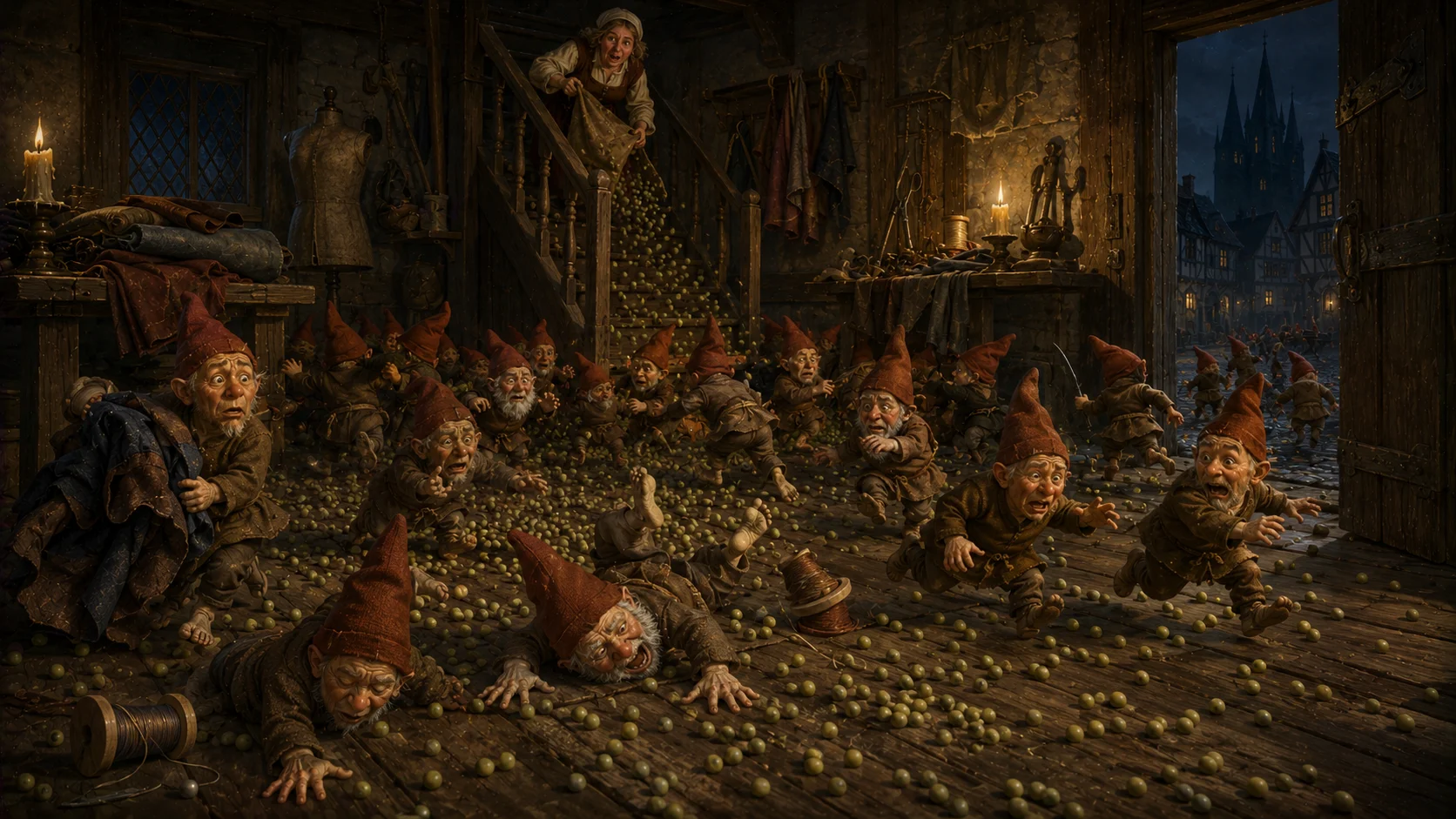
It was curiosity, in the end, that undid the arrangement. According to the legend, a tailor's wife could no longer bear not knowing what these nocturnal Wichtelmänner actually looked like. She devised a plan: she scattered dried peas across the workshop floor — in some retellings, flour instead — hoping the little men would be caught in the act when the light was struck. Her trick worked, but not in the way anyone had hoped. The Heinzelmännchen, arriving to finish the night's tailoring, slipped and stumbled on the scattered peas underfoot. In the commotion, they were seen at last.
A Vanishing Overnight
The consequence was immediate and total. Ashamed and betrayed by the very town they had served, the Heinzelmännchen fled Cologne that night and, according to the legend, never returned. The magic that had sustained the city's trades for so long simply ceased. There was no negotiation, no second chance — the same absolute, irreversible departure that marks every tale of this kind of spirit. Observation was the one thing they could not survive, and once it happened, the bargain was broken beyond repair.
The Morning After: Cologne Learns to Work
The morning after the Heinzelmännchen's flight, the craftsmen of Cologne awoke to workshops exactly as they had left them the night before — nothing baked, nothing built, nothing sewn. For the first time in living memory, the city's tradespeople had to do their own labor from start to finish. The legend offers this as an origin story, an etiological explanation for something the people of Cologne already believed about themselves: that they were, and remain, an especially hardworking people. The tale reframes that civic self-image not as a simple fact of character but as the direct, remembered consequence of a lost blessing — industriousness born of necessity, once a kindness was withdrawn.
Cast in Bronze at Am Hof
The legend's hold on Cologne's civic imagination eventually took physical form. In 1899, a bronze fountain — the Heinzelmännchenbrunnen — was unveiled at Am Hof in the city, sculpted by Heinrich Reinhold Löhr. Its reliefs depict scenes drawn directly from Kopisch's poem, including the pivotal moment of the tailor's wife's fateful trick with the scattered peas. The fountain transformed a poem into a piece of shared civic memory, a place where the story could be encountered in daily life rather than only in print, and it remains one of the clearest physical monuments to a modern German folk legend anywhere in the country.
Cousins in a Wider Household
The Heinzelmännchen do not stand alone in the folklore of the region. As Hausgeister and Wichtelmänner, they belong to a broad and much older category of belief in small, nocturnal, domestic spirits found throughout Central and Northern Europe — the Kobold of German tradition, the Wichtel more generally, and the Nisse and Tomte of Scandinavian folklore. What distinguishes the Heinzelmännchen within this family is their consistent, uncomplicated benevolence. Where a Kobold could turn destructive or vengeful if insulted or mistreated, the Heinzelmännchen of the Cologne legend are remembered as purely good-natured and industrious from beginning to end. Their loss is framed entirely as Cologne's loss — a diminishment of the town, never a relief from a threat.
From House-Spirit to Garden Ornament
The visual imagination of the Heinzelmännchen has left its mark well beyond Cologne. They are typically pictured as small, bearded, male figures wearing hoods or pointed caps — an image many folklorists trace as a direct ancestor of the modern garden gnome, the Gartenzwerg, now a familiar fixture of gardens far removed from the Rhineland and its legends. The line between a shy nocturnal house-spirit and a small pointed-cap figure standing quietly among garden plants is, in this reading, not a coincidence of style but a genuine thread of visual descent running through more than a century of folk imagery.
A Legend Still Living in Cologne
Unlike the more purely mythological house-spirits of earlier, pre-Christian Germanic belief — figures like the Kobold, rooted deep in older cosmologies — the Heinzelmännchen occupy a distinctly modern, civic space in Cologne's identity. The legend is kept alive today through tourism, through confectionery and local products bearing their image, through children's books that retell Kopisch's poem for new generations, and through the ordinary, ongoing sense that this story belongs to the city rather than merely to its past. Whether called Heinzelmännchen, Heinzelmann in the singular, or simply Hausgeister and Wichtelmänner in the older, plainer German of the folk tradition, they are remembered not as a relic to be studied at a distance but as a piece of Cologne telling its own story about itself: a city once helped by unseen hands, and hardworking ever since because those hands were seen, and lost.
Sources & traditions
- EncyclopediaWikipedia — Heinzelmännchen
- TraditionGermanic texts, inscriptions and later retellings (Germany)
Myths change from area to area and from time to time. This chronicle follows the most widely told versions; tellings in other villages, regions and eras may differ.