Frau Holle is a figure of German and Alpine folk tradition, keeper of snow, spinning, and the unseen order of household labor, whose realm lies at the bottom of a well and whose moods are written across the winter sky. She is known to most of the world through a single fairy tale set down by the Brothers Grimm — but beneath that tale, scholars have long argued, moves the shadow of something older: a figure Jacob Grimm himself believed to be a survival of a pre-Christian Germanic goddess. The two Frau Holles, the literary and the reconstructed, are not quite the same being, and a respectful account keeps them distinguishable rather than fusing them into one certainty.
The Woman Beneath the Well
The Frau Holle known best to the world begins in the pages of the Brothers Grimm's Kinder- und Hausmärchen, first published in 1812, as tale number 24. But the story did not begin there. It was gathered from oral tradition circulating across Hesse and central Germany, one thread among many regional folk-beliefs about a stern, fair, otherworldly woman who governs the unseen mechanics of winter. The Grimms did not invent her; they preserved a version of her, fixed in print at a moment when countless other tellings — the ones that varied by valley and village — were left to fade. What survives is therefore one branch of a wider, older folk-belief, not the whole of it.
A Tale of Two Sisters
The Grimm tale is built on a mirror. Two stepsisters live in the same household: one diligent, one lazy, set against each other from the story's first line the way Grimm tales so often frame moral instruction as family drama. Through misfortune — a bobbin dropped down a well while spinning — the diligent girl falls into the earth and finds herself in an unfamiliar world, greeted by an oven of bread that begs to be taken out and an apple tree heavy with fruit that begs to be shaken free. She tends to both. Only then does she meet the woman whose realm this is: Frau Holle herself, described in the tale by her great teeth, an image that has unsettled and beguiled children for two centuries in equal measure.
Frau Holle offers the girl a position in her household, tending to the domestic work of her realm, and the girl proves industrious and careful in the work of shaking out Frau Holle's featherbed each day so it releases its down properly. The lazy stepsister, sent after her in envy, makes the same journey down the same well, but performs every task carelessly — the bread burns, the apples are left to rot on the branch, the featherbed is shaken without diligence. The tale rewards and punishes accordingly, and in doing so, it teaches.
The Reward of the Golden Shower
When the diligent girl's time in Frau Holle's service ends and she asks to go home, she is led to a gate. As she passes through it, gold rains down upon her and clings to her, so that she returns to the world above transformed — visibly, materially rewarded for labor no one but Frau Holle witnessed. It is one of the most enduring images in the Grimm corpus: virtue paid not in blessing or wisdom but in gold that falls from the sky itself, as if diligence and weather were, in Frau Holle's domain, the same substance.
The Judgment of the Pitch
The lazy sister passes through the same gate expecting the same reward, and instead is doused in pitch — tar that will not wash away, a punishment as visible and lasting as her sister's gold was radiant. The story closes on this asymmetry without softening it. This is the reward-and-punishment architecture typical of Grimm didactic tales more broadly: two paths through the same trial, two outcomes fixed permanently to the body of whoever walked them. Frau Holle does not merely judge — she marks.
Shaking Out the Featherbed
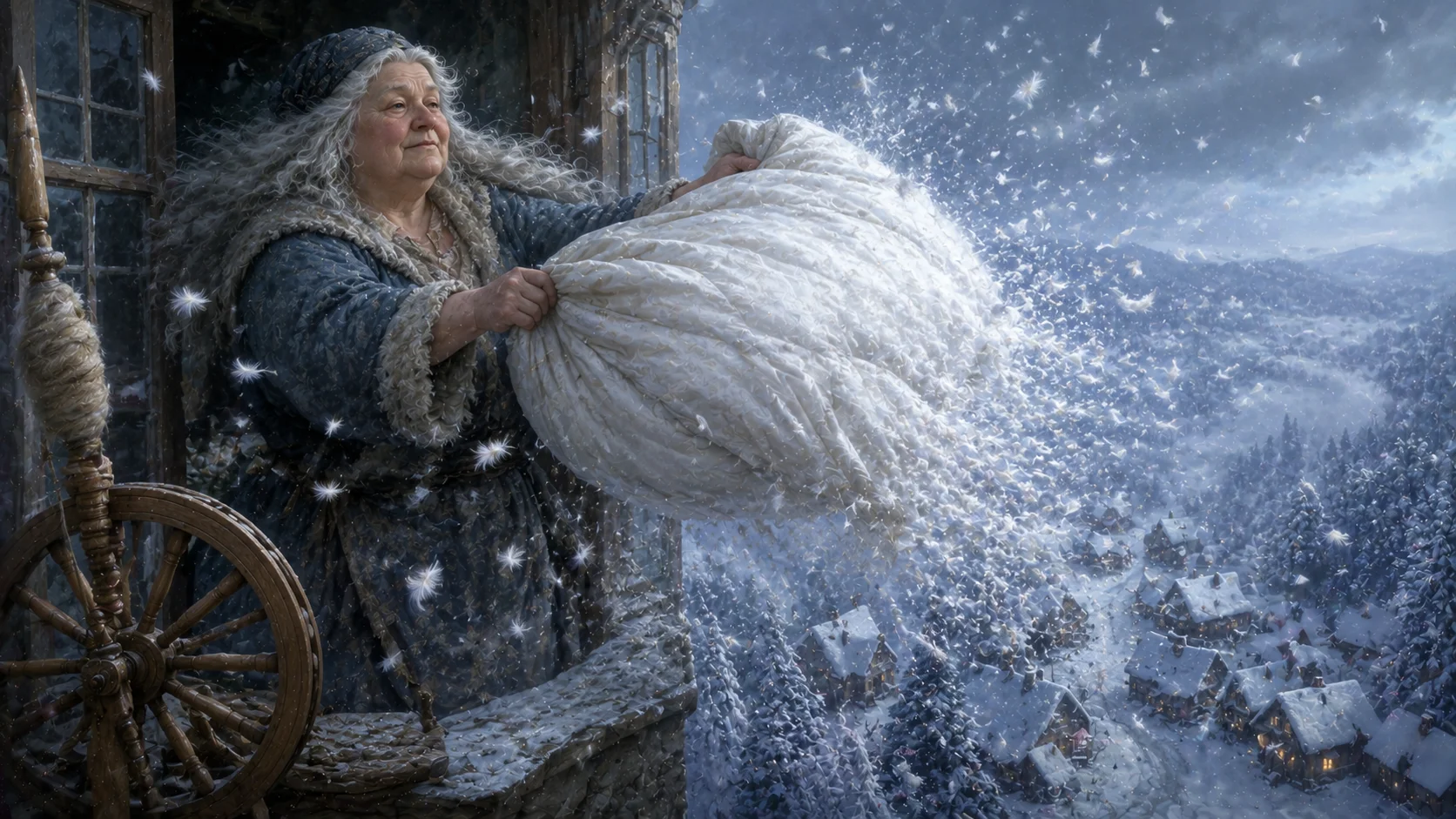
At the heart of the tale sits the detail that gave Frau Holle her lasting place in everyday German speech: when she shakes her featherbed, its down scatters and falls to the world below as snow. This single image gave rise to a folk saying still used in parts of Germany today — that Frau Holle is shaking out her bedding — spoken by parents to children watching the first snowfall of the year, an explanation of weather offered through story rather than science, gentle enough for a child and old enough that no one now remembers who first said it. In this sense Frau Holle functions as an etiological figure: a being whose task is not merely to appear in a story but to explain, plainly, why the sky does what it does in winter.
The Scholar's Goddess Behind the Tale
Jacob Grimm — collector of the tale with his brother Wilhelm, but also, separately, a serious scholar of Germanic religion — argued in his 1835 study Deutsche Mythologie that Holle, or Holda, was no mere fairy-tale invention but the folkloric remnant of an actual pre-Christian Germanic goddess, one whose worship had left traces in exactly this kind of surviving domestic custom and seasonal belief. It is an important and influential hypothesis, and it has shaped how generations have read the tale. It is also, honestly, a hypothesis and not a settled fact. No pagan-era text names her, describes her rites, or records her worship; everything claimed about her as a goddess is reconstructed backward from nineteenth-century and later folklore, comparative philology, and inference. Modern folklorists remain divided on how much of that reconstruction reflects genuine surviving pre-Christian religion and how much is a later folk elaboration mistaken, understandably, for something more ancient than it is. Both possibilities deserve to be held honestly rather than resolved by assertion.
A Name Rooted in Grace
Part of the case for Frau Holle's antiquity rests on her name itself. Some philologists have traced Holle and its variant Holda to the Old High German holdaz, meaning gracious or kind — an etymology that, if correct, casts an interesting light backward onto a figure who in the Grimm tale is stern and exacting rather than gentle. It suggests, perhaps, an older character than the one preserved in the fairy tale: a being whose fundamental nature was benevolence, later narrowed by storytelling into the disciplinarian of spinning-rooms and stepdaughters. As with the goddess hypothesis more broadly, the etymology is suggestive rather than proven, one thread pulled from language rather than from any direct record of belief.
The Silence of the Twelve Nights
In regional Alpine and central German custom, Frau Holle's authority was felt most sharply during the Rauhnächte, or Zwölften — the Twelve Days stretching from Christmas to Epiphany, a liminal stretch of the calendar year when ordinary time was widely felt, across many strands of central European folk custom, to loosen its grip. Tradition held that spinning was forbidden during these nights, and that any flax left unfinished on the distaff when the Twelve Days began would draw Frau Holle's displeasure. It is a striking convergence: a goddess of spinning who, during her own sacred season, forbids the very craft she oversees the rest of the year — as though the loom and the wheel needed their own rest alongside the households that worked them, and Frau Holle was the one who enforced it.
Companion of the Wild Host
In some regional tellings, particularly those recorded in nineteenth-century Hessian folklore collection, Frau Holle appears not only as a solitary household spirit but as a figure connected to the Wild Hunt — the Wilde Jagd, that spectral company said to ride through winter storms gathering the restless dead. Where this connection appears, Frau Holle is remembered as a leader of, or companion to, that ghostly host, riding with or ahead of it through the winter sky she otherwise governs from her quieter, subterranean household. It is worth being precise about how widely this belief actually extended: it is one regional strand documented in specific nineteenth-century collections, not a universal or uniform feature of Frau Holle across every place she was known. Where it does appear, though, it adds a darker current to her character — snow and diligence on one side, the restless winter dead riding the storm on the other.
Kinship with Frau Perchta
Nineteenth-century folklorists frequently drew a line between Frau Holle and Frau Perchta, the guardian-of-the-spinning-room figure of Alpine Austria and Bavaria, and some considered Holle and Perchta regional variants of essentially the same winter-season belief, differing mainly in the geography that shaped them — Holle chiefly rooted in Hesse and central Germany, Perchta further south in the Alpine lands. Both stand watch over the same domestic virtues, both are tied to the same wintering-down of the year, and both reward or punish according to how carefully a household kept its work in order. Yet they are recorded as distinct named figures in their respective regions, each with her own local character and her own body of story, and a careful account keeps that distinction rather than collapsing two separately remembered figures into a single interchangeable name.
The Well as a Door to the Otherworld
The mechanism by which the Grimm tale's heroine reaches Frau Holle's domain — falling down a well — belongs to a wider and much older pattern in European storytelling, the otherworld reached by a sudden, vertical descent through an ordinary household object. Some scholarly readings take this seriously as more than narrative convenience, suggesting that Frau Holle's realm functions as a euphemistic land of the dead, entered the way other cultures' tales send their protagonists through caves, hollow trees, or sleep itself. Under this reading, the bread that begs to be taken from the oven and the apples that beg to be shaken loose are not merely tests of the heroine's character but encounters with a threshold realm where ordinary courtesies take on unusual weight. This remains an interpretation rather than a documented certainty, but it is a serious and long-standing one, worth holding alongside the tale's more straightforward reading as a story about the rewards of hard work.
Between Folktale and Faith
It is worth returning, at the end, to the distinction that runs through everything known about Frau Holle: the fairy-tale figure fixed in print by the Grimms in 1812, and the hypothesized older goddess that Jacob Grimm himself argued lay behind her. The modern popular imagination — children's books, the beloved twentieth-century film adaptations that brought her story to new audiences — has overwhelmingly reinforced the first: the reward-and-punishment heroine of the well, weighed in gold and pitch. The second, the reconstructed pre-Christian goddess of winter and spinning theorized from comparative folklore and etymology, survives only in scholarly argument, never in a surviving pagan-era text of her own. Both are worth knowing. Neither should be mistaken for the other. What can be said plainly and with confidence is this: for two centuries, when snow has fallen over Germany, someone somewhere has told a child that Frau Holle is shaking out her bed — and in that small, enduring sentence, a figure first fixed in ink in 1812, and perhaps first honored in belief long before that, continues to explain the sky.
Sources & traditions
- EncyclopediaWikipedia — Frau Holle
- TraditionGermanic texts, inscriptions and later retellings (Germany)
Myths change from area to area and from time to time. This chronicle follows the most widely told versions; tellings in other villages, regions and eras may differ.