Across the farmhouses and stables of Bavaria, Austria, and parts of Switzerland, one figure was blamed more than any other for the terror of waking unable to move, unable to breathe, with an invisible weight crushing the chest: the Drude. She was not a monster of open daylight but a presence that arrived only in sleep, and the affliction she caused had its own name in the folk vocabulary — Drudendruecken, the "Drude's pressing."
The Weight That Comes at Night
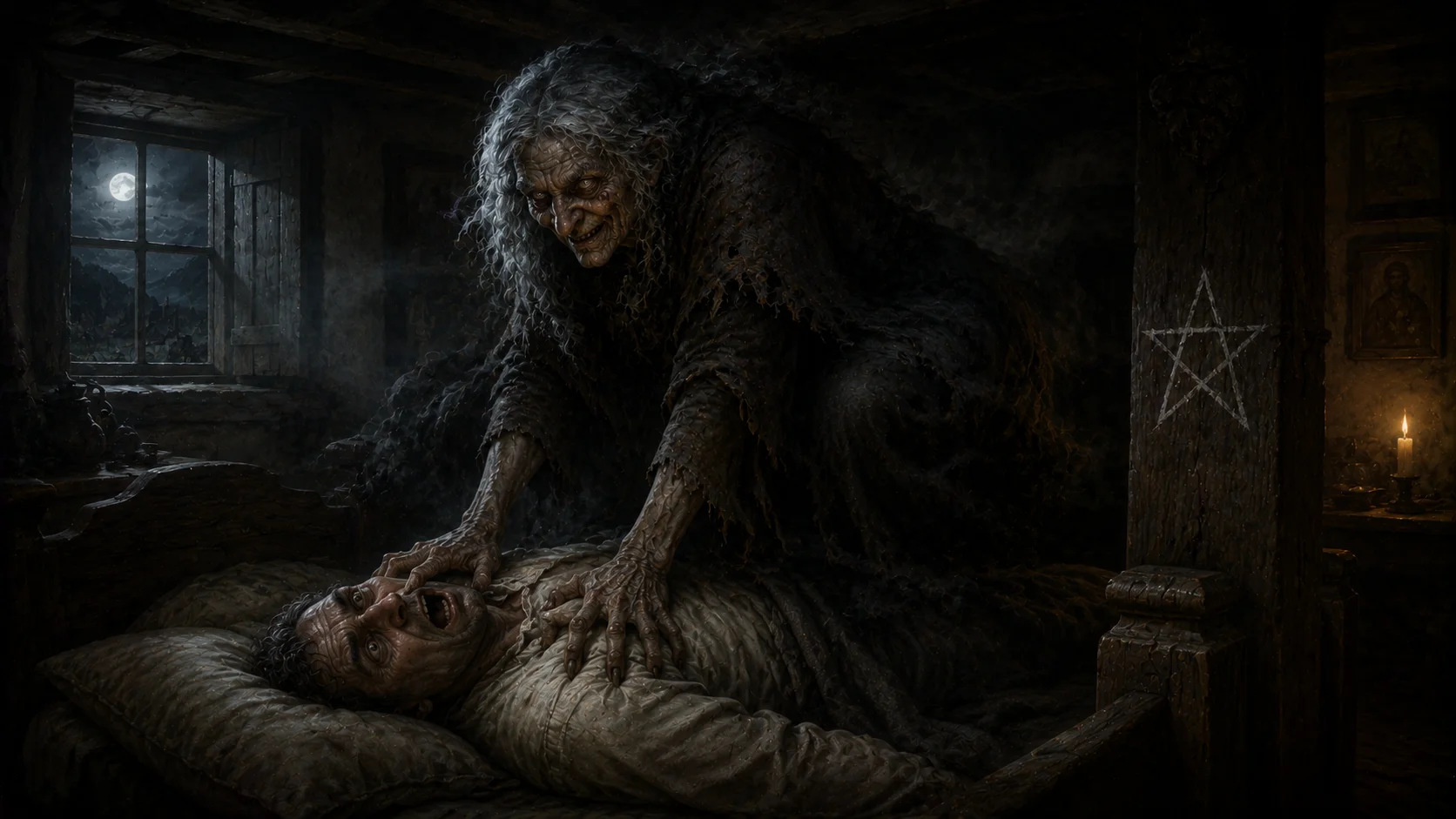
The core of Drude belief describes an experience that modern medicine now calls sleep paralysis: waking, or half-waking, to find the body locked rigid while a crushing pressure bears down on the chest, often accompanied by a sense of dread and an unseen, malevolent presence in the room. In South German and Alpine households this was not filed away as a bodily quirk but understood as an actual visitation — a being had come, sat upon the sleeper, and pressed the breath out of them. The word for this ordeal, Alpdruecken or Drudendruecken, survives in the modern German word for nightmare itself, Albtraum, a linguistic fossil of a belief most people no longer consciously hold.
An Old Woman Who Leaves Her Body
The Drude was most often imagined as an old woman, frequently one already regarded with suspicion in the village — a crone or witch-like figure whose reputation for strangeness marked her out long before any nocturnal accusation was made. What distinguished her from an ordinary witch was the manner of her attack: while her physical body lay in her bed at home, seemingly deep asleep or even deathlike in its stillness, some part of her — her spirit, her will, her second self — travelled out into the night and entered the house of a victim to sit upon the sleeper's chest.
The Woman Who Never Knew
Unsettlingly, some tellings held that a Drude did not always act with intent, or even awareness. A woman could be a Drude without knowing it, marked from birth or by curse with the Drudenzeichen, the Drude's sign, and compelled by forces beyond her control to leave her body and torment others while she herself slept innocently at home. This variant softened the figure into something closer to an affliction than a villainy — a woman could be feared and blamed for harm she had no memory of causing, a cruelty of the belief system as much as a feature of the demon.
Kinship With the Alp and the Mahr
The Drude did not stand alone in the Germanic imagination of the night terror. She overlapped heavily with the Alp and the Mahr (or "mare"), related nightmare-demons found across German-speaking Europe and into Scandinavia, all of them explanatory figures conjured to give shape and blame to an otherwise inexplicable bodily terror. Regional tradition sometimes distinguished a male Nachtmahr from the female Drude, and both from witches proper, yet the boundaries were never firm — a suspected witch in a village was very often simply treated as a Drude, the categories blurring into one another depending on the teller, the district, and the century.
A Name Descended From a Goddess
Philologically, "Drude" traces back to the Old High German trut or drut, and further still to the Old Norse Thrudr — Thrud, a name meaning "strength," borne in Norse myth by a daughter of the god Thor. This is a striking descent: a name once attached to strength and divine lineage settled, over centuries of folk transmission, into the name of a feared and malevolent nocturnal tormentor, illustrating how thoroughly a mythic origin can be reshaped by the fears of everyday peasant life. The nineteenth-century scholar Jacob Grimm addressed this connection directly in his Deutsche Mythologie (1835), linking the Drude to older Germanic fate-spirits and night-hags and tracing the philological line back to Thrudr, even as he recognized how far the folkloric figure had drifted from any divine warrior-goddess.
Shapes Taken in the Dark
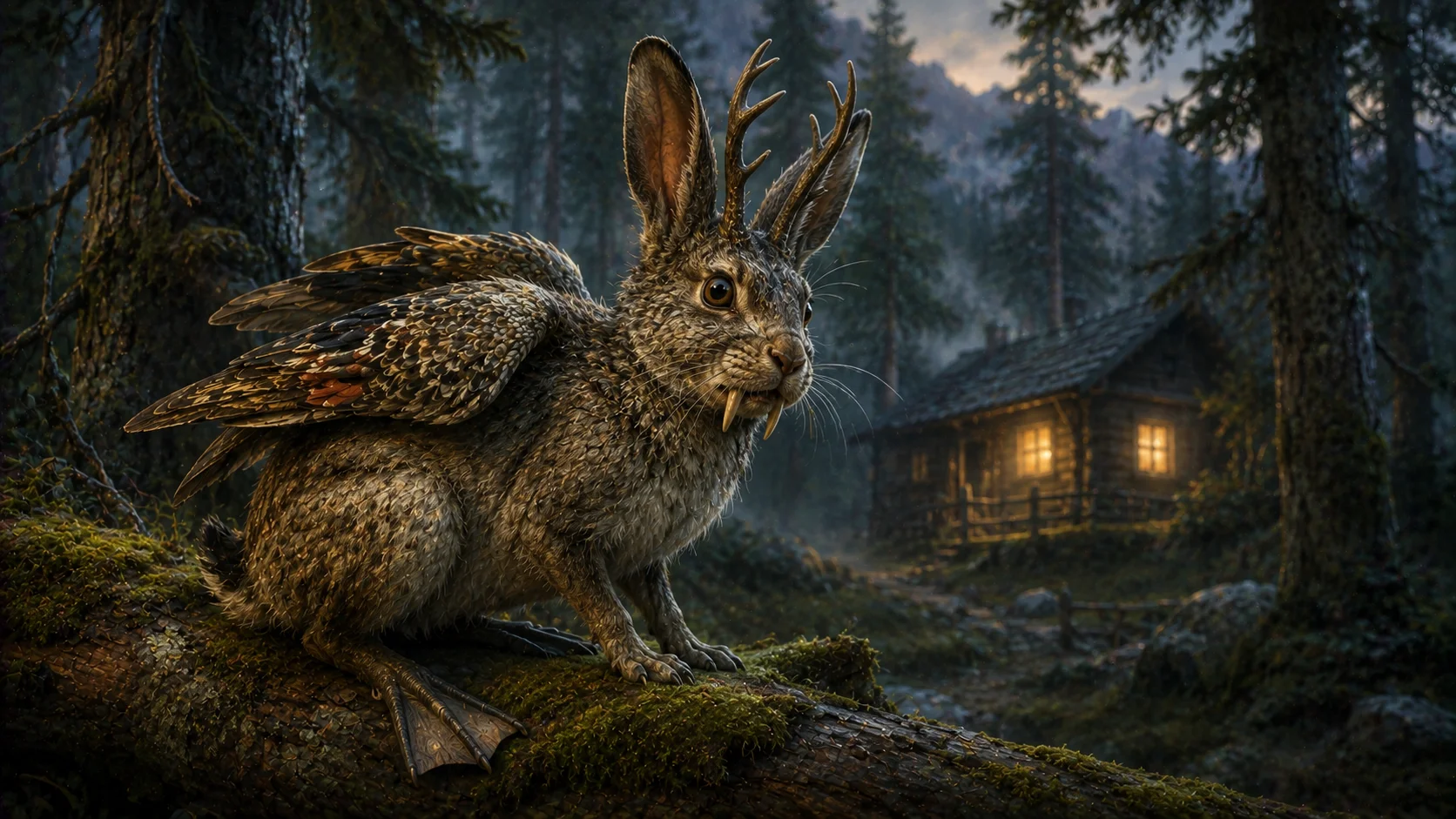
In Alpine and Bavarian accounts, a Drude was not always bound to human shape. She could transform — into a cat, a hare, or a moth — precisely so that she might slip through a keyhole or a gap too narrow for a human body, entering a locked house or a barred stable to reach a sleeping victim. This detail did real cultural work: it explained how a Drude could reach victims behind closed doors, and it gave villagers a reason to view an unfamiliar cat prowling at night, or a moth beating against a window, with sudden unease.
The Five-Pointed Ward
Against so intimate and undetectable a threat, the most enduring protection was a simple drawn or carved symbol: the Drudenfuss, the "Drude's foot," a five-pointed star or pentagram. Families marked it on stable doors to protect livestock, on cradles to guard infants, and on house beams to shield the sleeping household entire. The logic was apotropaic rather than explained — the symbol simply barred her entry, a boundary line drawn against a being who could otherwise pass through walls and keyholes alike. This same pentagram motif would later travel into European occult and grimoire traditions, where it retained protective associations that trace directly back to this Germanic nightmare-demon folklore, a rare case of peasant ward becoming ceremonial symbol.
Shoes, Iron, and the Counting Sieve
Beyond the pentagram, households kept a small arsenal of nightly countermeasures. Turning one's shoes backwards at the bedside was a widespread practice, thought to confuse a Drude's approach or her path home. An iron object or a broom placed near the bed served a similar purpose, motifs shared not only across German folklore but with related alp and mare traditions in Scandinavia as well. Perhaps the most charming defense was the sieve or net hung by the door: a Drude, it was believed, could not pass a mesh of holes without stopping to count every single one, and a task with no end would keep her occupied until dawn broke and her power lapsed. Waking sufferers might also recite a specific charm, a verbal ward meant to close out the memory and the danger of the visitation before the day began.
A Belief That Outlasted Its Explanation
Drude belief was not a brief superstition but a durable feature of rural life, documented by folklorists well into the nineteenth and early twentieth centuries across Bavaria, Austria, and parts of Switzerland. It sat within a wider regional constellation of related nightmare-beings, including the Swiss Toggeli, suggesting that wherever the specific bodily experience of sleep paralysis occurred, communities independently arrived at strikingly similar explanatory figures: an intruder, usually female, usually a night-traveling spirit, usually warded off by iron, counting, or a five-pointed star.
Naming the Boundary: Drude, Hexe, and Toggeli Compared
Folklorists collecting these accounts found the taxonomy of night-demons was never as tidy as later summaries suggest. A village might use "Drude" and "Hexe" (witch) almost interchangeably for the same suspected woman, reserving the more specific term only for the act of nocturnal pressing itself rather than for any settled category of being. Further east and south, the Swiss Toggeli filled a nearly identical role — a nocturnal presence that sat on sleepers and produced the same crushing paralysis — and the close resemblance between Drude, Alp, Mahr, Nachtmahr, and Toggeli across neighbouring valleys shows less a single coherent mythology than dozens of local communities independently naming the same universal, physiological experience. What varied by region was less the symptom than the cast of blame: whether the culprit was assumed to be a living neighbour secretly cursed with the Drudenzeichen, a wandering spirit with no fixed human identity, or an animal-shaped intruder slipping through a keyhole. The Drudenfuss, the backwards shoes, and the counting sieve travelled across all these regional variants largely unchanged, suggesting the protective repertoire spread and was shared more readily between communities than any single settled explanation of what, exactly, was doing the pressing.
From Nightmare-Demon to a Word for Nightmare
The clearest evidence of how deeply this belief took root is linguistic rather than archival. Drudendruecken and its close cousin Alpdruecken fed directly into Albtraum, the ordinary modern German word for nightmare — a word spoken today by people with no conscious knowledge of the Drude, the Alp, or the pressing weight they were once thought to inflict. In this sense the Drude never truly vanished from German-speaking culture; she simply receded from belief into vocabulary, a demon dissolved into a noun.
A Divine Name in Demonic Dress
What makes the Drude an unusually instructive figure within Germanic folklore is precisely this tension between her mythic ancestry and her folk reputation. Where the Norse Thrudr stood among the divine, a named daughter of Thor carrying the weight of "strength" itself, the South German Drude of peasant belief was something to be feared, warded off, and blamed — proof that a name and a meaning can travel an enormous distance across centuries of oral transmission, arriving somewhere its origin would scarcely recognize.
Sources & traditions
- EncyclopediaWikipedia — Drude
- TraditionGermanic texts, inscriptions and later retellings (Germany)
Myths change from area to area and from time to time. This chronicle follows the most widely told versions; tellings in other villages, regions and eras may differ.