In the villages of German-speaking Europe, a sleeper waking gasping in the dark, chest crushed by an invisible weight, had a name ready for what had happened to them. They had been ridden by the Alp — the nightmare-demon whose very name survives, transfigured, in the English word "nightmare" and lives on unbroken in the modern German Albtraum, an "Alp-dream" spoken every time a German speaker describes a bad night's sleep without ever thinking of the being behind the word.
A Name Older Than the Demon
The Alp did not begin as a demon at all. Its name descends from Old High German alb and Old Norse álfr — the same root that gives modern English "elf." Before the figure narrowed into a specific nocturnal tormentor, it belonged to the wider, older family of elf-beings: spirits neither wholly benevolent nor wholly hostile, capable of blessing a household or souring its milk depending on how they were treated. Over centuries the elf-root split. One branch kept the brighter, more ambiguous elf-figure of later fairy tradition. The other narrowed and darkened into something with one purpose only: to sit on the sleeping and steal their breath. That the Alp and the elf share a root is a reminder that folklore rarely invents wholesale — it specializes, narrows, and re-purposes what already exists.
The Weight That Has No Name Until Morning
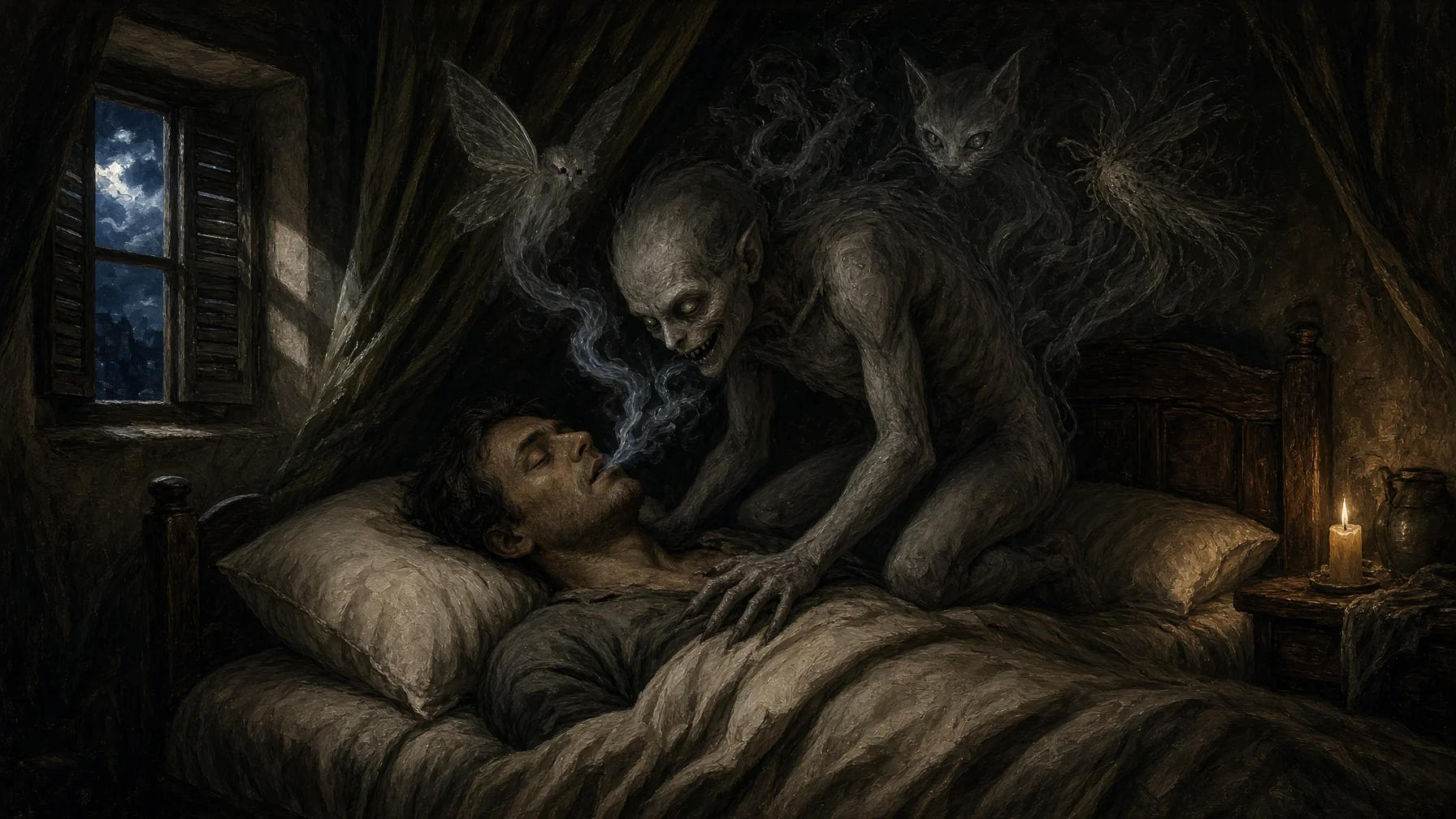
The affliction itself is universal and clinical: waking paralyzed, unable to move or cry out, with an overwhelming sensation of pressure on the chest and a conviction that something is in the room. Medicine today calls this sleep paralysis, a hypnagogic misfire between waking consciousness and the muscular stillness of dreaming sleep. German folk tradition, centuries before that vocabulary existed, gave the experience a face and a motive. The Alp was not a malfunction of the body; it was an intruder, and its intrusion had a shape — literally sitting, literally pressing, literally weighing the sleeper down until they could not draw breath. The folk explanation and the medical one describe the same three minutes of terror; only the agency differs.
Shapes That Slip Through Keyholes
Doors and locks meant little to the Alp. Accounts across German-speaking regions describe it entering a house in the form of a moth, a cat, a mouse, or even a wisp of straw — small, unremarkable things that could pass beneath a door, through a crack in the shutters, or through a keyhole no larger than a fingertip. Once inside, it would resume its true purpose and settle onto the chest of whoever lay sleeping. The choice of forms is telling: nothing monstrous, nothing that would alarm a half-waking mind glimpsing a shadow in the corner. The horror of the Alp was precisely that it looked like nothing at all until it was already sitting on you.
The Neighbor Who Walks at Night
Perhaps the most unsettling strand of Alp-belief held that the demon was not always a demon. In many tellings, the Alp was the wandering soul of a living person — someone's free soul, slipped out of the body during sleep, sometimes said to have departed through the very mouth of the sleeper. Suspicion fell readily on the unpopular: a neighbor with a reputation for envy, a person credited with the evil eye, anyone whose daytime malice seemed to need a nighttime outlet. This belief did something folklore does often and does dangerously well — it took an inexplicable private terror and gave it a face drawn from the community itself. The Alp was not only a supernatural hazard; it was a mechanism for airing suspicion between neighbors, and its victims often woke already certain of who had done it to them.
Catching the Thing That Cannot Be Caught
Because the Alp so often traveled in animal form, tradition held out a narrow chance of turning the tables. If a victim managed to seize the moth or mouse in the room and hold it fast through the night, refusing to let go no matter how it struggled, the human identity behind the demon could allegedly be exposed at first light — the guilty neighbor found exhausted, marked, or simply unable to explain their night. Other accounts held that sealing the hole or crack the Alp had used to enter would trap it inside the room until dawn revealed its true form. These tales gave the powerless victim of a paralytic night something rare: a plan, however fanciful, for the next time it happened.
The Stone With a Hole Through It
Of all the protections against the Alp, none is more distinctive than the Alpstein — a hag stone, naturally pierced by water or weather, hung above the bed or laid on the chest of the sleeper. The logic was elegant rather than aggressive: the demon would find the hole, be drawn to pass through it as it might pass through a keyhole, and in doing so miss the sleeper entirely. It was not a weapon against the Alp but a decoy, offering the intruder an easier way through that happened not to involve a human chest.
A Household Armed Against the Dark
Beyond the hag stone, households kept an arsenal of small, deliberate disorders meant to confuse or bar a nocturnal visitor. Shoes were placed backward beside the bed, toes pointing away, on the belief that a demon following the line of the shoes would be led back out the way it came. A broom or a pair of scissors laid crosswise near the bed stood sentry, iron and crossed lines both carrying old apotropaic weight in the region's wider folk practice. Most striking was the pentagram drawn or carved on the bedroom door — the five-pointed sign known specifically as the Drudenfuss, the "Drude's foot," named for the related nightmare-hag of southern German and Alpine tradition rather than for the Alp alone. None of these measures fought the demon directly. All of them were about denying it the one thing it needed: an easy, unnoticed way in.
The Drude of the Southern Mountains
In the Alpine and southern German regions, the Alp shades into a closely related figure, the Trud, or Drude — a nightmare-hag whose nocturnal assaults mirror the Alp's own, and whose name is stamped permanently onto the pentagram ward that protects against her. The overlap between Alp and Drude is not a contradiction in the tradition but its ordinary texture: regional nightmare-demons blurred into one another at the edges, sharing remedies even where their names and precise habits diverged. A traveler moving from northern to southern German-speaking lands might have heard the same crushing nighttime visitor described under two different names and warded off with the same sign on the door.
Riding the Beasts of the Barn
The Alp's victims were not only human. Horses and cattle found sweat-soaked and exhausted by morning, their manes tangled into knots overnight, were said to have been ridden by the Alp just as a sleeping person might be. Farmers responded with their own craft-remedy: braiding protective charms — Alpzöpfe, "Alp-braids" or hag-braids — directly into a horse's mane, both as a ward and as physical evidence, the tangled hair itself read as the demon's fingerprint from the night before. A farmhand discovering a snarled mane at dawn was not looking at ordinary restlessness; they were looking at proof that the household's troubles had spread from the bedroom to the stable.
A Demon of Two Sexes
Folk speech gendered the assault according to who was attacked. An Alp pressing on a sleeping woman carried erotic, incubus-like overtones, paralleling the medieval Latin concept of the incubus directly. A female counterpart tormenting a sleeping man went by a different name entirely — the Mahr or Nachtmahr, the figure that gives English "nightmare" its second half as surely as the Alp gives it the first. The two names, Alp and Mahr, sat side by side in the same body of belief, sometimes overlapping, sometimes kept carefully distinct, describing what was recognized even then as one underlying experience wearing two faces.
A Family Spread Across a Continent
The Alp did not stay confined to a single region or even a single language family. Northern German-speaking areas favored Mahr or Nachtmahr where the south held to Alb or Alp, and the concept crossed linguistic borders entirely into Slavic tradition, surfacing as the Polish zmora and the broader Slavic mora. Scandinavian saga preserves the same lineage under the name mara — most famously in the Ynglinga saga's account of King Vanlandi, said to have been ridden to death in the night by a mara sent against him. Across every one of these names, the shape of the belief holds steady: a demon that comes at night, presses the chest, and steals the breath of the sleeping.
Grimm's Catalogue of the Lower Spirits
When Jacob Grimm compiled Teutonic Mythology in 1835, he placed the Alp among the lower mythological beings, kin to elves and dwarfs, and read it as a survival — a fragment of pre-Christian Germanic spirit-belief that had persisted by folding itself into the demonology of a Christian age. Grimm's instinct matches what the etymology alone already suggests: the Alp is not a late invention but an old figure narrowed and darkened over time, carrying its elvish ancestry in its very name long after its role had hardened into something far less ambiguous.
The Crouching Shape in Fuseli's Canvas
The Alp's afterlife extends past folklore and into art. Henry Fuseli's 1781 painting The Nightmare — Swiss-English rather than strictly German in its making — gives the tradition its most enduring image: a demonic, incubus-like figure crouched on the chest of a sleeping woman, exactly where centuries of German household belief had always placed the Alp. Fuseli's painting is not an illustration of German folklore specifically, but it visualizes the same inherited terror, the same posture of pressing weight, that gave the Alp its name and its power over the imagination of anyone who has ever woken unable to move.
A Terror Given a Face
What the Alp ultimately represents is a particular way of making sense of the unexplainable: rather than treat a crushing, paralytic night as an internal malfunction of body or mind, German folk tradition externalized it, gave it a shape that could enter through a keyhole, a motive that might belong to a jealous neighbor, and a set of countermeasures — a pierced stone, backward shoes, a pentagram on the door — that returned some measure of agency to the terrified sleeper. The word survives every remedy and every hag stone; long after the countermeasures fell out of practice, Albtraum remains the ordinary way to say "nightmare," a small, everyday inheritance from a demon once taken entirely seriously.
Sources & traditions
- EncyclopediaWikipedia — Alp (folklore)
- TraditionGermanic texts, inscriptions and later retellings (Germany)
Myths change from area to area and from time to time. This chronicle follows the most widely told versions; tellings in other villages, regions and eras may differ.