The Roggenmuhme — the Rye-Aunt, sometimes Rye-Mother, and known in some regions simply as Kornmuhme — is one of the plainest and most practical figures in German rural folklore: a grain-field bogey invoked not to explain the harvest's abundance but to keep children alive and crops unbroken during the tense weeks when the rye stood taller than any child who might wander into it.
A Hag Who Lives in the Standing Grain
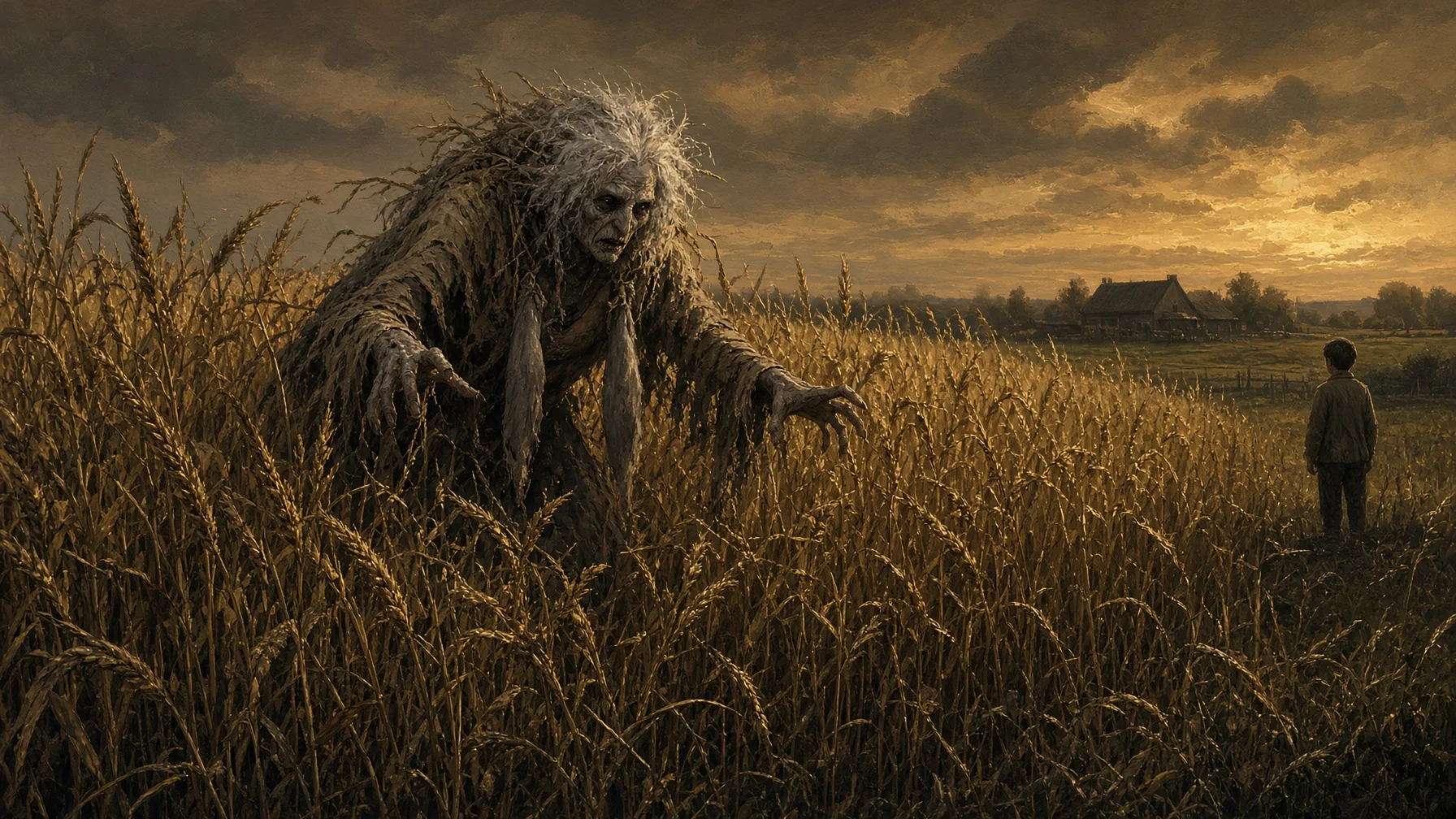
Unlike house-spirits or wood-dwellers with a fixed dwelling, the Roggenmuhme has no home at all in the ordinary sense. She moves through the rye itself, concealed by the same stalks that make the field dangerous in the first place. Nineteenth-century collectors who recorded her described a tall, wild-haired old woman, gaunt and unkempt, who could stand motionless among the rows and be indistinguishable from the crop until a child was already too close. Some tellings sharpen the menace further, giving her iron breasts or an iron-hard grip — details meant less to build a coherent physical portrait than to land, in a single sentence, on a child's imagination.
The Field as a Real Danger
It is worth pausing on how literally practical this figure was. Rye grown for grain reaches well above a small child's head by midsummer. A child who pushed a few rows in could vanish from view entirely, lose all sense of direction among identical stalks, and become genuinely difficult to find — while also flattening a swath of grain that a family depended on. The Roggenmuhme belief sat exactly on top of that real hazard. She was not an explanation invented for its own sake; she was a deterrent built to do a specific job, and the fact that she worked precisely where the danger was greatest is part of why the belief held on so widely across rural German-speaking regions.
Kin to the Kornwolf and the Field-Spirits of Harvest
The Roggenmuhme did not stand alone. She belongs to a wider Central European family of field-spirits invoked around the grain cycle — most notably the Roggenwolf, a comparable wolf-shaped scare-figure, and the broader Kornwolf and Feldgeist beliefs that clustered especially around the harvest itself. These figures shared a function more than a form: each gave rural households a supernatural reason, easy to explain to a child in one sentence, for staying out of a field or respecting the labor bound up in it. Where the Roggenwolf's imagery draws on the predator lurking at the field's edge, the Roggenmuhme's draws on the hag hidden within the crop — two faces of the same underlying anxiety about grain, growth, and the vulnerability of both to a wandering child.
Distinguishing Her From the Bilwis
Sources sometimes lump every grain-field being together, but the Roggenmuhme is functionally distinct from the Bilwis, a figure likewise associated with grain fields. The Bilwis's menace is aimed at the crop's own fertility and integrity — a magical threat to the harvest as a harvest. The Roggenmuhme's menace is aimed at trespassing children — a protective threat aimed outward, at keeping small feet from ever reaching the grain in the first place. The surface resemblance (both are "grain-field beings," both are frightening, both are invoked during the growing season) has caused real confusion in the record, but the underlying logic of each figure points in a different direction: one guards the crop's magic, the other guards the crop's physical safety by guarding the children who might damage it.
Where Kornmuhme and Roggenmuhme Blur
Even within her own name, the Roggenmuhme is not always cleanly separated from the Kornmuhme, a closely related — and in some collections, simply synonymous — corn-spirit figure. Folklore collectors working village by village did not always agree on whether they were recording one tradition under two names or two neighboring traditions that had grown to resemble each other. This is not a flaw in the record so much as an honest reflection of how oral, regional belief actually worked: names, details, and emphases shifted from parish to parish, and the boundary between "the Rye-Aunt" and "the Corn-Aunt" was never fixed by any central authority. Treating the overlap as an open question, rather than forcing a false precision onto it, is truer to how the belief was actually lived.
The Gentler Face: Harvest and the Corn-Mother Complex
Not every regional variant kept the Roggenmuhme as a pure scare-figure. In some tellings she is drawn instead into the broader corn-mother complex found across Central Europe — the belief that the grain itself carries a resident spirit whose fortunes rise and fall with the crop's own cycle. In these gentler variants, the harvest is treated less as an act of cutting the plant down and more as an encounter with a being who must be handled with a measure of ceremony. This softer thread does not erase her frightening role during the growing season; it simply shows that the same figure could carry two functions depending on the point in the agricultural year and the particular village doing the telling.
The Last Sheaf and the Anxiety of Finishing
Central to this gentler thread is the widespread "last sheaf" custom complex, in which the final patch of standing grain in a field — the last piece left uncut at harvest's end — is treated as something more than ordinary stalks. In many tellings across the region, that last remaining patch is where the field's resident spirit is imagined to retreat as the reapers work inward, row by row, cutting away its refuge. The custom reflects a very human anxiety: the harvest is not safely finished until every stalk is down, and the last sheaf becomes a focal point for that unease, sometimes bound, dressed, or treated with particular care rather than cut and gathered like the rest.
A Belief Told to Children, Not Recorded as Myth
One of the most telling features of the Roggenmuhme's documentation is how little elaborate narrative attaches to her. She has no origin story, no cycle of adventures, no named encounters passed down as set-piece tales. She survives almost entirely as a warning — a sentence a parent or grandparent could say at a field's edge, not a story told at length by a fireside. This puts her at odds with the richer mythic narratives built around other supernatural figures, and it is precisely why nineteenth-century folklore collectors filed her as a widespread agrarian scare-tale rather than a being with developed mythology. Her thinness as a "story" is not a gap in the record; it is the shape the belief actually took, because a scare-tale for keeping children out of a field only needs to be frightening, not elaborate.
A Pattern Older Than Any Single Village
Viewed from a wider angle, the Roggenmuhme is not a uniquely German invention so much as one regional expression of a much broader Indo-European pattern of grain-spirits and field-hags. Comparable figures — women who haunt or embody the standing crop, frightening or otherwise — recur across European folk traditions wherever cereal agriculture created the same underlying conditions: tall grain capable of hiding a child, a harvest whose completion mattered enormously to survival, and a need to translate both facts into something a household could tell its youngest members in a single warning. The Roggenmuhme's particular details — her iron breasts, her wild hair, her silent presence among the rows — are local color on a pattern that repeats, in different costume, across much of the continent.
Moving Through the Crop, Not Rooted to a Place
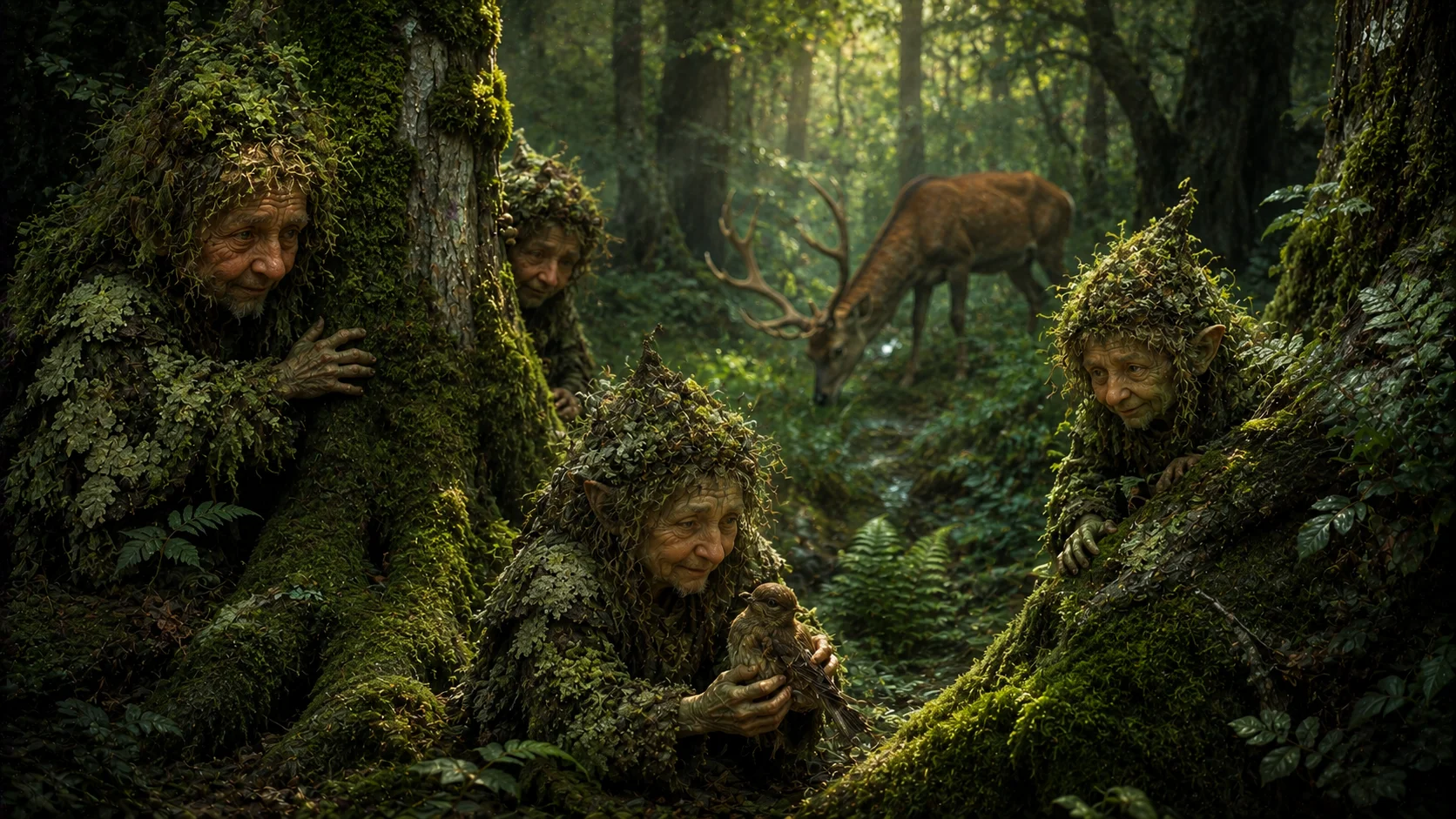
It is worth returning to how differently the Roggenmuhme occupies space compared to other folkloric beings tied to a fixed dwelling. Where wood-bound figures such as the Moss People are anchored to a particular grove or thicket, the Roggenmuhme has no analogous home. Her whole identity is bound to the crop's own presence: she exists, in the belief, only as long as and wherever the rye stands tall enough to hide her, appearing with the growing season and receding again once the field is cut and open. That mobility is itself meaningful — it ties her directly to the agricultural calendar rather than to a landscape feature, reinforcing that she is, at heart, a seasonal warning given a shape rather than a permanent resident of any one place.
Regional Variation Without a Single Authoritative Form
Because the Roggenmuhme was preserved mainly through oral transmission at the level of individual villages and districts, no single version of her can be called definitive. Some regions kept her purely as a child-scaring bogey, unadorned by ritual. Others folded her into the last-sheaf customs and the wider corn-mother sensibility described above, treating her partly as a fertility figure due some measure of respect at harvest's end. Both threads are genuine parts of her documented folklore, and neither cancels the other out — they represent the natural variation of a belief that was never standardized, only ever passed down by word of mouth from one growing season to the next.
What Remains of the Rye-Aunt Today
The Roggenmuhme no longer functions as active belief; no household today keeps children from a rye field by invoking her. She survives instead as a folklore curiosity, preserved in regional heritage collections and agrarian history rather than in living practice. That survival is worth treating with some care rather than condescension. Behind the frightening image is a record of how earlier generations of rural families managed a genuine hazard — tall grain that could truly swallow a wandering child — by giving that hazard a face memorable enough for a small child to heed. The Roggenmuhme belongs, in that sense, less to the history of monsters than to the history of how agrarian communities protected their youngest members and their most essential crop with the same story.
Sources & traditions
- TraditionGermanic texts, inscriptions and later retellings (Germany)
Myths change from area to area and from time to time. This chronicle follows the most widely told versions; tellings in other villages, regions and eras may differ.