The Bilwis — spelled in old sources as Bilwiz, Pilwiz, or Bilwitze — is one of Germanic folklore's most telling shapeshifters, not in body but in meaning. It began as something close to a blessing and ended as something farmers armed themselves against. No other field-spirit in the corn-demon complex studied by Wilhelm Mannhardt shows so complete a reversal, and no other reveals so plainly how a community's fears can slowly repaint a spirit's face.
A Name That Once Meant Wisdom
The earliest attestation of the word comes from Old High German, where pilwiz denoted something closer to a knowing or oracular presence than a monster. Linguists reading the compound have offered two threads that may in fact be the same thread: one traces it to a phrase meaning roughly "the one who strikes with a weapon of goodness," the other resolves it into bil-, meaning miraculous or magical, joined to wizzi, meaning knowledge or wisdom. Under either reading, the oldest Bilwis is not a threat but an authority — a being whose power was understanding, not harm.
The Linguistic Debate Behind the Name
Philologists have never fully settled which of these two derivations is correct, and the disagreement is not merely academic — it changes what kind of being the Bilwis originally was. If the "weapon of goodness" reading is right, the name preserves the memory of a protective or martial figure, something closer to a guardian spirit invoked against harm. If the bil- + wizzi reading is right, the emphasis falls instead on insight and prophecy, aligning the Bilwis with the wider family of Germanic wise-women and knowing-spirits whose gift was foresight rather than force. Compounding the puzzle, Old High German bil- itself carries a cluster of overlapping senses — the miraculous, the sudden, the uncanny — so that even isolating one clean etymology risks flattening a word that likely carried several connotations at once for the people who used it. What the debate agrees on, regardless of which branch is favored, is the direction of travel: whatever the Bilwis was called into being to mean, it was not damage. The demonic sense that later dominates the record is a semantic drift layered on top of, not derived from, the word's earliest attested use.
Jacob Grimm's Two Faces
When Jacob Grimm surveyed the figure in his Deutsche Mythologie of 1835, he did not describe one creature but two eras of the same word. He noted explicitly that the older sense was beneficent and prophetic, and that only later did the name curdle into something mischievous and malevolent. Grimm's account matters because it is not folklore layered over folklore — it is a scholar looking directly at the seam where a spirit's reputation broke in half, and naming both halves honestly rather than flattening the figure into the demon it later became.
The Field Begins to Turn
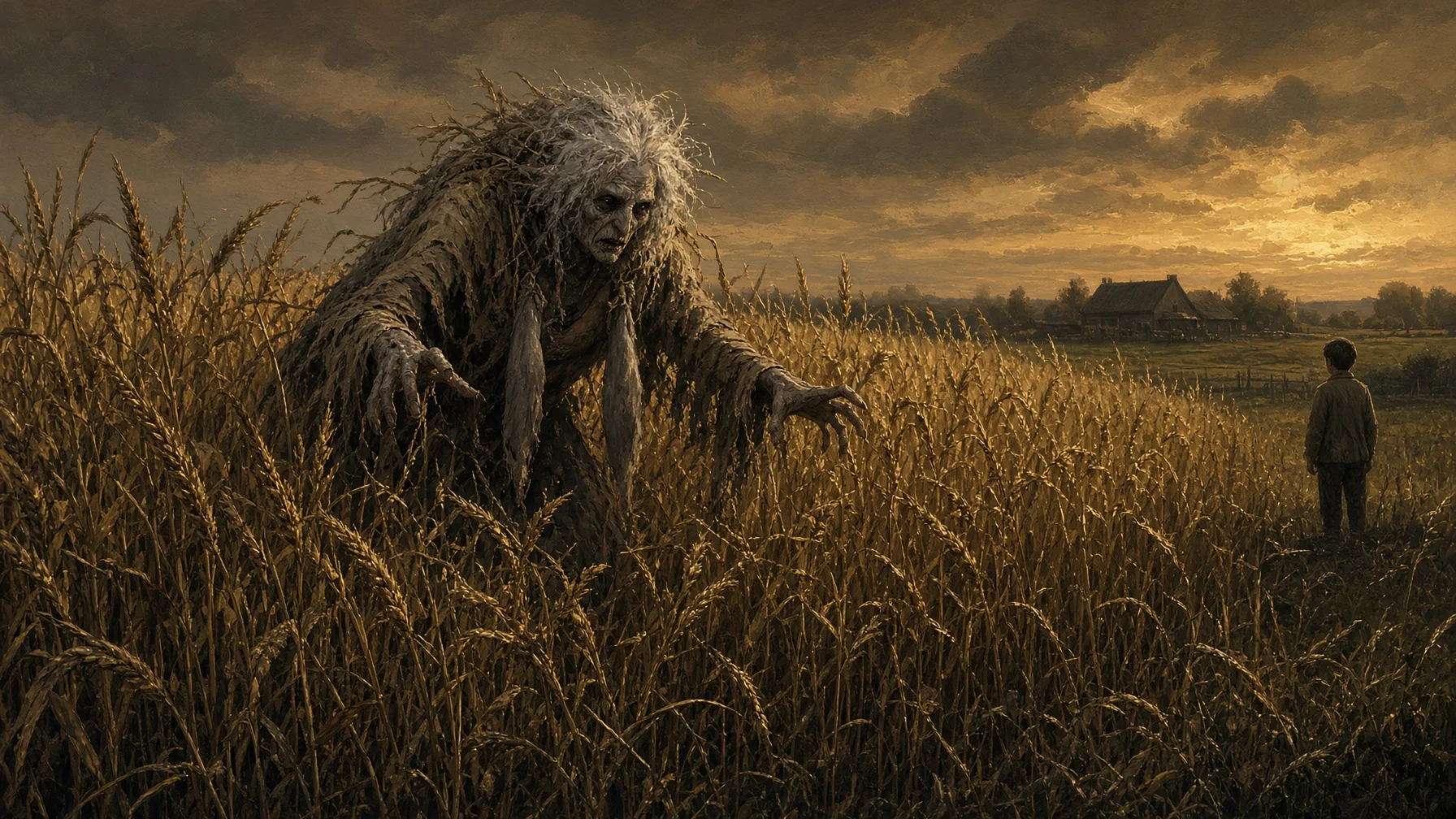
By the sixteenth and seventeenth centuries, chiefly across Bavaria, Austria, and the wider South German and Central European countryside, the Bilwis had been reforged into something the earlier tradition would barely recognize: a grain-field demon, blamed outright for damage to the crop a village depended on to survive the winter. This was not gradual erosion of an old story — it was the spirit being handed a new and much darker job.
The Bilwisschnitt
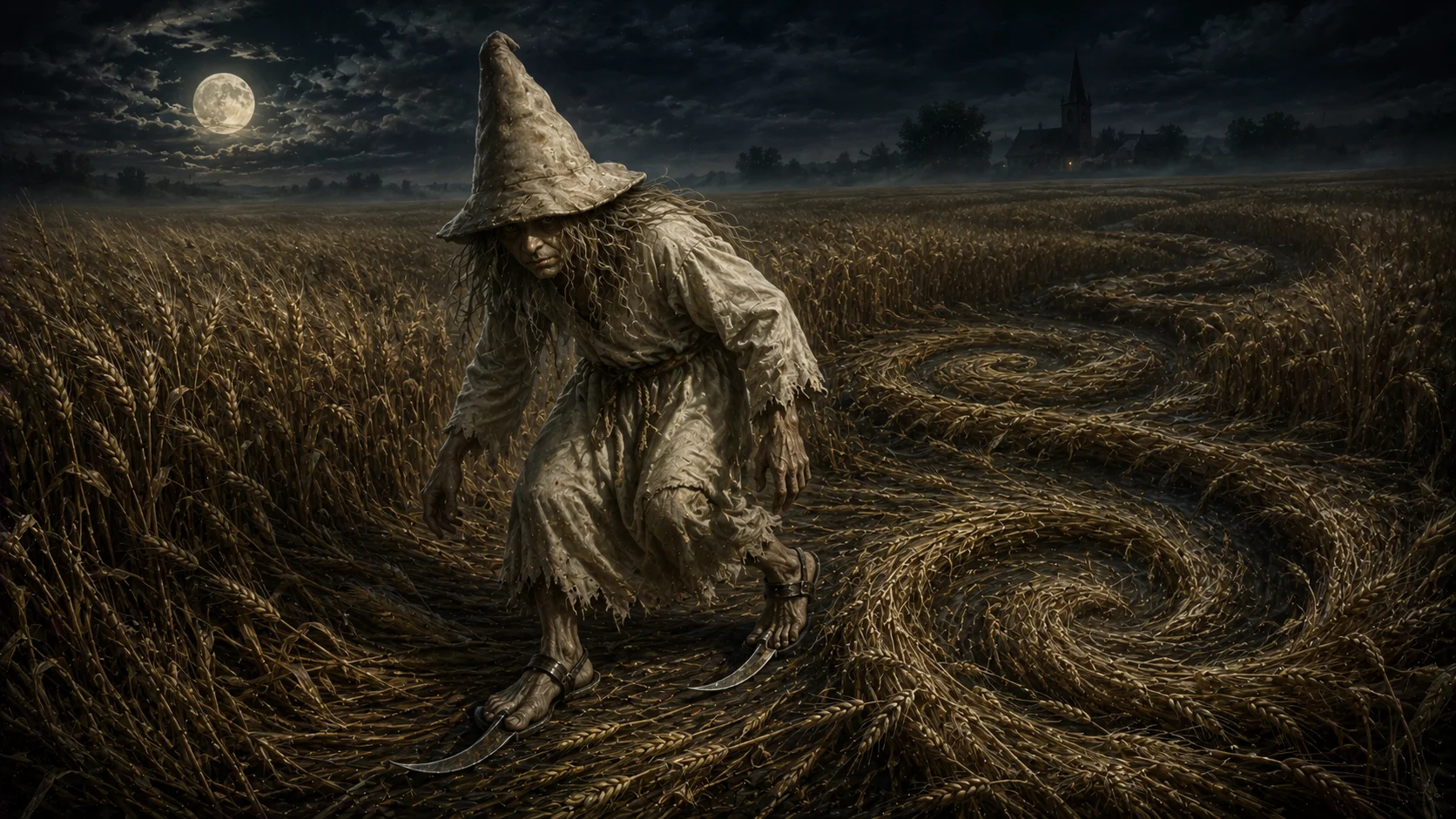
The demon's signature was a phenomenon farmers called Bilwisschneiden or Bilwisschnitt — patches of grain found flattened, twisted, or cut into strange shapes overnight, as though something had moved through the field with a blade in the dark. No one had seen it happen. The field simply woke up wrong, and a wrong field, to a household living at subsistence margins, was not an abstraction. It was hunger measured in exact rows.
Feet Turned the Wrong Way
Regional legend gave the culprit a body built entirely around the crime: crooked or backward-turned feet that forced it to walk only in circles or spirals. Folklorists have long connected this detail directly to the swirled, lodged patterns actually found in damaged cereal fields — the story's anatomy exists to explain the shape of the evidence. Some tellings sharpened the image further, describing sickles or scythes fixed to the demon's toes or knees, so that its very gait became the harvesting tool, and simply walking through a field was itself the act of ruin.
A Small, Horned, Hairy Thing
Physically, the Bilwis was usually pictured as small — a hairy, gnome- or dwarf-like being, occasionally marked with a single horn or spike rising from its head. This places it comfortably among the household and field spirits of the wider Germanic tradition, the Kobolde and Erdmännchen who inhabited barns, thresholds, and boundary lines rather than distant wilderness. The Bilwis was not an outside menace. It belonged to the same intimate, half-domestic category of being as the spirits already living at the edge of the farmyard — which made its betrayal feel closer to home.
Stealing a Neighbor's Fortune
The darkest version of the legend removed the demon from the realm of the supernatural entirely and placed it in the next farmhouse over. In many tellings the Bilwis was understood to be an evil sorcerer or witch — usually male, though the female form Bilwisschnitterin appears as well — who transformed in secret to reap a neighbor's grain and carry its fertility back to their own soil. The crime was not simple destruction. It was theft of abundance itself, one field's luck drained directly into another's.
When Envy Wore the Demon's Face
This is the point where the Bilwis legend crosses into darker, human history. An old woman whose neighbor's harvest had failed while her own thrived could find herself named a Bilwisschneiderin — accused of having become the demon, or of having sent it, out of envy. The folklore did not stay folklore. It fed directly into the logic of early modern witch-persecution, turning a village's anxiety over an unexplained crop failure into a specific, human target who could be blamed, watched, and punished.
Iron, Herbs, and the Solstice Watch
Communities did not simply fear the Bilwis — they built a whole seasonal defense against it. Farmers in the Alpine and Bavarian regions placed crossed sickles and iron objects at the edges of their fields, and planted or hung blessed herbs, among them St. John's wort, known locally as Bilwisskraut — the Bilwis-herb, named for the exact enemy it was meant to repel. These protections were timed deliberately around the summer solstice and the harvest season, the two windows when the crop was most vulnerable and most valuable at once.
Mannhardt's Corn-Spirit Framework
The Bilwis makes the most sense not as an isolated curiosity but as one specimen within a much larger system that the nineteenth-century folklorist Wilhelm Mannhardt spent decades mapping: the European "corn-spirit" complex. Mannhardt collected harvest customs, field-demon legends, and grain-related rituals from across German-speaking Europe and argued that they all reflected a single underlying idea — that the vitality of the crop was itself alive, embodied in a spirit that moved through the standing grain and had to be managed, honored, or driven off at harvest time. Under his framework, the Bilwis is a localized, demonized variant of a much older and more widespread belief that cereal fields host a resident life-force, one that could be beneficent if respected and destructive if provoked or stolen. Mannhardt's comparative method placed the Bilwis alongside figures such as the last-sheaf spirits bound up in harvest customs, the animal-formed corn-spirits reported in northern Germany, and the various "grain mothers" and "grain men" cut down — symbolically or literally — in the final swathe of the harvest. Read this way, the Bilwis's crooked feet and nocturnal circuits are not an isolated invention but a regional dialect of a pan-European grammar for talking about the mystery of why some fields thrived and others failed.
Kin to the Rye-Aunt
The Bilwis did not stand alone in the grain fields. Villagers sometimes conflated or compared it with the Roggenmuhme, the rye-aunt, and with other grain-guardian and grain-demon figures that populate the broader Germanic corn-spirit complex Mannhardt later catalogued. Both figures served a similar disciplinary function in village life — invoked to keep children out of the standing grain, and to explain any damage found there after the fact — though the Roggenmuhme's threat was aimed more at trespassers than at rival farmers, marking a subtle difference in what each spirit was ultimately policing: the crop's safety in one case, its ownership in the other.
Regional Variants Across Central Europe
Variants of the name and concept spread across the whole German-speaking expanse of Central Europe, taking on distinct local colorings as they traveled. Dialectal forms of the word drifted far enough from the Old High German root that some regional renderings — clustering loosely around Bilbo- or Bilbao-type variants — are barely recognizable as the same figure without tracing the sound changes step by step. In border regions such as Bohemia and Silesia, where German-speaking and Slavic-speaking communities lived in close and sustained contact, the figure shows clear traces of cross-pollination with neighboring Slavic and Baltic grain-demon traditions, which had their own independent repertoire of harvest spirits and field-damage explanations. The result in these contact zones was often a hybrid belief, German in name but shaped in detail by whichever neighboring tradition's harvest anxieties ran closest to the same soil — evidence that the fear of an invisible thief in the wheat was never confined to one language, and that folklore at a linguistic border rarely stays cleanly on one side of it.
What the Villages Were Really Afraid Of
Read as a whole, the Bilwis is less a creature than a diagnosis. It gives a face and a set of crooked feet to the things an agrarian community could not otherwise explain or control: a sudden blight, a night of hail, an unlucky wind, a rival's unspoken resentment. Modern folklorists point to natural causes — wind shear, hail damage, animal movement, fungal lodging in the stalks — as the likely origin of the flattened patches once blamed on the demon's nightly circuits. But the fear the legend carried was entirely real: that fertility itself was finite, that a neighbor's gain might be quite literally your own field's loss, and that the danger to the harvest might be walking on two feet rather than four.
An Old Story, Borrowed Again
The Bilwis found one last afterlife in the twentieth century, when the appearance of genuine crop-circle phenomena sent enthusiasts searching for historical precedent. The old accounts of the Bilwisschnitt were duly rediscovered and cited as proof that mysterious field patterns had a centuries-old pedigree — a modern echo answering a folk explanation that had itself been trying to answer something older still. Between the oracular spirit of the Old High German sources and the crop-circle footnote of recent decades lies the entire arc of the Bilwis: a being born to explain wisdom, remade to explain ruin, and never quite let go of by the fields it was said to haunt.
Sources & traditions
- TraditionGermanic texts, inscriptions and later retellings (Germany)
Myths change from area to area and from time to time. This chronicle follows the most widely told versions; tellings in other villages, regions and eras may differ.