The Kobold is the household and mine spirit of German folklore — a being of the hearth and the shaft alike, whose temperament is not fixed but earned. Attested in Middle High German sources from the medieval period and gathered at length by Jacob Grimm in his Deutsche Mythologie (1835), the Kobold occupies a space in the German imagination that is neither wholly benevolent nor wholly malicious. It is, instead, a mirror: it returns to the household exactly the treatment the household extends to it. Few figures in German folk belief express so plainly the old principle that the unseen world shares the house with the living, and that hospitality toward it is not sentiment but obligation.
A Guest Who Was Never Invited
Long before it had a settled name in scholarly compendia, the Kobold was simply understood to be there — under the floorboards, behind the hearthstone, inside the walls of a working farmhouse. It was not summoned and could not easily be evicted. Families spoke of a Kobold the way they spoke of a difficult but valuable relative: present by inheritance rather than by choice, tolerated because the alternative was worse, and capable of great service if treated with the courtesy due to any resident of the home. This is the seed from which every later story grows — the Kobold is fundamentally domestic, bound to a place or sometimes to a specific object within it, rather than to any one family bloodline.
The Bargain of Porridge and Milk
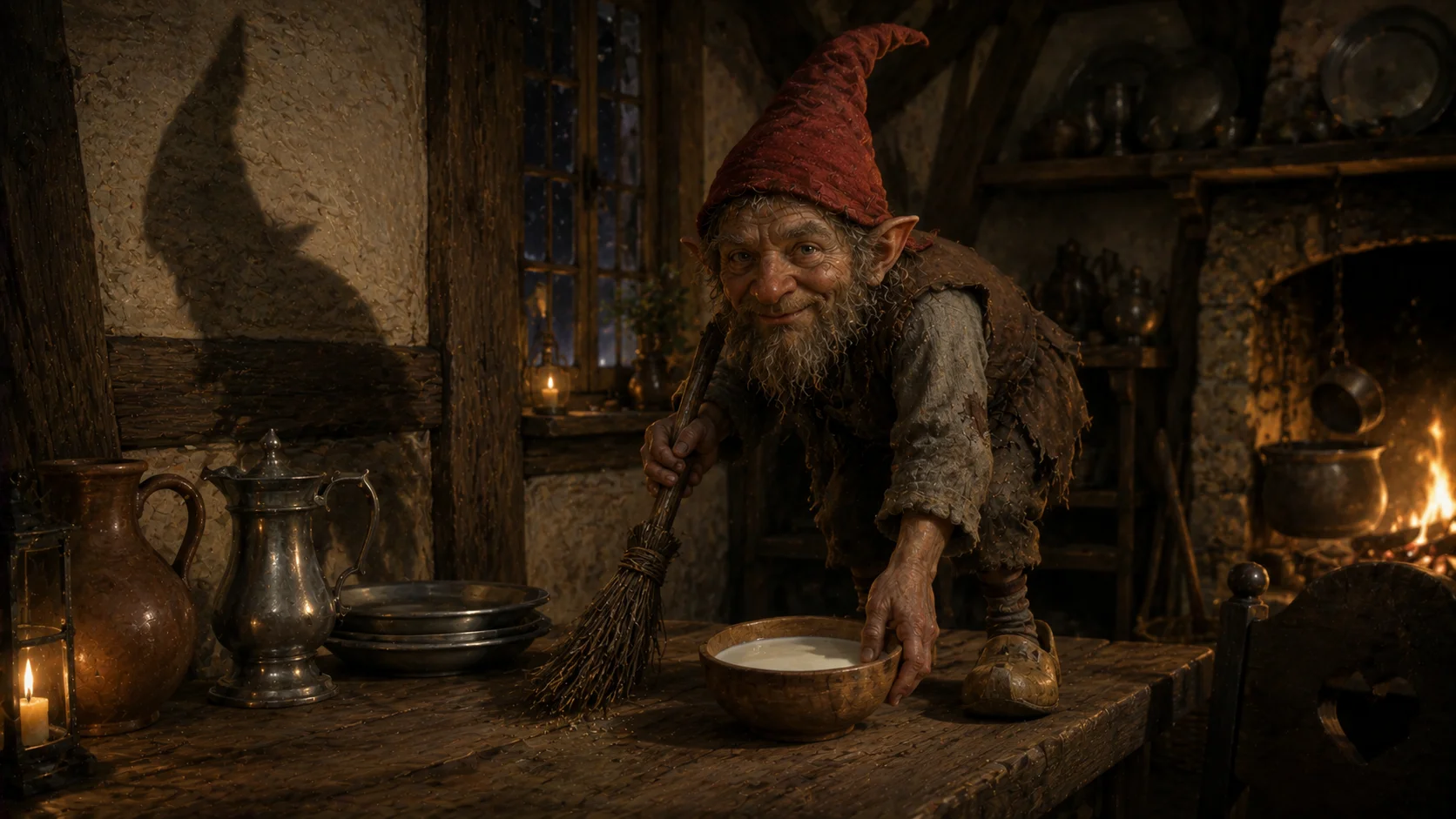
The relationship between household and Kobold was transactional in the most literal sense. A bowl of porridge, a saucer of milk, left out at night by the hearth, was the accepted toll for a spirit that would otherwise work for nothing — or worse, take for nothing. In return, a satisfied Kobold swept the kitchen, tended the livestock, mended what needed mending, and kept a kind of nocturnal watch over the property. This exchange, small as it sounds, carried real moral weight in the communities that practiced it: to forget the offering, or to substitute something inferior, was read as an insult, and insults to Kobolds were never absorbed quietly.
When Respect Runs Dry
The defining feature of Kobold lore, consistent across regional tellings, is its dual nature — not as two separate spirits but as one spirit responding in kind. A Kobold well-fed and well-spoken-of remained a quiet asset for years. The same Kobold, mocked by a servant, starved by a stingy master, or simply taken for granted, could turn its considerable talents to spite: souring the milk that should have fed it, hiding tools at the worst possible moment, tangling harnesses, waking sleepers with clatter, and in the darker tellings, doing the household real harm. Folklorists have treated this reciprocity as the single most stable element of the tradition — the Kobold is not evil or good by nature, only responsive.
Hödekin, the Little Hat of Hildesheim
Among named individual Kobolds recorded in the German chronicle tradition, none is more vividly preserved than Hödekin (also written Hödeken), associated with the Bishopric of Hildesheim and drawn from chronicle material reaching back to the twelfth and thirteenth centuries. His name is thought by some to derive from Hütchen, "little hat," describing the small cap by which he was recognized. Hödekin served — and haunted — a bishop's court, alternating between genuine helpfulness and calculated vengeance depending on how he was regarded by the household he attached himself to. He stands as one of the clearest bridges between the anonymous folk-belief Kobold and a Kobold with a face, a wardrobe, and a personal history worth setting down in writing.
The Spirit Under the Hearthstone
Not every Kobold was imagined as a small humanoid figure. In genuinely attested regional variants, the household's Kobold might take the form of a snake or a toad kept beneath the hearth — a creature that was never to be killed, on the understanding that it was not merely an animal but the resident spirit itself, wearing that shape. This animal-associate tradition sits apart from the later illustrated compendia that gave Kobolds little coats and pointed caps; it belongs to an older, more animistic layer of belief, where the boundary between spirit and creature, and between the hearth and the wild things that might shelter near it, was far less firm than later storytelling would suggest.
Down Into the Dark: The Bergkobolde
The Kobold's domain was not limited to the house. German miners spoke of Bergkobolde — mine-kobolds — believed to inhabit the shafts and tunnels they worked. As in the household tradition, these mine spirits carried a double character: sometimes helpful, knocking against the rock to warn of an unstable ceiling or a coming collapse, and sometimes blamed outright for cave-ins, vanished ore, and the foul, unbreathable air that could fill a shaft without warning. For miners whose lives depended on reading every strange sound in the dark correctly, the Bergkobold was less a superstition than a working theory of an environment that genuinely could kill without visible cause.
The Ore That Bears the Spirit's Name
The mine-kobold tradition left its mark permanently on the language of chemistry. Certain silver-adjacent ores resisted smelting and released toxic arsenic fumes when miners attempted to work them — frustrating losses that miners attributed to Kobolde spoiling the good silver ore out of spite. The ore itself came to be called Kobalt after the spirits blamed for its uncooperative nature, and when Georg Brandt isolated the element it contained in 1735, the name passed directly into the element itself: cobalt. It is a rare case where a piece of everyday folk belief survives, intact and largely unnoticed, inside the periodic table — a word spoken today in chemistry classrooms that began as an accusation against an unseen tormentor of miners.
A Ship-Bound Cousin: The Klabautermann
The Kobold's conceptual family extended even to water, or rather to the vessels that crossed it. The Klabautermann, a maritime spirit attached to ships rather than houses or mines, has been treated by many nineteenth-century folklorists and later popular sources as essentially a Kobold that took up residence aboard a vessel instead of beneath a hearthstone. This is not a claim that the two are the same individual spirit wearing different names, but rather that domestic, mining, and maritime tradition share one underlying conceptual type: a small, place-bound spirit whose favor must be earned through respect and whose absence, or anger, is felt immediately by those who depend on the space it occupies.
The Little Folk of Cologne
Related but distinct from the Kobold proper are the Heinzelmännchen, small helpful gnome-like house spirits particularly associated with the folklore of Cologne. In the best-known telling, these little folk did the townspeople's work for them each night — baking, building, finishing tasks left half-done at sundown — until curiosity got the better of someone who spied on them at their labor, at which point they vanished for good and never returned to help again. Folklorists generally treat the Heinzelmännchen as a related but separate named tradition rather than a mere synonym for Kobold, though the shared logic of hidden labor rewarded only by discretion and respect runs through both.
Neighbors in the Dark: Nixie and Klabautermann
German folk taxonomy, following the organizing framework Grimm himself used, grouped these lesser spirits by domain rather than by rank among gods. The Kobold belongs to house and mine; the Nixie belongs to water; the Klabautermann belongs to the ship. None of the three is a major deity in the mythological sense — each is a Naturgeist, a localized nature or dwelling spirit whose authority begins and ends at the edge of the space it inhabits. Distinguishing them by where they live, rather than by what they are made of or how powerful they are, remains the standard scholarly approach to organizing this whole tier of German folklore.
A Name of Disputed Ancestry
Even the word "Kobold" itself resists easy settlement. Some philologists connect it, via Latin transmission, to the Greek kobalos — a rogue or knave, tied to the mischievous kobaloi spirits of Greek folklore — though the exact path of that borrowing is debated. Others argue for a purely native Germanic compound: kob-, meaning hut or chamber, joined to a root meaning to rule, yielding something like "ruler of the house." Neither explanation has won full consensus, and any account that presents one as settled fact overstates what is actually known. The uncertainty itself is worth preserving, since it reflects how old and how thoroughly reworked this figure is within the language that carries its name.
The Moral Economy of the Unseen Housemate
Beneath the porridge bowls and the vanished tools lies a consistent piece of folk theology: the home is not occupied by humans alone, and the unseen co-tenant keeps its own ledger. This is the same reciprocal logic found in the spinning-room lore of Frau Holle, where diligence is rewarded and idleness punished, but the Kobold applies it to ordinary weekday labor rather than to a single winter reckoning. Every swept floor left ungratefully unacknowledged, every offering skipped because the household was in a hurry, was understood to accrue somewhere — and sooner or later, in the folklore's own telling, it always came due.
What the Kobold Still Guards
Long after the porridge bowls stopped appearing on German hearths, the Kobold persisted as shorthand for a particular kind of household truth: that the things which keep a home or a workplace running are often invisible, easily taken for granted, and quick to turn resentful when they are. Whether imagined as a capped little man haunting a bishop's court, a toad beneath the hearthstone, a knocking presence deep in a mineshaft, or the unseen crew-mate of a working ship, the Kobold's lesson does not change. Respect is cheap to give and expensive to withhold, and the spirit sharing your roof, your shaft, or your deck is always keeping count.
Sources & traditions
- EncyclopediaWikipedia — Kobold
- TraditionGermanic texts, inscriptions and later retellings (Germany)
Myths change from area to area and from time to time. This chronicle follows the most widely told versions; tellings in other villages, regions and eras may differ.