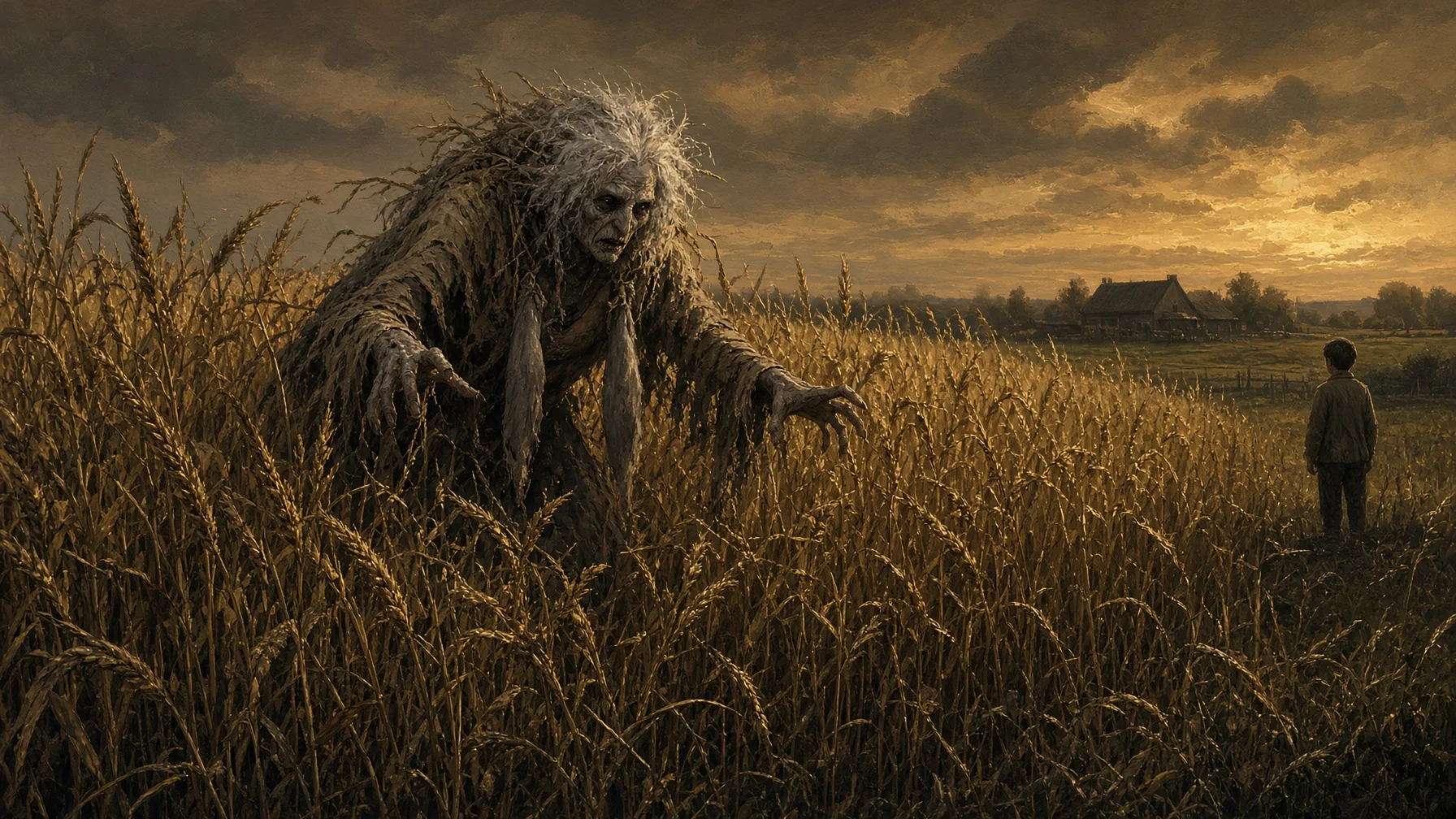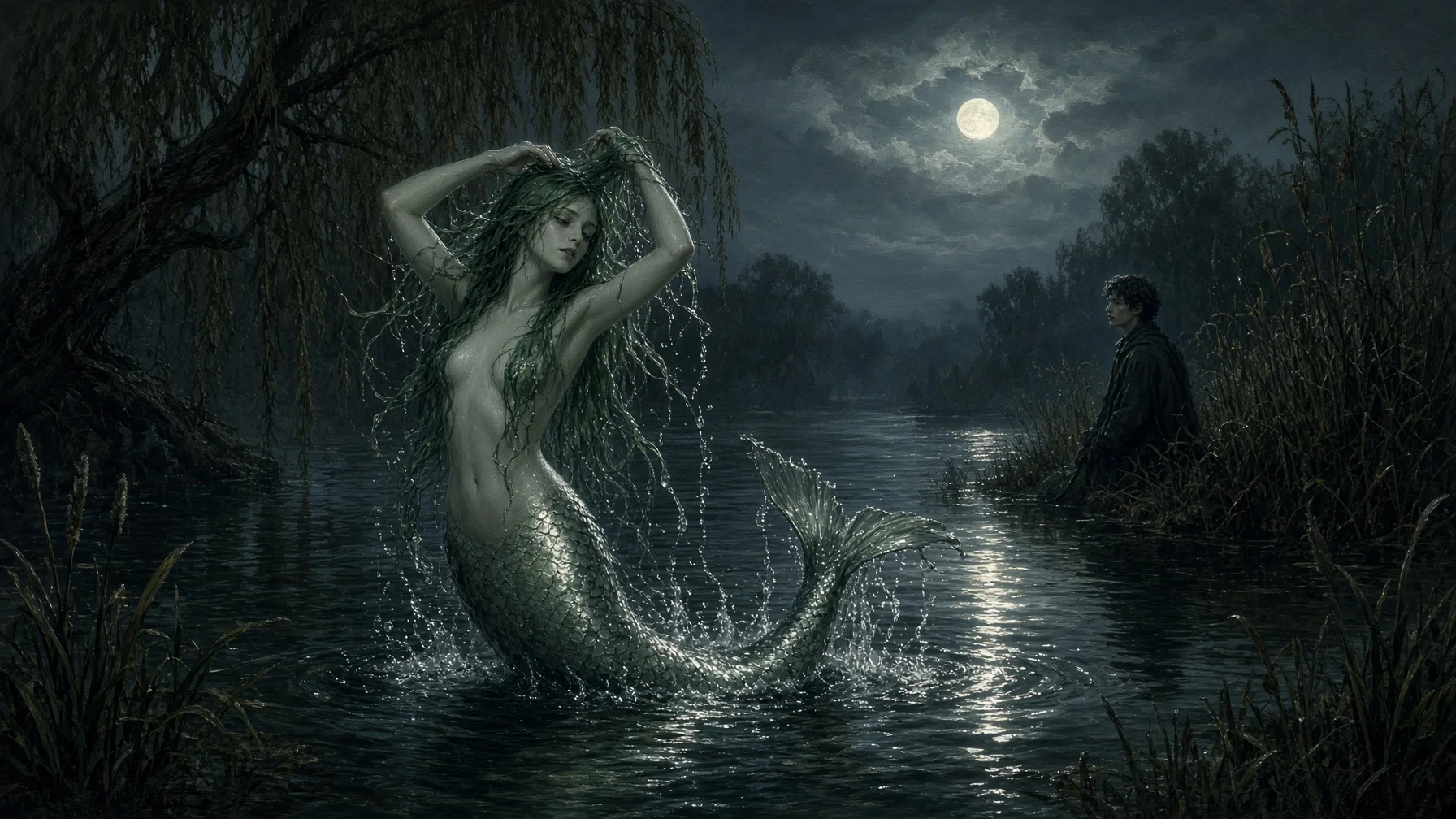
The Nixie is the shapeshifting water-spirit of Germanic folklore, known in German as the Nix in his masculine form and the Nixe in hers. Long before the Brothers Grimm set the type into print, German-speaking communities already spoke of the Nixie the way one speaks of a neighbor whose temper is known and must be managed: not a monster from far away, but a resident presence in the pond behind the mill, the bend in the river, the still lake at the wood's edge. She is not the sea. She does not belong to the wide, unclaimed ocean the way other water-beings of world folklore do. The Nixie's domain is small, specific, and local — a single body of fresh water that she is understood to own, patrol, and, when the mood or the custom demands it, claim a life from.
The Water-Folk of Pond and Mill-Race
To understand the Nixie is to understand the working landscape she inhabits. In a pre-modern agrarian economy built around water-powered mills, a pond was not scenery — it was infrastructure, and it was danger. Children drowned in mill-ponds. Millers and their families lived beside water that turned their wheel and fed their family, and that same water could take a life in a moment's carelessness. The Nixie gave that ever-present hazard a face, a will, and — crucially — a set of rules. She was not random misfortune. She was an agent who could be bargained with, angered, appeased, or occasionally outwitted. That distinction matters enormously to how the folklore functions: a drowning attributed to blind chance teaches nothing, but a drowning attributed to the Nixie's hunger, or to a broken promise made to her, becomes a story with a moral shape, one that can be told to a child at the water's edge as a genuine warning rather than an idle superstition.
Nix and Nixe: Two Faces of One Spirit
The Nixie is not a single fixed shape but a pairing of gendered forms, each with its own repertoire of behavior. The Nixe, the female water-spirit, is most often described as a beautiful young woman, her loveliness itself a kind of lure — men drawn toward the water by her face or by her singing voice find themselves drawn under it as well. The Nix, her male counterpart, carries a broader and stranger range of forms in the folk record: he might appear as a handsome young man capable of passing entirely for human, as a half-fish creature that betrays his nature at the water's edge, or as an old man whose sodden, dripping clothes give him away even on dry land. Folk tradition fixed on a handful of small, telling signs by which either form might be recognized before it was too late — a permanently wet coat-tail that never dries no matter how far from water its wearer stands, or a mouth of unmistakably green teeth. These are not decorative details. They function as a kind of practical folk taxonomy, a checklist a wary villager could run through when a stranger's manner at the well or the market felt slightly wrong.
Green Teeth, Wet Hems: The Marks of Their Kind
The physical tells attached to the Nixie deserve to be taken seriously as folklore in their own right, not merely as flourishes on a monster description. A wet hemline on an otherwise dry day, webbed fingers glimpsed at a handshake, clothing that clings with a dampness no fire seems able to draw out — these are the vocabulary of a tradition built for practical suspicion rather than abstract horror. The Nixie's danger, after all, was never that she looked monstrous. It was the opposite: that she looked almost entirely like one of us, differing only in details small enough to miss if a person were not taught, carefully and early, what to look for. That teaching is the whole social function of the tale-type. A community that has agreed on what a Nixie's damp hem means has given its members a genuine, actionable piece of caution, dressed as a story so that it will be remembered.
The Bargain at the Mill-Pond
Regional custom in various German-speaking areas held something starker still: that the Nix or Nixie of a given pond required periodic offering — sometimes described as demanding a human or animal life, particularly at the mill-pond specifically — and that failing to satisfy this demand invited her to take what she wanted regardless, dragging the unwary under to drown. This is the folk-belief substrate beneath the most famous literary telling of the type, and it recasts the Nixie's danger as something closer to an economy than an accident. She is owed. The mill draws its power from her water; someone, sooner or later, pays for that use. It is a bleak logic, but a coherent one, and it is precisely the logic that the Brothers Grimm's collected tale dramatizes and gives narrative flesh to.
That Which Has Just Been Born
In the tale the Grimms recorded as "Die Nixie im Teich" — "The Nixie of the Mill-Pond," catalogued as KHM 181 and added to a later edition of their Kinder- und Hausmärchen — the bargain takes its cruelest and most classically fairy-tale-shaped form. A poor miller, desperate and struggling, is approached by the Nixie of his own mill-pond with an offer of wealth. In exchange, she asks only for "that which has just been born" in his house. The miller, thinking of a newborn calf or puppy in his yard, agrees without a second thought — not realizing that his own wife is, at that very moment, giving birth to their son. The trap is sprung not through malice or cleverness on the miller's part, but through the oldest device in this kind of story: a promise made in ignorance of what it truly costs. The wealth comes. The son grows. And the debt, patiently, waits.
The Boy Beneath the Water
Years pass, and the miller's son grows to manhood never told the full truth of the bargain that funded his family's comfort. He becomes a huntsman, and one day, near the very pond where the Nixie has waited all these years, he is lured to its edge and drawn down beneath the surface — taken, at last, as payment for a debt he never knew he carried. This is the Nixie functioning exactly as the regional folk-belief describes: patient, entitled to her due, and entirely willing to collect it a generation late if that is when the collection falls due. The tale does not treat this as villainy exactly. It treats it as the fulfillment of a term that was always going to come due, the same way a mill-pond's danger was always going to be there for whichever child wandered too close, regardless of how many years had passed since the last drowning.
Comb, Flute, and Spinning Wheel
What follows is the tale's most celebrated sequence, and the reason it remains one of the clearest literary attestations of Nixie behavior in the whole German corpus. The huntsman's wife, refusing to accept her husband's loss, comes to the pond and undertakes a structured, three-part negotiation with the Nixie herself. She offers a golden comb, and is granted, in exchange, a single glimpse of her husband. She offers a golden flute, and is granted another. She offers a golden spinning wheel, and this final gift accomplishes what the first two could not — full contact, transformation, and eventually genuine reunion. This three-object bargaining structure — a sequence of increasingly costly gifts traded for increasingly complete access to a captured loved one — is not unique to the Nixie's story. It is a recognized structural pattern that recurs across a number of Grimm tales, and its appearance here should be understood as this particular tale-type finding its Nixie-specific expression, rather than as an invention singular to the water-spirit herself.
The Shape of a Rescue
What makes the mill-pond tale unusual within Nixie lore more broadly is that it ends, however painfully purchased, in the possibility of rescue and reunion rather than in pure loss. The Nixie of the tale is not depicted as purely implacable; she can be negotiated with, worn down, made to yield her captive through patience, sacrifice, and the right sequence of offerings. This matters for how the figure should be understood. The Nixie is dangerous and, in the custom surrounding her, genuinely owed a debt that she will collect — but she is not without limits, and she is not beyond reach. A wife's persistence, and three golden objects freely given, prove sufficient to undo what a careless promise once set in motion. The tale offers, in other words, both the warning and the narrow path back out of it — a shape of story that a community facing a genuinely dangerous pond might need in equal measure to the warning itself.
Kin Across the Northern Waters
The Nixie does not stand alone in the wider Germanic-language world. She is cognate with the Scandinavian Näcken and Nøkken, and with the Old Norse nykr — related names branching from a single, much older shared root belief in a freshwater spirit common across the Germanic-speaking regions of Northern Europe. Scholars treat these cognate figures as genuinely related rather than coincidentally similar, while still insisting on their local distinctness: the specific customs attached to a Scandinavian Näcken, the precise offerings or warnings associated with him, are not simply interchangeable with the German Nix's mill-pond bargain. The German Nixie should be understood as one regional and linguistic branch of this larger inherited tradition — a family resemblance across borders, not a single figure wearing different national costumes.
Not the Lorelei, Not the Klabautermann
Because German folklore holds several named water-and-maritime spirits, it is worth being precise about where the Nixie's boundaries lie. She is not the Lorelei, the single-site, nineteenth-century literary legend fixed to one particular rock on the Rhine — a figure born of a specific poetic tradition rather than the older, diffuse folk-belief category the Nixie represents. Nor is she the Klabautermann, the spirit bound not to a body of water at all but to a specific ship, a maritime helper-and-omen figure whose domain is the vessel rather than the pond or river. Folklorists group all three figures within a broader German water-and-maritime spirit complex, recognizing their shared thematic territory, but they are careful to treat them as separate named traditions, each with a genuinely different domain: the Nixie's general freshwater bodies, the Lorelei's single storied rock, the Klabautermann's one particular ship. Collapsing them into a single interchangeable water-ghost would flatten distinctions the tradition itself insists on keeping.
The Type Without a Name
One feature distinguishes the Nixie sharply from some of her fellow figures in the German supernatural landscape: there is no single, canonical, individually named Nixie. Where the Lorelei is one specific figure fixed to one specific rock, and where certain chronicled household spirits carry their own personal names and histories, "Nixie" and "Nix" function instead as a species name — a category covering the water-spirit type broadly, rather than a proper name belonging to one recorded individual. Even the miller's-pond tale, for all its narrative specificity, features an unnamed representative of the type; she is simply "the Nixie," the water-spirit that this particular pond happens to hold. This is a genuine and consistently noted feature of the tradition, not an absence to be explained away — the Nixie is less a person with a biography than she is a role that any given body of water's spirit may be understood to fill.
Song as Snare
Across the folk material, one motif recurs with particular insistence: the use of beauty and music as the mechanism of the lure. The Nix is described as capable of playing bewitching, irresistible music near the water's edge, while the Nixe's beauty and voice serve the equivalent purpose for her — both drawing the susceptible toward the water under the spell of something that feels, in the moment, like attraction or wonder rather than danger. This is worth dwelling on precisely because it is what separates the Nixie's danger from a simple physical hazard. A slippery bank or a sudden drop-off in the water is dangerous because a person is careless. The Nixie's lure is dangerous because it targets desire itself — the wish to hear more of the music, to see the singer more closely, to follow the light on the water just a few steps further. It is a folk articulation of a very real psychological truth about drowning: that many victims did not stumble into danger, they were drawn toward it, wanting something the water seemed to offer.
When the Water-Folk Walk Among Us
Some regional variants push the Nixie's boundary between water and land further still, describing her as capable of walking on dry ground, and even of marrying and living temporarily among humans before her true nature is revealed. This "swan-maiden"-adjacent motif — a supernatural being who passes as human within a household or a marriage until small, tell-tale physical signs betray her — appears elsewhere in the broader Grimm and regional German water-spirit corpus as well, and should be understood as one strand among several Nixie story-types rather than a universal or defining feature of the figure. Where it does appear, the reveal tends to come through exactly the same small physical signs already noted elsewhere in the tradition: a hemline that will not dry, fingers with the faintest suggestion of webbing between them. The human spouse, in these tellings, often discovers the truth only by accident, long after the marriage has already taken hold — a variation that trades the mill-pond tale's stark bargain for a slower, more domestic unease.
A Warning Whispered to Children
Beneath every version of the story lies the same practical function, and it is worth returning to as the tradition's true center of gravity. Parents in the regions where the Nixie was believed in used her, quite deliberately, as the reason a child should not wander to the pond or the riverbank alone. "The Nix will pull you under" is not decoration on top of a real safety concern; it is the safety concern, translated into a form a child can hold onto and repeat back. In this sense the Nixie belongs to a wider family of European water-hazard figures that perform the same cautionary role in their own regions — though she remains a distinctly named German and Germanic figure in her own right, never to be treated as simply identical to those unrelated traditions elsewhere. She personifies a real, physical, everyday danger of the milling and farming economy that produced her: the drowning risk of ponds, rivers, and mill-races that stood, quite literally, in the yard of any family living near water. That she does so through comb and flute and golden spinning wheel, through green teeth and wet hems, through a bargain struck in ignorance and undone through patient sacrifice, is what has kept her remembered long after the mills themselves fell silent.
Sources & traditions
- EncyclopediaWikipedia — Nixie (folklore)
- TraditionGermanic texts, inscriptions and later retellings (Germany)
Myths change from area to area and from time to time. This chronicle follows the most widely told versions; tellings in other villages, regions and eras may differ.