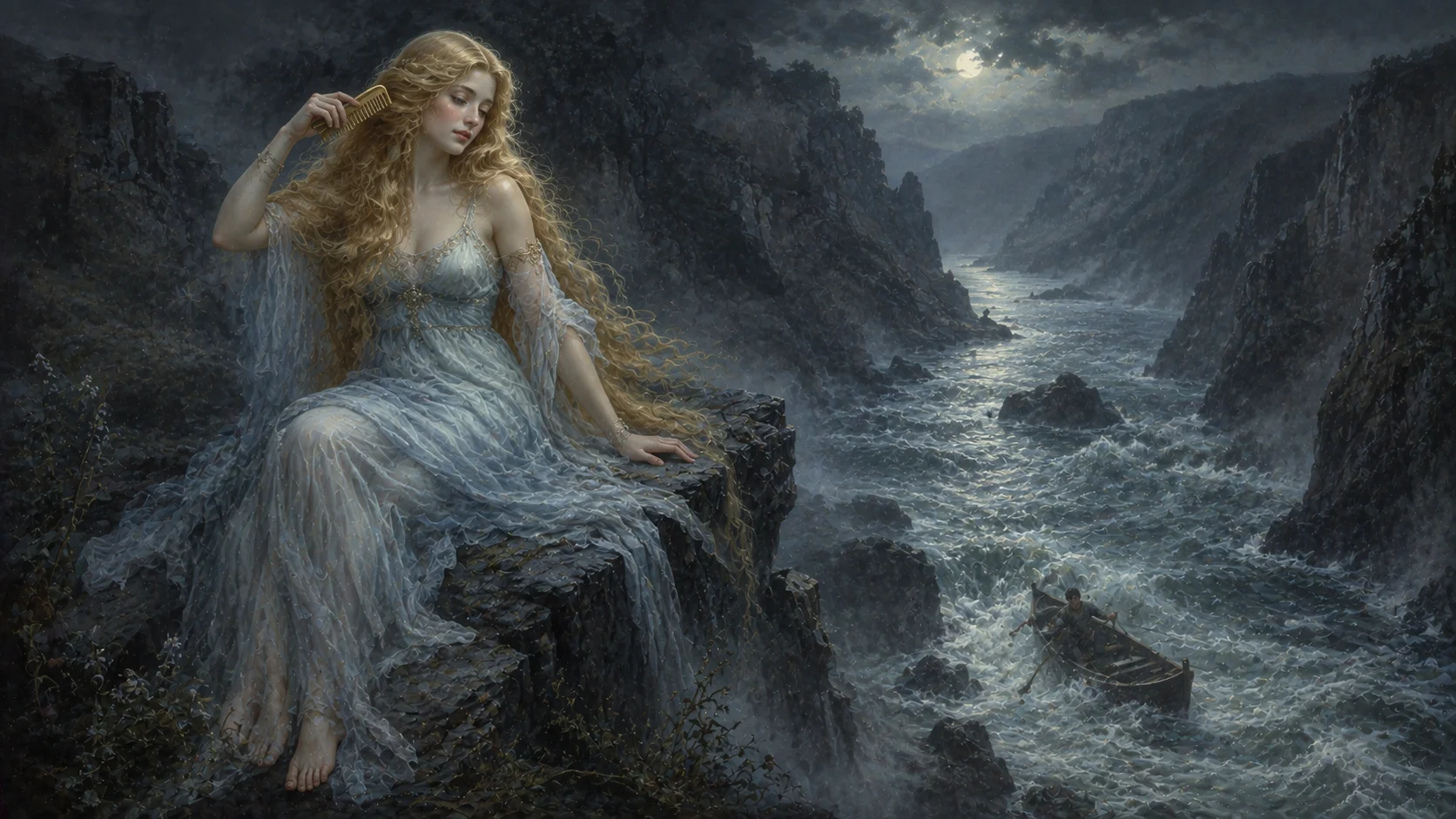
The Lorelei is the golden-haired maiden of the Rhine whose voice, in the most famous telling, undoes a boatman without her ever meaning him harm at all — she is combing her hair and singing to herself, and it is enough. She belongs to German Romanticism rather than to the deep well of inherited folk memory that gives us figures like Frau Holle or Krampus, and that distinction matters more here than almost anywhere else in this collection: the Lorelei is not a survival of something older, forgotten, and half-remembered. She is a literary invention with a birth certificate, a named author, and a river cliff that was waiting for her long before she arrived.
A Rock Before It Had a Name
Long before anyone sang of a maiden on the cliffs above St. Goarshausen, the Rhine itself had already marked the spot. The river narrows sharply there, the current quickens, and the rock face throws back a distinctive echo across the water — a natural acoustic curiosity that boatmen navigating the treacherous passage would have known intimately, and feared, for entirely physical reasons. The place-name Lorelei, or Loreley, is older than any legend attached to it, and its likely derivation is purely descriptive: a local dialect element related to "lureln," meaning to murmur or whisper, describing the sound of the rapids and their echo, combined with "ley" or "lei," a common Rhineland term for rock or cliff found in other place names along the river. The site earned its name from what it sounded like and what it did to boats, not from any tale of a woman who lived there. That the legend now feels inseparable from the rock is a testament to how thoroughly literature can graft itself onto geography — but the geography came first.
Brentano's Lore Lay
The figure herself begins in ink, in 1801, in Clemens Brentano's novel and ballad "Godwi." There, under the name Lore Lay, she is introduced as a woman of such devastating beauty that men accuse her of bewitching them to their deaths — not through song in this earliest version, but simply through the fact of her presence and her power over those who look at her. Brought before a bishop to answer for the ruin she has supposedly caused, she is sentenced not to execution but to a convent, a mercy that assumes she is more tragic than wicked. On the journey there, escorted toward a life of quiet penance, she asks to climb the rock overlooking the Rhine one last time. She believes she sees her faithless lover passing below on a boat. She falls, or leaps — Brentano leaves the exact nature of the act poised between accident and choice — and dies at the foot of the cliff that will bear her name into the following two centuries.
This original episode, with its bishop, its convent sentence, and its specific narrative of heartbreak and fall, is frequently stripped away entirely in the versions that made Lorelei famous. Most people who know the name today have never heard of the bishop or the convent at all.
The Song Replaces the Story
What survived and grew was not Brentano's courtroom and convent but a simpler, starker image: a woman on a rock, singing, and a man who dies for having listened. Brentano's own later work helped push the legend in this direction, but it was Heinrich Heine's 1824 poem "Die Lorelei" that fixed the figure in the form the world now recognizes. Heine's poem is compact and does not narrate a full episode the way Brentano's novel did — there is no bishop, no trial, no named sailor. Instead the poem is framed as a memory, an old sad story the poet cannot get out of his mind: "Ich weiß nicht, was soll es bedeuten, dass ich so traurig bin" — I do not know what it means, that I am so sad. From there it moves to the maiden herself, seated above the Rhine at evening, her golden hair caught in the light as she combs it and sings, and to the boatman below who is seized by a wild longing at the sight of her, so consumed by looking that he stops watching the water — and the rocks take him.
An Old Tale That Was Not Old
Heine's poem calls the story "ein Märchen aus alten Zeiten" — a fairy tale from ancient times — and that single phrase has done more to obscure the Lorelei's real history than anything else written about her. In 1824, when Heine composed those lines, the legend he was describing as ancient was barely twenty years old, dating only to Brentano's "Godwi" of 1801. There is no medieval chronicle, no early-modern ballad, no attested regional custom naming a Lorelei figure before Brentano's text. This is precisely what separates her from something like Frau Holle, whose roots reach into genuinely old and independently attested folk practice. Heine's framing device was itself a piece of Romantic artifice, a way of lending instant weight and inevitability to a very recent invention — and it worked so well that "ancient Rhine legend" remains the label most commonly attached to her today, even though it is not historically accurate. The record on this is settled among literary historians: treat any claim of pre-1800s origin for the Lorelei herself as a misunderstanding worth correcting, however charming the misunderstanding is.
Silcher's Melody
Heine's words became inseparable from music in 1837, when the composer Friedrich Silcher set "Die Lorelei" to a tune simple enough to be sung by heart, memorable enough to spread far beyond literary circles. The song, often known by its opening line, moved out of the poem's page and into taverns, schoolrooms, and gatherings across the German-speaking world, and it is largely through Silcher's melody that the Lorelei acquired her quasi-folkloric status — the sense, still widespread, that she must always have belonged to oral tradition. In truth the folk song was manufactured from a dated literary poem within living memory of its composition, then sung so widely and so long that it came to feel timeless. Few pieces of European culture illustrate so cleanly how quickly a deliberate artistic creation can be mistaken for something inherited from the depths of the past.
A Song Stripped of Its Author
The Lorelei's later history carries its own dark irony. Heinrich Heine was Jewish, and during the Nazi era his authorship of "Die Lorelei" became politically inconvenient for a regime eager to claim the song as pure German folk heritage. Rather than banning a piece so deeply embedded in national identity, some period publications simply relabeled it, crediting the words to "Volksweise" — anonymous folk verse — erasing Heine's name while keeping his lines intact. That the song could be laundered this way, its true origin scrubbed out while its emotional hold on the public remained undiminished, says a great deal about how completely the fiction of ancient folk origin had already taken hold. The melody survived; the truth of its authorship was, for a time, made to disappear along with the poet's name.
Kin to the Sirens, Not Descended from Them
Thematically, the Lorelei sits comfortably alongside the Greek Sirens — beauty and song weaponized, however unintentionally, against those who hear it — and alongside the broader Rhine-maiden (Rheintöchter) tradition of water spirits tied to the great river. But these are resemblances of theme and mood, not lines of direct descent. The Lorelei is not a surviving fragment of older water-spirit belief dressed in new clothes; she is a Romantic-era meditation on beauty, longing, and the destruction that unattainable desire can bring, built from scratch on the frame of a real dangerous cliff. Twentieth-century popular culture has sometimes folded her loosely into the company of other Germanic water spirits, including the Nixie tradition, but this is a modern grouping of convenience rather than an inherited genealogy, and it should not be mistaken for one.
Not Wagner's Rhine-Daughters
A confusion worth untangling directly: the Lorelei is not the same figure as the Rhine-maidens who open and close Richard Wagner's "Ring des Nibelungen," the monumental cycle that received its full premiere in 1876. Wagner's Rheintöchter — the water-nymphs who guard the cursed gold at the cycle's beginning and reclaim it at its end — descend from an entirely separate literary lineage rooted in the Nibelungenlied and related Norse-adjacent saga material, not from Brentano's or Heine's Rhine legend. Popular culture frequently lumps the two together under the loose banner of "Rhine sirens," and the surface similarity — women, water, the same river — makes the conflation an easy one to fall into. But they come from different centuries of source material, different literary traditions, and different symbolic purposes, and the two should always be kept distinct rather than presented as variations on a single myth.
A Solitary Figure
Unlike many of the entities gathered in this collection, the Lorelei exists almost entirely alone within her own story. The primary literary sources record no interactions between her and other named Germanic figures — no meetings with the Erlking, no crossing paths with Frau Holle's winter household, no place within Krampus's midwinter reckonings. She belongs to a self-contained Rhine legend, a single tragic image repeated and refined by successive poets rather than a character woven into a larger mythological fabric. This isolation is itself a clue to her literary rather than folkloric nature: inherited mythologies tend to be relational, full of family lines and rivalries and shared cosmologies, while a figure invented within one or two generations of writers tends to stay exactly where her authors left her.
The Cliff Endures
The Lorelei rock remains, to this day, one of the most visited sites along the Rhine, sitting within the Upper Middle Rhine Valley, a stretch of river landscape inscribed as a UNESCO World Heritage site in 2002. Visitors who climb it or pass beneath it by boat are, in a real sense, visiting two things at once: a genuinely hazardous stretch of river navigation with a genuinely striking natural echo, and a piece of early nineteenth-century Romantic literature so successful that it reshaped how millions of people experience that same stretch of water. The persistence of the legend — its survival through political upheaval, its transformation into folk song, its continued pull on visitors two centuries after Brentano first imagined a woman falling from that cliff — is itself a remarkable case study in how quickly literature can become landscape, and how a place can absorb a story until the two feel indistinguishable.
Handling the Legend Honestly
To tell the Lorelei's story with care is to hold two truths at once without letting either erase the other. The emotional power of the tale is genuine: the image of a beautiful, sorrowful woman singing above a river that will claim a man who cannot look away has earned its long life through the sheer craft of Brentano and Heine, and through Silcher's melody carrying it into ordinary voices for generations. But the historical record is equally clear, and equally worth respecting — this is not an ancient inheritance surfacing from the German past, but a documented literary creation of the early 1800s, built on a real and older place-name and a real and dangerous river bend. Calling her invented does not make her small. It simply means her power belongs to the poets who shaped her, and to the readers and singers who kept choosing, across two centuries, to believe the old tale that never actually was old at all.
Sources & traditions
- EncyclopediaWikipedia — Lorelei
- TraditionGermanic texts, inscriptions and later retellings (Germany)
Myths change from area to area and from time to time. This chronicle follows the most widely told versions; tellings in other villages, regions and eras may differ.