Krampus is the horned, half-goat, half-demon companion of Saint Nicholas (Sankt Nikolaus) in the folk custom of the Alpine German-speaking lands — Austria, Bavaria, South Tyrol, Slovenia, and the border regions toward Hungary. Where Nicholas rewards, Krampus punishes: on Krampusnacht, the eve of Saint Nicholas Day, he descends from the dark to answer for every child's bad behavior the mild bishop-saint would rather forgive.
A Name Carved From a Claw
The name Krampus is generally traced to the German and Bavarian dialect word Krampen, meaning claw — a fitting root for a figure defined by hooked, grasping hands and hooves that leave no doubt about what waits at the end of the lane after dark. Linguists do not agree on every step of that derivation, and the exact etymological chain remains debated, but the image the word points toward has never been in question: something clawed, something that catches. The name itself surfaces in print — dictionaries and regional glossaries — no later than the seventeenth or eighteenth century, which tells us the word was already settled and ordinary enough to need defining, not that the figure was new. A folk custom rarely enters a dictionary the year it is born; it enters once it has already become common knowledge.
The Question of What Came Before
Popular retellings like to push Krampus backward into a pre-Christian past, framing him as a wild-man or folk-demon survival from Alpine paganism that Christianity later paired with its own winter saint. That claim deserves to be handled carefully rather than repeated as settled fact. There is no direct pre-Christian textual attestation of a Krampus-like figure — no inscription, no chronicle entry, no unbroken line of documents connecting a Roman-era or early Germanic spirit to the goat-horned punisher of the Krampuskarten. Scholars who favor an older origin are working from comparative folklore and reconstructed custom, not from a paper trail. It is an honest and reasonable hypothesis. It is not proof, and a chronicle owes its reader that distinction rather than a tidier story.
A Church Uneasy With Its Own Custom
A twelfth-century Church prohibition on "pagan" winter masking customs is frequently cited in popular sources as evidence that Krampus himself is medieval and pre-Christian. The prohibition is real; its connection to Krampus specifically is not well documented, and the two should not be collapsed into one fact. What is far better attested is the discomfort the institutional Church felt toward the custom much later: during the Austrian corporate-state period of the 1930s in particular, and at earlier moments as well, ecclesiastical and state authorities moved to suppress Krampus processions as anti-Christian, even demonic in character — an irony worth sitting with, given that Krampus's entire traditional role was to serve a saint, not to oppose him. That the custom survived those suppressions, generation after generation, in the same villages that tried to legislate it away, says more about its hold on Alpine life than any single medieval document could.
Chains, Bells, and the Sound Before the Sight
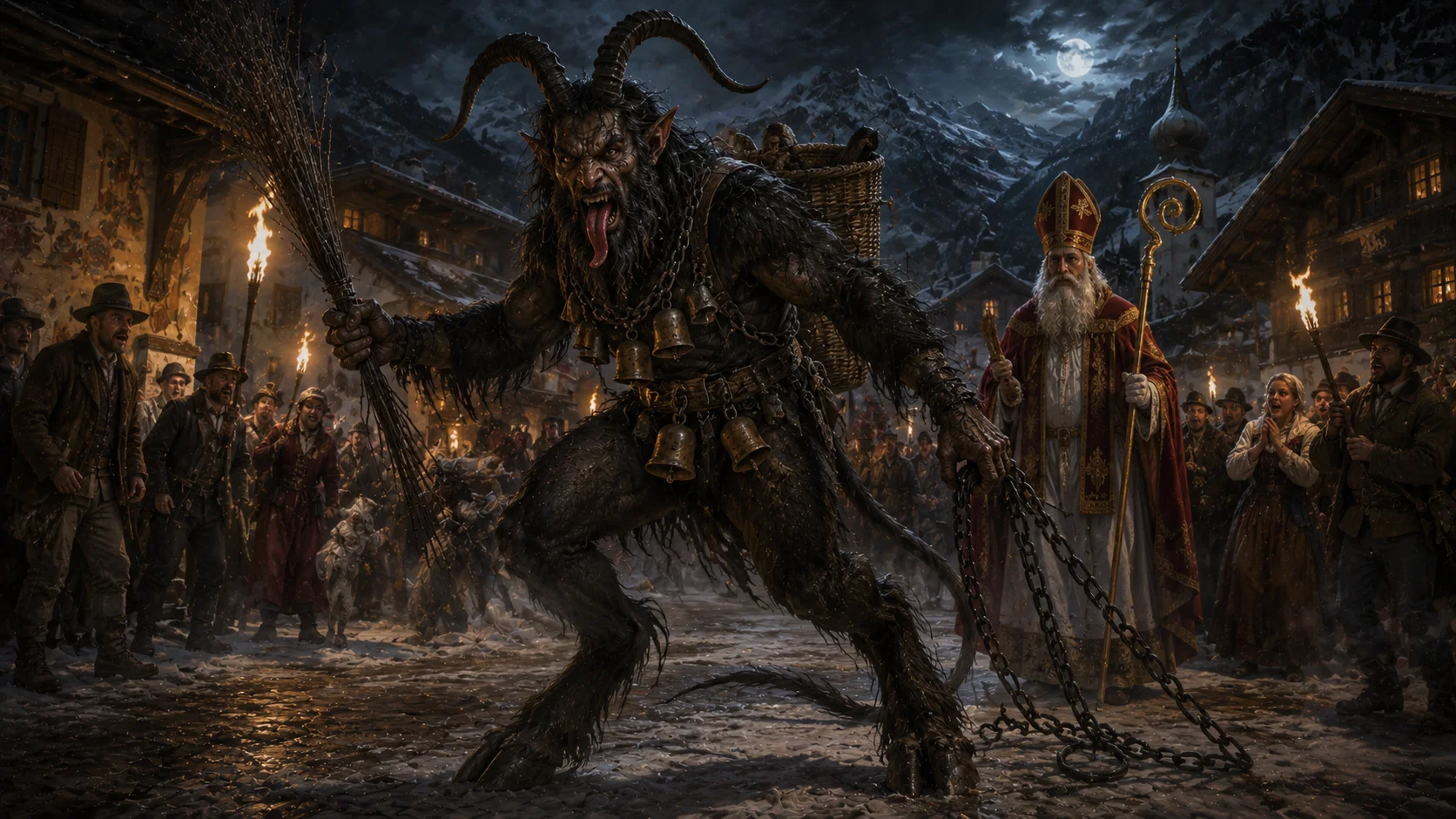
Krampus announces himself before he is seen. Heavy chains and cattle bells hang from his frame and rattle with every stride, so that a household hears him coming up the lane before a single shape appears at the window — a deliberate, theatrical dread built into the custom itself. Beneath the noise is a body assembled from unmistakable parts: cloven hooves, curved horns, a long pointed tongue lolling from a dark, snouted face, and a coat of shaggy, matted fur that swallows the lamplight. He carries two implements that define his purpose. The Rute, a bundle of birch switches, is for swatting the merely naughty — a sharp, stinging correction rather than true harm. The Butte, a washtub or basket slung across his back, is for something worse: hauling away the truly incorrigible child, a threat vivid enough that generations of Alpine parents needed to say very little else to secure good behavior in early December.
The Visit That Comes in Pairs
Krampus does not travel alone, and he is not really the point of the visit — he is the consequence. In the paired Nikolaus-und-Krampus custom, the two figures arrive at a household together on the same night: Nicholas first, gentle and questioning, asking a child to account for the year's behavior, consulting his book, offering the chance to recite a prayer or a poem in exchange for something sweet. Krampus stands behind him, chains stilled but never silent for long, the entire time. Only when a child's account falls short does his role activate — the switches, the growl, the mock lunge toward the Butte. The structure is the message: reward and punishment delivered by two figures in one visit, so that a child understands both halves of the bargain at once, from the same night, at the same door.
The Postcard That Fixed His Face
Much of what the modern world recognizes as Krampus — the specific tilt of the horns, the particular leer, the red-tongued grin — was not carved by folk tradition alone but printed by it. From the 1890s through the 1930s, Austria-Hungary produced enormous numbers of Krampuskarten, illustrated greeting cards traded through the same channels as any other holiday postcard. They are often comic, often risqué by the standards of their day — Krampus chasing fleeing women, menacing children with exaggerated relish, sometimes standing companionably beside a dignified Nicholas in the same frame, sometimes eclipsing him entirely as the more entertaining figure to draw. These cards were mass-produced, mass-mailed, and mass-collected, and in doing so they did something oral custom alone could not: they standardized his image across a wide, printed record, well before photography or film ever touched him. Anyone who wants to know what Krampus looked like to an ordinary Austrian household in 1905 can still hold the card.
The Run Through the Streets
The Krampuslauf — the Krampus run — is where the custom stops being a private household visit and becomes a public, communal event. Costumed and masked Krampus figures move as a group through town streets and into taverns, in a boisterous, often alcohol-fueled performance meant to unsettle as much as entertain. It is loud, physical, and occasionally genuinely frightening even to adults who know perfectly well that a neighbor is inside the mask. This is not folklore preserved behind glass; it is a living custom, continuously documented and continuously performed, renewed every winter by the same towns that have run it for generations. The Krampuslauf is arguably the clearest evidence that Krampus was never simply a bedtime cautionary tale — he is, and has long been, a reason for a whole community to gather in the cold and make noise together.
A Cousin Often Mistaken for a Twin
Krampus is frequently blurred together with the Perchtenlauf, the procession associated with Frau Perchta, but folklorists treat the two as separate in origin and calendar. Krampus belongs to 5 December, tied specifically to the eve of Saint Nicholas Day. The Perchtenlauf belongs to Epiphany, 6 January, and to Perchta rather than to any companion of Nicholas. The two masking traditions have blended regionally in modern practice, and popular usage today often uses the terms almost interchangeably — but that convenience obscures two genuinely distinct customs with different patron figures, different calendar positions, and different symbolic logic. The same caution applies to Frau Holle, another female winter figure tied to the Rauhnächte, the Twelve Nights stretching from Christmas to Epiphany. Krampus is male, his night is fixed and singular, and his role is punitive rather than seasonal or transitional — a common point of confusion in accounts that flatten every Alpine winter-demon custom into one interchangeable shape.
Not the Only Dark Companion
Krampus is the best known of a family of punitive companion-figures who appear across German-speaking Central Europe alongside Saint Nicholas, but he is not their only name. Belsnickel and Knecht Ruprecht occupy comparable roles in other regions — a stern or shaggy figure who tempers Nicholas's generosity with the threat of consequence — yet folklorists are careful to treat them as distinct named figures in their own regional traditions, not as mere aliases for Krampus wearing a different name. The pattern that repeats across these figures is structural rather than personal: Central European Nicholas customs tend to pair a rewarding saint with a disciplining shadow, and different valleys and regions filled that shadow role with their own local figure. Krampus is simply the version that became, by far, the most visually and commercially dominant.
Out of the Alps and Into the World
For most of his documented history, Krampus belonged almost entirely to the Alpine core — a regional custom known well beyond its borders mostly to folklorists and to Central European emigrant communities. That changed rapidly from the early 2010s onward, when tourism, international media coverage, and the internet's appetite for striking imagery carried the Krampuslauf and the Krampus figure into wider Western popular culture, including a notable foothold in the United States. This is worth stating plainly rather than letting it blur into the older story: the global popularization of Krampus is a recent, twenty-first-century phenomenon, layered on top of a folk custom with centuries of regional depth behind it. The horns are old. The worldwide fame is new.
The Shape of the Threat
Strip away the postcards, the parades, and the tourist coverage, and Krampus's symbolic function is simple and old: he is the disciplinary half of a paired reward-and-punishment structure built into midwinter visitation customs across the region. A culture that wants its children to behave well in the dark, cold weeks before Christmas built two figures to make the point — one who remembers good deeds, and one who remembers the rest. Krampus carries the weight of the second half, and he carries it in a body designed to be unforgettable: the claw in his name, the chains in his approach, the switches in his hand, and the basket on his back for the child who pushes his patience too far. Whatever his ultimate origin, disputed or otherwise, the custom he anchors has proven durable enough to survive Church suppression, outlive its own postcards, and walk, quite literally, into a new century of parades still rattling with the same bells.
Sources & traditions
- EncyclopediaWikipedia — Krampus
- TraditionGermanic texts, inscriptions and later retellings (Alpine Europe)
Myths change from area to area and from time to time. This chronicle follows the most widely told versions; tellings in other villages, regions and eras may differ.