Frau Perchta is the Alpine midwinter spirit of Austria, Bavaria, and Switzerland, a guardian of household order who walks the threshold between the old year and the new wearing two entirely different faces. She is remembered as the shining lady in white who rewards the diligent, and in the same breath as the iron-nosed hag who punishes the idle. No single image of her is complete without its opposite, and that duality — rather than any one appearance — is the truest thing that can be said about her.
A Lady of Two Faces
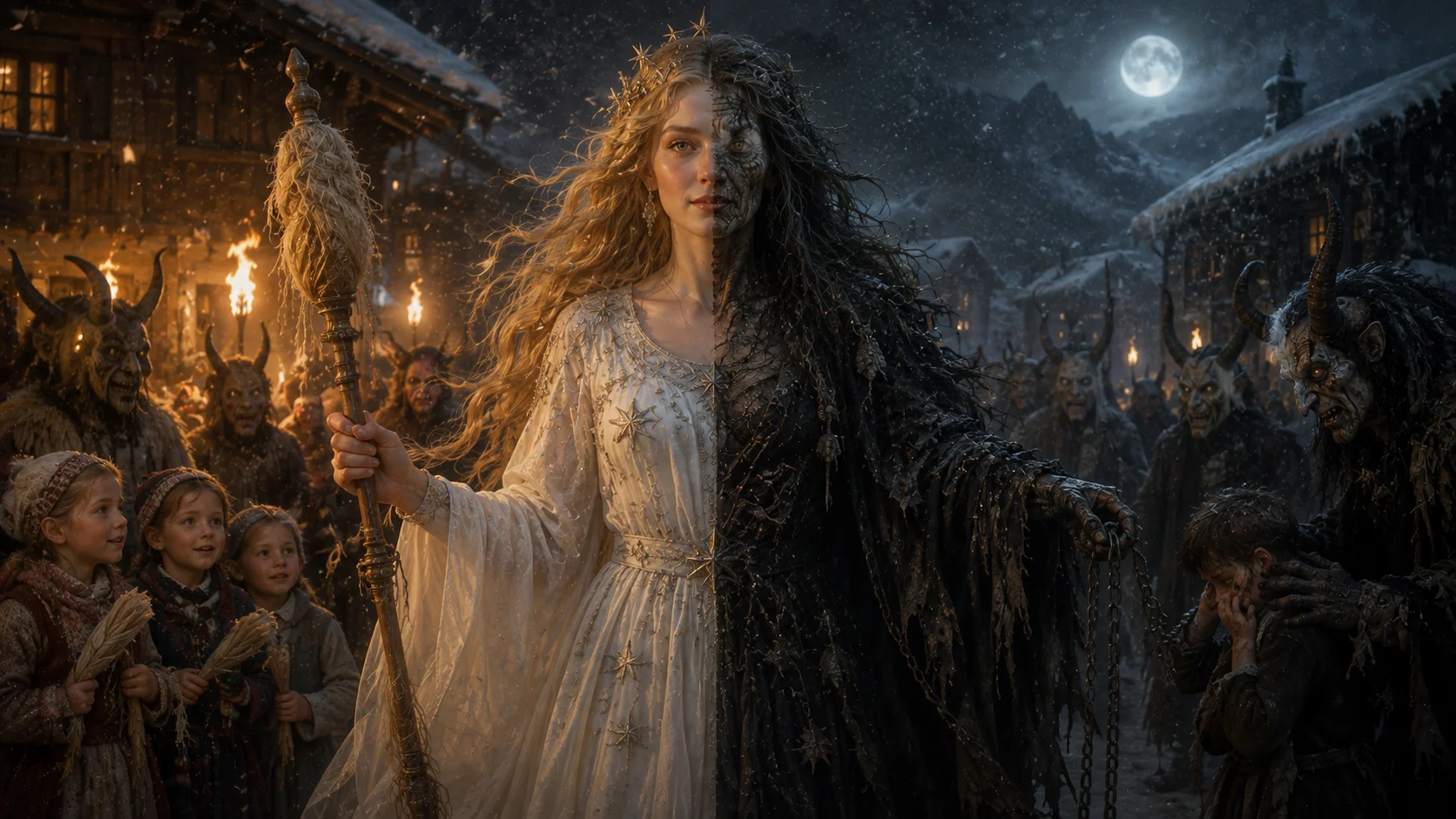
Alpine lore consistently describes Frau Perchta in two contrasting forms. The first is schön Perchta, the beautiful Perchta: radiant, white-robed, gracious toward the households that have kept the year's work in order. The second is schiech Perchta, the ugly or terrible Perchta: ragged, monstrous in form, marked by a distinctive iron nose, who visits the same houses when the opposite has been true. Regional storytellers did not treat this as two separate beings but as one figure whose appearance answers directly to what she finds when she crosses a threshold. She is judgment made visible — the household sees, quite literally, the face it has earned.
The Feast of Shining Night
Frau Perchta's season is fixed to a precise and narrow window: the Rauhnächte, the Twelve Nights running from Christmas to Epiphany, and above all the eve of 6 January, sometimes called Perchtennacht — Perchta's Night. This is the moment folklorists and philologists tie most closely to her name, which many scholars connect to the German word for the Epiphany feast itself, and to an older root meaning "shining" or "bright." Other linguists argue instead for a link to a hypothesized term meaning "the hidden" or "the covered one," and the true etymology remains genuinely unsettled. What is not disputed is the date: her power belongs to this liminal stretch of the calendar, when the old year has ended but the new one has not yet properly begun, and the ordinary rules of the world are understood to be thin.
The Belly-Slitter's Justice
The most feared strand of Perchta lore is a punishment distinct to her among the Alpine winter spirits. Households were expected to keep the customary Epiphany-eve meal — traditionally fish and gruel — and to have finished the season's spinning before the Twelve Nights closed. Those who had shirked either obligation risked a fate recorded by Jacob Grimm and later Austrian folklorists alike: Frau Perchta would slit open the stomach of the negligent, draw out whatever food they had eaten instead of the proper meal, and refill the cavity with straw and stones. It is a gruesome motif, sharper and more violent than the tar-and-feathers punishments attributed to her northern counterpart Frau Holle, and it marks Perchta as the harsher enforcer of the two related traditions. The image was never meant as literal instruction so much as a vivid, unforgettable warning against laziness and neglect of the household's obligations at the year's most consequential hour.
Mistress of the Spinning Room
Spinning discipline sits at the very center of what Frau Perchta oversees. The distaff and spindle were, for centuries, the daily labor of Alpine women through the dark winter months, and the expectation was that the year's wool be finished before the Rauhnächte arrived. A spinning room left mid-task, or flax still unspun when Perchta made her rounds, was read as a household out of order — exactly the condition her ugly aspect existed to punish. In this sense she functions less as a distant deity and more as an internalized standard: a figure households measured their own diligence against, with real consequences attached to the measuring.
Kinship with Frau Holle
Nineteenth-century folklorists, Grimm foremost among them in Deutsche Mythologie (1835), treated Frau Perchta as a close regional counterpart of Frau Holle. Both figures share the role of winter-season disciplinarian and "mistress of the spinning room," both reward diligence and punish idleness, and both are tied to the turning of the year. But the two are not identical, and collapsing them erases a real distinction. Frau Holle belongs more to the Christmas season and to central German lore, with a gentler signature punishment. Frau Perchta belongs specifically to the Alpine and Austro-Bavarian world, is anchored to Epiphany rather than Christmas, and carries the mask-and-procession custom that Holle's tradition simply does not have. They are siblings in a shared folkloric family, not two names for one figure.
The Perchtenlauf Through the Valleys
What separates Frau Perchta most sharply from a purely literary or textual figure is the Perchtenlauf — the Perchten run — a living Alpine custom rather than a story preserved only on the page. In parts of Austria, especially the Salzburg region and the Pongau valleys, masked processions still take to the streets each winter, continuously documented from early record into the present day. UNESCO and Austrian regional heritage bodies have recognized the Perchtenlauf as intangible cultural heritage in specific valleys, including Gastein and Pongau, giving Frau Perchta a line of evidence entirely independent of Grimm's written folklore: a custom that has kept walking, generation after generation, through the same mountain communities.
Schönperchten: The Beautiful Ones
Within the procession, the masked participants divide into two troupes that mirror Frau Perchta's own dual nature. The Schönperchten — the beautiful Perchten — wear elaborate, ornamented masks: gilded, flower-crowned, serene-faced, moving with a measured grace that represents her light aspect. Their appearance in a village is traditionally read as a blessing, an embodiment of the reward she offers to those who have kept the year in good order. Where the ugly troupe brings noise and threat, the Schönperchten bring the opposite — order affirmed rather than order enforced.
Schiachperchten: The Terrible Ones
Opposite them march the Schiachperchten, the ugly or grotesque Perchten: horned, fanged, shaggy masks carved to be as frightening as craft allows, moving with a deliberately unsettling, lurching energy. They embody Frau Perchta's punishing aspect and carry forward the same midwinter function found across the Alpine mask tradition more broadly — driving out the old year's evil spirits with noise, fear, and spectacle so that the new year can begin clean. Watching the two troupes pass through a village together is, in effect, watching Frau Perchta's entire nature performed in the street, light and terrible in the same procession.
The Sign of the Iron Nose
Beyond the general terror of her ugly aspect, Frau Perchta carries a specific, recurring physical marker in regional description: an iron nose, hooked and unmistakable, joined to a ragged appearance and an overall monstrous form. This is not incidental grotesquerie but a recognizable attribute, the kind of detail that let a listener know at once which spirit was being described among the many winter figures of the Alpine imagination. The iron nose in particular recurs across regional tellings closely enough to function as her signature, the single feature by which the schiech Perchta is identified even before her purpose is spoken.
Leader of the Lost Souls
In some regional traditions, Frau Perchta's role widens further during the Rauhnächte: she is said to lead a spectral procession of the souls of unbaptized infants, sometimes called die Perchtenschar, moving through the night alongside her. This motif, attested but variable from valley to valley, connects her to the broader Wild Hunt complex found across Germanic folklore — the image of a ghostly retinue crossing the world during the year's most liminal nights. It is not a universal feature of her lore, but where it appears, it deepens her standing from household disciplinarian to a genuine mistress of the liminal season itself, walking between the living world and the dead.
A Name Debated by Scholars
Even her name resists final settlement. The dominant scholarly reading ties "Perchta" to Perchtentag, the Epiphany feast, and further back to a root meaning "shining" or "bright" — an etymology that fits neatly with her association with the sixth of January and with her radiant, light-aspect form. A minority reading instead proposes a connection to an older term for something hidden or covered, which would point toward the concealment implied by masks and by the secretive nature of the Rauhnächte itself. Linguists have not resolved which reading is correct, and honest accounts of Frau Perchta leave the question open rather than picking a winner.
Between Krampus and Perchta
Modern popular practice has blurred Frau Perchta's custom with another well-known Alpine winter figure, Krampus. Folklorists generally treat them as historically distinct: Krampus is a companion of Saint Nicholas tied to the fifth of December, while the Perchtenlauf belongs to the Epiphany season and to Perchta specifically. But in several Austrian regions the mask traditions and even the terminology have partly merged, with "Krampus" and "Perchten" used near-interchangeably in local speech. This convergence is a documented later blending of two originally separate customs, not evidence that they were ever the same tradition to begin with — a distinction worth preserving even as the two continue to intertwine in contemporary practice.
Goddess or Later Invention?
Whether Frau Perchta descends from a genuine pre-Christian Alpine goddess or represents a later folkloric elaboration built up around the Christian feast of Epiphany is a question folklorists continue to dispute. Grimm's nineteenth-century comparative mythology argued for pagan survival, reading her as a fragment of older belief preserved inside Christian-era custom. That framework remains influential, but it is a reconstructive hypothesis rather than a claim resting on pre-Christian primary sources — no contemporary pagan text names her. The honest position is that both possibilities remain live, and that her documented history begins clearly in the folk-custom and early modern record rather than in any surviving ancient testimony.
A Custom That Still Walks
What ultimately distinguishes Frau Perchta from many figures preserved only in old collections of tales is that her custom did not stop. The Perchtenlauf still moves through Alpine villages each winter, carved masks passed down and renewed within families, the Schönperchten and Schiachperchten still processing together as they represent the same two faces she has always worn. She stands at the threshold of the year as both blessing and warning, shining lady and iron-nosed enforcer, a single figure holding together the diligence a community asks of itself and the fear it uses to enforce that asking — and, in the valleys where the run still happens, a tradition that has never fully become the past.
Sources & traditions
- EncyclopediaWikipedia — Perchta
- TraditionGermanic texts, inscriptions and later retellings (Alpine Europe)
Myths change from area to area and from time to time. This chronicle follows the most widely told versions; tellings in other villages, regions and eras may differ.