The Moss People (Moosleute) — known also as Holzleute, Waldleute, or in their most tender diminutive, Holzweibchen — are the small, mossy, half-hidden guardians of the Central German and Alpine forests. They belong to that deep layer of Germanic folk-belief in which the woods are not empty but inhabited, not a resource but a household, and where the trees themselves have kin who notice how they are treated.
Where Bark Ends and Body Begins
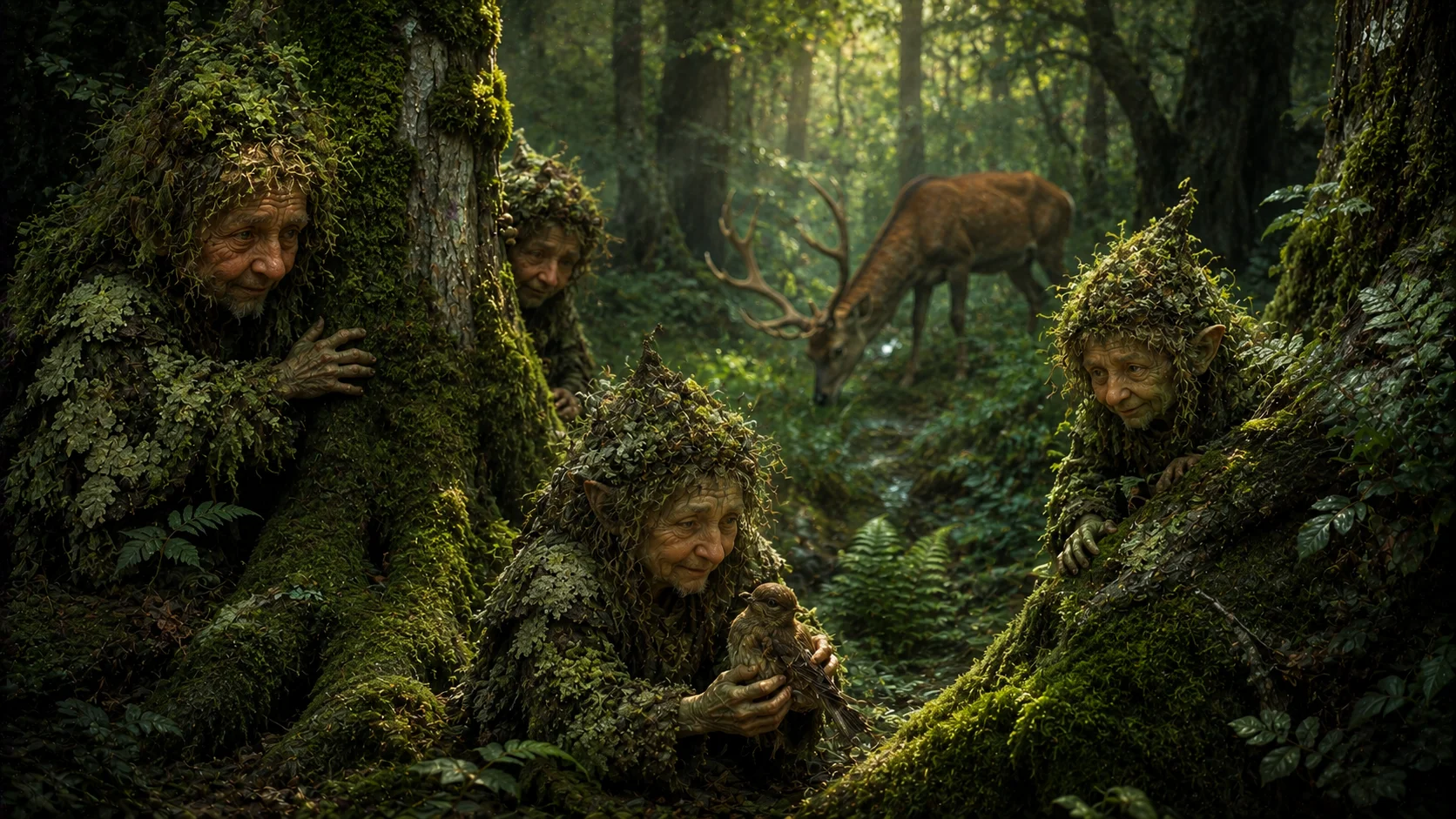
To meet a Moss Person, by every surviving account, is to nearly miss one. They are small — smaller than a child in many tellings — and so thoroughly fused with the textures of the forest floor that a woodcutter might rest against a stump for an hour before realizing the stump had a face. Their skin is described as grey and weathered like old bark; their hair and beards are mossy, lichen-flecked, sometimes said to be furred rather than haired. They are old-looking even when, presumably, they are young — ancient of face the way a gnarled root looks ancient regardless of the tree's actual age. This is not costume. Folk memory insists the moss and bark are simply what they are made of, the way a fish is made of scale and river-water.
They were not thought to live alone. Unlike the solitary witch or the lone hermit of other tales, Moss People appear in families, in small bands, in something like village life scaled down to the size of a mushroom cap — which, tellingly, is exactly where the smallest of them were said to shelter. A cluster of toadstools was not just fungus to a Thuringian forester's eye; it might be roofing.
Bechstein's Forest and the Written Memory
Much of what has come down to us travels through the pen of Ludwig Bechstein, the great nineteenth-century collector of Thuringian and Hessian legend. Bechstein did not invent the Moss People — he gathered what villagers already told each other around hearths and woodpiles — but his collections are the reason the tradition survived into print at all, fixing dialect names and regional variants (Holzweibchen here, Waldweibchen there, Buschweibchen elsewhere) that might otherwise have drifted into silence with the generation that spoke them. Reading Bechstein today is the closest most of us can come to standing in a nineteenth-century Hessian kitchen and hearing the stories first-hand.
The Courtesy the Forest Demanded
What makes the Moss People more than a charming curiosity is how thoroughly their presence shaped actual behavior. Woodcutters in these regions were expected to observe real courtesies before swinging an axe: leave the last tree standing in any stand you fell, never cut during the forbidden hours — midday chief among them — when the forest was said to belong more fully to its small residents than to human labor. These were not empty superstitions performed for their own sake. They were social contract, sworn to spirits who were understood to be watching, and who were understood to remember.
A woodcutter who broke these rules risked more than bad luck in the abstract. He risked offense — personal, specific offense — to neighbors he could not always see but who could, apparently, always see him.
The Borrowing and the Debt Repaid
The best-loved and most recurring tale type is the borrowing story. A Moss Woman — often described as harried, urgent, sometimes fleeing some trouble of her own — approaches a human with a request for help: flour to borrow, a tool to use, sometimes simply the loan of an oven or a moment's shelter. What she asks is always small. What she gives in return is calibrated with exacting moral precision to how she was treated.
Kindness and patience are rewarded lavishly and strangely: wood shavings swept from a workshop floor, worthless in every practical sense, turn to gold in the pocket of the man who helped her without complaint. Rudeness, suspicion, or refusal bring the opposite — ill luck, spoiled work, a debt collected in some quieter and crueler currency. The tale functions almost like a folk ethics exam disguised as an encounter with the uncanny: it tests not cleverness, not wealth, not strength, but plain decency toward a stranger who has nothing visible to offer in return.
The Flight and What Was Left Behind
A darker but related tale type has the Moss Woman not asking for help but running from harm — fleeing a hunter, sometimes fleeing dogs, sometimes fleeing a threat left unnamed in the telling. In her flight she drops something: a glove, a single shoe, some small article of her mossy dress. Whoever finds the dropped object inherits good fortune from it, as though luck itself clung to the fabric the way moss clings to bark. These flight tales carry a different emotional register than the borrowing tales — less a test of character, more a glimpse of vulnerability in a being usually cast as guardian rather than quarry. Even the small gods of the wood, it seems, sometimes need to run.
Neither Malice Nor Mercy Alone
It would be a mistake to read the Moss People as simply benevolent, and an equal mistake to read them as simply dangerous. The honest picture sitting underneath the tales is ambivalence — the same ambivalence a forest itself offers, generous in its shelter and unforgiving in its edges. They protected the woods from excess. A hillside stripped bare, a stand felled without the customary mercy of the last tree left standing, invited their displeasure in a way that gentler harvesting did not. They were not moralists in the abstract; they were guardians with a specific, practical grievance, and the grievance was always proportional to the harm.
Kin to the Wild Folk, Yet Apart
Central European legend crowds its forests with more than one kind of half-human resident, and the Moss People share territory — sometimes uneasily — with the larger tradition of the Wilde Leute, the Wild Folk. Where the Wild Folk are typically imagined as large, powerfully built, more fully humanlike in silhouette even when covered in hair, the Moss People are their opposite in scale and substance: small, plant-fused, closer to the undergrowth than to the human form the Wild Folk still roughly hold. The two traditions likely cross-pollinated in the telling — village storytellers were not folklorists sorting specimens into categories — but the distinction that survived in memory is real and worth honoring rather than blurring: bigness and hair on one side of the forest, smallness and moss on the other.
What Iron and Noise Were Said to Banish
Like a great deal of the broader Germanic fae-repelling tradition, the Moss People were said to recoil from iron and from loud, sudden noise — the clang of a bell, the report of an axe struck hard against metal, the general commotion of human industry pushed past a certain threshold. This is a thread that runs through countless other beings of the same folkloric fabric, and it places the Moss People firmly within a shared cosmology rather than as an isolated curiosity: whatever else divided the small gods of hearth, field, and forest from one another, cold iron and hard sound were common enemies to nearly all of them.
Whispers of an Older Reverence
Scholars have long wondered, without ever quite proving, whether the Moss People preserve some echo of pre-Christian tree veneration — a folk memory, worn smooth by centuries of retelling, of a time when particular trees or particular groves were understood to hold something sacred in their own right. This link is suggestive rather than documented: no unbroken written thread connects a pagan tree-cult directly to a nineteenth-century Hessian bedtime story. But the shape of the belief — that a tree might have something like a guardian, that harming it carelessly might have consequences beyond the merely practical — sits comfortably beside what little is known of older nature reverence in the region. It would be dishonest to claim proof where none exists; it would be equally dishonest to pretend the resemblance is nothing.
A Forest That Kept Its Own Accounts
Strip away the moss and the folklore trappings, and what remains is something almost administrative: a set of stories that functioned, whether or not anyone framed it this way at the time, as conservation ethics encoded in narrative rather than in law. A community without forestry statutes still needed some mechanism to prevent the woodland it depended on from being stripped bare in a single hard winter. Tales of small beings who rewarded restraint and punished greed did real work — quietly enforcing sustainable harvest, spacing out what was taken, leaving something standing for tomorrow. The Moss People were, in this sense, the forest's own accountants, keeping a ledger that no human institution was yet keeping for it.
Still Standing at the Treeline
The Moss People never asked to be worshipped, feared, or even fully believed in — only respected, in the specific and unglamorous way one respects a neighbor whose goodwill makes daily life easier. Their stories persist not because anyone still leaves the last tree standing out of genuine fear of a mossy old woman under a mushroom cap, but because the shape of the courtesy they demanded — take only what you need, notice what you disturb, treat the small and easily-overlooked with the same regard as the large and obvious — has outlived the belief that first gave it a name. Somewhere in the deep stands of Thuringia and the Alpine foothills, the old stories say, they are watching still.
Sources & traditions
- EncyclopediaWikipedia — Moss people
- TraditionGermanic texts, inscriptions and later retellings (Germany)
Myths change from area to area and from time to time. This chronicle follows the most widely told versions; tellings in other villages, regions and eras may differ.