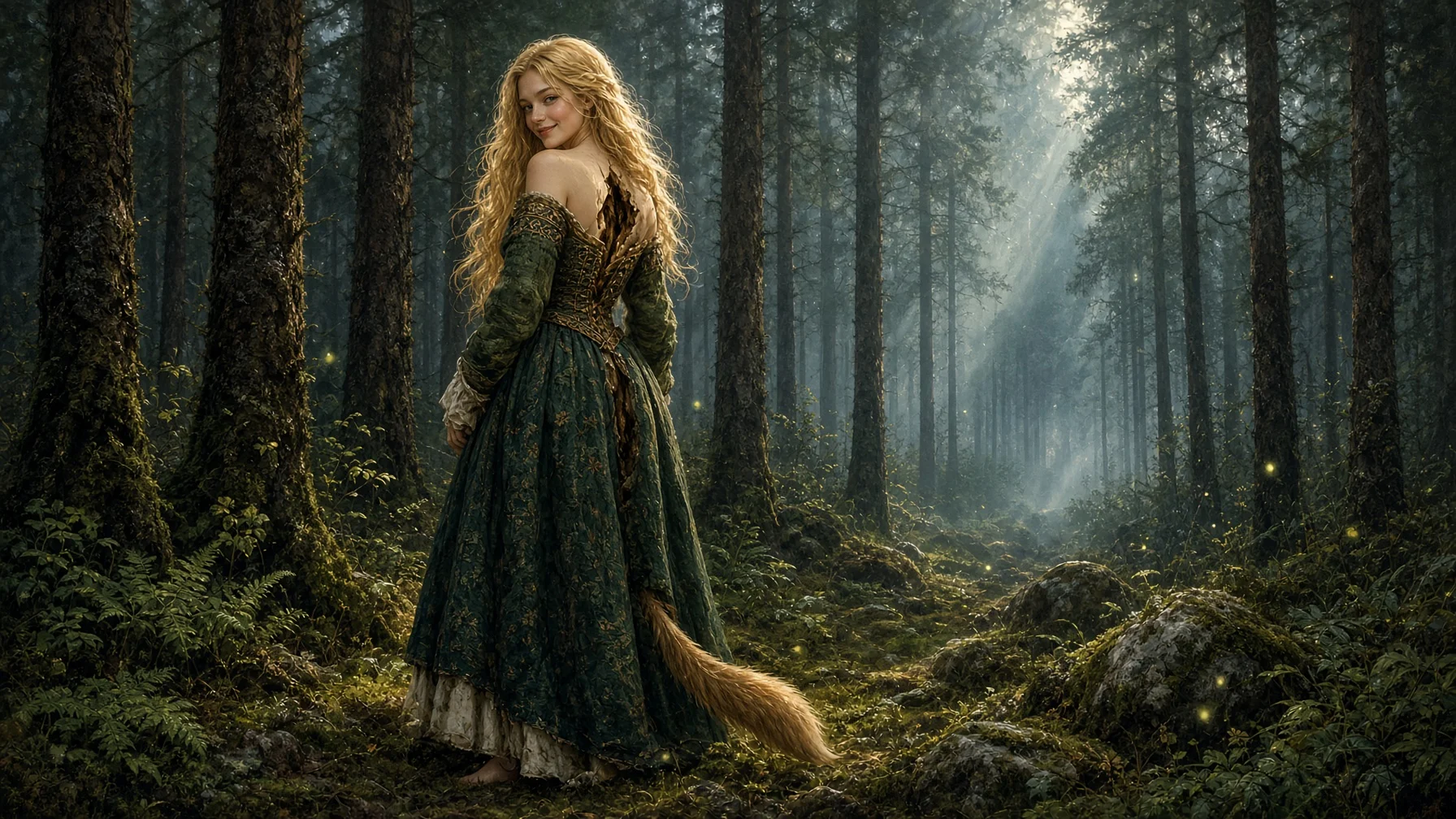
The Huldra is the most haunting and beautiful of the creatures of Scandinavian folklore, a seductive forest-woman of the huldrefolk, the hidden people, who lures men deep into the woods and mountains. From the front she appears as a ravishing young woman, fair and inviting; but turn her about, and the illusion breaks, for she has the long tail of a cow or a fox, and her back, in some tellings, is as hollow and rotten as an old tree-trunk. She is desire and danger entwined, the green wildwood given a woman's face.
What the Root Word Hides
Her name is not decorative; it is a description. Huldra, and the variant hulder, trace to an Old Norse and broader Scandinavian root, hul-, meaning hidden or covered, and that etymology is the key to everything else told about her. She belongs to the huldrefolk, the hidden folk, a category of Scandinavian belief distinct from the álfar, the elves, though the two are sometimes discussed together in comparative folklore studies because both occupy the same conceptual space: beings who exist alongside human settlement but remain, by nature and by name, concealed from it. To call her hidden was not merely to say she was hard to find. It was to place her in a whole system of belief in which the visible, cultivated world of the farm sat beside an unseen, parallel world that mirrored it, and the huldra was that other world's most famous emissary.
Recorded Voices from Rural Norway
The huldra as she is known today reaches modern readers chiefly through the 19th-century labor of collecting oral tradition. Peter Christen Asbjørnsen and Jørgen Moe, compiling Norske Folkeeventyr, set down versions of her story alongside the broader corpus of Norwegian folk narrative, and other folklorist accounts gathered from rural Norway and Sweden added further tellings. These were not inventions of the collectors; they were transcriptions of a belief already old and widespread among farming and herding communities, people whose working lives took them daily to the boundary between the tilled field and the standing forest, and who told these stories to explain what might be waiting on the far side of that boundary.
The Tail She Cannot Quite Hide
Every description of the huldra circles back to the same central image: a woman of extraordinary beauty who carries a flaw she is desperate to conceal. In the classic account she is lovely when seen from the front, but her back is hollow, sometimes described as bark-like, as though she were more tree than woman on the side she does not show. And beneath her skirts hangs a tail, that of a cow or a fox depending on the telling, which she holds still and tucks away, watching always for the moment a stranger's eyes might drift where they should not. The tail is not incidental ornament. It is the one part of her that folklore insists cannot lie, the physical proof, for anyone quick or lucky enough to glimpse it, that the beautiful woman standing at the treeline is not what she first appears to be.
Skogsrå and Tallemaja Across the Border
Scandinavian folklore does not present the huldra as a single fixed figure repeated identically from valley to valley. In Swedish tradition she is often known by other names, skogsrå, meaning forest spirit or guardian, or Tallemaja, and these regional figures share much with the Norwegian hulder without being simply identical to her. Folklore scholarship treats them as related beings rather than the same being under different names, a family resemblance across a shared cultural landscape rather than one myth copied wholesale over a border. The variation itself is part of the tradition, a reminder that hidden-folk belief was living, local knowledge, shaped by whichever community was doing the telling, rather than a single text handed down unchanged.
The Song That Drew Men from the Path
Among the most vivid motifs attached to the huldra is her singing, called the huldreslått, the hulder's tune, a melody said to drift out from the deep forest and catch the ear of any man working alone within earshot. Herdsmen tending animals at the mountain summer pastures and hunters pushing further into the woods than they meant to were the figures most often named in these tales, men whose work already carried them to the forest's edge and sometimes past it. The song, like her beauty, functioned as an invitation, and those who followed it followed her, sometimes toward simple company, sometimes toward far more binding attachment, and always into territory where the ordinary rules of the human world no longer quite held.
When the Tail Falls Away
Not every huldra tale ends in loss. A recurring and cherished motif tells of redemption: if a man who has discovered her secret names it aloud, pointing out the tail she has tried to hide, something in the concealment breaks. More powerfully still, if she is churched, brought into a Christian church and married there under its rite, she may lose the tail altogether and pass fully into the human world as a wife. This motif carries real theological and social weight within the tradition it comes from; it frames marriage and the church as a threshold capable of transforming even a being of the hidden world into one of the visible, ordered community, the bygd, the settled and cultivated land where human law and human faith govern life.
The Curse That Follows a Broken Promise
The tales are equally clear that kindness shown to a huldra, or a promise honored, was repaid, but cruelty or a broken engagement was not forgotten. A huldra wronged, her offer spurned with contempt or an agreement to marry cast aside, was said to curse the family responsible, and that curse was remembered as lasting, sometimes for generations. This consequence structure is central to how the tales function as belief rather than mere entertainment: the huldra was not a passive figure to be won or evaded at no cost, but an agent whose treatment by humans shaped what she, in turn, would do to them, a moral ledger kept across the boundary between the two worlds.
Neighbors in the Hidden Country
The huldra does not stand alone in Scandinavian folk belief; she is one figure within a larger, populated system. The huldrefolk as a whole include not only huldra women but also huldrekall or huldrekarl, the male figures of the same hidden kindred, and folk imagination pictured huldra society as an entire parallel farming community, its own households and its own herds, existing alongside or beneath human settlement, out of sight but not out of relation to it. This hidden community is distinct from other Scandinavian beings that occupy neighboring but separate roles in the same broader belief system: the nisse or tomte, household spirits bound to a farm and its buildings rather than the wild forest, and the draugr, the restless undead, a figure of the grave and the sea rather than the woodland. The huldra's proper place is the forest and the mountain pasture; keeping her distinct from these other beings, rather than blending her habits or her nature with theirs, is essential to representing the tradition honestly.
The Line Between Farmyard and Wilderness
Read as a body of moral instruction, huldra tales serve a clear cautionary function, warning young men in particular of the dangers of temptation and of the wilderness that began where the cultivated land ended. Scandinavian rural life drew a working distinction between the bygd, the human, ordered, domestic world of farm and village, and the utmark, the wild and liminal land beyond it, forest and mountain where the huldrefolk were said to dwell. The huldra, standing always at or just past that boundary, singing from within the treeline, embodied the risk of crossing it carelessly, and the tales that surround her are, among other things, a way of marking that line for anyone who might be tempted to wander past it without due caution.
A Painter's Vision of the Forest's Melancholy Face
The image of the huldra familiar today owes a great deal to the Norwegian Romantic Nationalist painters of the 19th century, who gave the oral tradition its now-standard visual form. Theodor Kittelsen in particular produced influential depictions of the huldra as a young woman, by turns melancholic and alluring, set against the forest landscapes that were her domain, her cow's tail rendered as plainly as her beauty. These paintings did not simply illustrate existing stories; they fixed, for generations of viewers afterward, what the huldra was understood to look like, folding the folk tradition into the wider current of Norwegian national art and its romantic attachment to the northern landscape.
Neither Wholly Good Nor Wholly Ill
Sources on the huldra do not agree on a single fixed moral character for her, and that disagreement is itself worth preserving rather than resolving. Some tellings lean toward danger, others toward a being who is fundamentally benevolent if properly respected, and still others toward simple moral neutrality, a nature-being whose conduct depends entirely on how she is treated by the humans she encounters. Folklorists studying the tradition are careful to note that she is not uniformly cast as evil. The honest account of the huldra holds these variants together as attested differences across tellings and regions, rather than smoothing them into one tidy verdict on her nature.
Names Written into the Land Itself
The huldra's presence in Scandinavian culture was never confined to stories told at the hearth. Across Norway, hills, mountains, and waterfalls carry names that reference the hulder-folk directly, a form of place-lore that embeds belief in the huldra into the physical landscape rather than leaving it as purely literary or oral invention. A traveler moving through such terrain would encounter her not only in a told tale but in the very names given to the ground underfoot, evidence that the belief shaped how communities understood and spoke of the specific places they lived among.
A Figure That Has Not Left the Forest
The huldra remains one of the most prominent and enduring figures in Norwegian national folklore, and her presence has only widened with time rather than fading. She appears across literature, in Norwegian folk music and in the country's black metal scene alike, and in tourism and place names that continue to draw on hidden-folk belief. She has become bound up with Norway's broader cultural self-image, an image inseparable from its forests and mountains, standing as a reminder that in this tradition, the wild landscape was never simply empty ground but a country understood to be inhabited, watched, and, on its own terms, deeply and abidingly alive.
Sources & traditions
- EncyclopediaWikipedia — Hulder
- TraditionScandinavian texts, inscriptions and later retellings
Myths change from area to area and from time to time. This chronicle follows the most widely told versions; tellings in other villages, regions and eras may differ.