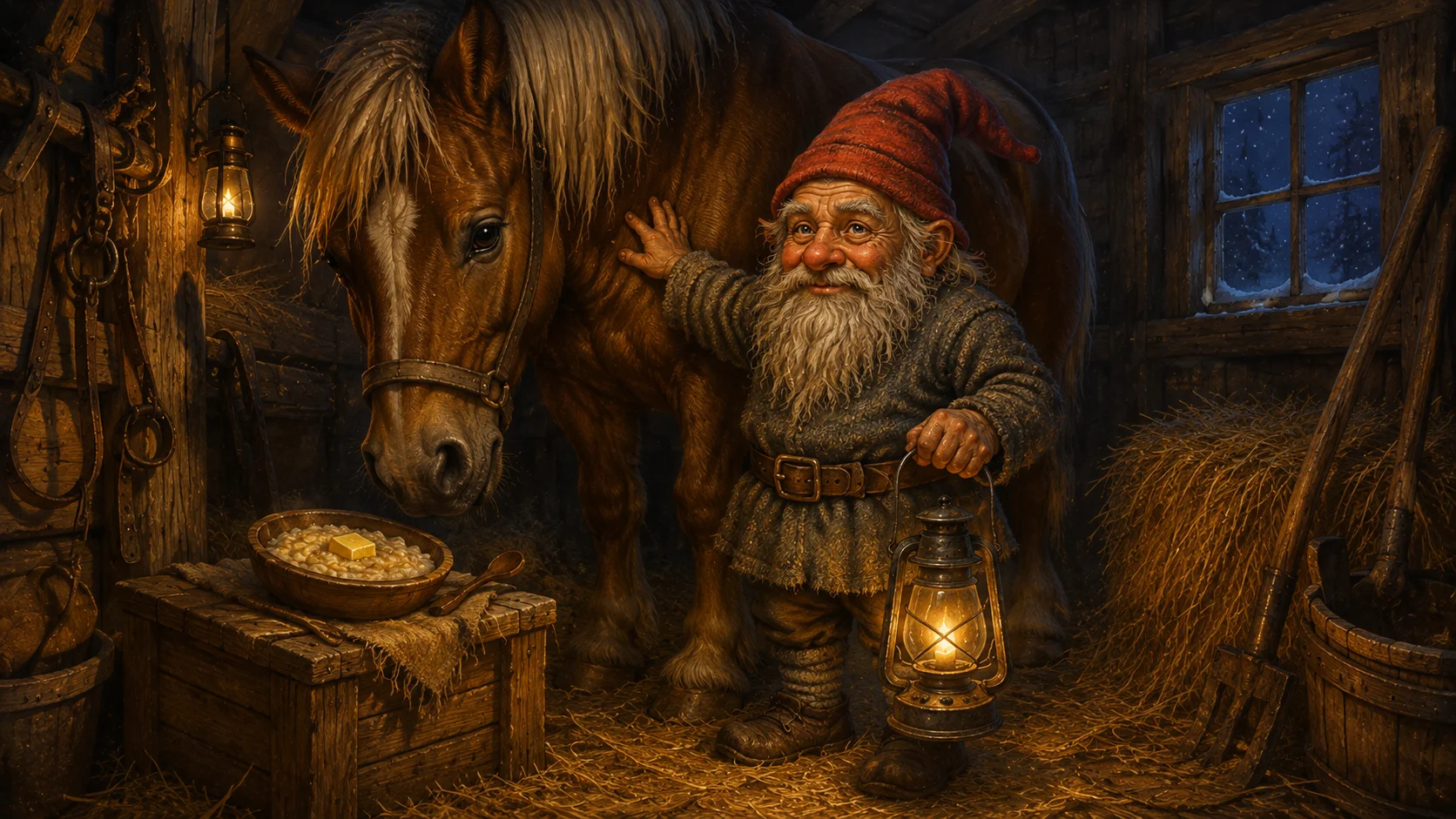
The Nisse is the household and farmyard guardian-spirit of Norwegian and Danish folklore, a small, bearded, grey-clad old man, no taller than a child, who lives in the barn or under the floor of the farmstead and watches over its fortunes. Industrious, proud, and easily offended, the Nisse will labour tirelessly for a household he favours, tending the animals and guarding against misfortune, but cross him, neglect his due, or insult his work, and his mischief can turn the whole farm to ruin. He is the very soul of the old Scandinavian homestead, made flesh.
The Little Old Man of the Farm
The Nisse is imagined as a small elderly figure, grey-bearded, dressed in homespun grey with a pointed red or grey cap, the nisselue, standing little more than a few feet high. In some tellings he is said to have only four fingers on each hand, a small mark of his otherness. His name is generally traced to Nils, a diminutive of Nicholas, a personal name so ordinary that giving it to the farm's unseen tenant was itself a kind of euphemism, a way of naming a being one did not wish to summon by naming too plainly. Folklorists note this link is not perfectly certain, but it is the explanation carried down through the tradition. Appearance varies considerably from valley to valley and telling to telling: sometimes the beard is grey, sometimes white and trailing to the waist; sometimes the cap is grey rather than red. What holds constant across every regional face is the essential shape of him, an old man in miniature, weathered as the farm itself.
Bound to One Roof
Unlike the wandering spirits of forest and fell, the Nisse is not a creature of the wild but of the farmstead specifically, and of one farmstead only. He dwells in the barn, the hayloft, the stable, or beneath the floorboards of the house, and he does not transfer his loyalty easily from one holding to the next. A farm was understood to have its Nisse the way it had its well or its boundary stones, a fixture of the place rather than a visitor to it. This rootedness is part of what makes him feel less like a spirit passing through and more like a member of the household who happens not to be entirely seen. He is not summoned and he does not need to be invited; he is simply there, already old, already resident, by the time anyone now living can remember.
Night Work in the Stable
When a farm was in the Nisse's good favour, his labour showed itself in small, unmistakable ways. Horses left restless and dull-coated the evening before were found in the morning combed, calmed, and groomed as if by a hand no one had seen. Cattle in his care stayed healthy through hard winters; grain stores held steadier than a bad season should have allowed. None of this was thought to happen by chance. The Nisse worked at night, while the household slept, moving through stable and byre unseen, and the visible proof of his favour was simply a farm that, against the odds, kept doing well. To have a contented Nisse was to have, in effect, an extra pair of hands that never asked for wages, only respect.
The Christmas Porridge
The custom most firmly attached to the Nisse is the bowl of julegrøt, Christmas Eve porridge, set out for him with a generous pat of butter melting on top. This was not a token gesture but a serious obligation, understood by every farmhand and mistress of the house: skimp on the butter, forget the bowl, or serve it thin and grudging, and the Nisse would take it as the insult it was. The most widely told story of this custom turns on a misunderstanding rather than deliberate stinginess. A servant, finding the butter had sunk beneath the porridge rather than sitting visibly on top, assumed none had been given at all, and in irritation ate the whole bowl herself. The Nisse, believing himself cheated, very nearly killed her for it, and was only satisfied when the butter was found waiting at the bottom of the empty dish and the mistake became plain. The tale is told less as entertainment than as instruction: intentions do not excuse the appearance of disrespect, and the porridge must always be given properly, in full, without haste.
A Being Easily Wounded
What makes the Nisse distinct from a simple household ghost is the intensity of his pride. He does not merely notice neglect, he takes it personally, and he holds farmhands and masters alike to a standard of ordinary courtesy that costs nothing to give and everything to withhold. Mockery of his work, careless treatment of the animals he tends, or plain rudeness spoken where he might hear it, were all understood to wound him in a way that outlasted the moment. He is not cruel by nature; he is proud, and pride slighted does not forget quickly. This temperament is part of why households took the porridge custom so seriously, not out of superstition alone but out of a working knowledge that this particular spirit's goodwill, once lost, was not easily won back.
When the Bowl Is Forgotten
The consequences of offending the Nisse ranged from the merely irritating to the genuinely feared. In the milder tellings, an offended Nisse tangled the horses' manes into knots overnight, soured the milk before it could be churned, or scattered tools and upset pails out of simple spite. In harsher versions the punishment escalated: livestock sickened, the household's luck turned, and in the most severe accounts the Nisse simply left the farm altogether, taking its prosperity with him. A farm without its Nisse was a farm without its old, quiet protector, exposed in a way that no amount of ordinary diligence could fully make up for. The fear was not of violence so much as of abandonment, of a guardian who had simply decided the household was no longer worth his effort.
A Farm Named Differently in Sweden
Across the border in Sweden, the same figure, or one very nearly identical to him, is known as the Tomte, and in some regional usage as tomtenisse, a name that visibly welds the two together. The Tomte keeps the same habits: he lives on the farm, tends its animals by night, and expects his due of porridge and butter at Christmas, taking offence in much the same way when it is withheld. Whether nisse and tomte represent one and the same figure known under two regional names, or two closely related but genuinely separate local traditions that grew alongside each other, is not settled among folklorists, and the honest position is to hold both possibilities rather than collapse them into a single tidy answer. What can be said is that the household-guardian belief itself was widespread across the old Scandinavian countryside, taking a slightly different local shape wherever it put down roots.
Older Names, Fainter Traces
Nisse and Tomte are the names that survived into wide use, but older Norwegian dialect sources preserve other terms for what appears to be the same or a closely related farm-spirit, among them gårdbo and godbonde. These names are far less attested than nisse or tomte, surfacing mainly in older regional collections rather than in living memory, but they suggest a belief that once had more local variation in its naming than the standardized Nisse of later tradition would imply. A farm's unseen tenant, it seems, went by whatever word the valley around it had settled on, long before any single name won out.
Guardian of the Threshold
Beneath the household detail, the Nisse occupies a particular symbolic position: he stands at the boundary between the ordered, domestic world of the farmstead and the older, wilder uncertainty pressing in around it. His presence, properly honoured, is what keeps that boundary sound, what keeps misfortune, sickness, and ruin on the far side of the fence. This is why his tribute could never be treated as optional or symbolic only. Food and respect were the price of the boundary holding, and a household that paid it carelessly was, in the old logic of the belief, inviting the wilder disorder back in. He is not merely a helpful spirit; he is the thing standing between the farm and what lies beyond it.
An Old Belief Recorded Late
Much of what is known of the Nisse today reaches back only as far as the nineteenth-century folklore collections in which Norwegian and Danish scholars first set the oral tradition down in writing. The belief itself is understood to be older, animistic in character, a farm-guardian faith rooted in a pre-Christian sense that a homestead had its own resident spirit tied to its luck and its land. That older belief did not vanish with Christianization so much as fold itself into the Christian calendar, becoming attached most firmly to Christmas rather than disappearing. The Nisse recorded in the nineteenth century is therefore a belief already carrying centuries of accumulated custom, caught in writing only once it had long since settled into its familiar shape.
A Face Given by the Illustrators
The Nisse most people picture today, the round-cheeked, red-capped little man now inseparable from Scandinavian Christmas, owes much of his visual form to nineteenth-century illustrators, among them Sweden's Jenny Nyström, whose paintings and cards fixed a particular warm, whiskered image of the farm-spirit into popular imagination. Before this visual standardization, the Nisse existed mainly in spoken description, varying farm to farm and teller to teller. The illustrated Nisse, consistent and recognisable, is a comparatively late layer laid over a much older and less uniform belief, and it is worth remembering that the charming card-image and the stern, easily offended guardian of the older oral tales are, in a sense, two different portraits of the same figure separated by a century of retelling.
The Julenisse and the Borrowed Santa
The modern Julenisse, a cheerful, gift-bearing figure who visits on Christmas Eve, is a documented result of the nineteenth and twentieth centuries, when the old farm-guardian's image merged with imported depictions of Santa Claus and Father Christmas arriving from further afield. This is a conflation folklorists can trace with some precision, not a seamless continuation of the older belief but a later grafting of two separate traditions onto one figure and one date. The stern, house-bound guardian who judged a household's courtesy and punished its neglect is not, in his oldest form, a gift-giver at all; that role belongs to the newer, hybrid Julenisse who absorbed him. Both figures now share a name, a cap, and a night of the year, but they did not always share a single origin.
What remains constant beneath the seasonal gift-giver and the older stable-guardian alike is the underlying conviction that gave the Nisse his shape in the first place: that a home is not simply a building but a place with its own quiet tenant, its own luck bound up in how that tenant is treated. Whether he is pictured stern and grey-bearded in the hayloft or smiling and red-capped beneath a Christmas tree, the Nisse still carries forward the old rural instinct that ordinary courtesy, paid faithfully and without grudge, is what keeps a household's fortune intact.
Sources & traditions
- EncyclopediaWikipedia — Nisse (folklore)
- TraditionScandinavian texts, inscriptions and later retellings
Myths change from area to area and from time to time. This chronicle follows the most widely told versions; tellings in other villages, regions and eras may differ.