The Name That Walks Twice
In the old speech of Norway and Denmark, gjenganger means simply "one who walks again," built from gjen-, again, and ganger, a walker. It is the direct northern cousin of the English revenant, a word built from the same idea in a different tongue: the dead returning on their own feet. Unlike many figures of legend, the gjenganger is not one being with one story. It is a category, a shape that the folklore of an entire region gave to a fear everyone shared, that death might not be the end of a person's presence among the living. Any dead man or woman, under the wrong circumstances, could become one.
A Body, Not a Shade
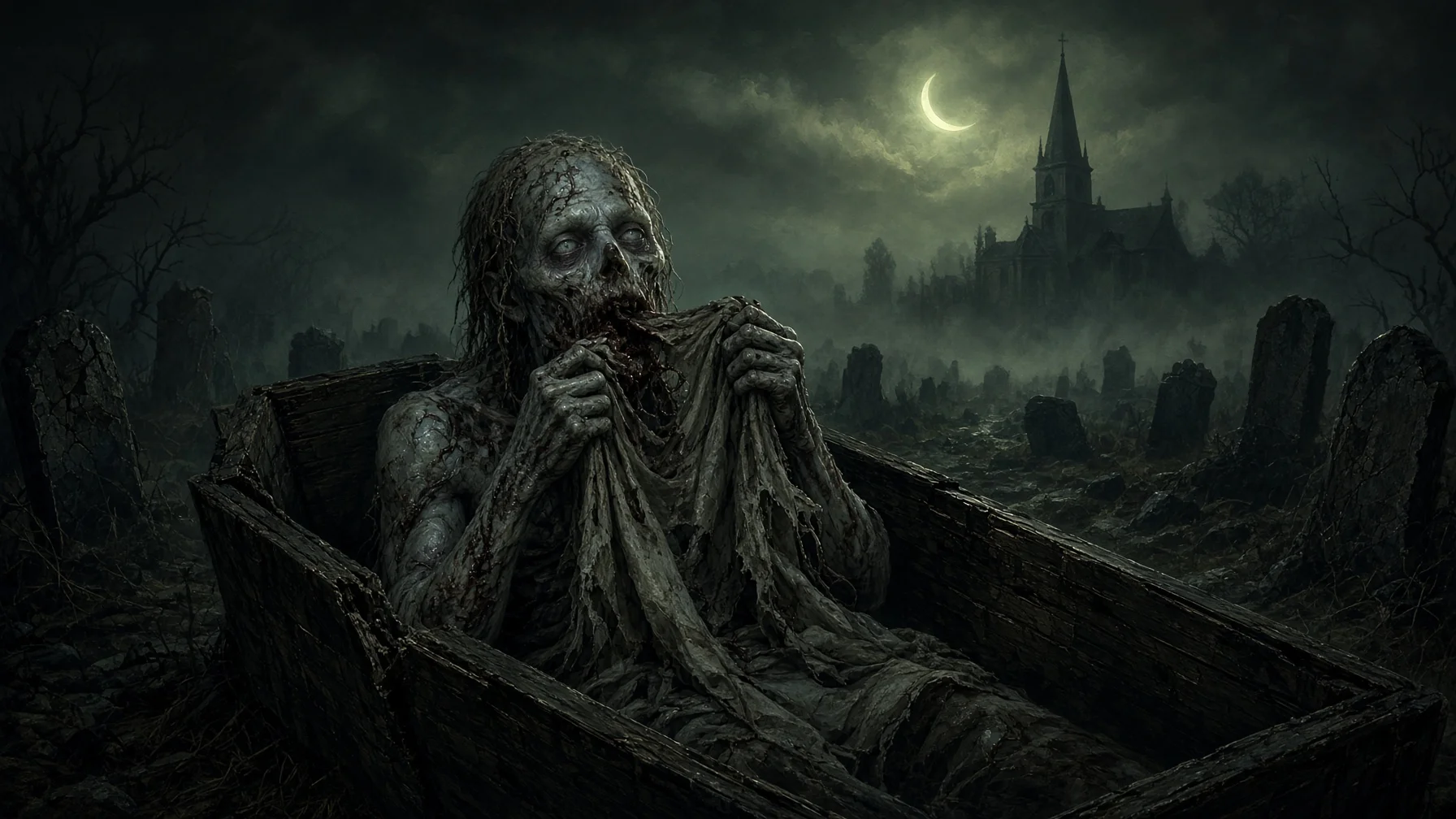
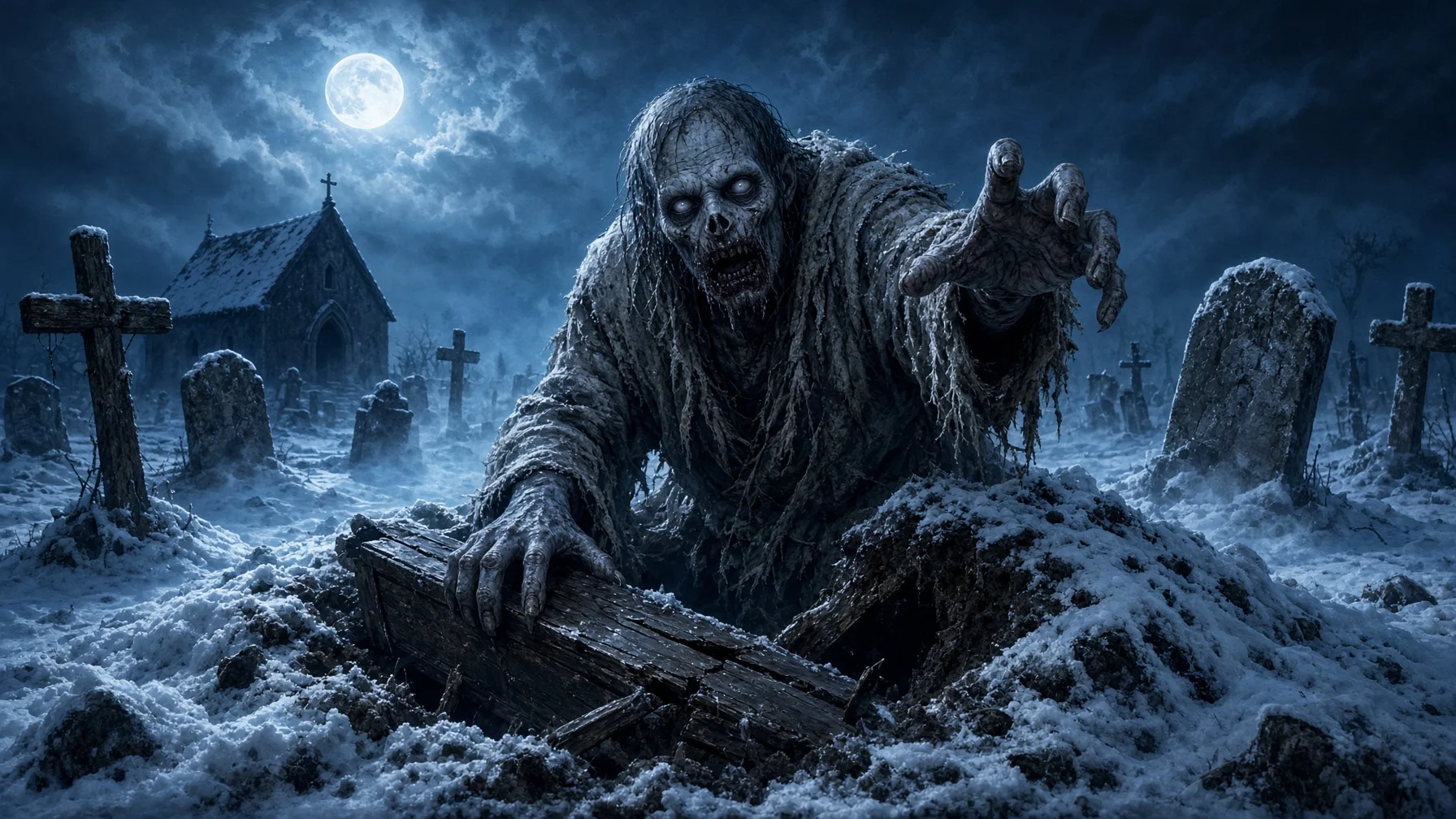
What set the gjenganger apart from a ghost in the thin, misty sense was its insistence on flesh. In many tellings it is not a spirit detached from the body but the corpse itself, risen and moving, retaining in some real degree the weight and solidity it had in life. Sources do not agree on exactly how corporeal any given gjenganger was said to be; the tradition was never standardized into a single rulebook, and village to village the emphasis shifted. But the general current runs the same way across the region: this is a dead thing that can be encountered, that leaves a grave visibly disturbed, that can be fought, staked, or struck, because it is still, in some sense, a body.
Kin of the Grave-Mound Dead
The gjenganger is widely understood by folklorists as the later, more diffuse folk-belief descendant of the draugr, the animated dead of the Old Norse sagas who dwelt in their burial mounds and rose to defend or avenge themselves with uncanny strength. Where the saga draugr belongs to an older, more mythic register, guarding treasure, wrestling heroes, the gjenganger belongs to the closer, more domestic world of the village and the churchyard. It is the saga's dread brought down to a human scale: not a monster in a mound far off, but the neighbor, the relative, the person from the parish, returned. Whether the draugr and the gjenganger represent one continuous belief slowly changing shape over the centuries, or two related but genuinely separate strands of tradition, is a question folklorists still debate rather than one long settled.
What the Dead Could Not Let Go
A death that came the wrong way was thought to leave a person unable to rest. Murder was foremost among these: to die at another's hand, with the wrong unavenged or unresolved, was believed to root the dead to the world rather than release them from it. Suicide carried its own weight, a death outside the ordinary order of things and often outside the ordinary rites that eased the passage from life. Accidents, sudden and unprepared-for, could do the same. What these causes share is a lack of resolution — a life cut off before its business was finished, in circumstances too violent or too abrupt for the community's usual ways of grieving and letting go to take hold.
The Rites Left Undone
Just as important as how a person died was how they were buried. Proper funerary practice, in this belief system, was not a courtesy but a mechanism: the wake, the coffin, the churchyard ground, each played a part in settling the dead into their new state. Skip or botch any of it, and the risk rose that the person would not stay settled. A corpse buried in haste, without a wake to mark the passing properly, without a coffin to hold and contain it, or without the confines of consecrated churchyard ground, was a corpse left in an unfinished condition — and folklore held that the gjenganger was often exactly this: a burial's failure given a walking shape.
Return to the Place of Death
When a gjenganger rose, it did not wander at random. It went back — to the spot where it had died, or to the home it had once kept. There it might haunt with purpose, seeking out those responsible for its death or its unfinished grief, or it might simply wander without evident aim, drawn back to familiar walls and rooms by a pull it could not resist. In some accounts the haunting took the form of reenactment, the dead retracing the last terrible moments of their life again and again, as though the moment of death itself were caught and replayed rather than passed through. For the living who witnessed it, there was little difference in dread between a purposeful revenant and an aimless one — both meant the dead had not gone where the dead belong.
A Warning Wearing a Corpse's Face
The gjenganger did more in the culture that told its stories than frighten children at the hearth. It functioned as a kind of moral instruction, a folk mechanism for reinforcing exactly the practices a community depended on when someone died: hold the wake properly, build the coffin right, bury in the churchyard, do not let a death go unattended or a rite go undone. Every gjenganger story was, in this sense, also a lesson about what happens when those obligations are neglected — a warning dressed in the shape of the community's own returned dead, walking as proof of what carelessness or violence could unleash.
Between the Pagan Grave and the Church
Two layers sit visible in how people responded to a feared gjenganger, and they tell of two eras folded together. Older practices, tied to the grave and the body itself, called for direct physical intervention: reopening the grave, restaking the corpse, cutting off the head. Later practices, arriving with Christianization, called on the church instead — a blessing spoken over the grave, a reburial carried out in consecrated ground under priestly authority. The two did not simply replace one another; folk memory kept both current, sometimes within the same telling, an old pagan grave-belief with a churchly layer settled over it rather than erasing it.
Opening the Grave Again
The most direct remedy, when other measures failed or were never taken, was to go back to the grave itself. The body would be exhumed and reburied correctly this time, with whatever rite had been missing the first time now properly performed. This was not undertaken lightly — disturbing a grave was itself a serious and unsettling act — but it was understood as the surest way to address a burial's original failure at its root, giving the dead, at last, the send-off that should have kept them settled from the start.
Iron, Wood, and the Blade
Where reburial alone was not trusted to be enough, sterner measures followed the same logic used against the draugr of the sagas. A stake driven through the body was meant to pin it in place, denying it the ability to rise again. Beheading was another answer, a more final severing of the dead from its own animating force. These were remedies of last resort, physical answers to a physical problem, matching the very corporeality that made the gjenganger frightening in the first place: if the danger was a body that would not stay down, the remedy had to work on that body directly.
Laid Face to the Earth
One particular practice recurs across this tradition and its draugr forebear alike: burying the body face-down. The logic is not spelled out in a single canonical source, but its shape is plain enough within the broader pattern — a corpse turned to face the earth rather than the sky above it is, in an old and blunt symbolic sense, oriented away from the world of the living, pointed down into the ground it is meant to keep to. It stands alongside staking and beheading as one of the practical, hands-on countermeasures a frightened community could still perform on its own, without needing to wait for a priest.
Draug, Draugr, and the Question of Kinship
Scandinavian tradition preserves at least three related terms for the troublesome dead, and folklorists have long argued over how closely they are actually bound together. Alongside the gjenganger and the saga-era draugr sits the draug, a specifically maritime figure, a sea-ghost tied to sailors who drowned rather than to a churchyard grave. Some see these three as a single lineage slowly diverging as it moved from sea to saga to village, and others treat them as related but genuinely distinct traditions that grew up answering to different fears — the deep and the drowned on one hand, the grave and the parish dead on the other. The argument remains open, and the honest position is that no single account fully resolves it.
Set Down in Ink
The gjenganger survives for us today chiefly through the great folklore collections of the nineteenth century, when Scandinavian scholars and enthusiasts went about gathering regional ghost-stories and oral traditions before they could fade. In these compilations the gjenganger appears not as a single canonical figure with one settled biography, the way a named hero or god might, but as a recognizable type, a shape a story could take whenever a community needed to tell of its own restless dead. Every parish had, or could imagine, its own gjenganger; the name gave the fear a form, but never a single fixed face.
The Thin Line Between Ground and World
At its core, the gjenganger speaks to an anxiety old enough to predate any single culture that gave it a name: the fear that death, once arrived, might not hold. A body properly buried, properly mourned, properly committed to consecrated ground, was a body that stayed where it belonged, and a community that carried out its rites correctly could trust that boundary to hold. The gjenganger is what that same community imagined on the other side of failure — the dead who cross back over, disrupting a social order built on the assumption that the departed, once seen off rightly, do not return. It is a figure that stands, ultimately, at the doorway between the grave and the living world, walking again precisely because that doorway was, in some way, left unclosed.
Sources & traditions
- EncyclopediaWikipedia — Gjenganger
- TraditionScandinavian texts, inscriptions and later retellings
Myths change from area to area and from time to time. This chronicle follows the most widely told versions; tellings in other villages, regions and eras may differ.