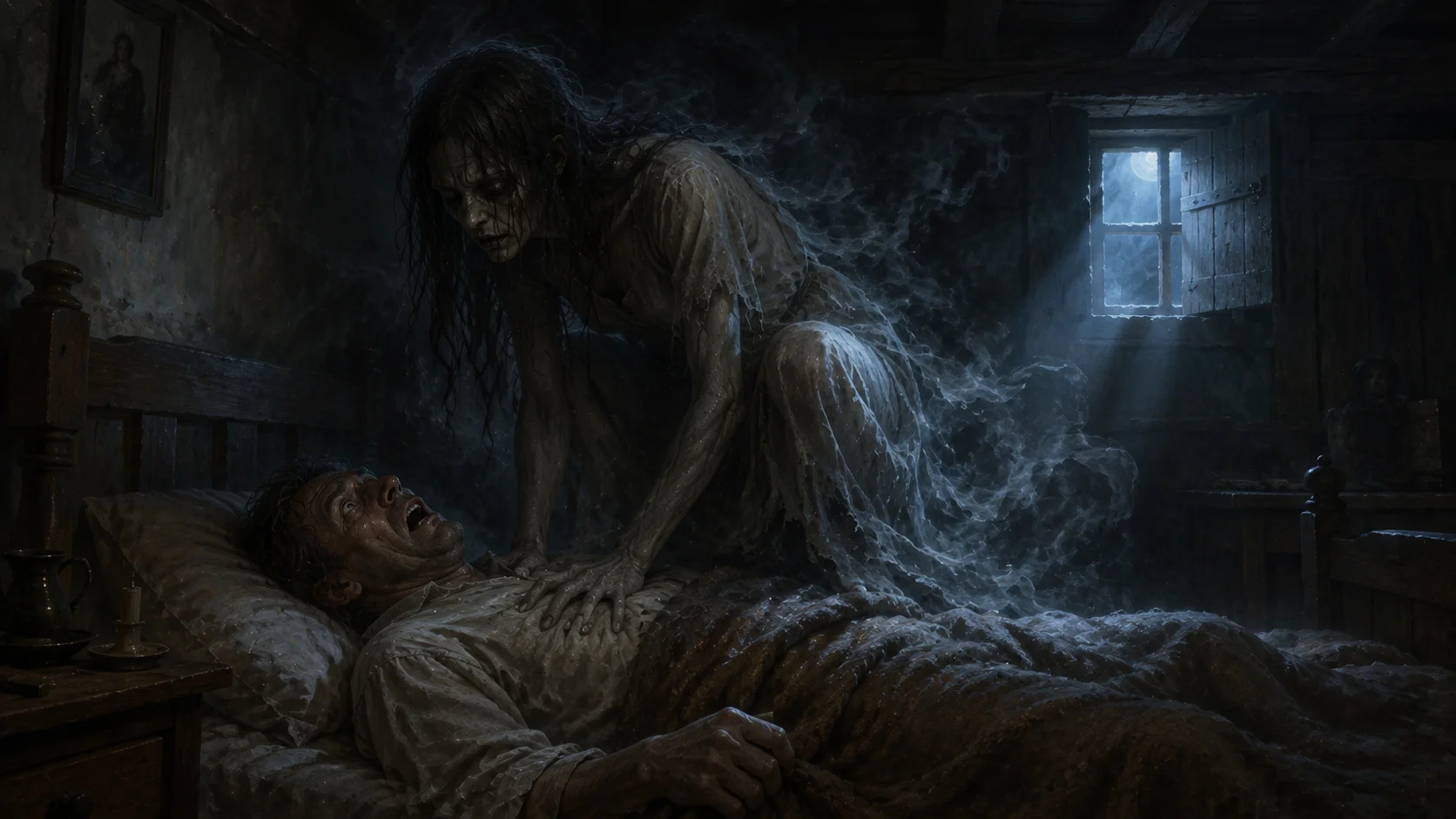
The Mare is the night-spirit of Scandinavian and Germanic folklore who sits upon the chests of sleepers and brings them suffocating, terror-filled dreams, the very being from whose name the word nightmare descends. A creature of the dark hours, the Mare creeps into the bedchamber while its victim sleeps, settles its crushing weight upon the breast, and rides the dreamer through the night, leaving him gasping, paralysed, and haunted by visions of dread. Across the northern lands her name changed shape from valley to valley, yet the fear she named held steady for centuries, passed down as living testimony to a suffering everyone recognized but no one, before modern medicine, could explain.
The Word Beneath the Word
Old Norse mara stands as the acknowledged root of English nightmare, and the line runs unbroken through the historical linguistics of the Germanic and Slavic worlds: Swedish and Norwegian mara, Danish mare, German Mahr, all daughters and cousins of the same ancient term. This is not a folk etymology assembled after the fact but a documented descent, traced by philologists through centuries of written and spoken record. What began as the name of a specific tormenting spirit hollowed itself out over time into the ordinary word for any bad dream, so that most who now speak of a nightmare have no notion they are still, in a fossilized way, naming her.
Last updated .
A Weight That Comes in the Dark
The core experience attributed to the Mare was startlingly consistent from region to region: a sleeper wakes, or half-wakes, to find an unbearable weight pressing on the chest, the limbs locked and unresponsive, the throat unable to cry out, and a distinct, dreadful sense that something is present in the room. Folklorists and medical historians alike now read this as a pre-scientific account of what is today termed sleep paralysis, a genuine neurological state in which the mind surfaces toward waking before the body's paralysis of REM sleep has released it. The Mare tradition did not invent this terror; it gave it a face, a name, and a reason, turning an inexplicable bodily event into a comprehensible visitation with rules, causes, and defenses.
A King Ridden to His Death
The oldest major literary witness to this belief comes from Snorri Sturluson's thirteenth-century Ynglinga saga, part of the great historical compilation Heimskringla. There it is recorded that King Vanlandi met his end ridden to death by a mara sent against him through sorcery. Scholars of Old Norse literature return to this passage again and again as a primary attestation, because it demonstrates that the mara was already, by the time of the sagas, understood not merely as a nuisance haunting ordinary sleepers but as a weapon: a spirit that could be deliberately dispatched by one person against another, with lethal consequence for a king. The saga treats her arrival as a fact of the world its audience already knew, not as an invention requiring explanation.
The Sleeper's Double
A widespread and much-discussed strand of the tradition held that the mara was not always an independent supernatural being but could be the wandering nocturnal double of a living person, most often imagined as a woman. Various districts offered various explanations for how a person came to possess this affliction: some said it fell upon those who were unbaptized, others that it marked those born with a caul, the thin membrane sometimes present at birth. These explanations were never standardized into a single universal rule; the mechanics of caul-born or unbaptized origin differed meaningfully from one collection to the next, and folklorists are careful to treat them as regional variants rather than a fixed doctrine. What united the accounts was the deeper idea that the spirit riding a sleeper by night might, by day, be an entirely unremarkable neighbor, unaware of or unable to control what her sleeping self did in the dark.
Iron, Stone, and the Backward Shoe
Against so intimate and inescapable a visitor, households across Sweden, Norway, and Denmark developed a repertoire of protective customs, carefully documented in folklore collections. Cold iron held particular power: a knife or a pair of scissors laid near the bed was thought to bar her entry or break her hold. Shoes turned backward at the bedside, heels pointing toward the pillow, were believed to confuse a spirit that relied on following the sleeper's own tracks. Most evocative of all was the mara-stone, a mara-sten, a stone bearing a naturally worn hole through its center, hung above the bed or over the door of the stable. The hole was the key to its power, for the Mare was thought bound to travel only through openings, and a stone she could see straight through was believed to trap her gaze or her passage rather than let her slip past into the room beyond.
Manes Tangled Before Dawn
The Mare's nocturnal rides were not confined to human sleepers. She was believed to torment horses through the night as well, and a farmer who found his animal sweat-soaked and exhausted by morning, its mane knotted into stiff, matted tangles, took this as unmistakable evidence of her visit. These mara-locks, as they were called, belong to a broader Germanic motif of the hag-ridden horse, a shared image of nocturnal exhaustion imposed by an unseen rider that appears across multiple traditions in the region. For a farming household whose horse was labor, transport, and wealth in one animal, a beast left ridden and ruined overnight was no small matter, and the belief gave that damage a cause that could, at least in principle, be guarded against.
Kin Among the Restless and the Malefic
The Mare did not stand alone in the northern imagination of the night; she occupied a place within a wider taxonomy of oppressive spirits that troubled sleepers and households after dark. In some regional traditions her identity blurred with the draug, the restless revenant of the dead, so that a mara-visitation and an encounter with the walking dead were not always sharply distinguished. In others, she was folded into the figure of the witch, the trolldomskvinnor, said to send maror out as a deliberate act of malefic magic against an enemy, echoing the very fate that befell King Vanlandi in the saga. Genuine ambiguity runs through the source material on this point, and it has never been resolved into a single settled classification: whether the Mare is best understood as an autonomous spirit in her own right, a projection sent out by a living witch, or a class of restless dead remains an open question that varies by district and by source, not a matter later scholarship has tidied into consensus.
A Shape Given to Suspicion
Over the early modern period, the association between the Mare and women hardened considerably, and it came to intersect with the broader currents of Scandinavian witch-trial accusation. The earliest medieval material, by contrast, is markedly less strictly gendered in how it presents the spirit. This shift matters for understanding the tradition honestly: it was not a static belief handed down unchanged from the saga age but one that moved with the anxieties of the centuries it passed through, absorbing the period's suspicion of women accused of maleficent power and reshaping the folk image of the night-rider accordingly. A belief that named a universal bodily terror could, in a different climate, be turned toward naming and blaming a neighbor.
An Explanation Without a Fixed Face
Unlike many folkloric beings who accumulate a settled, describable appearance, the Mare has no single canonical iconography in the primary sources. She is overwhelmingly described by her effect rather than her form: the crushing weight, the suffocating presence, the paralysis. Where storytellers did venture to visualize her, she sometimes took the shape of an old woman or a shadowy female figure at the bedside, but no consistent portrait emerges across the collected material. This absence is itself telling. The tradition existed to explain a felt sensation in the dark rather than to describe a creature glimpsed in daylight, and its power lay less in what she looked like than in the unmistakable, universally recognized weight of her arrival.
Into the Painter's Studio
The concept did not remain confined to the districts of Scandinavia. Its reach into later reception is most often traced by scholars through Henry Fuseli's 1781 painting The Nightmare, a canonical image showing a woman in the grip of a crushing dream-visitation. It bears stressing that this connection is a conceptual lineage rather than any claim of Scandinavian authorship: Fuseli's painting is an English and continental artistic response to a concept the word nightmare had already carried into the wider European imagination, evidence of how far the mara's shadow had traveled from its Old Norse and Germanic origins by the close of the eighteenth century.
A Belief Held in Common
What the Mare ultimately offered the households that feared her was a shared explanatory framework for suffering that otherwise had no name: the crushing terror of a paralyzed waking, the mystery of a horse ruined overnight without visible cause. Wrapped around that explanation was a whole practice of vigilance, the iron by the bed, the backward shoe, the holed stone above the door, rituals that let ordinary people feel they held some power against a visitation they could not otherwise resist. The regional variants of her name, mara, mare, Mahr, Nachtmahr, all issuing from one root, confirm that this was never a single village's superstition but a genuinely pan-Germanic belief complex, elaborated with particular richness in Scandinavian ritual practice. In the sleeper who wakes crushed and voiceless in the dark, and in the single word that names that dread across the whole English-speaking world, the rider who once had a name and a shape in the old sagas is, in her quiet way, still present.