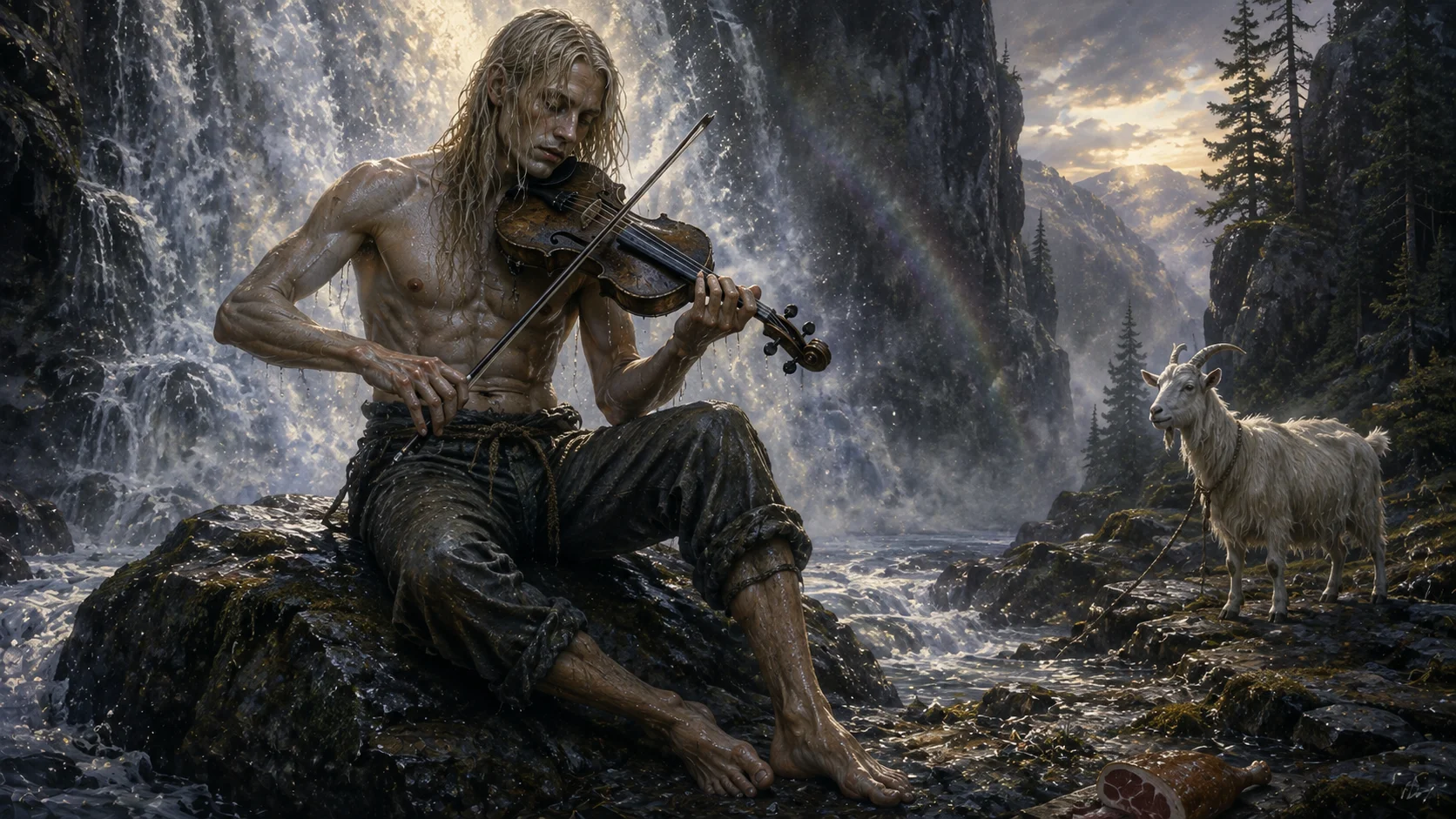
Beneath the white roar of a Norwegian waterfall, where the spray hangs like smoke and the rock is worn smooth by centuries of falling water, there is said to dwell a figure who is neither wholly kind nor wholly cruel: the Fossegrim, the fiddler of the foss. He is a spirit of the cataract itself, and the tales that surround him are not stories of monsters to be feared outright, nor of gods to be worshipped, but something stranger and more intimate — a being who will teach a mortal hand to play as no mortal hand has played, if that mortal is willing to pay the water's price on the water's own terms.
A Voice Among the Näck-Kin
The fossegrim belongs to a wide family of water-beings scattered across the Scandinavian folk imagination — the Swedish näcken, the Danish nøkken, and their many local cousins, all of them spirits bound to moving fresh water rather than the sea. What distinguishes the fossegrim from his kin is his address: not the still tarn or the slow river bend but the foss, the waterfall, the place where water becomes violence and music at once. Folklorists have long treated him as a Norwegian regional variant within this broader näck tradition, and in many districts the line between fossegrim and nøkken blurs entirely, the same spirit going by different names depending on which valley is telling the story. In other tellings the two are held apart quite deliberately — the nøkken cast as the drowner, the fossegrim as something gentler, a waterfall-dweller whose business is teaching rather than taking. Both versions are true in the only sense that matters for oral tradition: true to the community that told them.
Last updated .
A Face That Will Not Hold Still
Ask ten valleys what the fossegrim looks like and expect ten different answers. In some accounts he is a strikingly handsome young man, seated on a wet stone with his fiddle across his knee, easy to mistake for an ordinary traveler until you notice how the water bends toward him. In others his human shape is only partial — a fish-tail where legs should be, or the long face and dark eye of a horse, features borrowed from the water itself and from the animals that drown in it. Folklorists studying these accounts have made a point of not smoothing them into one tidy portrait. The inconsistency is not corruption of an original image; it is the ordinary texture of oral tradition, each parish shaping the spirit to its own waterfall, its own fears, its own fiddlers. Any single fixed image of the fossegrim, however vivid, should be read as one regional voice among many rather than the truth of the matter.
The Thursday Offering
The best-known fossegrim legend is also its most concrete: the ritual by which a human musician might buy lessons from him. The seeker was to come to the waterfall on a Thursday evening — a timing that echoes older Scandinavian associations between Thursday and the liminal, Thor's own day standing at a threshold between the ordinary week and something older, though the exact reasoning shifts from one collected variant to the next. The offering itself was an animal, killed and thrown into the falling water, given with the seeker's back turned or face averted, never watching the spirit take what was owed. It was not a gift given freely. It was payment, made according to rules the fossegrim set and the human had no power to negotiate.
What a Poor Gift Buys
The tradition is explicit that not every offering earned the same return, and this graded exchange is one of the most carefully preserved details in the whole legend. A thin animal, a small or spotted one, bought only a little — the fossegrim would teach the seeker to tune an instrument and no more, a modest and almost grudging lesson, technically a bargain kept but barely worth the walk to the falls. The spirit gave exactly what was paid for, no more generous in his teaching than the offering had been generous in its giving. It is a small piece of folk logic, this graded return, and it does a great deal of work: it explains why some fiddlers who tried the ritual came home with nothing remarkable, while others came home transformed.
What a Fine Gift Buys
A large offering, dark or black in color, was another matter entirely. For that, the tales say, the fossegrim gave full mastery — not competence but virtuosity, a command of the fiddle so complete that in some tellings the very strings were said to weep under the player's bow, sound drawn out that no ordinary training could produce. This was the outcome every seeker hoped for and few were bold or wealthy enough to properly buy: a black goat or a fine dark beast, given without hesitation, in exchange for hands that would never again play as an ordinary person's hands play. The graded bargain turned the fossegrim from a simple boon-giver into something closer to a judge of sincerity, rewarding the size of the sacrifice with the size of the gift.
Strings That Remember the Falls
Norway's hardingfele tradition — the ornamented, sympathetically-stringed folk fiddle at the heart of Norwegian dance music — carries the fossegrim's fingerprints throughout its lore. Certain slåtter, the traditional tunes passed down through generations of players, are attributed in legend to the spirit himself, said to have been learned note for note at the water's edge and carried back into human hands and human memory. It is worth being precise about what this attribution is and is not: it is a legend explaining the tune's uncanny beauty, not a documented line of historical transmission. But the attribution's persistence says something real about how Norwegian fiddling communities understood their own best players — that extraordinary skill needed an extraordinary origin, and the waterfall offered one ready to hand.
The Etiology of a Gift
Step back from the specific ritual and the fossegrim legend reveals its deeper social function. In an agrarian community where musical genius appeared, as genius always does, unevenly and without obvious explanation, the story of the waterfall bargain supplied a satisfying answer to an otherwise uncomfortable question: why is this fiddler so much better than his neighbors? The offering ritual functioned as a supernatural etiology, a folk explanation for exceptional talent that let a community account for the inexplicable without resorting to jealousy or suspicion of ordinary human means. The gifted fiddler had not simply worked harder or been born luckier — he had gone to the falls, paid the price, and been chosen.
The Danger Beneath the Music
It would be a mistake to hear only sweetness in these stories. The fossegrim, for all his generosity toward the serious student, shares his family's darker inheritance. Some tellings present him as genuinely dangerous, capable of luring the unwary — children especially, and young women — toward the water's edge with the same music that taught fiddlers their craft. This is the drowning-spirit function common to nearly every water-being in Scandinavian belief, and the fossegrim is never entirely free of it. The same falls that could make a fiddler's fortune could also take a child who wandered too close at dusk, drawn by a melody that was never meant for innocent ears. The line between teacher and predator, in these accounts, is thinner than a listener might wish.
Water as a Divided Power
Taken as a whole, the fossegrim gives shape to something the old Scandinavian peasant cosmology understood about water long before it had a folklorist to say so: that it is a divided power, generative and lethal in the same current. The waterfall that turns a mill and carries a tune also drowns the careless. The fossegrim is that ambivalence made into a person — capable of the highest gift a musician could receive, and just as capable of pulling someone under. He is not evil, in the way a story needs a villain to be evil, and he is not safe, in the way a story might want a wise teacher to be safe. He is simply what the water is.
Collectors of the Falls
What survives of the fossegrim today reaches us largely through the work of nineteenth-century Norwegian folklore collectors, working in the same broad tradition as Asbjørnsen and Moe's famous gatherings of Norwegian folk tale and legend, alongside regional ethnographers who went valley by valley recording what older residents remembered of the old beliefs. It is thanks to that patient, district-by-district collection that the fossegrim's many faces — handsome youth, fish-tailed shape, horse-featured stranger — were written down before they could fade entirely from living memory, preserved with all their local disagreement intact rather than flattened into a single official version.
The Grim in His Name
The second half of his name invites a question that folklorists have not settled. "Grim" appears elsewhere in Scandinavian spirit-lore — the kyrkogrim among them, a guardian spirit tied to churches rather than water — and whether these grim-named beings share a real etymological or mythic root, or whether the resemblance is coincidental, remains genuinely disputed among scholars of the tradition. It is one of the quieter uncertainties in the fossegrim's history, unresolved rather than forgotten, and worth holding as an open question rather than a settled fact.
Company Kept in the Modern Imagination
The fossegrim has not stayed confined to nineteenth-century collection notebooks. He persists in contemporary Norwegian culture in several living forms: as a figure invoked in folk-music education, where his legend still frames conversations about mastery and inheritance in the hardingfele tradition; in material written for waterfall tourism, where his story gives a name and a mood to falls that might otherwise be admired only for their scenery; and in Norwegian fantasy and children's literature, where he takes his place beside the huldra, the nisse, and the troll as one of the recognizable figures of the national folk imagination. Each of these afterlives is a different kind of survival, but together they keep the fossegrim from becoming merely historical.
At the Water's Edge
What endures, finally, is the shape of the bargain itself — a Thursday evening, an offering carried in silence, a spirit whose generosity was exactly proportioned to what was given him, and a gift that could make an ordinary hand extraordinary at a cost never fully spelled out in the telling. The fossegrim asks to be approached the way the old communities approached him: with respect for what the water can give, and without forgetting what it can take. His many faces, his disputed name, his place between benign teacher and dangerous drowner — none of it resolves into a single comfortable story, and perhaps that unresolved quality is the most faithful thing that can be said of him.