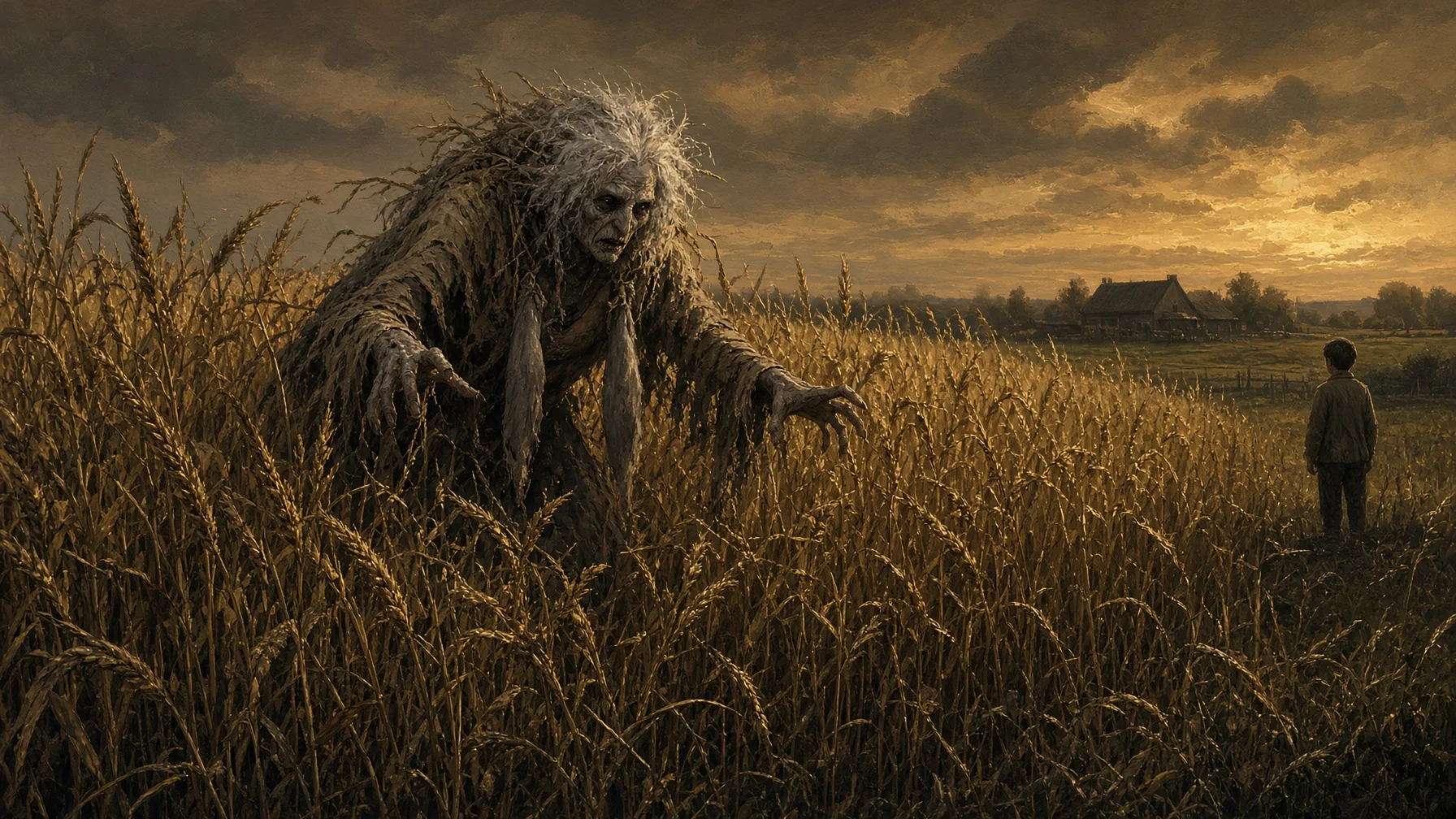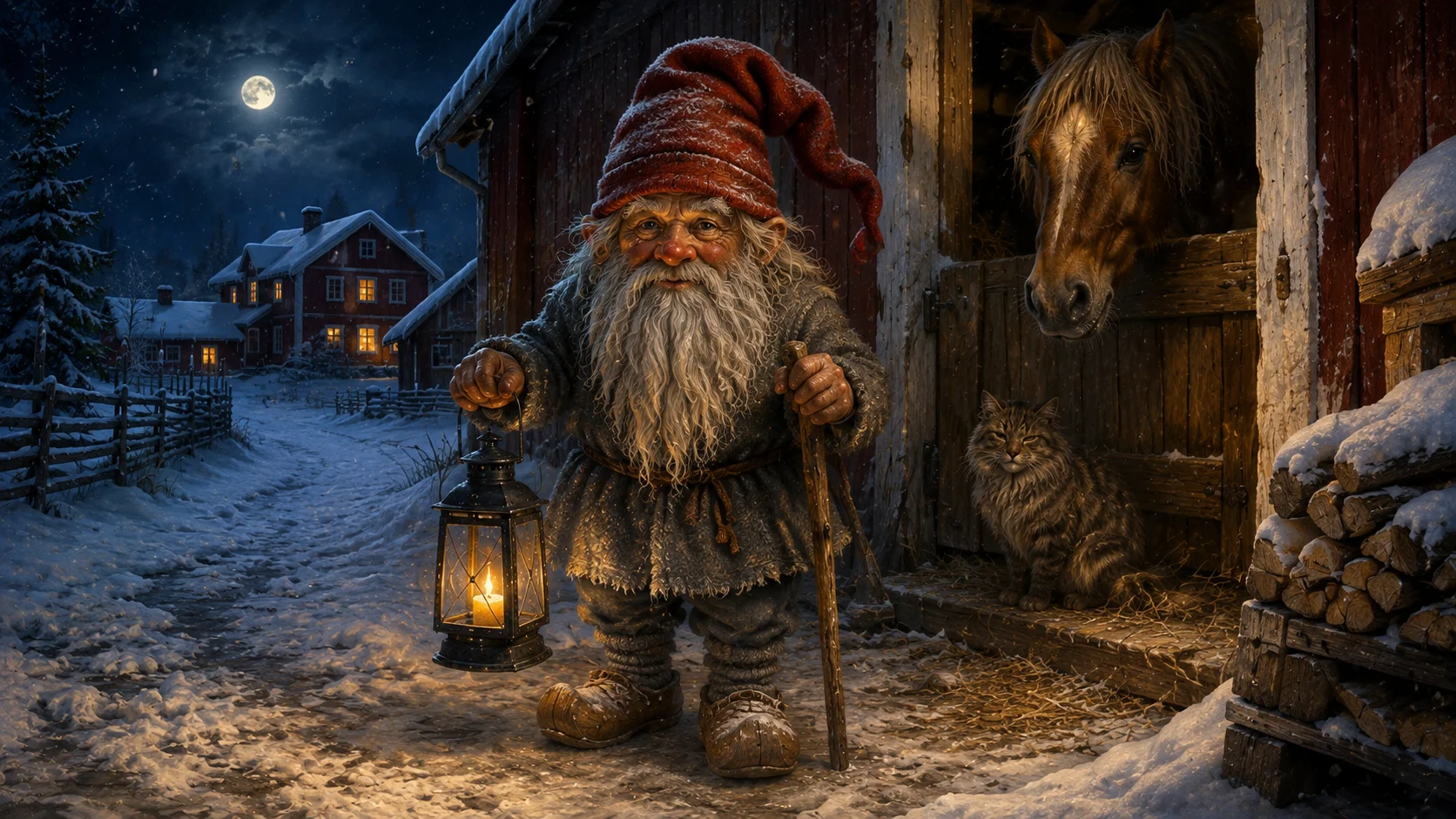
The Tomte, called also the tomtenisse, is the household and farmstead guardian-spirit of Scandinavian, and above all Swedish, folk belief: a small, ancient, grey-bearded being who dwells unseen about the farm, labouring through the night for its prosperity and asking in return only respect, quiet, and a bowl of porridge left out with a pat of butter. He is not a spirit summoned or invited but one already there, bound to the ground itself, and the story of the tomte is in large part the story of what a household owed to the place it stood on.
The Keeper of the Homestead
His name comes from tomt, the plot of ground on which a farm's buildings stand — the tomte is, quite literally, the one belonging to the home site. This is not incidental to who he is: he is not a spirit who happens to live at the farm but a being whose identity is inseparable from the land itself, a survival of an older, pre-Christian belief in guardian spirits tied to particular places, later folded gradually into folk Christianity without ever fully losing its older shape. Where a churchyard might have its watching dead, a farm had its tomte, and the two ideas were never entirely distinct.
The Farm's First Master
In parts of Sweden the tomte was understood, in some tellings, to be the spirit of the farm's original settler — the gårdstomte, the farm-tomte, imagined as the ancestral figure who first cleared the ground, raised the first buildings, and never fully departed. This identification of the tomte with a specific founding ancestor is attested regionally rather than universally; not every collected account makes this claim, and in many the tomte simply is, without a remembered human history behind him. But where the belief does appear, it gives the whole tradition its emotional centre: the guardian is not a stranger doing a farm a favour, but something closer to a forebear who never left, still keeping watch over the ground he once broke with his own hands.
By Grey Cloak and Long Beard
He is described, across the older accounts, as small — roughly the size of a child, sometimes likened to a gnome — old in appearance, with a long beard of white or grey, and dressed in the plain grey homespun cloth of a farm labourer, not in the bright red now so widely associated with him. That vivid red cap is a later addition to his image, popularised especially through the illustrations of Jenny Nyström in the nineteenth and twentieth centuries; the oldest attested tomte is a greyer, more austere figure, closer in dress to the farmhands he laboured alongside than to any festive ornament. He keeps to the outbuildings and the quiet corners of the farmstead — the barn, the stable, the loft — and is said to shun being seen, doing his work while the household sleeps.
The Nightly Labor
What he does, when unseen and unbothered, is work. The tomte is above all a labourer: he tends the animals, keeps the stable clean, sees that the horses are calm and the cattle thrive, and generally holds the farm's fortune together through effort no one witnesses. A farm with a contented tomte was a farm whose luck held — its crops came in, its animals stayed healthy, its stores did not mysteriously dwindle. This is the heart of the belief: prosperity was not simply weather and labour, but the visible sign of an invisible guardian's continued goodwill, and its failure was read the same way, as a withdrawal of that goodwill rather than mere misfortune.
The Porridge and the Butter
The central, most widely attested custom binding a household to its tomte was the julgröt, the Christmas porridge, set out for him on Christmas Eve — though in many tellings a nightly or regular offering was expected as well, not solely a once-a-year rite. The porridge was to be given generously, with a good measure of butter set upon it, for the butter was no small courtesy: it was the mark of whether a household honoured its guardian properly or merely went through the motions. A tomte slighted in his porridge, or given a bowl grudgingly and without its butter, was a tomte insulted, and an insulted tomte was a danger to the whole farm.
The Tale of the Forgotten Butter
No story illustrates the stakes of this reciprocity better than the widely recorded episode of the forgotten butter, attested in numerous variants across nineteenth-century Swedish and Norwegian folklore collections. In its common shape, a farmer or a servant, thinking little of the tomte's due, eats the butter off the top of his porridge before setting it out — leaving him, in effect, a bowl of plain grain and nothing more. The tomte, discovering the theft, flies into a fury and kills the farm's finest cow, or brings some comparable disaster down on the household, exacting a price far beyond the value of the stolen butter. Only afterward, in the telling's bitter turn, does he discover the butter smeared on his own body or clothing — proof that the butter had been there all along, that the servant had merely skimmed it for himself before ever presenting the bowl, and that his vengeance had fallen on an innocent farm. The tomte's grief at this discovery is as much a part of the story as his rage: he is not cruel by nature, only proud and easily wounded, capable of remorse once the truth is plain to him. The tale exists to teach exactly what it dramatizes — that disrespecting the tomte, even by a small and seemingly private theft, could cost a household dearly, and that the guardian's power to bless was matched by an equal power to punish.
A Temper Quick to Rise
Beyond the butter tale, the tomte's temperament runs consistently through the tradition: he is fundamentally benevolent and industrious toward a household that honours him, but he is easily offended, and the list of offences was not small. Cruelty or neglect toward the farm animals could turn him against a household as surely as neglecting his porridge; so could laziness, an untidy farmstead, mockery of him or of the old customs, or simple discourtesy. Once offended, he was capable of real mischief and real harm — souring milk, tangling the manes of horses into knots overnight, withholding the luck that had made the farm prosper, or, in the gravest cases, departing outright and taking the farm's fortune with him. He was not, in the folk imagination, a being to be taken lightly or treated as a quaint household fixture; he was a presence a family had to actively keep faith with, season after season.
Kin Across the Water: Nisse, Vård, and Gårdsrå
The tomte does not stand alone in the wider Scandinavian tradition. He is closely related to the Norwegian and Danish nisse, and in some regional traditions the two are treated as effectively the same guardian figure known under different names on either side of a linguistic border, rather than as two separate beings. The tomte is also regionally distinguished from, yet overlapping with, other Scandinavian guardian-spirit concepts: the vård or vårdträd, a spirit tied to a particular guardian tree watching over a home or family, and the gårdsrå, the farm-wight understood more broadly as the ruling spirit of a particular farmstead. These figures shade into one another at the edges — the tomte, the vård, and the gårdsrå all express a related conviction that a farm or a family is watched over by something not quite human, tied to a specific place — but they are not simply interchangeable labels for one identical belief, and the older sources preserve them as related rather than identical.
Names for the Nameless Keeper
The tradition is recorded under a cluster of names beyond the common tomte and tomtenisse. He is called tomtegubbe, the "tomte old-man," a term that leans into his aged, bearded appearance; gårdstomte, the farm-tomte, emphasising his tie to the particular farmstead rather than the household in a general sense; and in some regional dialects, particularly Norwegian ones, gardsvord. A further regional variant preserves the name goanisse. The Danish and Norwegian cognate nisse is itself thought to derive from Nils, a diminutive personal name — a small but telling detail, suggesting that at some point in the tradition's development the guardian spirit was thought of, and addressed, almost as a familiar figure with something like a Christian name of his own, rather than as an abstract force.
One Tomte, or Many
Belief in how many tomtar might inhabit a single farm varied by region and telling. Some accounts describe a single guardian for the whole property, bound to the tomt as a unified plot of ground. Others describe several, one attached to each building — a tomte of the barn distinct from a tomte of the house, each with his own particular domain to watch over and his own portion of respect to be paid. Neither version was universal; the tradition, like most orally transmitted folk belief, tolerated real regional variation in its details even while holding to the same underlying conviction, that the buildings and the ground of a working farm were not simply inert property but places actively watched.
When the Tomte Departs
The gravest consequence a household could bring on itself was the tomte's departure. Where his presence explained a run of good fortune, his absence explained the opposite: a farm gone suddenly, inexplicably unlucky — animals sickening, harvests failing, the ordinary rhythm of the place falling out of joint — could be understood as a sign that the guardian had finally given up on an ungrateful or careless household and moved on, taking the farm's prosperity with him as he went. This belief gave the tomte tradition its practical force in daily life: the porridge left out, the courtesy shown to the animals, the tidiness kept in the barn, were not simply superstition observed out of habit, but insurance against a loss that once suffered might not be reversible.
The Moral Economy of the Farm
Taken as a whole, the tomte tradition reads as a folk expression of reciprocity as the governing principle of a working farm. Respect, hospitality, and fidelity to custom were rewarded with prosperity; disrespect, neglect, and mockery were punished, sometimes severely and sometimes, as in the butter tale, tragically out of proportion to the original slight. The tomte's moods functioned as a kind of moral weather over the household, and his presence or absence served as the folk explanation for why one farm thrived while its neighbour, seemingly no different in soil or labour, did not. In this sense the tomte was never only a figure of superstition to be feared or placated; he was also a way of talking about obligation — to the animals in one's care, to the customs handed down, and to the ground a family lived and worked on, which was understood to remember how it had been treated.
Viktor Rydberg's Watching Spirit
In the nineteenth century the older, sterner farm-guardian was reshaped by literary and artistic hands into a gentler and more solitary figure. The most influential single work in this transformation was Viktor Rydberg's 1881 poem "Tomten," illustrated by Jenny Nyström, whose images did much to fix the character's now-familiar look in the public imagination. Rydberg's tomte is less the vengeful enforcer of the butter tale than a patient, ageless watcher, keeping his lonely vigil over the sleeping farm through the long winter dark, pondering the passage of generations who have lived and died under his unchanging care. This is documented literary and artistic reinvention rather than the oldest attested folk figure — a real and traceable moment where an agrarian belief was deliberately softened and made poignant for a wider, increasingly urban readership, rather than a straightforward continuation of the older oral tradition.
The Red Cap and the Modern Jultomte
That literary reshaping fed directly into a further, well-documented process of syncretism: the blending of the older guardian-spirit tomte with imported Santa Claus imagery to produce the modern jultomten, the Christmas gift-bringer now familiar throughout Scandinavia. The now-iconic red pointed cap belongs to this later phase of the tradition's history, not to its oldest layer, and the shift from stern household guardian, capable of killing a farm's best cow over a stolen pat of butter, to a benign gift-giving figure of the holiday season marks a genuine and traceable change in the character over time — one worth naming plainly, since the two figures, older guardian and modern gift-bringer, are related by descent but are not simply the same thing wearing different clothes.
A Guardian Remembered
The tomte survives today chiefly as a fixture of Swedish and Norwegian Christmas custom — as a decorative gnome figure, as the small bearded ornaments still called tomtenisse, and as a widely recognised piece of national folk identity — rather than as an active, daily belief in a guardian spirit whose porridge must not be forgotten. It stands, in this sense, as a genuine agrarian folk-religious tradition that has passed largely out of practiced belief while remaining vividly present in domestic custom and memory. What endures, beneath the decorative surface, is the older story it once carried in earnest: of a farm as a place that could be watched over, of a guardian whose favour had to be earned and kept through steady courtesy rather than assumed, and of a household's fortune as something bound up, quite literally, with how well it kept faith with the ground it stood on.
Sources & traditions
- EncyclopediaWikipedia — Nisse (folklore)
- TraditionScandinavian texts, inscriptions and later retellings
Myths change from area to area and from time to time. This chronicle follows the most widely told versions; tellings in other villages, regions and eras may differ.