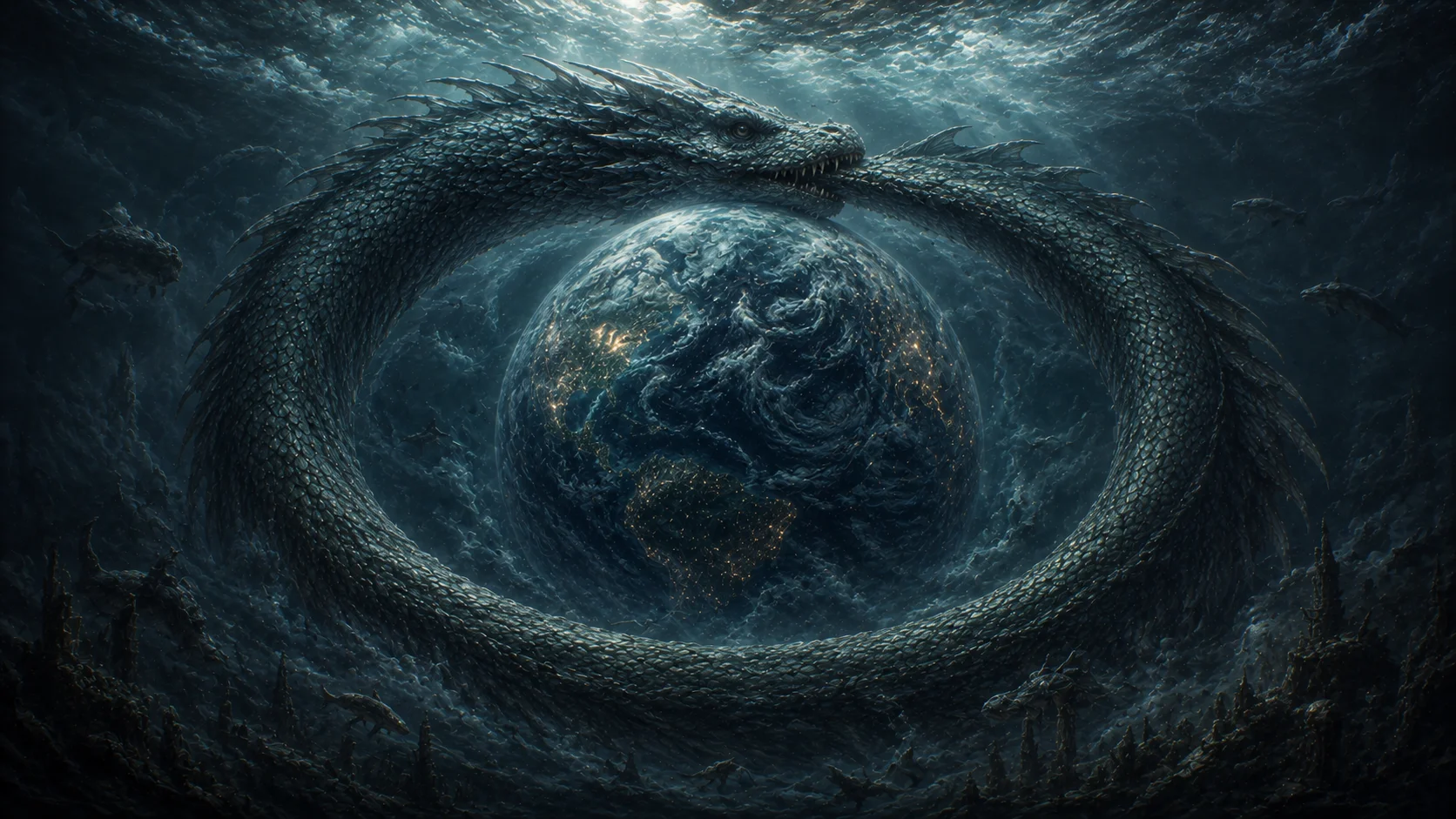
Jörmungandr was the world-serpent of Norse myth — the colossal sea-serpent, child of Loki, who grew so vast that he encircles the entire world beneath the ocean, biting his own tail, and who is the great fated enemy of Thor, destined to slay and be slain by the thunder-god at Ragnarök. He is the serpent that holds the world in its coils, the boundary of the sea and the doom of Thor.
The Serpent That Circles the World
Jörmungandr (Old Norse Jörmungandr, “huge monster”), also called the Midgard Serpent (Miðgarðsormr), was one of the three monstrous children of Loki by the giantess Angrboda — brother to the wolf Fenrir and to Hel. When the gods learned of the doom these children were fated to bring, Odin cast Jörmungandr into the great ocean that surrounds the world of men (Midgard). There, in the deep, the serpent grew — and grew, and grew — until he had become so enormous that he encircled the entire world, and could grasp his own tail in his jaws. So he lies, a vast ring of serpent beneath the sea, his body the very boundary of the world, and it is said that when he releases his tail, the world will end.
The Fishing of Thor
The enmity between Jörmungandr and Thor is one of the great rivalries of Norse myth, and they met more than once before their final battle. The most famous encounter came when Thor went fishing from the boat of the giant Hymir, using the head of an ox as bait. The serpent took the bait, and Thor hauled with all his divine might, bracing his feet through the bottom of the boat, until he drew Jörmungandr's venomous head up out of the sea and the two ancient enemies glared at one another face to face. Thor raised Mjölnir to deal the killing blow — but the terrified Hymir cut the fishing line, and the serpent sank back into the depths, their reckoning postponed.
The Doom at Ragnarok
That reckoning comes at last at Ragnarök. As the world ends, Jörmungandr releases his tail and rises from the sea, writhing onto the land and spewing his deadly venom into the air and water, poisoning the sky. There, on the final battlefield, he meets Thor for the last time. The two destroy each other: Thor slays the great serpent with his hammer Mjölnir — but the serpent's venom is upon him, and the thunder-god is able to stagger only nine steps away before he falls dead, killed by the poison of his ancient enemy. So the world-serpent and the thunder-god, fated foes since the beginning, die together at the end.
The Boundary of the World
Jörmungandr endures as one of the most awesome images in all of myth — the serpent so vast it encircles the entire world, biting its own tail, the living boundary of the sea, the fated nemesis of Thor. He is a Norse version of the world-encircling serpent (the ouroboros) found across many cultures, and he embodies the Norse vision of a cosmos held in tension by vast opposing forces — the serpent whose coils define the world, whose venom poisons the sky, and whose release means the end of all things.
So vast he circles the whole world and bites his own tail beneath the sea — and when he finally lets go, he and the thunder-god will kill each other, and Thor will walk nine steps before he falls.
The Poems Behind the Legend
Around the 980s, long before either Edda was written down, the Icelandic skald Úlfr Uggason composed Húsdrápa — a “house-poem” describing the carved panels that decorated a chieftain’s new hall at Hjarðarholt. Among the scenes was Thor’s fishing trip for Jörmungandr, already familiar enough to an audience of Icelandic farmers that a poet could allude to it in passing rather than explain it from scratch. The skalds came back to that scene more than once; by the standards of the surviving corpus it was a favourite. The two fullest tellings are later ones, and they disagree. The Eddic poem Hymiskviða, preserved in the thirteenth-century Codex Regius but older in oral form, lets Thor land his blow: he strikes the serpent’s head before it goes back under the water. Snorri Sturluson’s Gylfaginning, written around 1220, does not — there the line is cut first and the hammer never falls. Neither poet troubled to reconcile the difference. Medieval Icelanders seem to have carried more than one version of the same myth in their heads at once, the way a modern reader holds two film adaptations of one book without needing them to agree.
The Cat That Could Not Be Lifted
Jörmungandr appears in disguise in one of the strangest episodes in the Prose Edda. Travelling through the hall of the giant Utgard-Loki, Thor is set a string of trials dressed up as party games, each one secretly impossible. The mildest-looking is also the cruellest: lift my grey cat off the floor. Thor strains at it with both arms and manages only to raise a single paw before his strength gives out, to the giants’ polite amusement. It is only afterwards, once Utgard-Loki admits the whole visit was built out of illusion, that the joke is explained. The cat was Jörmungandr, wearing a shape small enough to fit inside a hall, and in lifting that one paw Thor had come very close to hauling the Midgard Serpent — and with it the boundary of the world — clear of the ground. The giants had not been laughing at his weakness. They had been hiding how near he came.
Carved on Stone, Not Just Written on Vellum
The fishing trip was not only a story told aloud; Viking-Age carvers put it where it could be seen every day. The Altuna runestone in Uppland, Sweden, shows Thor in a boat with one leg driven through the hull and an ox head on his line, hauling the serpent up from below — a scene close enough to the written accounts that carving and poem are read as illuminating each other. The subject travelled with Scandinavian settlers, too. A carved stone at Gosforth in Cumbria, then a Norse-settled corner of England, shows the same fishing scene, and it stands in the same church as the tenth-century Gosforth Cross, whose panels set figures from Ragnarök beside Christian imagery. That such things could be cut in stone at a Christian site says something on its own: for at least a generation, the old myths and the new religion were being carved by the same hands.
The Sentences Passed on Loki’s Children
The serpent’s exile reads differently once you set it beside what happened to his siblings, because the gods dealt with all three of Angrboda’s children in a single act of judgement. Hel — half her body flesh-coloured, half of it corpse-dark — was cast down into Niflheim and given authority over the dead who arrive by sickness and old age rather than by the sword. Fenrir was kept close at first, on the theory that a danger watched is a danger managed; Týr was the only god with nerve enough to put a hand near him at feeding time, and it cost him the hand when the wolf was at last bound with the fetter Gleipnir. Jörmungandr was given the sea. The three sentences look unrelated — a throne, a chain, an ocean — but they share a logic: each child was fixed at the edge of something, made to hold a boundary the gods could not close by any other means. At Ragnarök all three edges fail at once.
A Name Built From “Huge”
The first element of the name, jörmun-, is not an ordinary adjective but an intensifier, one that surfaces across the older Germanic languages wherever poets needed a word for something too large to measure. Old English uses the cognate eormen- the same way: eormengrund, the “vast ground,” means the whole earth. The second element, gandr, is the stranger of the two, and it does not simply mean “monster.” Elsewhere in Old Norse the word carries a charge of magic — an enchanted object, a wand, something sent out by a worker of seiðr — and it attaches to Fenrir as well, who is called Vánargandr, the gandr of the river Ván that runs from his jaws. Put the halves together and the name sits closer to “the vast uncanny thing” than to any plain word for a big snake. The sagas never spell that out. The vocabulary preserves it anyway.
After the Vikings
Jörmungandr outlived the culture that told his story first. Henry Fuseli painted Thor Battering the Midgard Serpent as his diploma work for the Royal Academy in London — Norse myth hung as high art in a city with no Norse gods left in it — and the nineteenth century’s appetite for Northern antiquity kept the serpent circulating among painters and illustrators long after anyone was worshipping Thor. In the twentieth century he moved into comics, most durably as a recurring adversary in Marvel’s Thor titles. The 2018 video game God of War took the largest liberty yet, casting the World Serpent as an ally rather than an enemy and offering an explanation for him that only this myth could carry: Thor’s blow at Ragnarök hurls the serpent so far backwards that the one the player meets is the same creature, returned to a time before the ending he has already lived through. It is a very modern conceit and a very old one at once, which is fitting for a creature that bites its own tail. A circle closed by a bite is not a picture of something escaped. It is a picture of something postponed.
Sources & traditions
- EncyclopediaWikipedia — Jörmungandr
- TraditionNorse texts, inscriptions and later retellings (Scandinavia)
Myths change from area to area and from time to time. This chronicle follows the most widely told versions; tellings in other villages, regions and eras may differ.