Hel was the Norse goddess and ruler of the realm of the dead that bears her name — the grim, half-living, half-corpse daughter of Loki who presided over the shadowy afterlife of those who died of sickness and old age. Neither cruel nor kind but coldly impartial, she is the queen of the dead in the Norse imagination, and her name has passed, by a long road, into our word for the underworld itself.
The Daughter of Loki
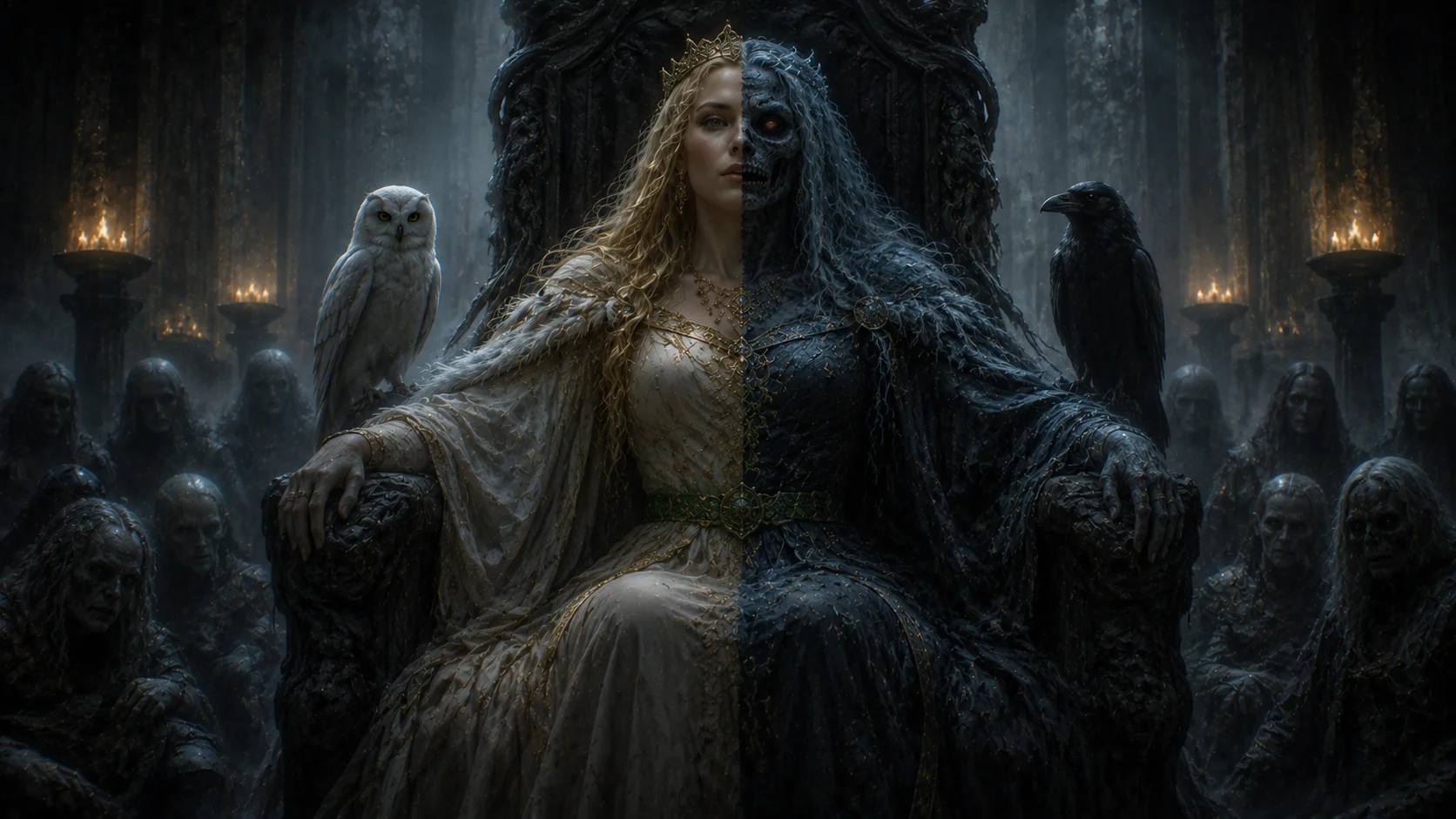
Hel (Old Norse Hel) was one of the three monstrous children of the trickster Loki by the giantess Angrboda — sister to the great wolf Fenrir and the world-serpent Jörmungandr. When Odin learned that Loki's children were fated to bring great harm, he cast Hel down into the cold lower world and gave her dominion over it — authority over all the dead who came to her, that she might give them lodging in her vast, grim halls. She was described as half one colour and half another — one side of her a living woman, the other side the blue-black of a rotting corpse — a fitting form for the queen of death, at once alive and dead.
The Realm of Hel
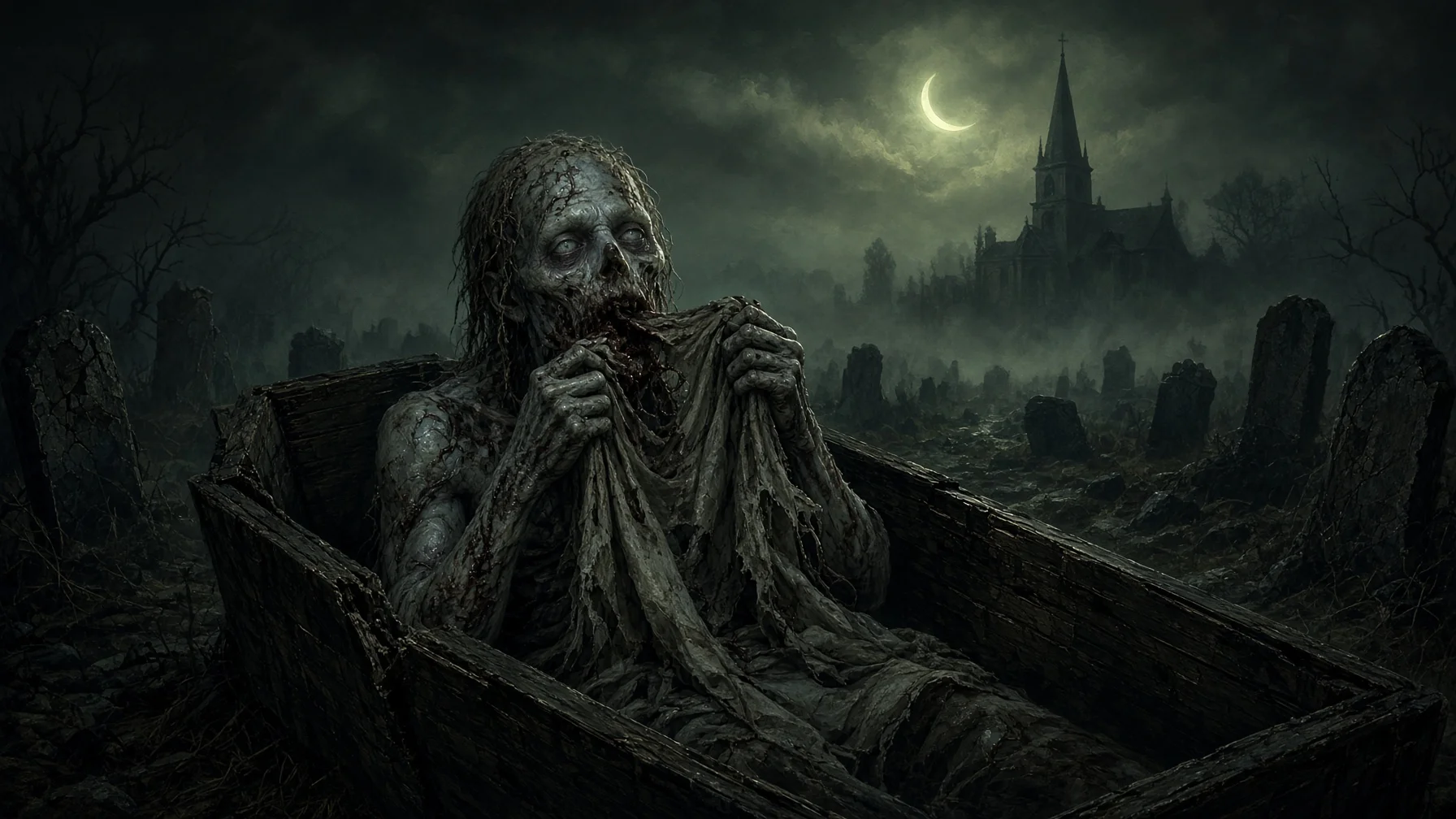
The realm she ruled, also called Hel (or Niflheim in its deepest cold), lay far below the world, reached by the long dark road that Hermod rode and guarded by the river Gjöll. To it came the great mass of the dead — not the warriors slain gloriously in battle, who went to Odin's Valhalla or Freya's Fólkvangr, but those who died of sickness, of old age, of the ordinary deaths that claim most mortals. Her hall was called Éljudnir, and her domain was a cold, dim, joyless place — not a hell of torment like later Christian visions, but a shadowy, gloomy abode where the dead simply continued, grey and quiet, beyond the reach of the living world.
The Keeper Who Would Not Yield
Hel's most famous appearance is in the tale of Baldr. When the shining god was slain and came down to her realm, she received him and seated him in honour. And when the gods sent Hermod to beg for his return, it was Hel who set the condition: she would release Baldr only if all things in all the world wept for him. When one giantess (Loki in disguise) refused to weep, Hel held to her word and kept Baldr among the dead. In this she showed her essential nature: not malicious, but utterly impartial and unbending — death keeping what death is owed, according to the bargain struck, neither moved by grief nor swayed by the gods.
The Queen of the Dead
Hel endures as the Norse personification of death and ruler of the dead — the grim half-corpse queen whose name became, through the conversion of the north, the English word “Hell,” though her cold and quiet realm was far from the fiery torment that word later came to mean. She embodies the Norse vision of death as a vast, shadowy continuation rather than punishment, ruled by an impartial queen who claims her due, gives the dead their lodging, and holds, unbending, to the bargains of death.
She is half living woman and half rotting corpse, queen of all who die quietly in their beds — and when she sets the price of a soul's return, not even the weeping of all the gods can move her to lower it.
The Oldest Ink
Hel does not begin with Snorri Sturluson, though his thirteenth-century Prose Edda is where most of her furniture and family gossip survive. The older poems know her too. Völuspá, the seeress's vision of the world's beginning and end, speaks of the roads that lead to Hel and of the grim shore that lies beyond them; and a short, strange poem called Baldrs draumar, “Baldr's Dreams,” takes us inside her hall before the story of Baldr's death has properly begun. In it Odin rides down alone into the lower world, raises a long-dead seeress from her grave with corpse-spells, and asks who the hall is being made ready for — the benches strewn with rings, the dais flooded with gold, a house dressed for an honoured guest. The mead, she answers, stands already brewed for Baldr. It is one of the coldest pieces of dramatic irony in the whole mythology, and it belongs to Hel alone: her hall is decorated for Baldr's arrival before he has died.
A House Furnished by Hunger
Snorri is where the household inventory comes from, and it reads less like a residence than a curse spelled out in furniture. Hel's dish was called Hungr, Hunger. Her knife was Sultr, Famine. Her bed was Kör, the Sick-bed, curtained with hangings named Blíkjandaböl, Gleaming Bale, and her threshold was Fallandaforad — loosely, the Pitfall, a name that turns the simple act of stepping into her hall into a small deliberate hazard. Even the staff are in on it: her manservant is Ganglati, her maidservant Ganglöt, both built from the same root meaning slow-going, sluggish, loath to hurry. Every object in Éljudnir is named for the last things a failing body feels — hunger, wasting, the ache of a sickbed, the slowness that arrives before the end. It is not a random list of props but the vocabulary of a bad death, arranged as housekeeping.
Shoes for a Long Walk
Belief in a journey to the land of the dead was not confined to poetry recited in a hall. Gísla saga Súrssonar records an actual burial custom, mentioned almost in passing the way a modern account might mention closing a coffin lid: helskór, hel-shoes, bound onto the feet of the dead before the mound was closed, so that nobody was sent off barefoot. It is a rare glimpse of Old Norse religion practised rather than sung — not a poet's cosmology but a family doing something with their hands at a graveside, because the road was to them as real as any road they walked themselves. There is a wrinkle in it worth keeping, too. Although the shoes are named for Hel, the speaker in the saga says they are for walking to Valhalla. Either the name had outlived the belief that produced it, or the destinations of the dead were less tidily separated in practice than the poems make them sound.
The Corner Even Hel Keeps Grim
Her own realm, as we have seen, was no place of torment — but Norse tradition did not leave the dead entirely without a reckoning. Völuspá sets a far worse address beyond it: Náströnd, the Corpse Shore, where a hall stands far from the sun with its doors facing north, woven together out of the backs of serpents. Venom falls in streams through the smoke-vent, and Snorri adds the detail that the snakes' heads all turn inward to spit it. Those who wade the heavy currents there are named with unusual precision: oath-breakers, murderers, and the man who seduces another's wife. The same poem knows a river called Slídr that runs out of the east through venomous valleys, carrying knives and swords along in its current. All of it sits at an odd angle to Hel's own impartiality — the ordinary dead she receives get grey continuation, not judgement — but the cosmology still wanted somewhere to put the few crimes a warrior culture found unforgivable, and built it a few dark steps further down.
When Hel's Dead Ride Out
Hel is not written out of the story once Baldr is settled among her dead. At Ragnarök the rising sea lifts Naglfar — the ship built from the nails of the dead — off its moorings; Snorri puts the giant Hrymr at its steering-oar, while Völuspá has a ship come out of the east with Loki at the helm. Snorri breaks off mid-catastrophe to warn his readers that a man who dies with his nails uncut adds material to that hull, which gods and men alike would prefer to see finished late — which is how trimming a corpse's fingernails became, for a few centuries, a small act of cosmic maintenance. What matters for Hel is the muster: Snorri writes that all of her people go with Loki to the last battle. Her dead do not simply wait out eternity in the grey. On the last day, they march.
The Word Beneath the Word
Her name is not decorative. Old Norse Hel and Gothic halja descend from the same Germanic word, and its nearest surviving relative is a plain verb: Old English helan, to hide or conceal. Behind that stands the Proto-Indo-European root *kel-, “to cover” — the root that gives Latin celare, to hide, and, by another branch into Greek, kalyptein, to cover, and from it the word apocalypse: an un-covering, the drawing back of a veil. Hel's name and the last revelation are the same word turned inside out. One names the hiding; the other names the moment everything hidden is finally shown. Her realm was never named for fire or punishment. It was named for concealment — the plain, unglamorous fact that the dead go somewhere out of sight and do not come back to describe it.
A Queen Who Answers to No Husband
Set beside her nearest classical parallel, Hel's strangeness comes into focus. Persephone rules the Greek underworld as a wife: carried there once, and permitted back to the world above for part of every year. Her queenship arrives through a marriage, and the seasons are an arrangement renegotiated annually. Hel has no consort named in any surviving source, no abduction, no yearly return, no bargain that comes up for renewal. She holds her seat alone and holds it permanently, ruling not through marriage but through the plain fact of who her father was and what she looked like when she was born. Where Persephone's story is a settlement revisited each spring, Hel's was struck once at the beginning and never reopened — the same unbending quality she shows Hermod at the door.
Hela in the Modern Imagination
Almost nothing survives from the Norse world to show what Hel looked like to the people who feared her: no securely identified carving, no half-corpse face on a rune stone that scholars agree is hers. Her afterlife is almost entirely literary and, lately, cinematic. The 2017 film Thor: Ragnarok rebuilt her as Hela, played by Cate Blanchett — Odin's estranged firstborn rather than Loki's daughter, her half-rotted body traded for a more conventional villain's silhouette. The game Smite makes her playable and gives her a light form and a dark one that she switches between mid-fight: not the half-living, half-dead body the medieval sources describe, but a duality of its own kind. It is a fair illustration of how selectively myths get inherited. The name travels easily. The details — the dish called Hunger, the threshold that trips you, the servants too slow to fetch help — are where the original chill lived, and they are usually what gets left behind.
Sources & traditions
- EncyclopediaWikipedia — Hel (mythological being)
- TraditionNorse texts, inscriptions and later retellings (Scandinavia)
Myths change from area to area and from time to time. This chronicle follows the most widely told versions; tellings in other villages, regions and eras may differ.