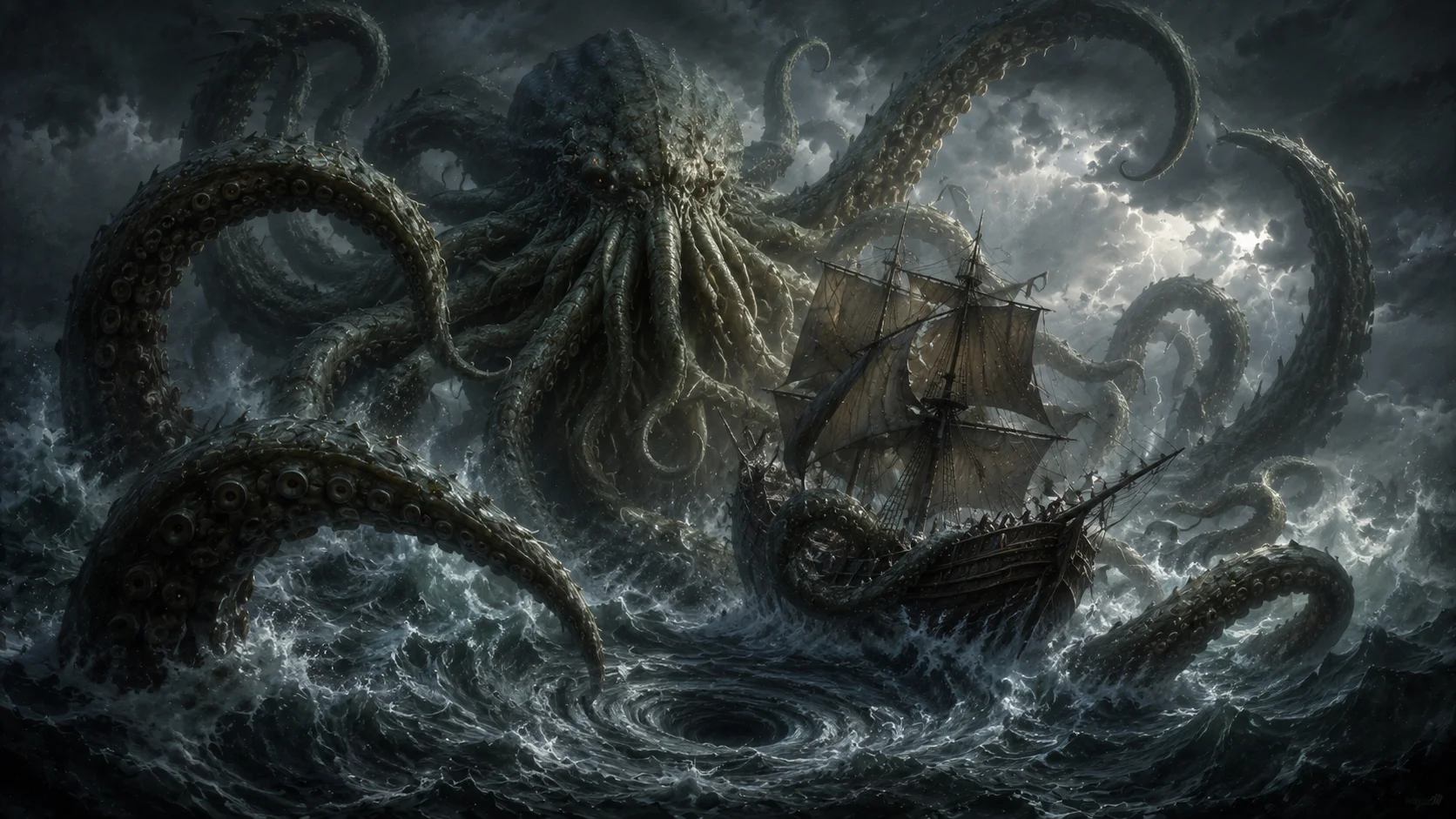
The Kraken was the legendary colossal sea-monster of Norse and Scandinavian lore — a vast, many-armed beast of the deep ocean off Norway and Iceland, so enormous that it was mistaken for an island, capable of dragging entire ships down into the depths and churning the sea into a deadly whirlpool when it dived. The most famous sea-monster in the world, it has become the very archetype of the terror of the deep.
The Monster of the Norwegian Sea
The Kraken (from the Norwegian krake) was a gigantic sea-creature said to dwell in the deep, cold waters off the coasts of Norway, Iceland and Greenland. Described as the largest of all sea-monsters, it was imagined as a vast beast — often depicted with enormous tentacles or arms like a colossal octopus or squid, though early accounts described it as crab-like or simply as an immense rounded creature. So huge was the Kraken that when it rose to the surface, its back was mistaken for a chain of islands or a stretch of land, and sailors who landed upon it found, too late, that the “island” was a living monster.
The Sinker of Ships
The Kraken was a terror to sailors in two ways. When it surfaced near a ship, its sheer size and its great arms could seize and crush the vessel, dragging it and its crew down into the depths. And when the monster dived back into the deep, it pulled down such a vast volume of water that it created a tremendous whirlpool or maelstrom on the surface, sucking down any ship caught nearby. Thus even a ship that survived the monster's rising might be doomed by its descent, swallowed by the swirling vortex left in its wake. The disappearance of ships in the northern seas was laid at the Kraken's door.
The Lure of the Fish
There was, however, a strange benefit to the Kraken in the lore. Fishermen observed (in the legends) that great shoals of fish gathered above and around the submerged monster, feeding on its droppings or drawn to it — so that a sudden abundance of fish in a particular spot was a sign that the Kraken lay below. Bold or desperate fishermen might fish directly over the monster for the rich catch, knowing that they did so at terrible risk, for the Kraken might rise at any moment and drag them down. To fish above the Kraken was to gamble a great catch against one's life.
The Archetype of the Deep's Terror
The Kraken endures as the most famous sea-monster in all the world — the colossal many-armed beast of the Norse deep, the island that is a monster, the sinker of ships and maker of whirlpools. From Scandinavian legend it passed into the wider imagination, becoming the model for countless tales of giant squid and tentacled horrors of the deep, and the very byword for the terror that lurks in the unknown depths of the sea. It embodies the ancient and universal dread of the ocean's darkness and the vast, unknowable things that may dwell below — the monster so great it could be mistaken for the land itself, waiting beneath the waves.
So vast it was mistaken for an island, it dragged whole ships into the deep and churned the sea to a whirlpool when it dived — the great Kraken, terror of the northern deep.
Before It Had a Name: Hafgufa and Lyngbakr
The Kraken is younger than the fear it carries. The word itself does not appear in the medieval Norse sources at all — what appears there instead are two other creatures, and the Kraken as we know it is largely their inheritance. The oldest surviving description comes from the Konungs skuggsjá, the Old Norwegian “King’s Mirror”, written around the middle of the thirteenth century as a father’s instruction to his son on the world and how to move through it. In its catalogue of the marvels of the Iceland sea, it describes the hafgufa — the “sea-steam” or “sea-reek” — as the greatest of all fish, so seldom seen that most men doubt it, and so enormous that the text pauses over a genuinely unsettling arithmetic: there can only ever be two of them alive, it reasons, and they must be barren, for if the hafgufa bred like other fish the oceans would long since have been filled solid with its offspring.
That is not the logic of a fairy tale. It is the logic of a medieval naturalist trying to reconcile a reported animal with the observable fact that the sea is still navigable — and it tells you how seriously the northern world took this creature. Alongside the hafgufa the same tradition sets the lyngbakr, the “heather-back”: the whale-like beast whose weathered hide, breaking the surface, looks exactly like an offshore islet with scrub growing on it. Örvar-Odds saga puts the two in a single scene, and it is the best-told version of the story in Norse. The ship sights two rocks standing out of the water and an island nearby; five men are sent ashore for water against the advice of Oddr’s companion Vignir; the island sinks under them and they drown, and what floats to the surface afterwards is heather. When the crew look back for the rocks, those have gone too. Vignir then names what they have just survived: the island was the lyngbakr, and the rocks were the open jaws of the hafgufa. Two beasts, two terrors — the false island and the vast mouth — and by the eighteenth century they had fused into one monster with a new name.
The way the hafgufa was said to feed
The detail the medieval texts dwell on is not violence but patience. The hafgufa is said to open its mouth, belch up a scent that draws fish, and simply wait while shoals crowd in of their own accord, closing only when the mouth is full. For centuries this read as pure fable. It reads very differently now. Biologists have only recently documented trap-feeding: humpback and Bryde’s whales holding their jaws agape and near-motionless at the surface while fish, apparently taking the gap for shelter, swim in unassisted. In 2023 a team led by the maritime archaeologist John McCarthy set the medieval accounts of the hafgufa beside the modern observations in the journal Marine Mammal Science and argued that the Norse were describing a real feeding behaviour rather than inventing one. Whether some fisherman actually watched it happen, nobody can prove. But it is a reminder that these accounts were not conjured from nothing: they were the deep ocean reported by people who worked on top of it, in open boats, with no way to see below.
The Island That Waits: An Older, Wider Motif
The trap of the living island did not begin in Norway. It runs through the whole medieval Mediterranean and Latin Christian world, where the Physiologus — the Greek bestiary compiled in Alexandria in the early centuries AD, which shaped European animal lore for a thousand years afterwards — describes the aspidochelone, a sea-beast whose back is crusted with sand and vegetation. Sailors moor to it, disembark, light a cooking fire, and the warmth wakes it; it dives, and takes them with it. In the Old English poem known as The Whale, preserved in the Exeter Book, the same creature is called fastitocalon, and the poet spells the allegory out rather than leaving it implied: the false island is the Devil, and the seafarers who make themselves at home on his back are the souls he carries down with him.
The Irish tradition softens it into wonder rather than warning. In the Navigatio Sancti Brendani, Brendan and his monks celebrate Easter each year on the back of the great fish Jasconius, who patiently carries them and does not drown anybody. The Norse north took the same motif and stripped out both the sermon and the miracle. No allegory, no saint — only the flat, practical horror of a coastline that is not a coastline, told among men whose livelihoods depended on reading the surface of the water correctly. That is the Kraken’s real ancestry: an old Mediterranean parable of damnation, secularised by the Atlantic into a navigational hazard.
The Bishop Who Put the Monster in a Natural History
The Kraken became the Kraken because a churchman decided it was a real animal and wrote it up as one. Erik Pontoppidan, Bishop of Bergen, published Det første Forsøg paa Norges naturlige Historie in 1752–53 — a survey of Norway’s minerals, plants, fish, birds and people, translated into English as The Natural History of Norway shortly afterwards. Set among its chapters on the sea and its creatures is a sober account of the kraken as a very large but perfectly natural animal, assembled from the testimony of fishermen and coastal clergy.
What matters is the register. Pontoppidan is not writing demonology. He is doing what an Enlightenment naturalist does: gathering eyewitness reports, comparing them, estimating dimensions — he settles on a back some “English mile and a half in circumference” — and offering practical field signs by which the creature may be recognised. His fishermen, rowing out on a summer day to a ground where the landmarks tell them to expect eighty or a hundred fathoms, find twenty or thirty instead, and cod and ling unaccountably thick around the boat; that is how they know the thing is beneath them. If the sounding keeps shallowing, it is rising, and they row. The monster is filed under animals of Norway, not under portents. This is exactly why the account spread: it came with a bishop’s authority and a naturalist’s tone, and it named the thing.
The scientific establishment briefly took the bait. In the first edition of Systema Naturae (1735), Carl Linnaeus — the man who gave us the binomial system — entered the kraken among the cephalopods as Microcosmus marinus. He was still calling it a singular monster of the Norwegian seas in his Fauna Suecica of 1746, with the honest caveat that he had never laid eyes on one; and as the work grew more exacting across its later editions the entry quietly disappeared. It is a small, telling episode: for a moment, the monster of the northern sea had a place in the same book as the housefly and the horse.
A Name That Means Something Crooked
“Kraken” is a grammatical accident that English never noticed. The root is Norwegian krake, a word applied to a crooked, branching pole or a stunted tree — and, by extension, to a sickly or misshapen animal. It carries the sense of something twisted and many-limbed rather than something merely large, which is precisely the impression a squid’s tangle of arms makes on a person seeing it break water at night. In Norwegian, kraken is simply krake with the definite article stuck on the end, as that language does: it already means “the krake”. English borrowed the definite form and then put another article in front of it, so that every time we say “the Kraken” we are, strictly, saying “the the crooked thing”. The same root survives in German, where Krake is the ordinary, unmonstrous word for an octopus.
The Whirlpool Was Not Invented
The Kraken’s most cinematic attribute — the vortex it leaves as it dives — had a real address. At the southern end of the Lofoten chain in northern Norway, between Moskenesøya and the islet of Mosken, powerful tides drive Atlantic water across a shallow, uneven ridge and into the deep Vestfjorden, producing the Moskstraumen: a system of eddies and whirlpools reckoned among the strongest tidal currents on earth, with individual vortices reported at forty to fifty metres across. Unusually, it happens in open water rather than in a confined channel, which is part of why it so unnerved the people who met it. Renaissance cartographers knew all about it. Olaus Magnus’s Carta Marina of 1539 sets a great swirl in the sea among the Lofoten islands, with a ship going down in the middle of it, and labels the spot as the horrible Charybdis. Dutch charts gave the phenomenon the name that entered English — maelstrom, the grinding stream.
So the sailors were not imagining the whirlpool. They were explaining one. A recurring, lethal, apparently causeless disturbance in open water demands a cause, and in a world without tidal hydrodynamics the only available explanation with sufficient scale is something enormous going down. Edgar Allan Poe would return to the same strait in 1841 for A Descent into the Maelström, by which time the whirlpool no longer needed a monster to be terrifying — but for the men who first told the story, the monster was the physics.
The Animal at the Bottom of the Story
Most monsters stay monsters. The Kraken is unusual in that something answering to a good deal of the description was eventually hauled onto a deck. Through the nineteenth century, fragments kept arriving: enormous beaks, arms, carcasses stranded on Danish and Icelandic beaches. From one such stranding the Danish zoologist Japetus Steenstrup recovered a beak, assembled the scattered evidence, and in 1857 gave the giant squid its scientific name, Architeuthis dux — the chief among squids. In November 1861 the French vessel Alecton met a living one in the waters off Tenerife and tried to haul it aboard; the body tore under its own weight and sank, leaving the crew with a portion of the tail, some watercolours, and an account that was read to the Académie des Sciences and disbelieved by a good number of its members.
The corroborating evidence had been in plain sight for centuries on the bodies of whalers’ prey. Sperm whales surface with rings of circular scarring on their heads, the imprint of sucker discs, and their stomachs are full of squid beaks — the record of running battles fought a kilometre down, in absolute darkness, that no human being has ever witnessed. A live giant squid was not photographed in its own habitat until September 2004, on a baited line lowered off Japan’s Ogasawara Islands, and not filmed in the deep from a submersible until 2012. Meanwhile the Southern Ocean produced something heavier still: Mesonychoteuthis hamiltoni, the colossal squid, shorter in the arms but far more massive, and equipped with rotating hooks rather than plain suckers.
It is worth being precise about what this does and does not prove. No squid sinks ships or is mistaken for an island. But the essential claim — that the deep water of the northern Atlantic holds an animal with many enormous arms, which almost nobody ever sees alive — turned out to be true, and was ridiculed for the better part of a century before it was confirmed. The Kraken is the rare case where the sceptics and the fishermen were each about half right.
The Afterlife: From Tennyson to the Multiplex
Alfred Tennyson published The Kraken in 1830, when he was twenty: fifteen strange lines in which the creature does nothing at all, lying in an ancient and dreamless sleep in the abyss and destined to rise only once, at the end of the world, to be seen by men and angels and to die on the surface. It is the moment the Kraken stops being a hazard and becomes an idea — deep time, deep water, something older than us and indifferent to us.
Nineteenth-century fiction then made the tentacle a permanent fixture of horror. Melville gives Moby-Dick a chapter in which the crew sight a vast pale mass of arms on the water and read it as an omen; Victor Hugo’s Les Travailleurs de la mer (1866) stages a long, clammy, hand-to-hand fight with an octopus in a sea cave; Jules Verne’s Vingt mille lieues sous les mers (1870) sends a pack of giant cephalopods against the Nautilus and gives the twentieth century its defining image of the arm coming through the hatch. John Wyndham’s The Kraken Wakes (1953) transposes the whole anxiety into the nuclear age, with intelligences colonising the deep ocean trenches where humanity cannot follow.
Modern screen versions have been cheerfully indifferent to the geography. Clash of the Titans (1981) planted the Kraken in Greek mythology, where it has no business whatever — the sea-beast Perseus faces in the Greek sources is Cetus — and gave the language a command line that has outlived the film. Pirates of the Caribbean: Dead Man’s Chest (2006) restored the tentacles and the ship-crushing and made the creature a summoned weapon rather than a hazard of the sea. Between them they have made “kraken” a general-purpose English word for any overwhelming thing called up from below, attached now to sports teams and spirits and software, usually by people who could not place Lofoten on a map.
Why the Deep Keeps Its Monster
Every culture that fishes has a story about the water being deeper than it looks. What makes the Kraken the one that survived is that it is a monster of scale and concealment rather than malice. It does not hunt sailors. It does not hate them. It is simply so large that its ordinary movements — surfacing, feeding, diving — are, from the deck of a boat, indistinguishable from catastrophe. That is a far more modern kind of fear than a dragon: the fear of being incidental, of drowning inside something else’s uneventful afternoon.
And the conditions that produced it have not really gone away. The floor of our own ocean is mapped in far coarser detail than the surface of Mars, and the overwhelming majority of the deep sea has never been looked at by anyone. The Kraken persists because the gap it was invented to fill — the darkness beginning a few metres below the keel, where our senses simply stop — is still there, and still full of things we meet only when they wash ashore.
Sources & traditions
- EncyclopediaWikipedia — Kraken
- TraditionNorse texts, inscriptions and later retellings (Scandinavia)
Myths change from area to area and from time to time. This chronicle follows the most widely told versions; tellings in other villages, regions and eras may differ.