The Shield-Backed Colossus of the Deep
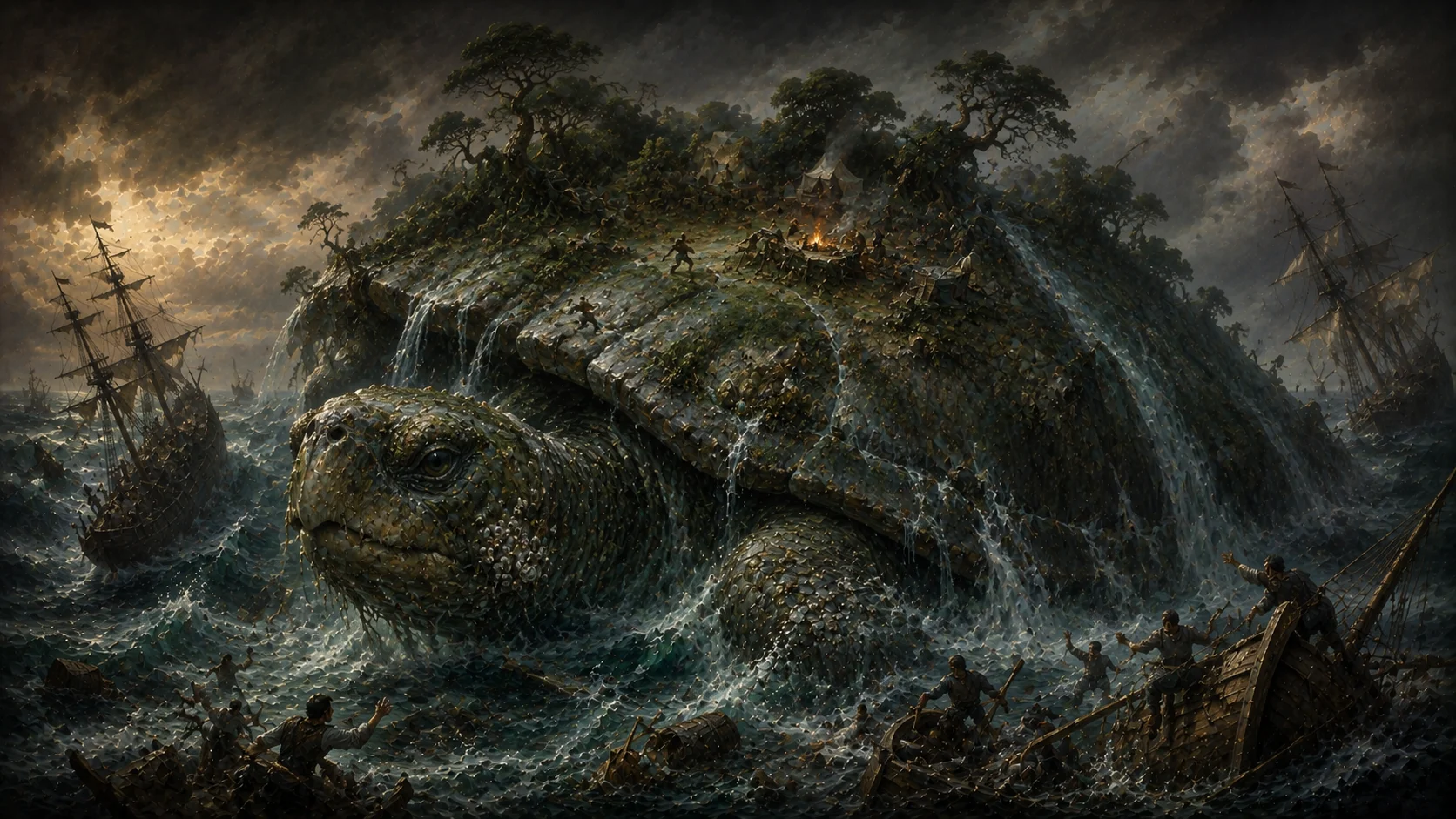
Among the strange bestiary of the ancient sea, none plays a crueler trick on the unwary than the Aspidochelone. Its very name announces the paradox at its heart: a fusion of the Greek aspis, "shield," and chelone, "turtle" — the shield-turtle, a creature armored and vast beyond any true tortoise that ever crawled from the surf. Some tellings describe it as an immense sea-turtle; others render it as a colossal whale, so that across the manuscript tradition the beast shifts shape between two of the ocean's largest bodies without ever losing its essential terror. What never changes is the scale: a back so broad, so long undisturbed by storm or tide, that it gathers sand upon itself, and vegetation takes root in that sand, and in time trees grow tall enough to sway in the sea wind. Where a sailor's eye expects only grey water to the horizon, the Aspidochelone offers instead the impossible gift of solid ground.
A Beast Born of Text, Not of Olympus
It is worth being precise about where the Aspidochelone comes from, because its origin is easy to mistake. This is not a creature that stalks the pages of Homer or Hesiod, and it holds no seat among the pagan sea-powers of the classical age — it shares no lineage with Poseidon, with old Nereus, or with his fifty Nereid daughters, and despite the surface resemblance it should never be folded into the same company as Scylla or the ravening Cetus of the Perseus myth. The Aspidochelone belongs instead to a later and very different tradition: the Physiologus, a Greek-language text compiled sometime between the second and fourth centuries of the common era, in the early flowering of Christian literature. The Physiologus is neither epic nor history; it is a catalogue of creatures, real and fabulous alike, each one yoked to a moral or theological lesson. The Aspidochelone takes its place there beside other Physiologus beasts — the self-immolating phoenix, the single-horned unicorn, the pelican that was said to feed its young with its own blood — not as a personality with a myth of parentage and deed, but as a type, an exemplar, a teaching-creature summoned to make a point about the soul and its dangers.
No Name Beyond the Name Itself
This distinction matters more than it might first appear. Where the great figures of Greek myth arrive trailing genealogies — a divine father, a monstrous mother, siblings, unions, offspring, a place carved out in the family tree of gods and Titans — the Aspidochelone arrives with none of that scaffolding. No parentage is recorded for it. No individual name distinguishes one Aspidochelone from another, because in the logic of the Physiologus there is no "another": it is a singular representative of its kind, described once and understood to stand for all its kind at once. It has no epithets beyond the plain descriptive compound that gives it its name — no cult title, no honorific, no poetic byname earned through some remembered exploit. It performs its function, teaches its lesson, and the text moves on to the next creature in its catalogue. To search for a hidden family history or a suppressed personal myth is to look for something the tradition never gave it.
The False Shore
The central drama of the Aspidochelone's story is a single, devastating sequence, told and retold with only minor variation across the centuries. A ship crosses open water, its crew weary, watchful for any relief from the featureless sea. Land appears — or what looks like land: a low rise breaking the water's plane, textured with sand and green with growing things, exactly what a tired sailor hopes to see. The ship turns toward it. The crew disembarks, feet finding what feels like solid earth beneath them, and begins to do what shipwrecked or simply exhausted mariners do on any shore: they make camp. They drive stakes into the "ground" to secure their vessel or their tents. And, because the work of the day is done and the evening calls for it, they light fires to cook their food.
The Heat That Wakes the Deep
It is the fire that undoes them. The Aspidochelone has lain motionless and patient throughout — whether out of true stillness or simple indifference, the old text does not say — but the growing warmth of a cooking-flame on its back is not a sensation it will endure. Feeling the heat spread across that vast hide, the creature stirs, and then, in a single overwhelming motion, it dives. There is no second warning, no slow subsidence that might let a quick-footed sailor scramble back to the ship. The island the crew had trusted simply ceases to be, and the sea closes over the place where solid ground had stood only moments before. Men, fires, stakes, and — in the fullest tellings — the ship itself are dragged down together into the drowning dark, the false shore proving, at the last possible instant, to have been alive all along.
A Second Mouth, A Second Snare
The island-deception is the Aspidochelone's most famous trick, but the Physiologus tradition credits it with a second, smaller cruelty that mirrors the first at a different scale. Some versions of the account describe the creature luring not sailors but fish, drawing them in with a breath or an emanation described as sweet-smelling — an odor that small fish find irresistible, swimming toward it of their own accord only to be swallowed the instant they draw close. The parallel is exact and clearly intentional: where the island lures men with the promise of rest, the scent lures fish with the promise of pleasure, and in both cases what looks like an invitation is in truth the opening of a mouth. The Physiologus was not interested in the Aspidochelone as a single anecdote but as a demonstration of a principle, and giving the creature two separate methods of the same deception was its way of underlining that the danger was general, not incidental — that deceit, wherever it appears, tends to work by exactly this logic.
The Devil Wearing an Island's Face
None of this would have mattered to the text's original audience as mere nautical folklore — the Physiologus existed to moralize, and the Aspidochelone was given one of its most explicit and fully developed allegorical readings. The beast, in this reading, is not simply a hazard of the sea but a figure for Satan, the Devil himself, cast in the shape of a vast and patient predator. The sailors who mistake its back for land and its false hospitality for safety stand in for sinners: souls who fasten their trust to something that only resembles solid ground — worldly comfort, false doctrine, the seeming safety of sin — and settle in, build their lives upon it, warm themselves at fires that feel secure. The dive that follows, sudden and total, is damnation: the moment the trusted ground reveals itself as the mouth of the abyss and drags the unwary down to Hell. This was not a moral appended after the fact to an existing sailor's tale; it is a core and well-attested part of how the Physiologus presents the creature from the outset, inseparable from the narrative itself. The Aspidochelone does not merely frighten in this text — it accuses, and it warns.
An Older Current Beneath the Text
Even so, the Physiologus's Aspidochelone was almost certainly not invented whole-cloth by its compiler. The image of an island that turns out to be a living creature belongs to a much broader family of ancient Mediterranean sailors' tales, stories of vast sea-beasts mistaken for land that likely circulated — in variant, unwritten forms — before and alongside the Physiologus's own version, and that some scholars trace further still, into a wider Indo-Mediterranean tradition of mariners' lore. What can be said with confidence is narrower and more precise: the Aspidochelone as a named Greek term, fixed with its specific moral apparatus and its specific double motif of island and scented breath, is the Physiologus's own formulation. The text did not conjure the fear of the false island from nothing; it gave that fear a name, a shape, and a sermon to carry.
A Turtle That Became a Whale
As the Physiologus was carried outward from its Greek original into Latin and from Latin into the vernacular bestiaries of medieval Europe, the Aspidochelone's very anatomy proved unstable in translation. Where the Greek text leans toward the image of an immense sea-turtle, later manuscript traditions frequently render the creature as a giant whale instead — sometimes glossed directly as a "whale-island" in Latin and later European renderings. This is not a case of two different creatures being confused with one another; it is one figure, translated and re-translated across centuries and languages, drifting in physical description while its function and its moral never wavered. Turtle or whale, shield-backed or smooth-hided, the beast that mattered to the bestiary compilers was never really zoological — it was the shape deception takes when it wants to be mistaken for rest.
The Most-Copied Page in the Bestiary
Whatever its exact silhouette, the Aspidochelone traveled further and was copied more widely than almost any other entry the Physiologus produced. Carried into Europe through successive Latin translations, it became one of the most frequently reproduced figures in the entire medieval bestiary tradition — a testament to how well its single, vivid image did the work asked of it. A moral about false security needs no elaborate theology to land; it needs only the picture of a ship's crew lighting a fire on what they believe is solid earth, and readers across centuries and languages found that picture as unsettling as the Physiologus's first audience had.
The Island That Sailed On Without It
The motif the Aspidochelone popularized did not end with the bestiaries that carried its name. The image of the vast sea-creature disguised as land resurfaces, unmistakably, in later medieval legend — most famously in the Voyage of Saint Brendan, the Irish tale of a monk's voyage across the ocean in search of a paradise beyond the waves, in which Brendan and his companions land upon an island that turns out to be a colossal whale, and — in the versions where the whale is given a name at all — is called Jasconius. These later appearances are best understood as descendants and parallels of the Physiologus's Aspidochelone rather than as pieces of the original Greek entry itself: the Christian allegorical apparatus that gave the Aspidochelone its meaning does not travel with the motif into every later retelling, even as the central image — the ground that is not ground, the island that dives — proves durable enough to outlive the text that first fixed it in words.
What the Shield-Turtle Still Teaches
Stripped of the theology that first gave it purpose, the Aspidochelone remains one of the most economical images the ancient world produced for the experience of being deceived by exactly the thing that felt safest. It asks nothing of its audience beyond a moment's imagination: the relief of sighting land after too long at sea, the trust that lets a crew put down stakes and build a fire, and the single unbearable instant in which all of that trust turns out to have been misplaced from the very beginning. The Physiologus built the creature to warn against false ground of every kind — doctrinal, moral, spiritual — and in that warning gave later centuries an image sturdy enough to be borrowed again and again, long after the sermon that first launched it had been set aside in favor of the story alone.
Sources & traditions
- EncyclopediaWikipedia — Aspidochelone
- TraditionGreek texts, inscriptions and later retellings (Greece)
Myths change from area to area and from time to time. This chronicle follows the most widely told versions; tellings in other villages, regions and eras may differ.