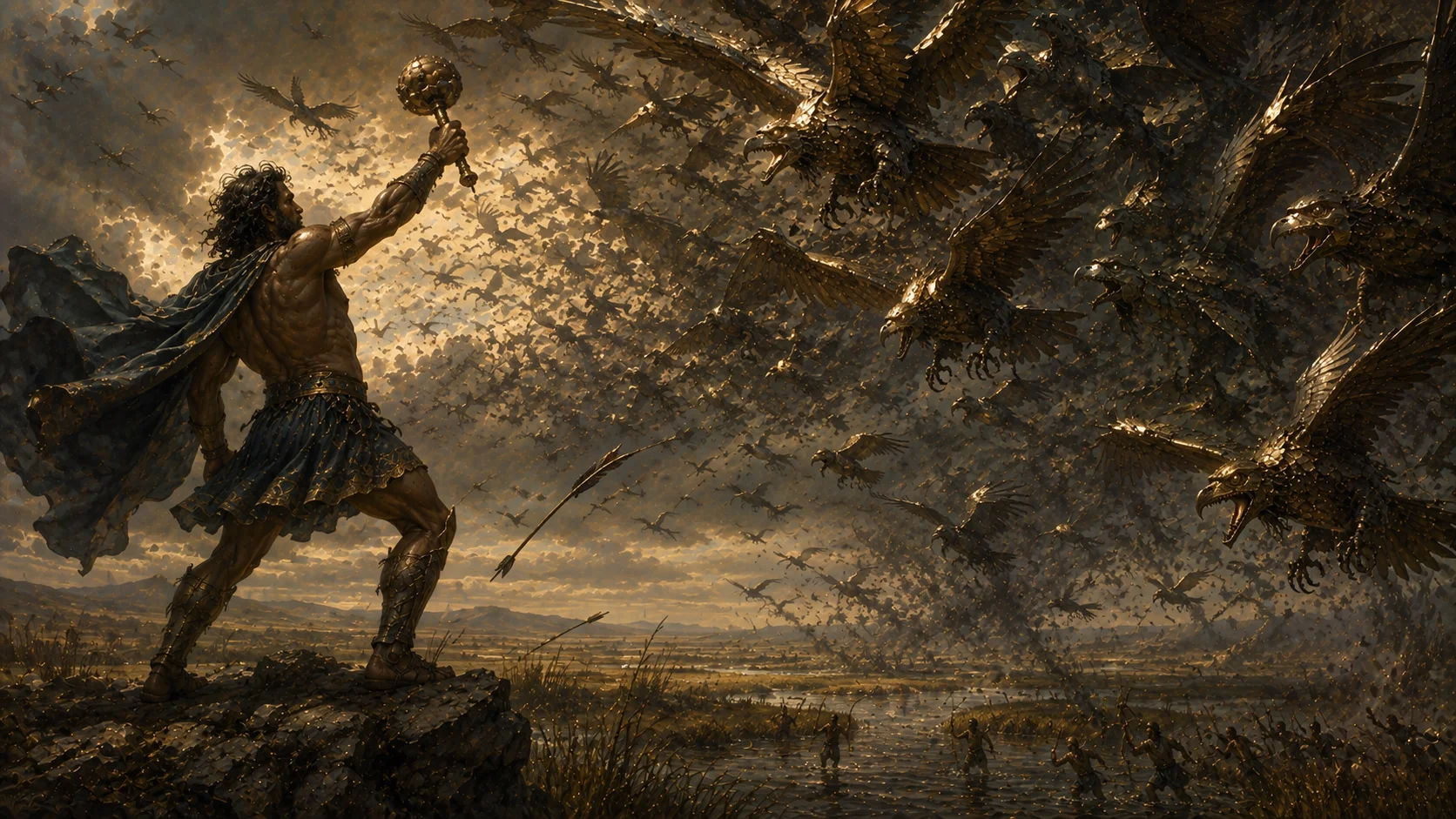
The Stymphalian Birds were a flock of monstrous, man-eating birds with beaks, claws and feathers of bronze, which infested the marshes of Lake Stymphalia in Arcadia — the quarry of the sixth Labour of Heracles. They darkened the sky in their multitudes, fed on human flesh, and loosed their metal feathers like arrows; driving them off required not strength but cleverness and the help of a goddess.
The Birds of Bronze
The Stymphalian Birds were sacred to Ares, the god of war, and were said to have bronze beaks, sharp metallic feathers that they could shoot like darts, and toxic dung that poisoned the crops. They had bred to a vast and uncontrollable number in the dense marshes around Lake Stymphalia, where they fed on the local people, and their sheer multitude — a whole sky-darkening swarm — made them impossible to fight by ordinary means. They were a plague with wings, a living storm of metal and hunger.
The Sixth Labour
King Eurystheus sent Heracles to clear the birds from the marsh — but the ground was too swampy to walk on and too watery to support a boat, and the birds too numerous to shoot down one by one. The solution came from the goddess Athena, who gave Heracles a great rattle or pair of bronze castanets (the krotala), forged by the smith-god Hephaestus. Standing on a height, Heracles shook the rattle, and its tremendous clashing din so terrified the birds that they burst into the air in a panicked cloud — whereupon the hero shot down great numbers of them with his arrows as they fled, and the rest scattered far away, never to return.
The Survivors and the Argonauts
The birds that escaped Heracles were said to have flown to an island in the Black Sea, where they were later encountered by Jason and the Argonauts, who drove them off in turn by clashing their shields and spears — borrowing Heracles's trick of frightening the metal birds with noise. Thus the creatures linked two of the great hero-cycles of Greek myth, a plague passed from one band of heroes to the next.
The Cleverness of the Labour
The Stymphalian Birds endure as a reminder that not all of Heracles's Labours were won by raw might. Against an enemy too numerous and too elusive for strength, the answer was ingenuity and a god's gift — noise to break their nerve, arrows to thin their ranks. They embody the Greek delight in the clever solution, the labour that defeated a sky full of bronze not with muscle but with a rattle.
An entire sky of man-eating bronze birds was defeated not by a sword but by a clatter loud enough to break their courage.
Before the Rattle: The Birds in Early Art
The story most readers know — Athena's gift, Hephaestus's bronze castanets, a hero standing on a hill and shaking a rattle until the sky clears — is a comparatively late elaboration. On the metopes carved for the Temple of Zeus at Olympia around the middle of the fifth century BC, among the earliest monuments to fix Heracles's exploits into a set of twelve, the panel given to the birds shows something far quieter: Heracles simply holds them out to Athena, as if presenting trophies rather than re-enacting a chase. Archaic black-figure vases of the previous century show the encounter with no rattle in sight at all — a hero armed with a sling, picking the birds off one at a time. The clashing bronze that makes the labour clever rather than brutal in the version everyone repeats today looks, on the evidence of the oldest images, like a refinement laid over an older and much plainer picture: a man bringing down troublesome birds by hand.
The Temple at the Lake
The marsh the birds infested was a real and visitable place, and centuries after Heracles supposedly cleared it, travellers still went to look at it. The geographer Pausanias, touring Arcadia in the second century AD, described the town of Stymphalos beside its lake and a sanctuary of Artemis Stymphalia in which images of the birds had been set high up near the roof. He could not decide, squinting at them from below, whether they had been made of wood or of gypsum, and settled on wood — a wonderfully deflating detail from a man surrounded by monsters. Behind the temple, he adds, stood maidens of white marble with the legs of birds. Pausanias also recorded something stranger than any monster: the lake's water, he reports, drained away into a chasm in the ground and, by local reckoning, resurfaced far off in the Argolid as the river Erasinus. Water that vanished underground and came back somewhere else needed no invented terror to feel uncanny; the birds gave a face to ground that already behaved unaccountably.
The Argonauts' Precise Escape
The Argonauts' brush with the surviving flock, sketched only in outline in most retellings, is given real narrative texture in Apollonius Rhodius's Argonautica. The birds had settled on a small island in the Black Sea called the isle of Ares, after the very god they had once served. As Jason's ship drew near, a bird passing overhead loosed a feather like a dart and struck the crewman Oileus in the left shoulder, wounding him before anyone had set foot on land. What follows is the interesting part. It is Amphidamas who knows what to do, and he knows it because he remembers: arrows are useless against these birds, he tells the others, and Heracles drove them off not with his bow but with a bronze rattle. Having no rattle, the Argonauts improvise one out of themselves — helmets on, half the crew rowing while the other half roof the deck with locked shields, and then a shouted, hammered din that lifts the whole flock away in a single rush. The episode is less a fresh invention than a deliberate echo, written for readers who already knew how a swarm of bronze birds ought to be beaten.
Kin in Feather, Not in Kind
Ancient audiences filed the Stymphalian birds alongside other predatory hybrids — Harpies and Sirens chief among them — but the resemblance is more surface than substance, and the differences say something about what each monster is built to do. The Harpies are storm-spirits with names of their own and an errand, sent to torment the blind king Phineus by snatching the food from his table. The Sirens are individuals with voices, ruining sailors by song, a temptation aimed squarely at one man's will. The Stymphalian birds have no names, no voices and no grudge to explain themselves. They are a mass, sacred to a god of war yet acting with no more purpose than a plague of locusts: a threat that cannot be reasoned with, seduced or bargained with, because there is no single mind behind it to appeal to. Where a Harpy or a Siren tests a hero's will against another will, the birds test something plainer and, in its own way, more frightening — what do you do when the enemy is simply everywhere at once?
The Fear Underneath the Feathers
Of all Heracles's opponents, the Stymphalian birds are the least like a monster and the most like a natural disaster. A lion or a hydra can be cornered, wrestled, outwitted one on one; a marsh gone black with an uncountable flock can only be endured or fled. Wetlands carried a specific dread for the Greeks beyond mere inconvenience — ground too soft to stand on, and standing water that the Hippocratic writers already linked with fever and sickness — and a lake that drained periodically into the earth only sharpened the sense that this corner of Arcadia did not answer to ordinary rules. Set loose on that landscape, a flock that could not even be counted gave shape to an anxiety older than any single hero: not the beast waiting in the dark, but the moment nature itself turns hostile in overwhelming numbers, when no measure of individual courage is enough on its own to answer it.
Sources & traditions
- EncyclopediaWikipedia — Stymphalian birds
- TraditionGreek texts, inscriptions and later retellings (Greece)
Myths change from area to area and from time to time. This chronicle follows the most widely told versions; tellings in other villages, regions and eras may differ.