Orion was a giant huntsman of extraordinary size, beauty and skill — a mortal so mighty he could walk across the sea and through the deepest waters with his head above the waves, whose tangled loves and violent death ended with his being set among the stars as the most magnificent constellation in the winter sky. His tale weaves together the hunt, blindness and healing, divine love and divine jealousy.
The Giant Hunter
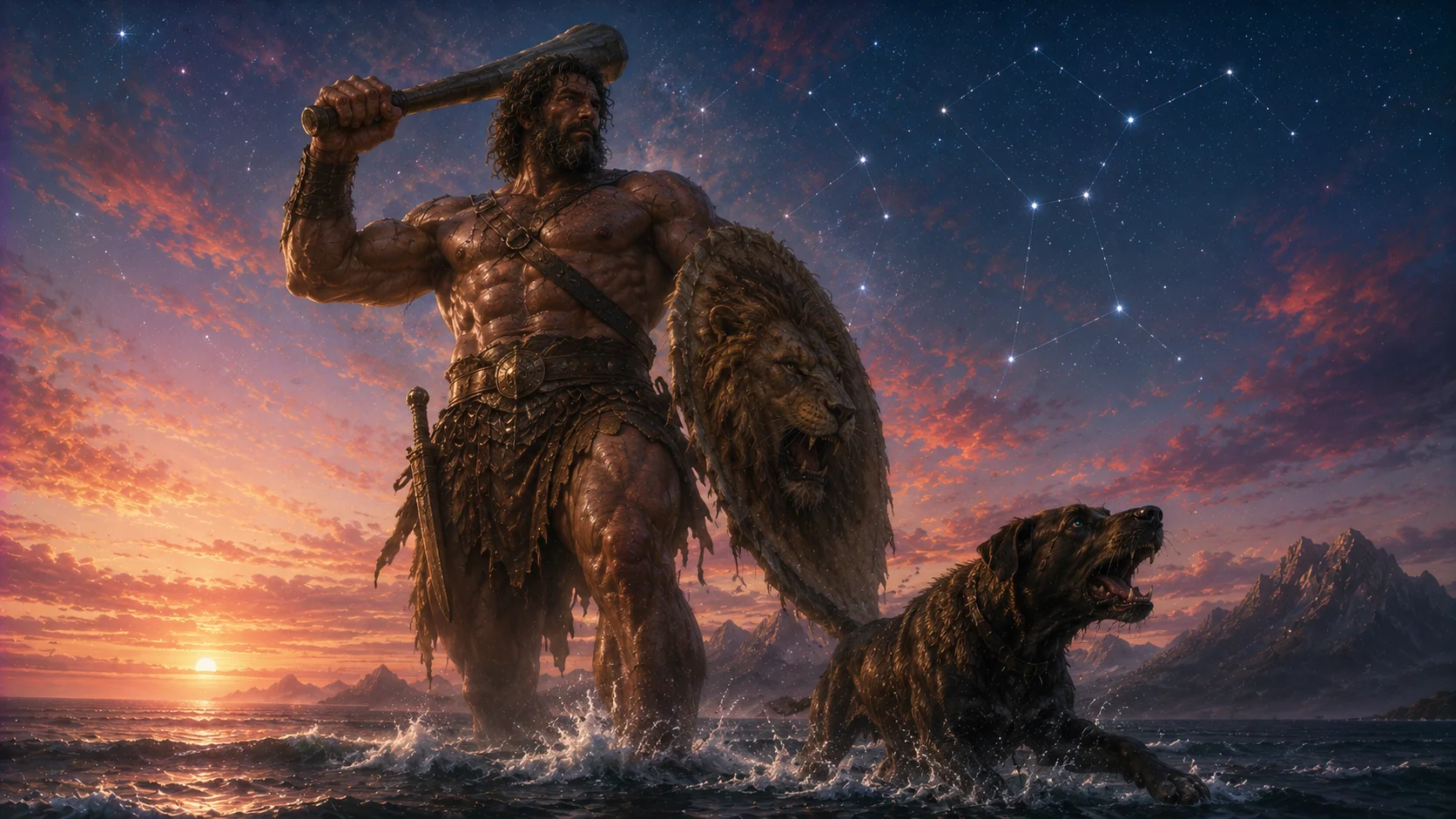
Orion was a son of Poseidon (who gave him the power to stride across the sea) and was renowned as the greatest hunter of his age, a giant of beauty and strength who roamed the wild with his hunting dogs. He loved the goddess Artemis, mistress of the hunt, and was perhaps the only mortal she ever cared for in return — for in him she found a companion who shared her passion for the chase. His prowess was such that he boasted he could slay every beast on earth.
Last updated .
Blinding and Healing
One of the most famous episodes of his story tells how Orion, in love with the princess Merope, was blinded by her father Oenopion as punishment for an offense against her. Sightless, the giant was guided by a boy he set upon his shoulders and walked east toward the rising sun; and when he came to the place where Helios the sun-god rose from the Ocean, the sun's healing rays restored his sight. The image of the blinded giant walking toward the dawn to be healed became one of the most haunting in Greek myth.
Death and the Stars
Orion's death is told in several ways, each tied to his fate among the stars. In one, his boast that he would kill all the beasts of the earth so alarmed Gaia that she sent a giant Scorpion to sting him to death — and the gods set both hunter and scorpion in the sky as constellations, placed so that Orion forever sets below the horizon as the Scorpion (Scorpio) rises, the hunter eternally fleeing his slayer. In another, the goddess Artemis was tricked by her jealous brother Apollo into shooting Orion herself with an arrow, and the grieving goddess placed her beloved hunter among the stars. Either way, the giant was raised to the heavens as the brilliant constellation that bears his name, with his belt of three bright stars, his sword, and his hunting dogs (Canis Major and Minor) at his heels.
The Hunter in the Sky
Orion endures as one of the most recognisable figures in the night sky — the great winter constellation whose belt and sword have guided and awed humanity for millennia. He embodies the Greek love of the heroic hunter, the bittersweet theme of love crossed by jealousy and death, and the consoling belief that the greatest of mortals are not lost at death but lifted into the stars, to stride the heavens forever.
The mightiest hunter who ever lived walks the winter sky still, his belt ablaze, forever fleeing the scorpion that brought him down.
The Poet's Sky: Orion in Homer and Hesiod
Long before any playwright staged a tragedy in Athens, Orion was already climbing the sky in the two oldest works of Greek literature to survive. Homer reaches for him in both poems, and the glimpses that stayed with later readers are not comforting ones. In the Iliad, as Priam watches Achilles race across the plain toward Troy in blazing bronze, the old king compares him to the star the Greeks called “Orion's Dog” — the brilliant but baleful Sirius, rising in late summer as an evil sign that brings fever upon “wretched mortals.” The shield of Achilles carries him too, alongside the Bear that wheels in one place, watching Orion and alone taking no share in the baths of Ocean.
The bleakest image comes in the Odyssey. Among the dead at the edge of the world, Odysseus sees Orion's shade still hunting: a giant driving together, across the meadow of asphodel, the very beasts he had killed alone on lonely mountains in life, gripping a club all of bronze and forever unbroken. It is a hero whose appetite for the chase survives his body and outlasts the world he chased it through.
Hesiod, writing not long after Homer, cared less for Orion's ghost than for his usefulness. Works and Days turns the hunter into a farmer's clock. When Orion first appears, set the workers to thresh Demeter's grain on a well-rolled floor. When Orion and Sirius stand in the middle of the sky, cut the grape clusters and carry them home. When Orion begins to set, remember the season for ploughing. And when the Pleiades plunge into the misty sea to escape his strength, gales blow from every quarter: haul the ship out of the water and pack stones around it until the sailing season comes back. Centuries before anyone owned an almanac, the position of a dead hunter's body among the stars told an entire agricultural and seafaring world when to work and when to stay ashore.
Born of a Bull's Hide
Not every hero comes from a mother. The strangest version of Orion's birth, preserved in Ovid's Fasti and in the astronomical handbook of Hyginus, has nothing to do with Poseidon and everything to do with hospitality. A childless old farmer of Boeotia named Hyrieus once welcomed three travellers without knowing who they were: Zeus, Poseidon and Hermes in disguise. He slaughtered his ox to feed them properly, and when the gods asked what he wished for in return, the old man asked for a son. Rather than send one, the three urinated on the hide of the sacrificed ox and told him to bury it; months later a boy split the earth and stood up from the spot. The ancients themselves explained his name as a pun on that act — the Greek verb ourein, to urinate, gave the child his first name, Urion, which a single changed letter later smoothed into Orion. Homer and Hesiod give no hint of the tale; it surfaces only in later handbooks and in Latin poetry, long after the constellation had been fixed in the sky — proof that a myth already finished in the heavens could still keep growing on earth.
Dawn's Lover, Artemis's Victim
Two versions of Orion's death are told above — the scorpion Gaia sent, and Apollo's trick on his own sister. Homer preserves a third, older still. In the Odyssey, Calypso complains bitterly to Hermes that the gods begrudge goddesses their mortal lovers, and Orion is her first example: rosy-fingered Eos, the dawn, chose him, and the gods who live at ease were jealous, until gold-throned, chaste Artemis attacked him in Ortygia with her gentle arrows and killed him. It is a pattern Eos repeats elsewhere in Homer and Hesiod — she snatches away Cleitus for his beauty, and Cephalus, and Tithonus, gathering mortal men out of the world at daybreak. Only Orion's ends with the lover dead by another goddess's hand: not scorpion, not accident, but naked divine resentment over one mortal body.
The Sisters Who Fled into the Sky
Orion was not only a lover in myth; he was also a pursuer. The Pleiades — seven daughters of the Titan Atlas and the nymph Pleione — were said to have fled across Boeotia from Orion for years, until Zeus ended the chase by turning them, in one telling, first into doves and then into stars. It did not end it. Every night since, the little cluster rises ahead of the constellation Orion and appears to run before him across the sky, the giant's own rising trailing theirs by some weeks. Farmers and sailors read that chase as closely as they read Orion himself: Hesiod times harvest, ploughing and the safe sailing season by exactly when the Pleiades rise and set, so the myth of an eternal pursuit and the practical business of knowing when to bring in the grain were, for the people who told these stories, the same piece of knowledge seen two ways.
Reading the Giant: Belt, Sword and Egypt's Sah
Even someone who has never opened a book of mythology can usually point out Orion, because no other constellation offers such an unmistakable shape: three close, nearly equal stars — Alnitak, Alnilam and Mintaka, carrying names inherited from medieval Arabic astronomy — mark the hunter's belt, with a fainter smear of light hanging beneath them that the eye reads as a sword and a telescope reveals as a nursery of newborn stars. Red Betelgeuse burns at one shoulder, blue-white Rigel blazes at the opposite foot, and the whole figure straddles the celestial equator, which is why it can be seen from very nearly every inhabited latitude on Earth.
That visibility meant more than one civilisation claimed the same stars. Ancient Egypt saw them as Sah, a stellar figure identified with Osiris; the Pyramid Texts send the dead king up into the sky to take his place as Sah, travelling the same patch of heaven the Greeks would later people with a jealous huntsman and a fleeing scorpion. Two very different cultures, reading two very different stories into an identical set of points of light.
From Engraved Charts to Spacecraft
Orion's afterlife did not end with antiquity. When Albrecht Dürer helped produce Europe's first printed star charts in 1515, the hunter took his place among the classical figures drawn across them, fixing that image of him for the age of print. Less than a century later, Johann Bayer's star atlas Uranometria (1603) gave the constellation's brightest stars the Greek-letter names astronomers still use — Betelgeuse is Alpha Orionis, Rigel is Beta Orionis, though Rigel is usually the brighter of the two — turning a hunter's body into a coordinate system. The name persists even now: NASA's crewed Orion spacecraft, built to carry astronauts back toward the Moon under the Artemis programme, borrows it from the same sky the goddess Artemis was said to have sent him into.
Why the Hunter Never Truly Sets
What kept this story alive for nearly three thousand years was not only its drama but its usefulness. A farmer who could not read, and a sailor with no chart, could both look up and know the month, the work due and the weather coming, because a dead hunter's belt told them. That is the quiet strangeness of Orion: the same figure that carries the Greek fear of loving the wrong immortal also carried the harvest calendar, and carried an Egyptian king's soul into the sky, and now carries a spacecraft's name. The giant who once waded the deepest sea with his head above the waves wades through the years instead, rising every winter with the same belt and sword, still a few weeks behind the sisters he will never catch.