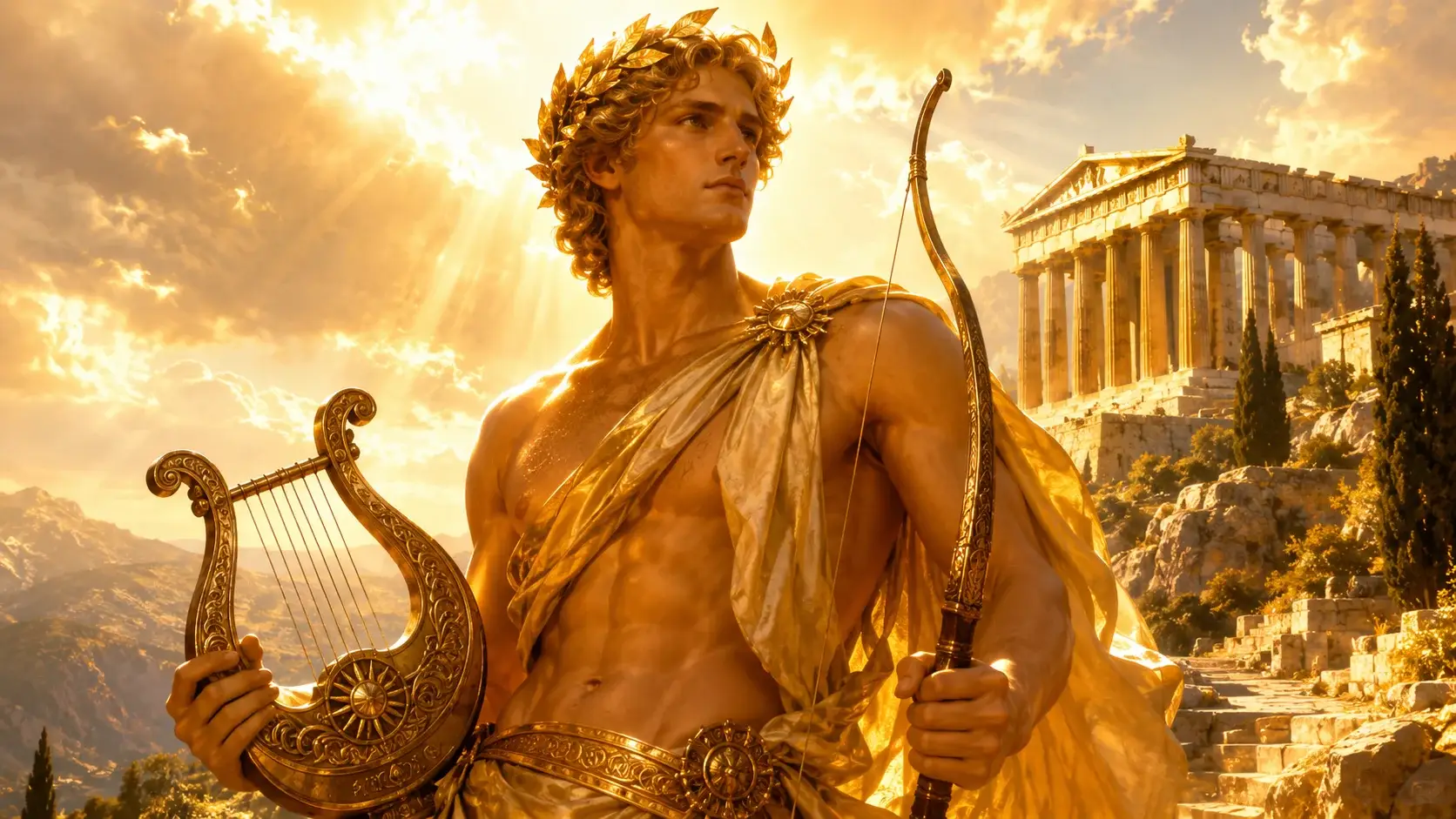
Apollo was the most luminous of the Greek gods — and the most double-edged. He was light and music and healing and prophecy, the golden ideal of harmony and reason. He was also the archer whose silent arrows brought plague, the god whose oracle spoke truths that destroyed the men who heard them. To the Greeks, Apollo was proof that beauty and terror are often the same god wearing two faces.
The Twin Born on a Floating Island
His mother Leto, pregnant by Zeus, was hunted across the world by a jealous Hera who forbade any solid land to give her shelter. Only the floating island of Delos dared receive her, and there Leto bore twins: Artemis first, then Apollo. Delos was anchored to the sea-floor in gratitude and became one of the holiest places in the Greek world.
Slayer of the Python, Lord of Delphi
While still young, Apollo travelled to Delphi and slew the monstrous serpent Python that guarded the place. Over its sacred chasm he founded his oracle, where the priestess — the Pythia — spoke his prophecies in riddling words. For a thousand years, kings and commoners alike journeyed to Delphi to ask the god what the future held. Carved at its entrance: Know thyself.
The God of Music and the God of Plague
Apollo's lyre made the music of the spheres; he led the nine Muses and embodied poetry, reason and proportion. Yet the same hand drew a bow whose arrows carried pestilence — the opening of Homer's Iliad shows Apollo striding down from Olympus “like the night,” loosing plague upon the Greek camp. Healer and harm-bringer, he held both gifts; the Greeks understood that the power to cure is the power to kill.
Loves and Losses
For all his radiance, Apollo's loves ended in grief. He pursued the nymph Daphne, who prayed to escape him and was transformed into a laurel tree — whose leaves he wore ever after in mourning. He accidentally killed his beloved Hyacinthus with a discus, and from the boy's blood raised a flower. The brightest god carried the longest shadows.
At Delphi the laurel still grows, and the old riddle still waits: know thyself — if you dare.
A God Older Than Greek
The name Apollo has no convincing derivation in the Greek language itself — a strange thing for a god the Greeks treated as the most Greek of them all, patron of everything they thought civilised about themselves. Some scholars have proposed a link to a Hittite treaty of around 1280 BCE, sworn between the great king Muwatalli II and a ruler of Wilusa — very likely the city the Greeks called Ilios, or Troy. Among the local gods called to guarantee that treaty's oaths is a name written Appaliunas. If the connection holds, it puts a strange light on something the Iliad never explains: why the most Hellenic of the Olympians spends the whole poem working against the Greeks — stripping Patroclus of his armour with his own hands, and keeping Hector's abused body from decay.
A second thread runs through the Bronze Age palace archive at Knossos, where a Linear B tablet lists a divine name, pa-ja-wo-ne, alongside Athena and Poseidon. It reaches Homer as Paieon — and in the Iliad he is still a separate figure, the physician of the gods, called in to close the wounds of Ares and of Hades himself. Apollo's cult eventually absorbed him whole. The name never vanished: it survived as the paean, the hymn sung in Apollo's honour, and as one of his oldest titles, older by centuries than any story about him that survives in writing.
The Flayed Satyr and the Donkey-Eared King
Apollo's lyre did not go unchallenged. A satyr named Marsyas found an aulos — a reed pipe — that Athena had thrown away in disgust at how it puffed out her cheeks, and he played it so well he dared challenge the god of music himself. The Muses judged, the god of Delphi could not be seen to lose, and Marsyas paid a punishment sized to the insult: Apollo hung him from a tree and flayed him alive. Centuries later Herodotus reports that travellers to the Phrygian city of Celaenae were shown a skin hanging there and told it was his, beside a river that Ovid says rose from the tears of the mourning satyrs and nymphs. It is one of the cruellest stories the Greeks told about any Olympian, and they told it about the god of harmony.
Pan fared better, if only barely. When he claimed his rustic pipes could rival Apollo's lyre, the mountain-god Tmolus judged for Apollo without hesitation — but King Midas, listening, said he preferred Pan's tune. Apollo did not kill him for it. He simply turned Midas's ears into a donkey's: a punishment far less bloody than Marsyas's, and no less pointed. Taste, to Apollo, was never a matter of opinion, and disagreeing with a god carried a price even when it was not paid in flesh.
The Raven, the Bolt, and a Year Herding Cattle
Apollo loved the mortal princess Coronis, and she was carrying his child when she took a mortal lover, Ischys, in his absence. In Ovid's telling a raven — white-feathered then, the story insists — carried the news to the god, and Apollo repaid the tale-bearer by scorching its feathers black for good: an origin story for why every raven since has worn the colour of a bad omen. Coronis died for the betrayal, by Apollo's own arrow in Ovid and by his sister Artemis in Pindar's older version. But Apollo would not let his unborn son die with her. He snatched the child from her body as it burned on the pyre and gave him to the centaur Chiron to raise. That son was Asclepius, and he grew into a healer so gifted he learned to raise the dead.
Zeus judged that an intolerable breach of the order separating gods from men, and struck Asclepius down with a thunderbolt. Apollo could not touch Zeus for it, so he took his revenge sideways and killed the Cyclopes who had forged the bolt. For that open act of sacrilege Zeus condemned his own son to a year of servitude to a mortal — not a punishing labour of the Heracles kind, but tending the cattle of King Admetus of Pherae in Thessaly. Euripides opens his Alcestis with Apollo explaining exactly this, and adds what came of it: the god repaid Admetus's decency by talking the Fates into letting him escape his appointed death, on the single condition that some other life be given in exchange. His wife Alcestis was the one who paid it. The most self-possessed of the Olympians spent a year as a herdsman, and the Greeks who worshipped him seemed to relish the image rather than hide it.
How to Worship a God Who Answers in Riddles
Delphi did not run itself. The Pythia was drawn from the local population — Plutarch, who served as a priest at the sanctuary, describes her as a woman of ordinary and unlearned background — and she sat on a tripod set over the ground where Apollo had killed the Python. Ancient writers describe her chewing the laurel sacred to the god and speaking in a trance, with attendant priests putting the answer into the hexameter verse the oracle became famous for. Those same writers spoke of a vapour rising from the rock beneath her; geologists surveying the fault lines under the sanctuary have since proposed that gases seeping up through the limestone could genuinely have produced an altered state. The idea is still argued over, but it is one of the rare places where a myth and a modern rock survey are within sight of each other. Beside her stood the omphalos, a carved stone marking what the Greeks held to be the navel of the world: the exact point where two eagles, released by Zeus from opposite ends of the earth, were said to have met.
Nobody consulted the oracle casually. City-states sent formal sacred embassies before founding a colony, starting a war or changing a law, and the answers they carried home shaped real Mediterranean history and not only myth. Every four years Delphi also hosted the Pythian Games, second in prestige only to Olympia — and where Olympia was built around athletics, the Pythian festival had begun as a single competition in singing a hymn to Apollo, the contestant accompanying himself on the lyre or kithara rather than hiring a musician to do it for him. Even after the athletic and equestrian events were added, the programme still opened with the music. At Apollo's own festival the lyre came before the discus. His epithets record his different faces: Phoebus, the bright or pure one; Loxias, the slanting speaker, for an oracle whose answers were never quite straight; Musagetes, leader of the Muses, for the god who led their choir.
Reading Apollo in Marble and Paint
A Greek vase-painter or a Renaissance sculptor gave Apollo a small, consistent set of attributes, and knowing them is the difference between recognising the god and mistaking him for any beautiful young man holding a lyre. The laurel wreath recalls Daphne. The tripod recalls the Pythia's seat at Delphi. A bow and quiver mark the archer whose arrows carry both plague and cure. Less obvious to modern eyes is the dolphin: the Homeric Hymn to Apollo tells how the god took a dolphin's shape to commandeer a Cretan ship and steer its crew to the shore below Delphi, where he made them his first priests — and the hymn has him tell them outright to worship him as Delphinios for it. Whether the sanctuary's name really came from the dolphin is another matter; linguists doubt it, but the Greeks believed it, and that is why the animal is there on the marble.
The swan belongs to him too, and the reason is unexpectedly precise. Callimachus describes swans circling Delos seven times in song as Leto laboured — and gives that as the reason Apollo afterwards strung his lyre with seven strings, one for each circuit the birds sang over his birth. Greek poets also sent a swan-drawn chariot to carry him north to the Hyperboreans, since even a god of light needed somewhere to be once Delphi turned cold and the winter months there passed into the keeping of Dionysus.
Apollonian Reason, and a Rocket to the Moon
Apollo's afterlife outgrew Greece by a wide margin. In The Birth of Tragedy, published in 1872, Friedrich Nietzsche gave the god's name to one half of a pair of forces he thought explained Greek art and much of human nature besides: the Apollonian, standing for order, individuality, dream and reasoned form, set against the Dionysian — ecstasy, dissolution, the loss of the self in music and wine. The pairing escaped philosophy entirely and became ordinary vocabulary for anyone describing the tension between control and impulse in a novel, a building or a piece of music.
Nearly a century later NASA gave his name to the programme that put human beings on the Moon. The choice was made early in 1960 by Abe Silverstein, then the agency's director of space flight programs, who went looking through a book of mythology and settled on Apollo because the image of the god driving his chariot across the sun seemed to him to match the scale of what was being attempted. It is a strange kind of immortality for a god who may have entered Greece as an import from the enemies of Troy: the last great thing to take his name was humanity's furthest reach toward the light he had always been supposed to carry.
Sources & traditions
- EncyclopediaWikipedia — Apollo
- TraditionGreek texts, inscriptions and later retellings (Greece)
Myths change from area to area and from time to time. This chronicle follows the most widely told versions; tellings in other villages, regions and eras may differ.