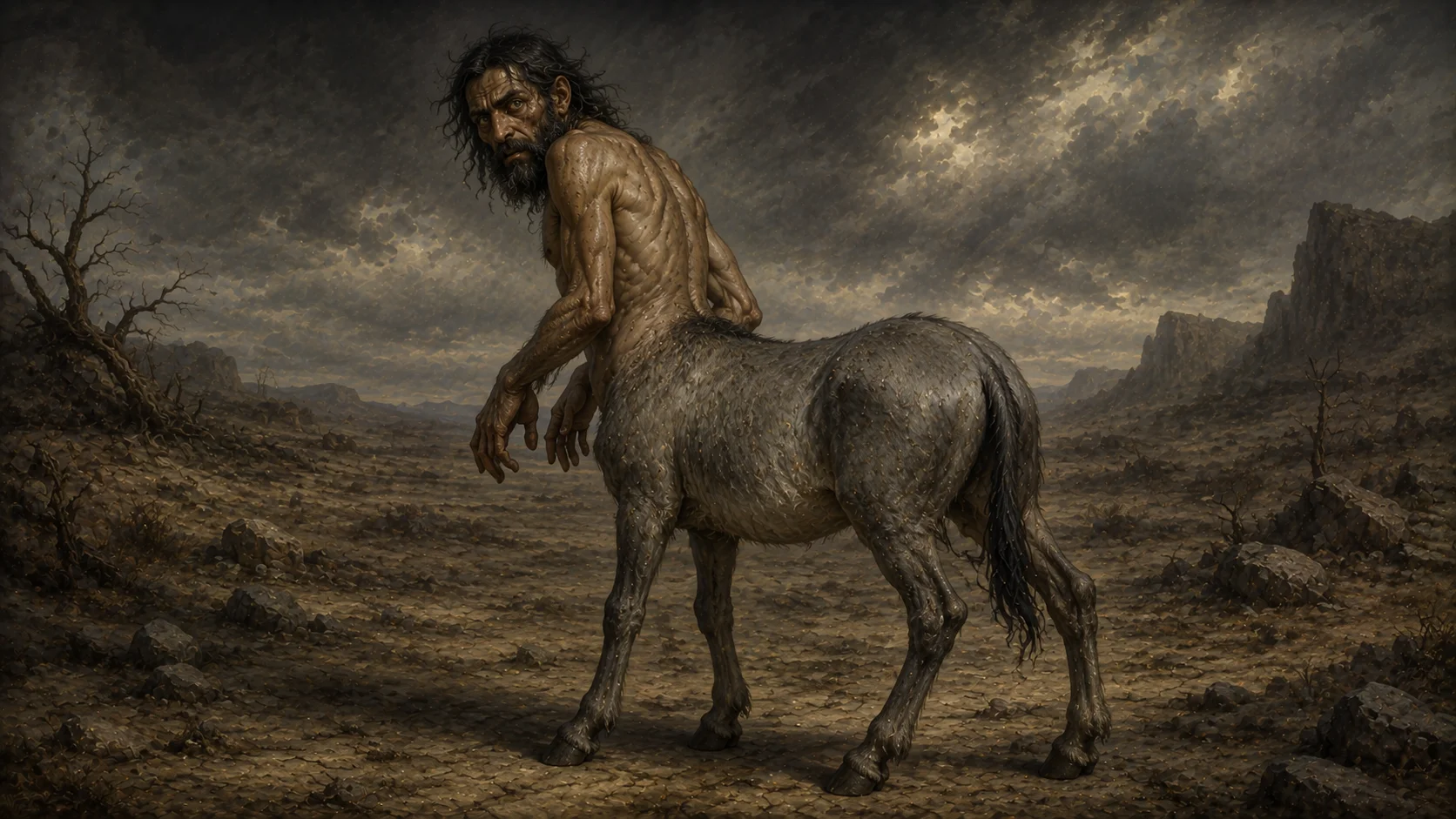
The Onocentaur was a strange hybrid of myth and bestiary — a creature with the upper body of a man joined to the body and legs of a donkey, the asinine cousin of the noble horse-centaur. Half-comic and half-sinister, it became in later tradition a byword for the brutish, deceitful and only half-human, a being in which the lower nature visibly overwhelmed the higher.
The Donkey-Centaur
The Onocentaur belongs to that crowded family of Greek composite beings in which a human upper half is grafted onto an animal's lower half, but it sits at the family's edge rather than its centre. It is a comparatively minor and late-attested figure — it does not stride through the epics or the tragic stage the way its horse-bodied relatives do, and no ancient storyteller ever gave it a name, a lover, a battle, or a death. What survives of it belongs almost entirely to a different kind of writing: not myth told as narrative, but marvel recorded as fact, or reported as believed, by men cataloguing the strange things said to live at the world's far rim.
A Name Built From Two Words
The name itself does the introducing. Onos is the Greek word for donkey or ass; kentauros is the centaur. Set together they announce the creature before a single feature is described: not the centaur of the Thessalian hills and the wedding-feast brawl, but its lowlier double, defined from the outset by the beast it is not. Where the ordinary centaur takes its dignity partly from the horse — an animal the Greeks prized for war, speed, and nobility — the onocentaur takes its character from an animal they associated with stubbornness, appetite, and foolishness. The name was never neutral. It arrived already carrying a judgment.
The Shape That Set It Apart
In form the Onocentaur followed the familiar centaur template with one substitution that changed everything: a human head, torso, and arms, set upon the body, legs, and tail not of a horse but of a donkey. The silhouette was close enough to the standard centaur to be read instantly as kin to it, and different enough that no ancient viewer could mistake the one for the other. A horse-centaur reared and charged; a donkey-centaur, whatever it did, carried the shape of the pack animal, the plough animal, the beast of stubborn burden — and that shape did a great deal of the creature's talking for it, long before any moralist put a sentence to the idea.
No Father, No Founding Myth
The ordinary centaurs come with an origin. Tradition ties them to Ixion and the cloud-phantom Nephele, or to a figure named Centaurus, and that lineage — however strange — gives the horse-centaurs a place in a family tree and a reason for existing. The Onocentaur has no equivalent. No parentage myth for the class is well attested in the surviving sources, and no specific claim about where an onocentaur comes from should be taken as settled fact; it appears in the record already fully formed, a type rather than a descendant, unanchored to the genealogies that root its horse-bodied cousins in the deeper mythic past.
A Creature of the Wonder-Catalogues
What the Onocentaur has instead of a birth story is a place in the literature of wonders. It surfaces in the tradition of Greco-Roman natural-history and paradoxographical writing — the genre, associated above all with Pliny the Elder's Natural History, that gathered exotic and composite beasts said to exist in far-off lands and set them down as reported marvels rather than as narrative myth. This is the genre's characteristic move: not "here is what the onocentaur did," which no source claims, but "here is a creature said to exist, and this is its shape." The Onocentaur belongs more properly to this catalogue of wonders than to mythology proper, and that distinction matters for understanding what kind of creature it actually is in the record.
At the Edge of the Known World
Fitting its place in the wonder-literature, the Onocentaur was typically located not in Greece itself but at the margins of the known map — in the distant, half-imagined territories such as Ethiopia or India that recur again and again in Greek paradoxography as the home of fabulous hybrid creatures. This was a common reflex of the genre: the stranger the beast, the further from the familiar Greek world it was said to dwell, so that no traveller could easily confirm or deny the report. The Onocentaur's geography is thus less a fact about a real place than a signal about the kind of claim being made — a creature of hearsay from beyond the horizon, not a beast of the local woods and rivers.
Kin Without a Family
Ancient sources classed the Onocentaur alongside the standard, horse-bodied centaurs as a hybrid variant of the same broad idea, and later writers — particularly in the early Christian and Byzantine periods — sometimes discussed it in the same breath as satyrs and other half-human beings within moralising bestiary contexts. But this classification is generic, not personal. The Onocentaur is not depicted as kin to any specific named centaur. It shares no bloodline with Chiron, no rivalry with Nessus, no companionship with Pholus. It belongs to the category of centaur-like beings without belonging to their stories.
The Standard Centaur It Was Never Confused With
It is worth being precise about what the Onocentaur is not, because the ordinary centaur's myths are so much louder that they threaten to bleed into anything wearing a similar shape. The Onocentaur has no part in the Centauromachy, the great battle between the centaurs and the Lapiths that erupted at a wedding feast. It is absent from the story of Chiron, the wise and gentle tutor who trained heroes and stood apart from his violent kin. It plays no role in the tale of Nessus, whose death at the hands of Heracles set in motion the poisoning of Deianira, nor in the story of Pholus and his hospitality gone wrong. These are horse-centaur narratives through and through, built around named individuals with grievances, virtues, and fates. The onocentaur, lacking any named individual of its own, simply never enters them.
A Wasteland Word in a Sacred Text
The Onocentaur's more prominent afterlife begins later, and in a different world entirely — that of Christian and Byzantine exegesis. In some Greek renderings of Old Testament passages describing desolate, demon-haunted wastelands, a term rendered as "onocentaur" appears among the creatures said to inhabit such ruined places. This is a distinctly post-classical, Christian-era layer of reception, grafted onto a name that pagan Greek tradition had used for something closer to a zoological curiosity. In this new setting the word stopped naming an exotic animal from a distant land and began naming a monstrous presence fit for a cursed and empty landscape — a shift in meaning as much as in genre.
The Beast the Bestiaries Loved to Moralise
From that scriptural foothold, the Onocentaur passed into the Physiologus tradition and the medieval bestiaries that drew on it, where it was reshaped again — this time into a teaching figure. Bestiary writers, working in a genre devoted to reading animals as moral emblems, seized on the Onocentaur's divided body as a ready-made lesson: here was a creature that was visibly, literally split between a rational human portion and a stubborn, lowly animal portion. It did not need much interpretive work to become a warning about people who are divided in the same way — fair-spoken on the surface, base underneath.
Two Minds in One Skin
The specific reading the bestiary tradition settled on was duplicity: the Onocentaur as a being "of two minds," its human reason and its asinine appetite pulling in opposite directions and never resolving into one coherent nature. This is a distinctly medieval Christian development, not a classical Greek interpretation — the pagan sources that mention the creature show no sign of moralising it this way. It was the exegetes and bestiarists who turned a reported wonder-beast into a portrait of hypocrisy, a creature whose two halves never agreed and whose human face could not be trusted to speak for the whole.
Painted Into the Margins
That moralised Onocentaur went on to a modest visual afterlife. It appears among the illustrated monsters of medieval manuscript bestiaries, rendered as an exotic hybrid alongside the other creatures the genre loved to catalogue and interpret, and it turns up occasionally in heraldic and illuminated contexts as a curious, marginal figure — never a central emblem, but a recognisable one. This entire visual and moralising tradition is essentially a medieval phenomenon, built on the late-antique reinterpretation of a concept that classical Greek sources had barely sketched in the first place. The bestiary onocentaur, with its allegorical baggage, is a much more fully developed figure than anything the Greeks themselves left behind.
Reason at War with the Beast
Like all the part-human hybrids, the Onocentaur — at least in its later, moralised form — dramatised the old and recurring idea of reason struggling against appetite, the human mind yoked to an animal body it cannot fully master. But where the horse-centaur could be ennobled, as in the case of the wise Chiron, the donkey-centaur carried no comparable counter-example within the sparse classical record to soften the picture. It arrives in the sources already tilted toward the lower reading: a creature whose animal half was, by the associations built into its very name, unlikely ever to be redeemed.
The Half-Human Warning
The Onocentaur endures as one of the lesser-known but tellingly layered figures at the edge of Greek tradition — a wonder-catalogue creature from Roman-era natural history that was later claimed, renamed in effect, and moralised by Christian exegesis and the bestiary tradition into an emblem of the divided and the duplicitous. It never had the narrative life of Chiron or Nessus, and no classical source hands down an onocentaur myth in the way epic and tragedy hand down theirs. What it offers instead is a case study in reception: how thin a classical thread can be, and how much later ages can weave onto it once the thread passes into new hands.
The horse-centaur could rise to wisdom in the person of one wise teacher; the donkey-centaur, without a comparable figure of its own, remained in the record what its name always suggested — the human face set over the beast that was never quite mastered.
Sources & traditions
- EncyclopediaWikipedia — Onocentaur
- TraditionGreek texts, inscriptions and later retellings (Greece)
Myths change from area to area and from time to time. This chronicle follows the most widely told versions; tellings in other villages, regions and eras may differ.