The Laestrygonians were a race of giant, man-eating cannibals encountered by Odysseus on his long voyage home — monstrous beings who destroyed eleven of his twelve ships in a single, horrifying assault, in one of the bloodiest episodes of the Odyssey. They were the savage opposite of every law of hospitality the Greeks held sacred: a people who welcomed strangers only to devour them.
The Cannibal Giants
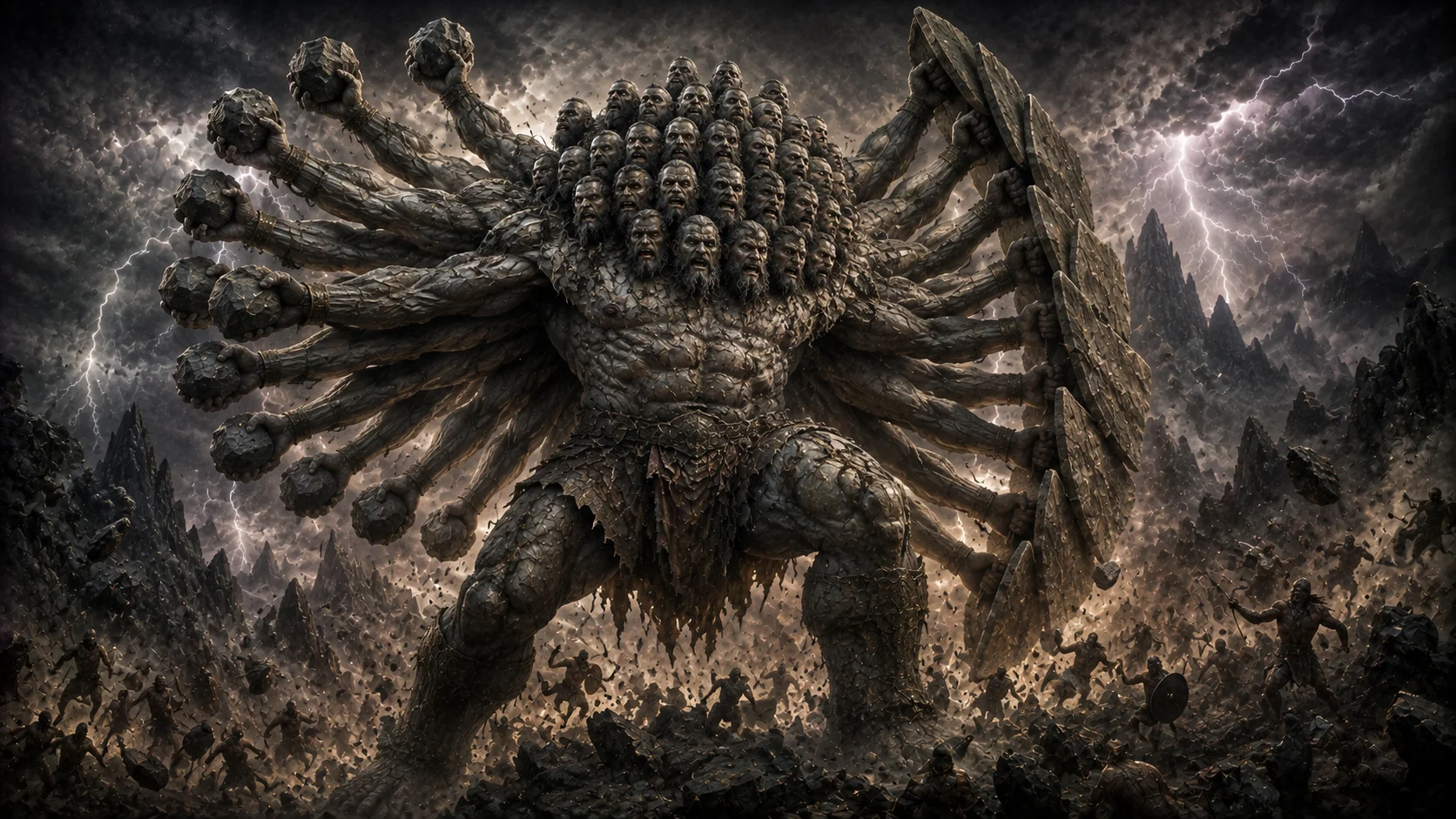
The Laestrygonians were a tribe of enormous size and brute strength, described as towering as high as mountains, who dwelt in a far land of strange days where the paths of night and morning lay close together (a hint, some think, of the long summer daylight of the far north). They were ruled by a king named Antiphates, and they lived not as scattered monsters but as a whole nation of giants — which made them all the more terrible, for there was no single beast to slay, but an entire people who hungered for human flesh.
The Destruction of the Fleet
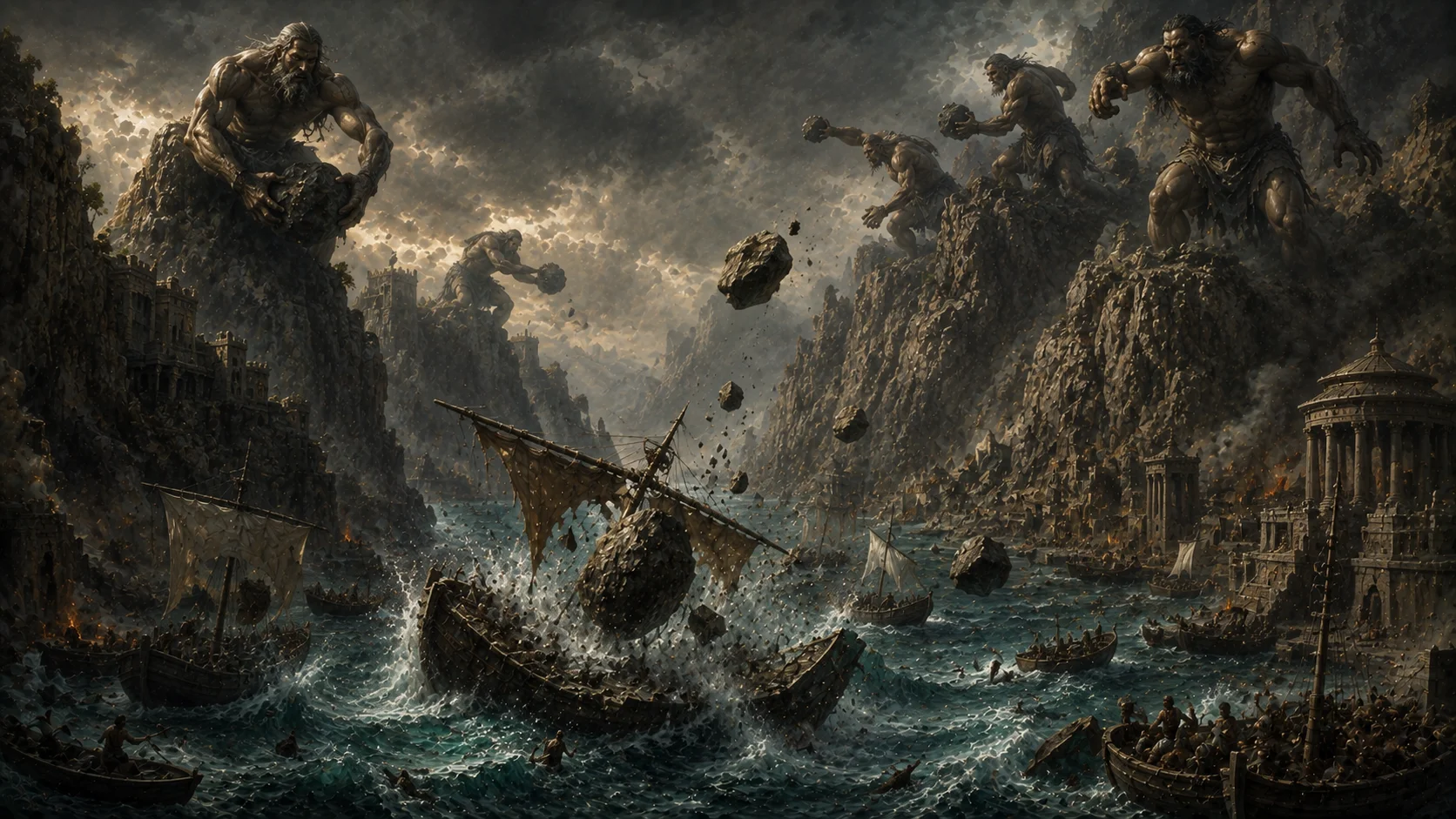
When Odysseus came to their harbour, all his ships but one sailed in and moored within the sheltered, cliff-ringed bay; Odysseus alone, cautious, tied his own ship outside. He sent scouts ashore, who met the gigantic daughter of Antiphates and were led to the king — who promptly seized one of them and ate him. As the others fled, the king raised the alarm, and the Laestrygonians swarmed to the cliff-tops and hurled down boulders, smashing the trapped ships to splinters in the harbour below. Then they speared the struggling men in the water like fish and carried them off to be eaten. Only Odysseus's single ship, moored outside, cut its cable and escaped — eleven crews lost in a few terrible minutes.
The Horror of the Closed Harbour
The episode is among the darkest in Homer. The Laestrygonians embodied the Greek nightmare of the xenos betrayed — the guest destroyed by his host, hospitality turned to slaughter. Their cliff-ringed harbour, which seemed a perfect refuge, became a death-trap precisely because it was so enclosed; the very feature that promised safety sealed the sailors' doom. The lesson, as so often in the Odyssey, was Odysseus's wary survival against his crews' fatal trust.
The Devouring Nation
The Laestrygonians endure as the archetype of the cannibal giant-race — kin in horror to the Cyclops Polyphemus, but more terrible still for their numbers. They embody the ancient terror of the unknown shore where the inhabitants are not men but monsters, and where the stranger who lands hoping for welcome finds instead that he has sailed into a larder.
Eleven ships sailed into the sheltered harbour and not one sailed out — the Laestrygonians had made hospitality itself a trap.
Telepylos, the Far-Gated City
Homer does not call their country by the vague name of a monster's lair. He gives it an address. On the seventh day of rowing, after the winds of Aeolus have betrayed him, Odysseus reaches the steep citadel of Lamos, Telepylos of the Laestrygonians — and every part of that phrase is strange. Telepylos means something like "the far gate" or "the distant gateway", a name that sounds less like a town than like a threshold at the edge of the world. Lamos is a figure the poem never explains: a founder, a king, named once and then abandoned. The tribal name Laistrygones itself resists confident etymology; no Greek root explains it cleanly, and for a name in this poem that usually points to something older or foreign, carried into the verse from a source the poet could not name either.
What the poem describes with precision is the water. The harbour is enclosed by an unbroken sheer cliff on both sides, with two headlands running out toward each other so that the entrance is a narrow throat. Inside, Homer says, no swell ever rises, great or small — there is a white calm all about. It is one of the eeriest images in the poem. Sailors who have spent six days and nights at the oar row through a stone gate into water that does not move. Every instinct a Greek seaman had would read that stillness as mercy. It is, instead, the silence of a room with no other door.
A City With an Assembly
The detail that makes the Laestrygonians more frightening than the Cyclopes is not their size. It is their civics.
Of the Cyclopes, Homer is explicit: they hold no assemblies for counsel, they have no established laws, each one rules his own wife and children and cares nothing for his neighbour. They are monstrous because they are pre-social. The Laestrygonians are the opposite. Odysseus's scouts walk up a smooth road — a made road, worn by the wagons that bring timber down from the high mountains to the town. They meet a girl at a public spring, the fountain called Artakie, drawing water as a daughter of any Greek household would, and she points them courteously to her father's house. Only inside does the scale break: they find the queen there, huge as a mountain peak, and are sickened by the sight. And when she wants her husband, she sends for him from the agora — the assembly place, the single institution that in Greek thought separates a people from a herd. Antiphates is not a beast in a cave. He is a king in council, and he is fetched from a meeting to eat a guest.
So the Laestrygonians possess the entire visible apparatus of civilisation: roads, a water supply, kingship, deliberation, a crowd that assembles at its ruler's cry. Only the content has been replaced. Homer's line as the tribe pours down from every side is that they seemed not like men, but like Giants — and the horror lands precisely because, for the length of a road and a conversation, they had seemed like men indeed.
The Joyless Feast
The Odyssey is a poem obsessed with eating. Nearly every society Odysseus meets is judged by how it handles a meal: the suitors devouring another man's herds, the Phaeacians feasting a stranger before they ask his name, Circe's drugged bowl, the crew's fatal slaughter of the cattle of the Sun. The shared meal, the dais, was the central social technology of the Homeric world — the ritual by which strangers became guests and guests became allies. The word itself comes from dividing: meat was distributed in portions, and the portions were the visible shape of the community.
What the Laestrygonians do to Odysseus's men is therefore not simply murder, and Homer's phrase is exact. They carry the speared men home for an aterpea daita — a joyless banquet. The word for the feast is the same word used for the good ones. The syntax of civilisation is intact; only the object has changed. Antiphates does not fall on the three scouts in a rage; he selects one and prepares him for dinner. The men in the water are speared like fish, which is to say they are processed, not fought. This is not the frenzy of a beast. It is provisioning.
The Hinge of the Poem
Structurally the episode is a demolition. Odysseus left Ithaca with twelve ships. The Ciconians take six men from each. The Lotus-eaters take none but nearly take the will to go home. Polyphemus eats six men in total. Telepylos takes eleven hulls and every soul aboard them — the overwhelming majority of everyone who ever sailed with him — and what follows is a different poem. From this point on there is one ship, one shrinking crew, and no reserve of any kind. Every later disaster, from Scylla to the thunderbolt that finally leaves Odysseus alone on a spar, is only possible because the fleet died here.
It is also the last time the epic pretends that caution can be shared. Odysseus's decision to moor outside the gates, tying his cable to a rock while every other captain took the sheltered water, is the survival of one man's suspicion against eleven crews' reasonable judgement. Nothing about their choice was foolish. That is the point, and it is bleaker than a moral.
The Argonauts' Harbour
Telepylos has a shadow elsewhere in Greek tradition. In Apollonius of Rhodes' account of the voyage of the Argonauts, at Cyzicus in the Propontis, the crew leaves its anchor stone at a spring also named Artakie, and the mountain above the harbour is home to a race of earth-born giants who come down and block the harbour mouth with rocks to seal the ship inside. The elements recur with unsettling exactness: the same spring-name, the same enclosing bay, the same giants, the same weapon of thrown stone, the same tactic of closing a harbour on trapped men. Whether one story fed the other, or both drew on an older sailors' tale about a particular bad anchorage in the north-east, the Greek imagination clearly kept a fixed image on file — the beautiful sheltered inlet whose hills are inhabited.
Where the Paths of Night and Day Run Close
The strangest thing Homer says about Telepylos is not about its people at all but about its working hours. There, he tells us, herdsman hails herdsman — one driving his flock in as the other drives his out — and a man who needed no sleep could earn double wages, herding cattle by one shift and pasturing white sheep by the other, because the paths of night and day lie close together.
It is a labourer's detail, not a poet's, and that is what has made it one of the most argued-over lines in ancient literature. Read literally it describes a place where darkness is so brief that the two working days almost touch — the short summer night of high latitudes — and the temptation to plant a pin on a map is enormous. It should be resisted at least a little. Homer is not writing a pilot book, and the same poem puts a country of the dead beyond the stream of Ocean. What the line does tell us reliably is the emotional direction of the voyage: Odysseus has passed out of the world where the sun behaves as it should. The Laestrygonians live where the ordinary rhythm of light has come loose. Whatever traveller's report may lie behind the detail, its function in the poem is to say this is no longer your sky.
Rome's Laestrygonian Coast
Later antiquity was far less cautious about the map, and it dragged the Laestrygonians firmly into the western Mediterranean. Thucydides, writing about the earliest settlement of Sicily, records the tradition that Cyclopes and Laestrygonians were the island's first inhabitants — and then, in a wonderfully dry aside, declines to discuss their race or where they came from, and leaves the matter to the poets. Roman writers were happy to be specific where he was not: the fertile plain around Leontini in eastern Sicily went by the name of the Laestrygonian fields.
Italy claimed them too. Formiae, on the Latian coast between Rome and Naples, was identified as the town of Lamos, and the identification stuck hard enough to become ordinary literary shorthand: Horace can mention a "Laestrygonian" jar and simply mean good Formian wine. He also addresses his friend Aelius Lamia as a nobleman descended from that ancient Lamus who first held the walls of Formiae and the shores of the Liris. Here the man-eating horror of the Odyssey has completed an astonishing journey — a Roman senatorial family has taken the cannibal giants' founder as an ancestor, and a poet is flattering them for it. Myth becomes pedigree; the man-eaters become a coastline where the rich keep villas and cellar their wine.
Painted on an Esquiline Wall
The most remarkable surviving ancient image of the episode is Roman, not Greek. In a house on the Esquiline Hill in Rome, decorated around the middle of the first century BC, a continuous painted frieze ran around a room showing the wanderings of Odysseus as a single unbroken landscape — airy blue-green cliffs and inlets with small figures moving through them, framed by painted pilasters as though the wall had been opened onto a coast. Of that cycle, now in the Vatican, the Laestrygonian panels are the best preserved, and they give several successive moments in one continuous space: the scouts on the road, the meeting at the spring, the giants on the heights, the boulders coming down, the ships breaking up in the narrow water.
What is striking about the paintings is how little interest they take in gore and how much in scale. The landscape dominates; the men are small. It is the same instinct Homer had when he described the calm inside the harbour before anything had happened — the terror belongs to the place first, and to its inhabitants second.
The Long Afterlife
The Laestrygonians never acquired the independent literary career of the Cyclops, who had a name, a face, and a grievance. They remained what they are in Homer: a plural, a crowd on a cliff. That anonymity is exactly why they have proved so portable.
In the schema he drew up for Ulysses, James Joyce gave their name to the eighth episode, and set it at lunchtime in Dublin. There are no giants in it. There is only Leopold Bloom, hungry, walking through a city where every window shows him men eating — and recoiling from a restaurant full of them, gulping and swallowing, before retreating to a quiet pub and a cheese sandwich. The correspondence is appetite itself: the crowd that consumes, the recognition that feeding is a spectacle of violence when you look at it too closely. It is one of the most faithful modern readings of the episode anyone has made, and it required no monsters at all.
Constantine Cavafy, in his poem on the voyage to Ithaka, lists them among the horrors the traveller need not fear — and his reason is the sharpest gloss the myth has received: you will not meet such things unless you are carrying them with you.
Why the Story Still Bites
Strip the giants out and the Laestrygonian episode is a scenario every human society has rehearsed. A group of exhausted people arrive somewhere unknown. The place looks good. The signs of habitation are reassuring — a road, a well, a town, people going about their business. They go ashore because everything they know about reading a settlement says this one is safe. And the reading is correct in every particular except the one that matters.
What Homer understood, and what keeps the passage from ageing, is that the deepest fear is not of the wilderness. Wilderness announces itself. The fear is of the place that has all the outward grammar of community — institutions, courtesy, a girl at a fountain who answers your question politely — and has made a different decision about what strangers are for. The Cyclops is what we are afraid of finding outside the human world. The Laestrygonians are what we are afraid of finding inside it.
Sources & traditions
- EncyclopediaWikipedia — Laestrygonians
- TraditionGreek texts, inscriptions and later retellings (Greece)
Myths change from area to area and from time to time. This chronicle follows the most widely told versions; tellings in other villages, regions and eras may differ.