Polyphemus was the most famous of the Cyclopes — a one-eyed giant, a son of Poseidon, a shepherd of monstrous flocks who became the great obstacle of Odysseus's journey home. His blinding is one of the most thrilling episodes in the Odyssey, and the moment that turned the whole sea against its hero.
The One-Eyed Shepherd
Polyphemus lived a solitary, savage life on an island (traditionally Sicily), tending his sheep in a great cave, with a single enormous eye in the middle of his forehead. A son of Poseidon, he knew no law but his own appetite, and he had no fear of gods or men.
Trapped in the Cave
When Odysseus and his men landed and entered the cave seeking hospitality, Polyphemus rolled a boulder across the entrance — far too heavy for any man to move — and casually began eating the crew, two at a time. Trapped, Odysseus could not simply kill the giant, for then no one could move the stone. So he turned to his greatest weapon: his mind.
“Nobody” and the Burning Stake
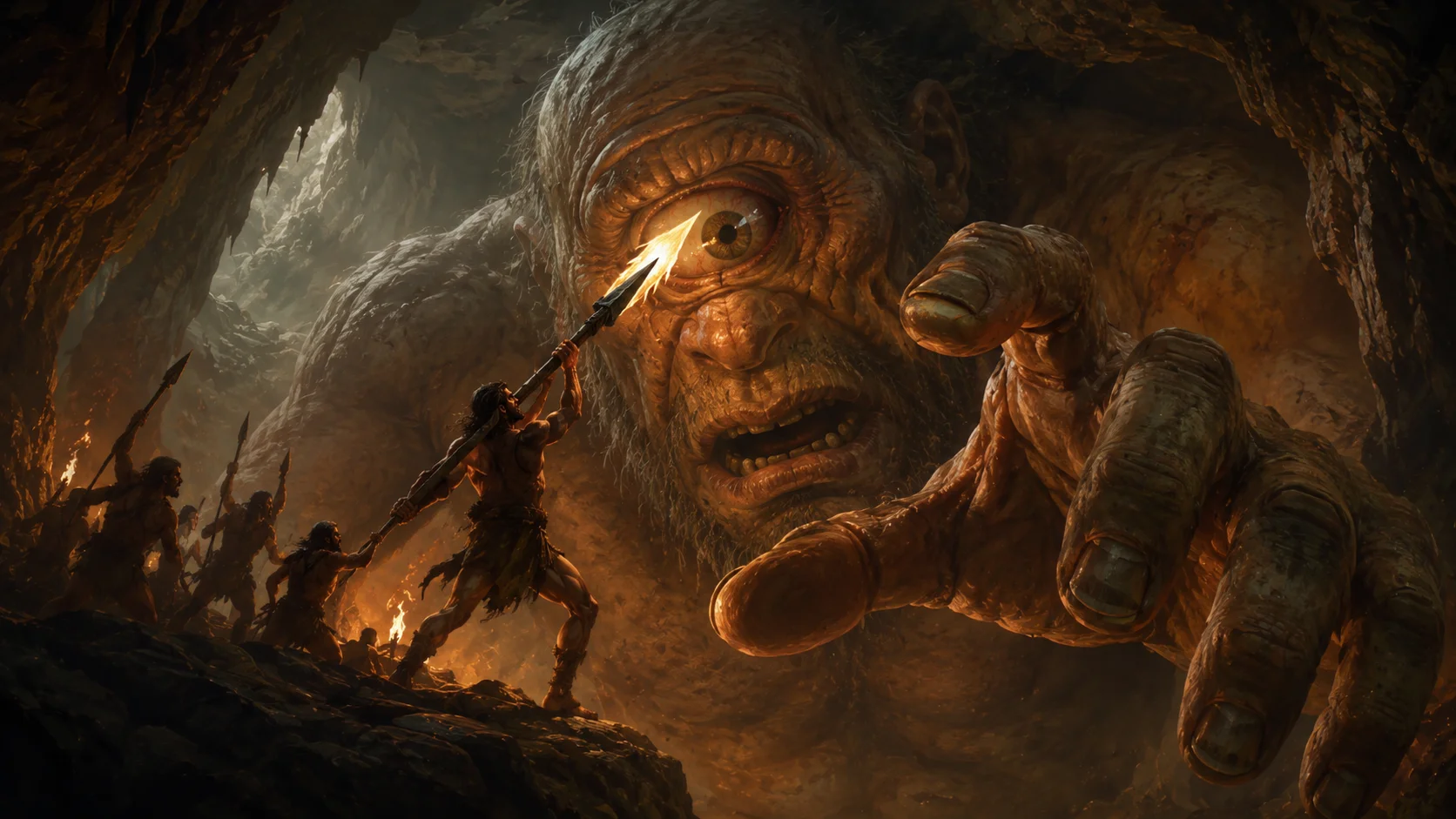
Odysseus gave the giant strong wine, and when Polyphemus, pleased, asked his name, the hero replied: “Nobody.” Once the Cyclops fell into a drunken sleep, Odysseus and his men drove a sharpened, fire-hardened stake into his single eye, blinding him. When Polyphemus roared for help, the other Cyclopes called out asking who was hurting him — and he bellowed that “Nobody” was killing him, so they shrugged and left. The men then escaped by clinging to the bellies of his sheep as he let them out to pasture, his blind hands feeling only their backs.
The Curse of the Sea
But Odysseus could not resist a final taunt — he shouted his true name back at the shore as he sailed away. Now the blinded giant knew who had wounded him, and he prayed to his father Poseidon for vengeance. The sea-god heard, and cursed Odysseus to a decade of suffering and loss before reaching home. A single moment of pride turned a clever victory into a ten-year ordeal.
He won by being “Nobody” — and nearly lost everything the instant he insisted on being somebody.
Three Sets of Cyclopes, and Only One of Them Keeps Sheep
The word Cyclops — kyklops, “round-eye” — covers three quite different populations in Greek tradition, and confusing them has muddled Polyphemus for centuries.
Hesiod's Theogony knows the Cyclopes as three primordial brothers, Brontes, Steropes and Arges — Thunderer, Lightning-flash and Bright — children of Sky and Earth, born with one eye in the forehead, and craftsmen of genius. It is they who forge the thunderbolt that makes Zeus the ruler of the cosmos. They are not monsters at all; they are the reason the universe has a king.
A separate tradition credits Cyclopes with the colossal masonry of the Argolid. Travellers in antiquity looked at the walls of Tiryns and Mycenae — Pausanias reckoned a yoke of mules could not have shifted the smallest block — and concluded that giants had built them. Archaeologists still use the term: the boulder-work of Bronze Age Greece is called Cyclopean masonry to this day, a piece of ancient guesswork fossilised in a technical vocabulary.
And then there is Homer's version, which is neither divine smith nor mason. The Cyclopes of Odyssey 9 are herdsmen. They plant nothing, though grain and vines grow for them unsown. They hold no assemblies and have no laws; each one lays down the law for his own wives and children in a hollow cave and cares nothing for his neighbour. Most tellingly, Homer notes that they have no shipwrights — no boats at all — and so a fertile island lies unworked in sight of their shore. That detail is doing quiet work. The whole passage is a Greek sailor's inventory of everything a people must have in order to count as civilised: ships, agriculture, assemblies, and the rules of hospitality. Polyphemus has none of them.
His parentage sits oddly with all three groups. He is not earth-born but the son of Poseidon by the sea-nymph Thoosa, daughter of the old sea-god Phorcys — which is precisely why his prayer, unlike the empty threats of every other creature Odysseus outwits, is answered.
The Anti-Host
To a Greek audience the horror of the cave was not the eating. It was the violation of xenia.
Guest-friendship was not manners; it was law, and its enforcer was Zeus Xenios, Zeus in his aspect as protector of strangers and suppliants. A traveller who arrived at your door was fed first and questioned second, given a bed, and sent away with a gift. Odysseus says exactly this to the giant — that Zeus avenges suppliants and strangers — and Polyphemus laughs at him. The Cyclopes, he replies, care nothing for Zeus, because they are stronger.
Then he makes the cruellest joke in Homer. Asked for a guest-gift, he promises one: he will eat Nobody last. The gift of hospitality, inverted into the order of a menu.
This is why the episode carries such weight in the poem. The Odyssey is a long catalogue of hosts — the courteous Phaeacians, the negligent suitors devouring another man's stores, Circe who feeds you and then makes you a pig. Polyphemus is the absolute floor of that scale: a host who eats his guests. Everything the poem values about human society is defined, negatively, by one afternoon in a cave.
Nobody — and the Pun Homer Buried Inside It
The trick is famous. What usually gets lost in translation is that the joke is completed not by Odysseus but by the neighbours, and in a different Greek word.
Odysseus gives his name as Outis, “No-one”, and that is the word Polyphemus bellows through the rock: Outis is killing me. But when the other Cyclopes answer, the grammar of their question and their shrugging conditional — if no one is doing you violence — requires the second Greek negative instead: mê tis. And mêtis, run together as one word, is the Greek for cunning intelligence — the exact quality Odysseus is famous for, the word sitting inside his standing epithet polymêtis, “of many counsels”.
So the Cyclopes, standing outside in the dark and deciding there is nothing to be done, unknowingly say the true answer aloud: mêtis is killing him. Then they go home. It is one of the oldest and best jokes in European literature, and it is a joke about the nature of the hero himself: brute force (biê) against wit (mêtis), with wit winning by being, in the most literal sense, nothing you can lay hands on.
There is a further irony in the giant's own name. Polyphemos means something close to “much spoken of” — abounding in phêmê, in talk, in rumour, in fame. The monster called Much-Talked-Of is defeated by a man calling himself Nobody, and then destroyed a second time when that man cannot bear to stay nameless.
The Prophecy He Had Forgotten
The moment the blinding is done, Polyphemus says something that changes the shape of the whole story. A seer had lived among the Cyclopes long ago — Telemus, son of Eurymus — and he had told Polyphemus that he would one day lose his sight at the hands of Odysseus.
The giant had been waiting, all his life, for someone huge. He had always looked, he says, for some tall and handsome man to arrive here clothed in enormous strength. Instead he got a small, worthless weakling who beat him with wine.
It is a superb piece of characterisation. Polyphemus is not undone by ignorance of his fate but by an assumption about what a threat should look like. He knew the prophecy. He simply could not imagine that danger might arrive in a shape he despised.
The Ram He Spoke To
Homer then does something almost nobody expects of a monster story: he makes you feel sorry for the monster.
Blind, groping at the mouth of the cave, Polyphemus lets his flock out one at a time, and the great lead ram comes last, slowed by the man clinging beneath its fleece. The giant stops it and talks to it. Why last today, when you are always first to the tender grass and first to the running river, first to want the fold at evening? Are you grieving for your master's eye?
Then he tells the ram that he wishes it could speak and say where Nobody is hiding.
Whatever else the scene is, it is tender — a lonely, mutilated creature confiding in an animal, while the man who blinded him hangs silently under its belly listening to every word. The Odyssey gives the Cyclops no defence, but it does give him this, and it is the reason Polyphemus has never quite settled into being a simple villain. Later Greek poets took the hint and ran with it.
The Lovesick Giant
Long after Homer, Polyphemus acquired an entirely different career: as a hopeless lover.
The object is Galatea, a sea-nymph whose name is built on gala, milk — the milk-white girl, courted by a man whose whole world is cheese and curds. The pairing is a joke about scale and about class, and Greek poets found it irresistible.
The poet Philoxenus of Cythera is credited with putting the story into a dithyramb; ancient anecdote claims he wrote it while imprisoned by the tyrant of Syracuse and made the ridiculous Cyclops a portrait of his jailer. Theocritus then gave us the version that lasted — a pastoral poem in which the young Polyphemus sits on the rocks above the sea singing to a girl who will not come out of the water, listing his assets (a thousand head of grazing stock, cheese all year round, a cave with laurels and cypresses) and admitting, with real pathos, that he knows exactly what is wrong with him. He is shaggy. He has one eyebrow, straight across from ear to ear, and one eye beneath it. Theocritus frames the whole thing as medical advice to a physician friend: there is no remedy for love but song.
Ovid completed the transformation by giving the triangle a third point. In his telling Galatea loves Acis, a beautiful youth, son of Faunus and the river-nymph Symaethis; Polyphemus sings his monstrous serenade, catches the two of them together, and hurls a piece of the mountain. Galatea cannot restore her lover, so she does the only thing available to a nymph: she turns his crushed body into water, and Acis becomes a river running clear and cold to the sea.
Sicily still keeps the scars
The geography is not vague. Sicilian tradition planted Polyphemus on the flanks of Etna and left his fingerprints along the coast north of Catania. Off the fishing village of Aci Trezza stand the Faraglioni dei Ciclopi, black basalt stacks rising straight out of the sea, pointed out for centuries as the boulders the blinded giant threw after the departing ship. The cluster of towns nearby — Acireale, Aci Castello, Aci Catena — carry the name of the murdered boy, and the little river Aci is his afterlife. Whether the myth grew from the volcanic landscape or was fitted to it afterwards, the two are now inseparable: a lava coastline that reads as the debris of a tantrum.
The Cyclops on Stage
Euripides turned the cave into comedy. His Cyclops is the only complete satyr play to survive from antiquity — the short, bawdy piece performed after a tragic trilogy to send the audience home laughing — and it is, by pure accident of preservation, our single best evidence for an entire Greek dramatic genre.
Euripides sets it beneath Etna and staffs the cave with Silenus and a chorus of satyrs, driven ashore while hunting for Dionysus and press-ganged into shepherding for the giant. Silenus is a coward and a liar who cheerfully trades away his master's lambs and cheese for a taste of Odysseus's wine, then swears blind to Polyphemus that the Greeks took them by force. Polyphemus himself arrives as something more dangerous than a brute: an articulate sophist who argues that wealth is the only god, that the belly is divine, and that hospitality laws are a fiction invented by the weak. The satyrs, promised freedom if they help with the stake, find urgent reasons to stay out of the way at the critical moment. It is very funny, and the humour has an edge — the play lets the monster make his case in the fashionable rhetoric of fifth-century Athens.
The Man Odysseus Left Behind
Virgil found a gap in Homer and pushed a whole scene into it. In Aeneid 3, Aeneas's fleet touches the Sicilian shore and a filthy, starving Greek runs down to the beach begging to be taken aboard. He is Achaemenides, one of Odysseus's crew — forgotten in the panic of the escape and left in the land of the Cyclopes for three months, living off berries and roots and hiding in the woods.
He has watched the giant since. He describes it: Polyphemus wading out into the shallows with a lopped pine for a staff, washing the ruined socket, grinding his teeth, the blood running out into the water. And then, as the Trojans row for their lives, the blind giant hears the oars and roars, and the Cyclopes come down from Etna and stand along the shore, glaring uselessly at a ship they cannot reach.
The scene is a small masterpiece of literary tact. Virgil's Trojans rescue the enemy who was abandoned by the cleverest Greek of all — and the moral point lands without a word of comment: pietas picks up what mêtis dropped.
An Ogre Older Than the Odyssey
Folklorists long ago noticed that Homer's cave is not unique. Versions of the same tale — a traveller trapped by a one-eyed man-eating giant, who blinds him with a heated stake and escapes hidden among the livestock — have been collected right across Europe, the Caucasus, the Near East and Central Asia. It has its own entry in the international index of folktale types, filed as The Ogre Blinded. Sindbad the Sailor meets a man-eating giant and puts out his eyes with red-hot spits, and one-eyed cannibal giants defeated by exactly this trick recur in the Nart epics of the Caucasus.
Which came first is genuinely unsettled, and honest scholarship says so. Either the folktale is ancient and Homer is using material his audience already knew, or the Odyssey was so widely diffused that it seeded oral tradition across three continents. What is not in doubt is that the shape of the story — small clever human, huge stupid appetite, a single vulnerable point — is one that human beings keep reinventing, and Homer's telling is the oldest surviving version we have.
How to Recognise Him in Art
Polyphemus appears in Greek art remarkably early, before the Homeric poems had settled into fixed texts. On a large Proto-Attic amphora found at Eleusis, dated to the seventh century BCE, three men drive a long pole into the face of a seated giant who is still holding his cup — the drunkenness and the stake, already the canonical composition. A krater signed by the potter Aristonothos, of roughly the same period, shows the same scene on one side and a sea battle on the other.
Two conventions help identify him:
- The pole and the wine cup together. Archaic painters often include the cup, because the wine is the point: the giant is beaten by a gift he did not understand.
- The seated, oversized body. Vase-painters could not make him tall without leaving the frame, so they made him seated and still larger than the standing men attacking him.
Roman patrons preferred the drama at full scale. At Sperlonga on the coast between Rome and Naples, a natural sea-grotto converted into a dining room for the emperor Tiberius held colossal marble groups from the Odyssey, among them a blinding of Polyphemus — figures well over life-size, staged inside a real cave, so that the guests ate their dinner in Polyphemus's own setting. It is hard to think of a more theatrical use of a myth.
The Afterlife of a One-Eyed Shepherd
The lover, not the cannibal, is what the Renaissance and after chose to keep.
At the Villa Farnesina in Rome, Sebastiano del Piombo's brooding Polyphemus sits on the wall beside Raphael's radiant Triumph of Galatea, the two frescoes conversing across the plaster — the giant looking, the nymph looking away. In Spain, Góngora built one of the most demanding poems in the language out of the story, the Fábula de Polifemo y Galatea, so dense with mythological compression that it launched a literary war. Poussin painted him from behind and very small, a dark silhouette piping on a mountainside above an enormous quiet landscape — the monster reduced to a mood in the weather.
Handel set the tale twice, in Italian and then in English, and gave Polifemo a bass part of such punishing range that it is still notorious among singers. Odilon Redon, at the other end of the tradition, painted the giant as a soft, mournful, mushroom-pale head rising over a hill to watch a sleeping woman — more voyeur than predator, and unsettling precisely because he seems so sad.
He is also, in one strand of ancient genealogy, an ancestor: Appian reports that Polyphemus and Galatea had three sons, Celtus, Illyrius and Galas, from whom the Celts, the Illyrians and the Galatians took their names — northern peoples explained, in the usual Greek fashion, by attaching them to a name already in the repertoire.
Why the Stake Still Makes Us Flinch
Every element of the episode is designed to make an audience feel small. The cave is not a lair but a working farm — cheese racks, pens with the lambs and kids sorted by age, firstlings apart from the newly weaned, vessels swimming with whey. Polyphemus is a competent dairyman. He does his evening chores, sits down, and eats two men the way you would eat two figs, and the ordinariness of the surrounding routine is what makes it obscene.
And the wound goes to the eye, which in Greek thought is where a person is. Sight is knowledge; the blind seer who sees anyway is the exception that proves the rule. Odysseus does not kill the giant — he cannot, or the stone stays shut and the cave becomes a tomb — so he takes the one thing that makes a hunter a hunter, and leaves him alive to feel it. That restraint is not mercy. It is the coldest calculation in the poem.
What survives, nearly three thousand years later, is the arithmetic underneath: strength has one weak point, and intelligence will find it. It is the fantasy every physically outmatched creature tells itself, which is why the story kept being retold from the Caucasus to the Atlantic long before anyone wrote it down. Homer's version endures because he refused to make it comfortable. The clever man wins — and the thing he beats is left alive, in the dark, talking to a sheep.
Sources & traditions
- EncyclopediaWikipedia — Polyphemus
- TraditionGreek texts, inscriptions and later retellings (Greece)
Myths change from area to area and from time to time. This chronicle follows the most widely told versions; tellings in other villages, regions and eras may differ.