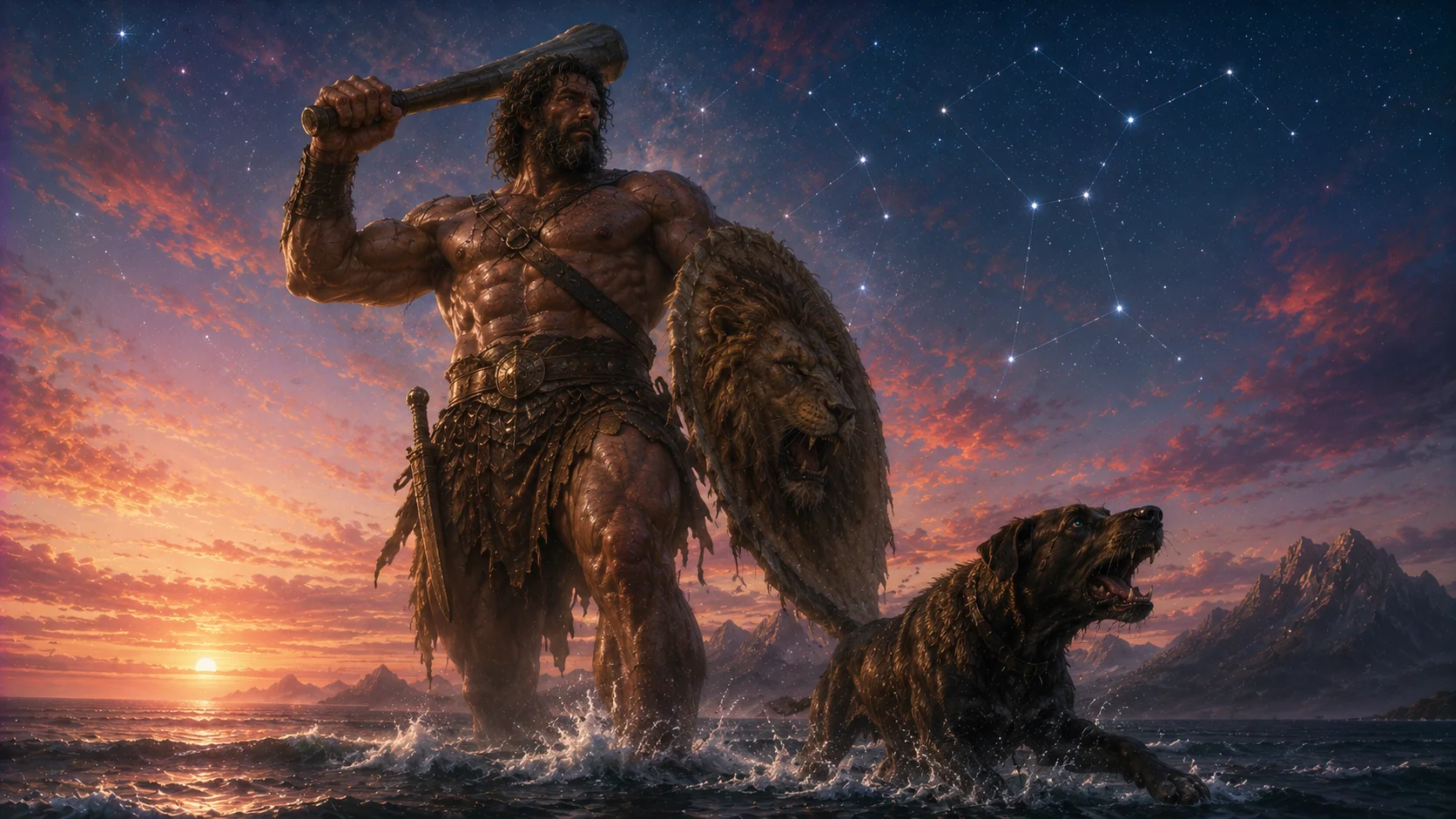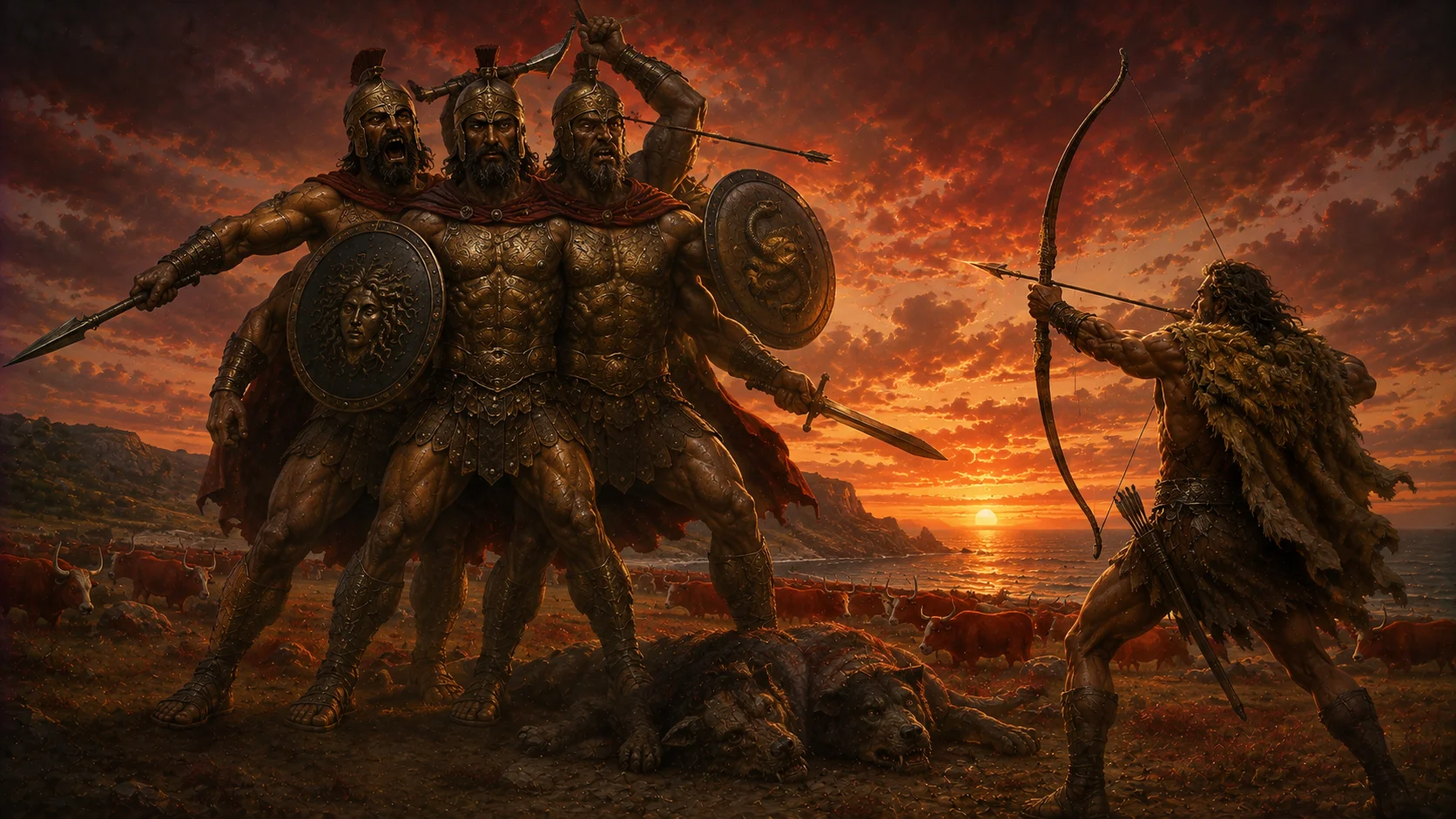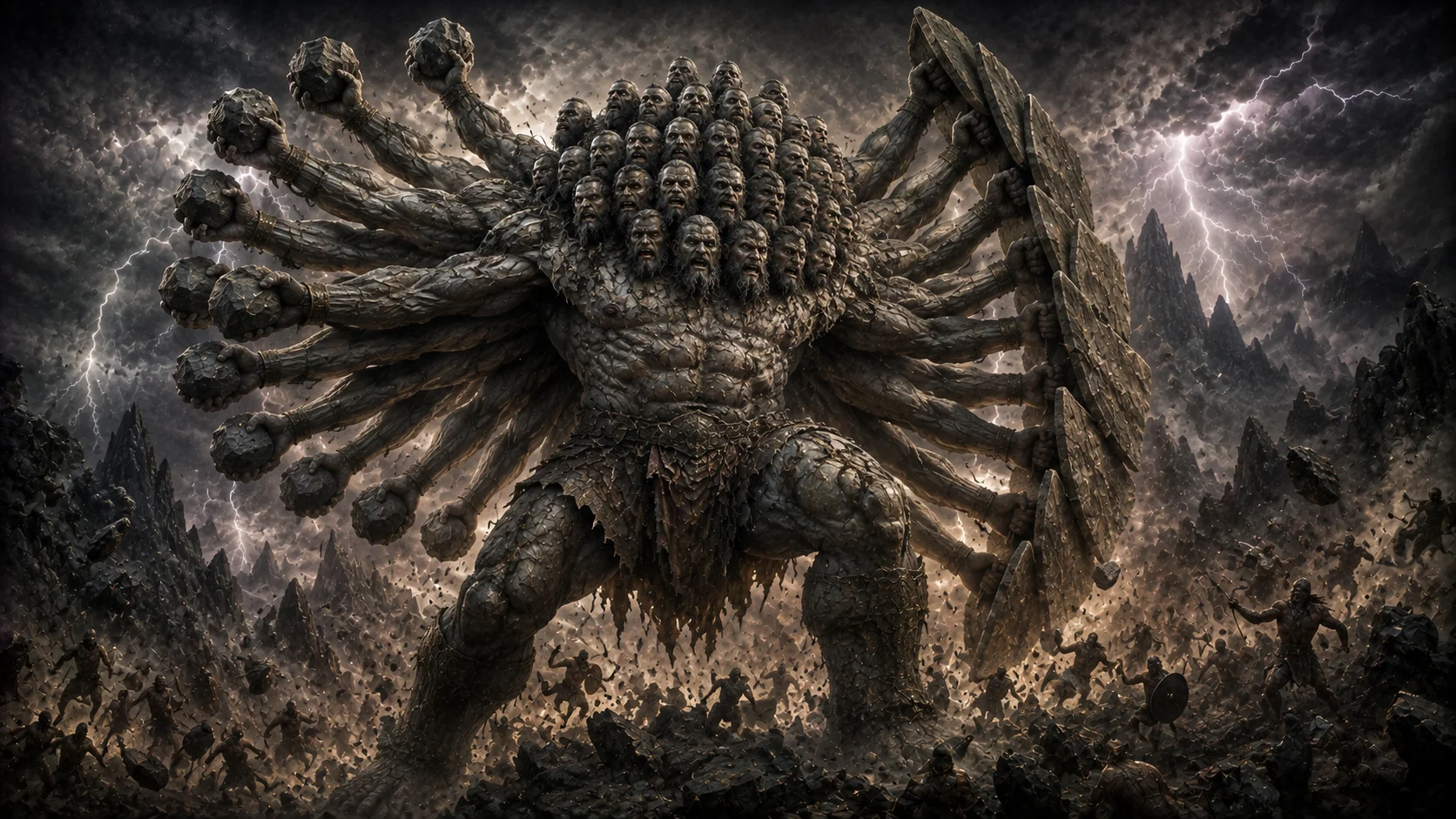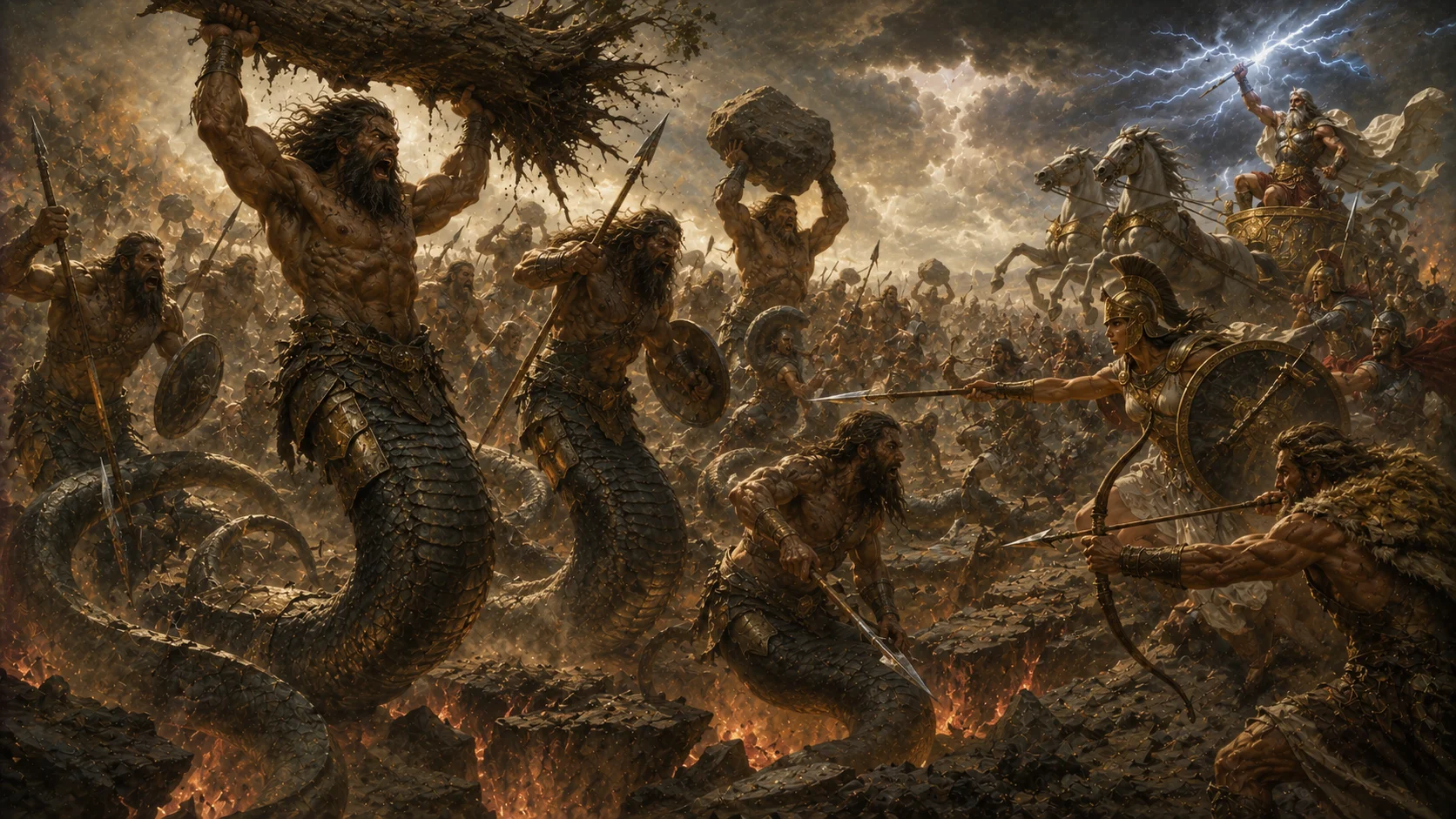
The Gigantes were a race of immense and terrible giants, born of the Earth, who rose up to make war on the gods of Olympus in the cataclysmic struggle known as the Gigantomachy — the great battle that, with the earlier war against the Titans, secured forever the rule of Zeus and his kin. They were the children of Gaia's wrath, and their defeat was the final triumph of cosmic order over primal chaos.
Born of the Earth's Blood
The Gigantes sprang from Gaia, the Earth, sown by the blood that fell upon her when the Titan Cronus castrated his father Uranus — they were thus born of an act of primal violence, monsters of the deep past. They were beings of vast size and strength, often depicted with serpents for legs and great masses of hair and beard, wild and earthy where the Olympians were ordered and bright. Gaia, ever resentful of the gods who had imprisoned her Titan children, raised the Gigantes to overthrow Zeus and avenge the older order.
Last updated .
The Gigantomachy
The war that followed was one of the defining struggles of Greek myth. The Gigantes assailed Olympus itself, hurling huge rocks and burning trees, piling mountains to scale the heavens. But there was a prophecy: the gods alone could not slay the giants — victory required the aid of a mortal hero. So the Olympians called upon Heracles, whose arrows finished what the gods began. One by one the great giants fell: Alcyoneus, who was immortal as long as he touched his native earth, was dragged out of his homeland by Heracles and killed; Porphyrion, the giant-king, was struck down by Zeus's thunderbolt and Heracles's arrow together; Enceladus was crushed beneath Sicily by Athena.
The Triumph of Order
The Gigantomachy was understood by the Greeks as far more than a battle — it was the symbolic victory of civilisation, reason and divine order over the forces of barbarism, chaos and the raw, untamed earth. It was carved on temples (most famously the Pergamon Altar) and painted on countless vases as the supreme image of the triumph of the gods. That the victory required a mortal hero's help carried its own meaning: the new order was a partnership of gods and noble men against the monstrous old powers.
The Fallen Giants
The Gigantes endure as the archetype of the giants who war against heaven — the earth-born horde whose defeat established the reign of the Olympian gods. They give us the very word “gigantic,” and they embody the deep mythic theme found across the world: that the present order of things was won in a primordial war against vast and chaotic powers, and that order, once, had to be fought for.
The earth itself rose up against heaven in the Gigantes — and only when gods and a mortal hero fought side by side was the old chaos finally put down.
Armoured Men, Not Yet Monsters
Open the oldest surviving account of the Gigantes and a strange thing happens: there are no serpent legs, no mountainous bodies, no monstrous faces. Hesiod's Theogony, our earliest source, describes them simply as earth-born warriors gleaming in their armour, long spears in their hands. They read like an army, not an abomination. Archaic and Classical artists agreed, painting the giants as hoplites who meet the gods on something close to equal terms. The snake-legged giant — legs tapering into coiled serpents, shoulders straining under a boulder — belongs to later art, above all to the sculpture of the Hellenistic age and the Roman work that followed it. Myths are not fixed at the moment they are first told; the Gigantes grew more monstrous exactly as the story of their defeat grew more triumphant, because a war against mere soldiers flatters the gods far less than a war against chaos made flesh.
Giants Easily Confused
Ancient readers themselves tangled the Gigantes up with other bands of oversized troublemakers, and the confusion has never quite gone away. They are not the Titans, Gaia and Uranus's own children, whom Zeus had already overthrown a generation earlier — the Gigantes rose specifically to avenge that defeat. They are not the Hecatoncheires, the Hundred-Handed Ones, also children of Gaia, who fought for Zeus rather than against him and hurled rocks on the Olympians' side in the war against the Titans. And they are not Typhon, the last and most dangerous challenger to Zeus's throne, a solitary storm-monster born of Gaia and Tartarus rather than of Uranus's blood, whom Zeus put down alone with the full weight of his thunderbolts. Typhon is the easiest mistake of all to make, because ancient writers pinned him beneath Mount Etna — the same volcano that elsewhere holds down the giant Enceladus, a coincidence of geography that has been blurring the two for a very long time. A fourth confusion is worth naming because it carries such a familiar shape: Otus and Ephialtes, the Aloadae, whom Homer makes the sons of Poseidon, and who tried to storm heaven by piling Mount Ossa on Olympus and Mount Pelion on Ossa. Homer's account is older than any surviving full narrative of the Gigantomachy, and the brothers were never part of Gaia's uprising at all — yet centuries of retelling have folded them into the same general memory of giants scaling the sky.
Names the War Swallowed
Heracles and Athena did not fight alone. The fullest ancient telling of the Gigantomachy — the handbook of myth that has come down to us under the name of Apollodorus — insists on giving each kill its own particular shape, as though the manner of a giant's death mattered as much as the fact of it. Ephialtes the giant, not to be confused with the Aloadae brother of the same name, was shot through the left eye by Apollo and through the right by Heracles: one arrow from an Olympian, one from a mortal. Mimas fell to Hephaestus, who threw red-hot metal at him. Clytius was burned down by Hecate wielding torches. Eurytus died on the point of Dionysus's ivy-wreathed thyrsus. Polybotes fled across the open sea until Poseidon tore a piece from the island of Kos and dropped it on him — the fragment became the small island of Nisyros, said ever after to pin him beneath it. Hippolytus was killed by Hermes, who wore Hades's cap of invisibility into the battle so that he could strike unseen. Even the weavers of fate joined the slaughter: the Moirai waded into the fighting with bronze clubs and beat the giants Agrius and Thoas to death. And Pallas was flayed by Athena, who used his skin as a covering for her own body through the rest of the fight — a detail the source offers, unsettlingly, without further comment.
Stone Witnesses
Centuries before any surviving text narrated the Gigantomachy in full, sculptors were already carving it. The north frieze of the Siphnian Treasury at Delphi, raised around 525 BC, shows gods and giants locked together in relief — proof that the battle was public spectacle and civic memory long before it was settled literature. The most complete image the ancient world left behind, though, is the Great Altar of Pergamon, built in the second century BC in what is now western Turkey. Its Gigantomachy frieze runs for well over a hundred metres around the altar's base, carved in relief so high that the combatants seem to break out of the wall and kneel on the real stairway, with gods and giants alike identified by names cut into the stone beside them. Athena hauls a winged Alcyoneus up by the hair while Gaia herself rises waist-deep from the ground to beg for her son's life, and a small Nike glides in to crown the victor before the fight is even finished. Buried and forgotten for centuries, the altar was identified by the German engineer Carl Humann in the 1870s, excavated, and shipped to Berlin, where the frieze was reassembled inside the museum that now takes its name from the site — the Gigantomachy's grandest surviving witness, a war frozen at the exact moment of its outcome.
Rome's Giants, and Ours
When Ovid retold the myth in the Metamorphoses, he gave it a turn of his own: after the giants fell, their blood soaked into the earth, and the earth — unwilling to let such violence simply vanish — warmed it into a new race of men, born already carrying their ancestors' contempt for the gods and appetite for slaughter. It is a striking piece of Roman moralising, folding the Gigantomachy directly into the origin of human wickedness rather than leaving it a closed chapter of divine history. The image of giants toppling beneath falling architecture found its most spectacular afterlife more than a thousand years later, in Giulio Romano's Sala dei Giganti at the Palazzo Te in Mantua, painted in the early 1530s: an entire room frescoed floor to ceiling so that the walls and the vault above appear to collapse inward on the giants crushed below, leaving a visitor standing at the exact centre of the ruin. From an Archaic treasury wall to a Renaissance ceiling, the Gigantes kept finding new stone and new plaster to fall through — the same defeat staged again and again, because an order that wants to believe in itself needs to keep watching chaos lose.