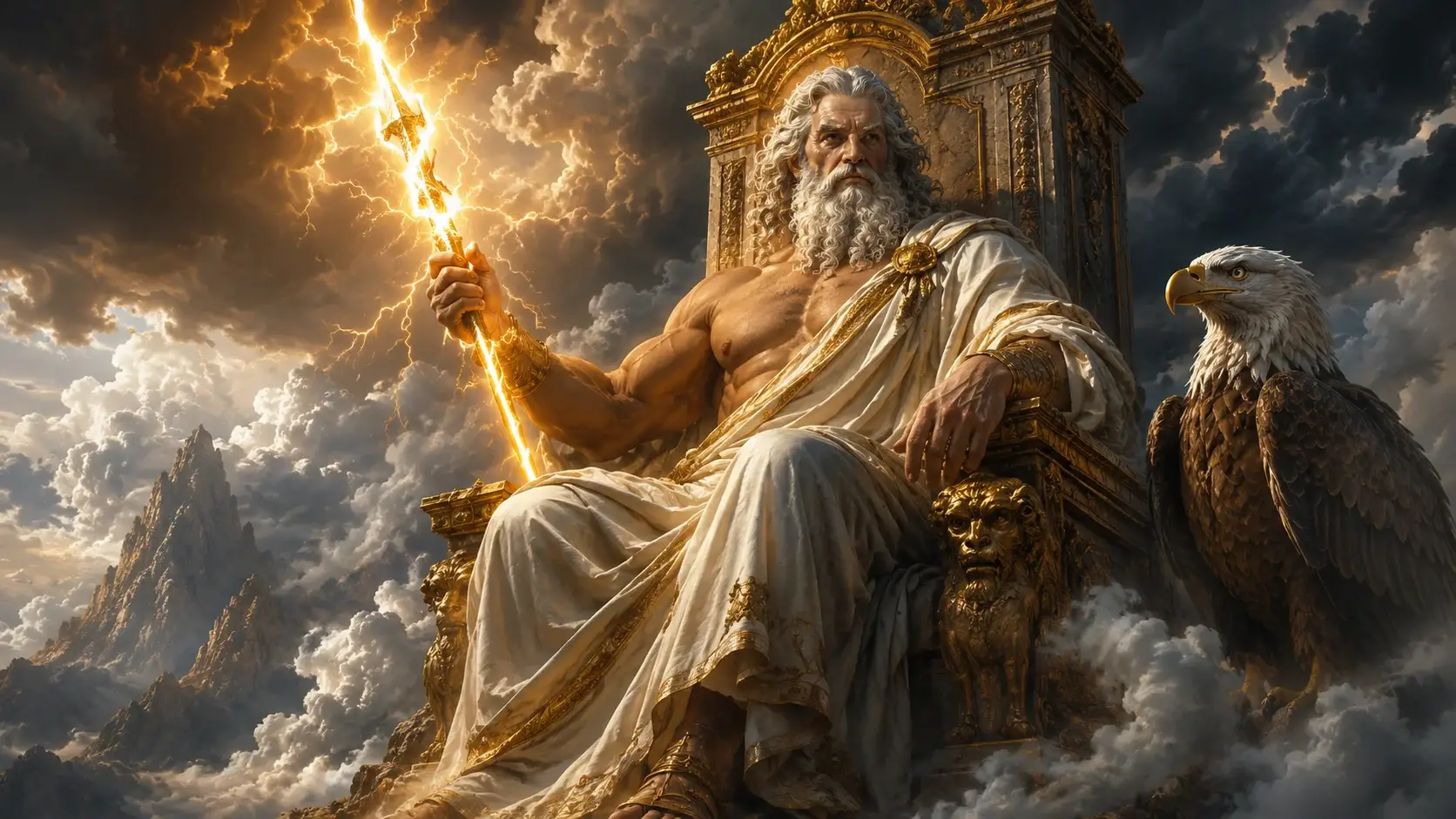
On the cloud-wreathed summit of Mount Olympus sat a god the whole of the ancient world looked up to — literally. When thunder broke over the Aegean, when an oath was sworn, when a stranger knocked at the door asking for shelter, the Greeks felt the same presence behind all of it: Zeus, father of gods and men, king of the sky.
But the most revealing thing about the greatest of the Greek gods is not his power. It is the question his myths keep circling: what does it mean for the keeper of cosmic order to be ruled, himself, by appetites he cannot master?
The Child Who Was Never Swallowed
Zeus was born into a prophecy of betrayal. His father, the Titan Cronus, had overthrown his own father — and feared the same fate so deeply that he swallowed each of his children whole the moment they were born. Five gods vanished into his gullet. When the sixth came, the mother-goddess Rhea had had enough. She hid the infant Zeus in a cave on Crete and handed Cronus a stone wrapped in swaddling clothes. He swallowed it without looking.
So the future king of heaven grew up in secret, suckled by the goat Amaltheia, his cries drowned out by dancing warriors clashing their shields — the whole cosmos hanging on a mother's desperate trick.
The War That Made a King
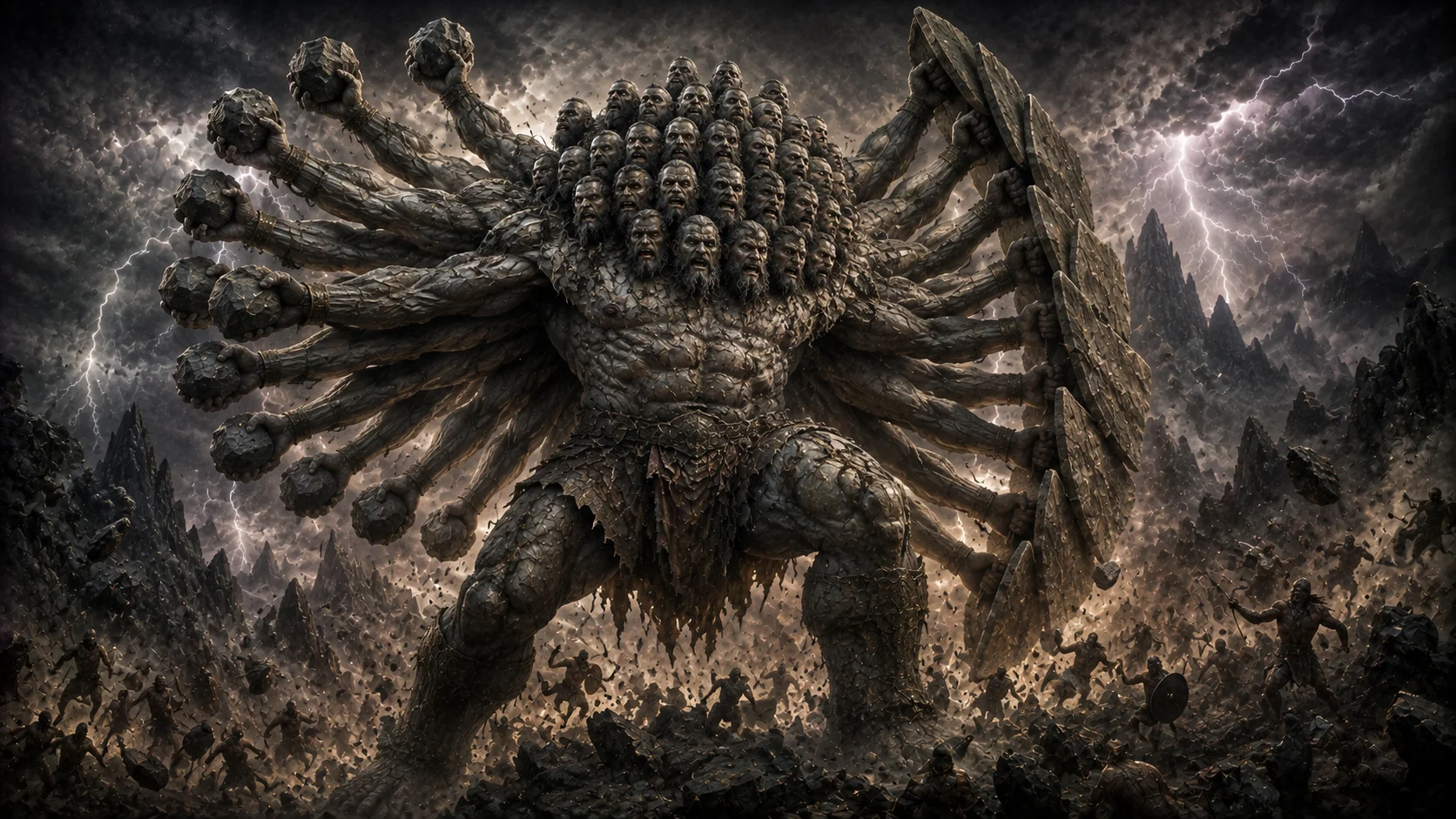
Grown and hidden no longer, Zeus forced Cronus to disgorge his swallowed siblings — Hades, Poseidon, Hera, Demeter, Hestia — alive and full-grown. Then came the Titanomachy, ten years of war that shook the world to its roots. Zeus freed the hundred-handed giants and the Cyclopes from the pit of Tartarus, and in gratitude the Cyclopes forged him the weapon that would define him forever: the thunderbolt. With the Titans cast down into Tartarus, the three brothers drew lots for the cosmos. Hades took the underworld, Poseidon the sea — and Zeus the sky, and with it dominion over all.
The Sky-Father's Justice — and His Hunger
Zeus was no mere storm-god. He was the guarantor of order: of sacred oaths (Zeus Horkios), of the bond between host and guest (Zeus Xenios), of kings and justice itself. To break faith with a stranger was to offend him directly. In this he is the moral spine of Greek religion.
And yet the same myths that crown him with justice are crowded with his infidelities — Metis, Leto, Leda, Danae, Europa, Semele, and dozens more, pursued in the shape of a swan, a bull, a shower of gold. Each affair seeds a hero or a god; each provokes the cold, patient fury of his wife, Hera. The Greeks did not flinch from this contradiction. Their highest god was both the upholder of order and its most habitual transgressor — power that writes the rules and then bends them.
The Blood of Zeus
From his unions and his will came the brightest of the divine and mortal worlds: grey-eyed Athena, sprung fully armed from his skull; the twins Apollo and Artemis; quicksilver Hermes; the twice-born Dionysus; and among mortals the mightiest heroes — Heracles and Perseus chief among them. To be a child of Zeus was to be marked for greatness and, just as often, for Hera's revenge.
Why Zeus Endures
Zeus is older than Greece. His name descends from the same ancient root as the Roman Jupiter and the Sanskrit Dyaus Pita — a primordial Indo-European Sky Father worshipped before Greece had a name. In him, a civilisation gave its sharpest expression to an eternal unease: that the one who holds ultimate power is the one least bound by the rules that power exists to keep.
When the thunder rolls over the mountains even now, some part of the old world still looks up — and remembers who is said to be watching.
The Oldest Voice in Greece
Long before the Parthenon, the wind moving through a stand of oaks in the mountains of Epirus was thought to be Zeus speaking. At Dodona — which Herodotus reckoned the most ancient oracle in Greece — priests called the Selloi slept on the bare ground with unwashed feet and listened for the god's will in the rustle of leaves. Homer already knew them and described them exactly so. Herodotus was told the sanctuary began when a black dove settled in the oak and spoke with a human voice; later visitors describe a ring of bronze cauldrons around the tree, ringing on in the wind long after they were struck, until "Dodonian bronze" became a Greek byword for anyone who would not stop talking. The medium here was not smoke or a chasm in the rock. It was a tree, and the ordinary noise of the world moving through it.
The Games Built to Honour Him
Every four years for well over a thousand years, Greeks crossed a fractured and frequently warring peninsula to a valley in the western Peloponnese to honour one god with sweat and speed. A sacred truce did not stop Greek wars, as later admirers liked to imagine — what it guaranteed was that anyone travelling to the festival could pass through hostile territory unharmed, which in that world was miracle enough. The temple of Zeus at Olympia stood for decades before it received the thing it is remembered for: a seated colossus of gold and ivory by the sculptor Phidias, roughly twelve metres of god wedged in beneath the roof, counted ever after among the Seven Wonders. Victors were crowned with wild olive cut from a tree inside the sanctuary, and the statues they raised in the precinct were dedications to Zeus rather than monuments to themselves. Across the Peloponnese at Nemea, a second panhellenic festival did the same in his name. Play, for the Greeks, could be liturgy.
A God With a Grave?
Crete had given Zeus his cradle in the myths. A stubborn local tradition insisted it had given him his grave as well. Travellers were shown a mountain near Knossos, Iuktas, whose ridgeline seen from the plain was read as the profile of a bearded face turned up to the sky — the king of the gods lying dead in the very island that had hidden his infancy. For a religion built on Zeus's deathlessness this was close to an open scandal, and the poet Callimachus opens his Hymn to Zeus by refusing the claim outright, reaching for the oldest insult available: Cretans are always liars, he says, for they built you a tomb, O Lord — but you did not die, you are forever. The slur was proverbial long before he used it. Greek had a verb for it, kretizein, to act the Cretan, meaning to lie. Strip away the theology and what remains is one part of the Greek world accusing another of getting their own supreme god's biography wrong.
Fire, Prometheus, and the Price of a Gift
Not every challenge to Zeus's order came from monsters. Some came from sympathy for mankind. When the Titan Prometheus hid fire in a hollow fennel stalk and carried it down to freezing, defenceless humanity, he crossed a boundary Zeus had drawn on purpose — the line between what gods keep and what mortals may have. The punishment was designed never to end: Prometheus bound to a crag, an eagle sent each day to tear out his liver, the organ growing back overnight so the torment could begin again at dawn. Zeus's answer to humanity itself was subtler and, in its way, crueller. He had the smith-god Hephaestus mix earth and water into the shape of Pandora, the first woman, and sent her down with a great jar she was not meant to open. Fire bought a species light and warmth; Hesiod insists it also bought them sorrow.
The War Zeus Nearly Lost
The Titanomachy secured Zeus's throne. It did not make him unbeatable. After the Titans fell, the earth-goddess Gaia bore the monstrous Typhon — a creature whose head was said to brush the stars, roaring in a hundred serpent voices at once — and the gods of Olympus, in one widely repeated version, fled into Egypt in animal disguise rather than face him. In Hesiod, the oldest surviving account, Zeus burns the monster down with thunderbolt after thunderbolt and hurls the wreck of him into Tartarus; it is later poets, Pindar and Aeschylus among them, who pin him under Mount Etna and make the volcano's fire his breath escaping. A darker retelling goes further still: Typhon overpowers Zeus outright, cuts the sinews from his hands and feet, and leaves the king of the gods helpless in a Cilician cave until they are stolen back and restored to him. Even inside his own mythology, Zeus's supremacy was never simply guaranteed. It had to be won, and then won again.
The Wolf-King and the Flood
One Arcadian myth reaches further into the folklore of monsters than anything else told of Zeus. King Lycaon of Arcadia, testing whether his divine guest could really tell god from mortal, served Zeus a meal containing butchered human flesh. Zeus overturned the table, blasted Lycaon's sons with lightning, and turned Lycaon himself into a wolf — the earliest werewolf story in European literature, and one whose setting kept its reputation for centuries. Appalled at how far mankind had fallen, Zeus resolved to erase it, sending a flood that spared only Deucalion and Pyrrha, who repopulated the earth by throwing stones over their shoulders that rose up as people. The unsettling part is what happened afterwards on the actual mountain. Worshippers went on climbing Mount Lykaion for secret rites at Zeus's altar for centuries, and the rumour attached to them never died: Plato repeats the story that whoever tasted the human portion mixed among the sacrificial meat there was fated to become a wolf, and Pausanias, who visited, wrote that he preferred not to inquire into what was done at that altar. Never confirmed. Never quite denied.
Reading the King in Stone and Paint
Strip away the name and a figure on a temple pediment is still recognisably Zeus by his props alone: the thunderbolt gripped like a spear, an eagle at his shoulder or beneath his fist, the oak that had been his tree since Dodona, and across his chest the aegis — a goatskin fringed with serpents, sometimes carried by Athena, which in the Iliad he shakes to drown the mountains in cloud and break the nerve of an army. Sculptors gave him a full beard and a heavy, mature body, deliberately unlike the athletic youths of Apollo and Hermes: age itself was part of the authority. The eagle doubled as a disguise. Zeus carried off the Trojan prince Ganymede to Olympus to be his cupbearer, granting him immortality and unaging youth — and later tellings make the bird that took him Zeus himself. Two thousand years on, painters found in these transformations a way to put erotic subject matter on a wall under a classical alibi: Correggio's swan bearing down on Leda, Titian's shower of gold breaking over Danaë. The god's shapeshifting outlived the god's religion.
The God Who Crossed the Desert
Greek colonists and traders did not leave Zeus at home. In the Libyan desert, at the oasis of Siwa, Greeks met the ram-horned Egyptian god Amun and simply recognised him as their own sky-father wearing a foreign face. Zeus Ammon, horns curling from his temples, acquired shrines back across the Greek world. The oracle at Siwa grew famous enough that Alexander the Great made a punishing detour across open desert to consult it in person, and returned letting it be understood that the god had confirmed him a son of Zeus — a claim that shadowed the rest of his reign. Wherever Greek ships went, it seems, the sky-father put on the local face and went on ruling.
Sources & traditions
- EncyclopediaWikipedia — Zeus
- TraditionGreek texts, inscriptions and later retellings (Greece)
Myths change from area to area and from time to time. This chronicle follows the most widely told versions; tellings in other villages, regions and eras may differ.