When the Greeks wanted to imagine the single most terrifying thing that could exist — a monster so vast and so dreadful that it nearly unmade creation itself — they imagined Typhon. The largest and deadliest creature in all of Greek myth, he was the one being who came within a breath of toppling Zeus and ending the reign of the gods before it had truly begun.
The Last Child of Gaia
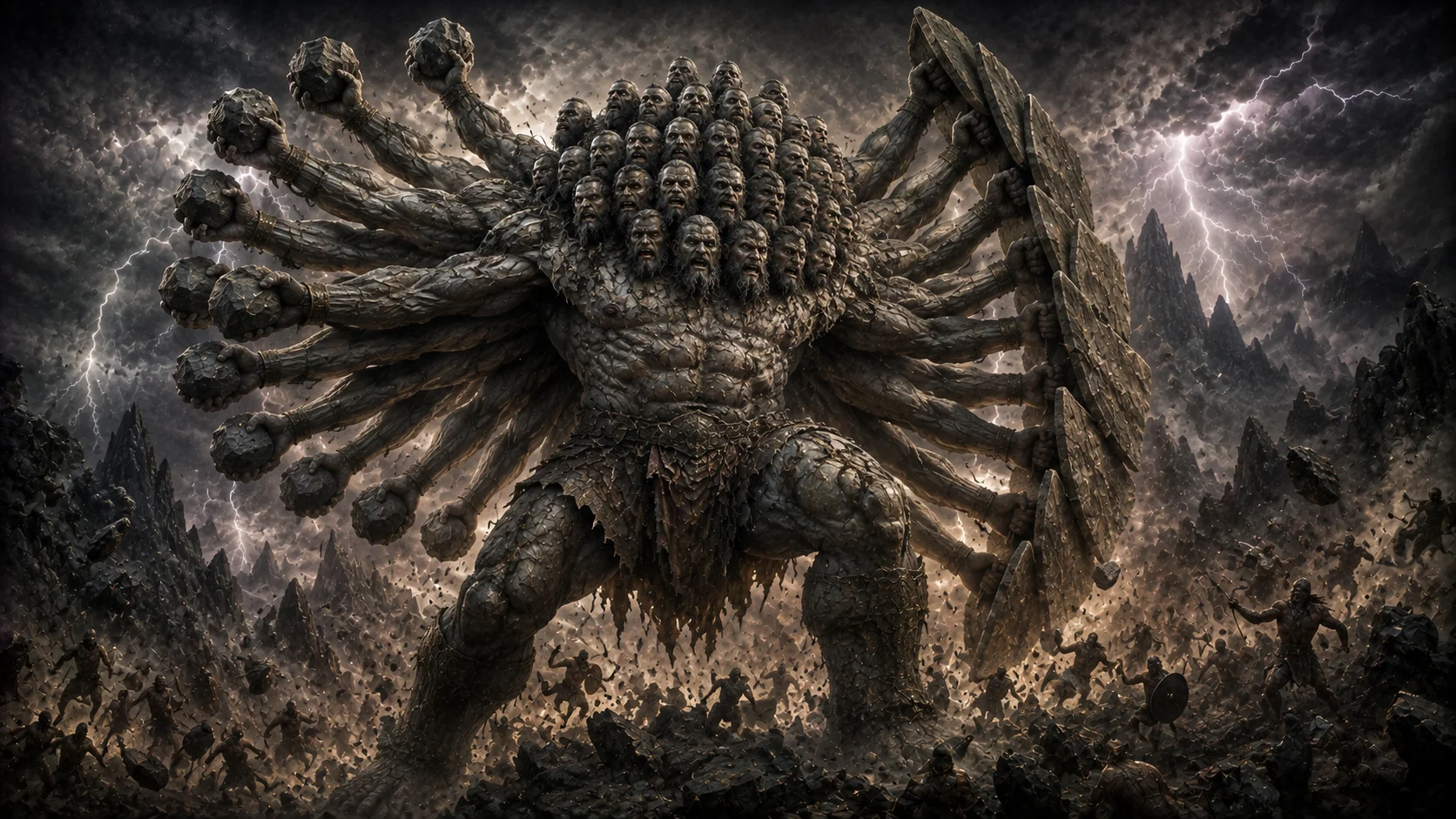
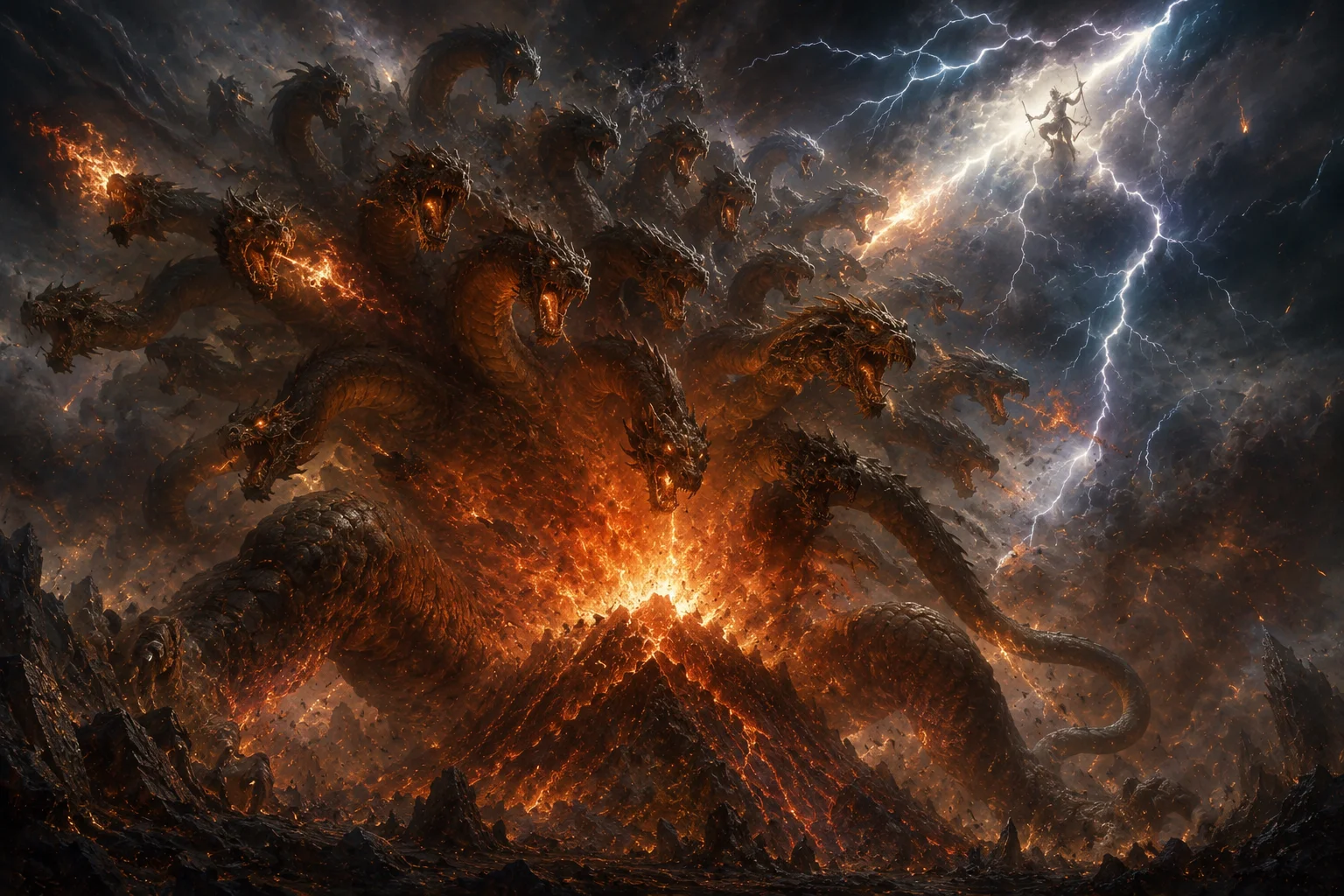
After the Olympians defeated the Titans, the Earth-goddess Gaia, enraged at the imprisonment of her Titan children, brought forth one final, monstrous son with Tartarus: Typhon. He was colossal beyond reckoning — so tall his head brushed the stars, his arms reaching from east to west, with a hundred dragon heads sprouting from his shoulders, eyes flashing fire, and a din of terrible voices pouring from his mouths. From the thighs down he was a mass of coiling vipers. He was chaos given a body.
The War for the Sky
Typhon assaulted Olympus itself, and the sight of him was so appalling that the gods fled to Egypt and hid in the forms of animals. Only Zeus stood his ground. Their battle shook the cosmos — in an early clash Typhon tore out Zeus's sinews and left him crippled in a cave, and for a moment the monster all but ruled the world. But Zeus recovered his strength, and with a hundred lightning bolts beat the monster down.
Buried Beneath the Mountain
Zeus hurled the colossal body of Typhon down and pinned him beneath Mount Etna in Sicily. There he lies still, the Greeks said — and when the volcano roars and spits fire, it is Typhon raging beneath the rock, never quite dead, never quite free.
The Father of Monsters
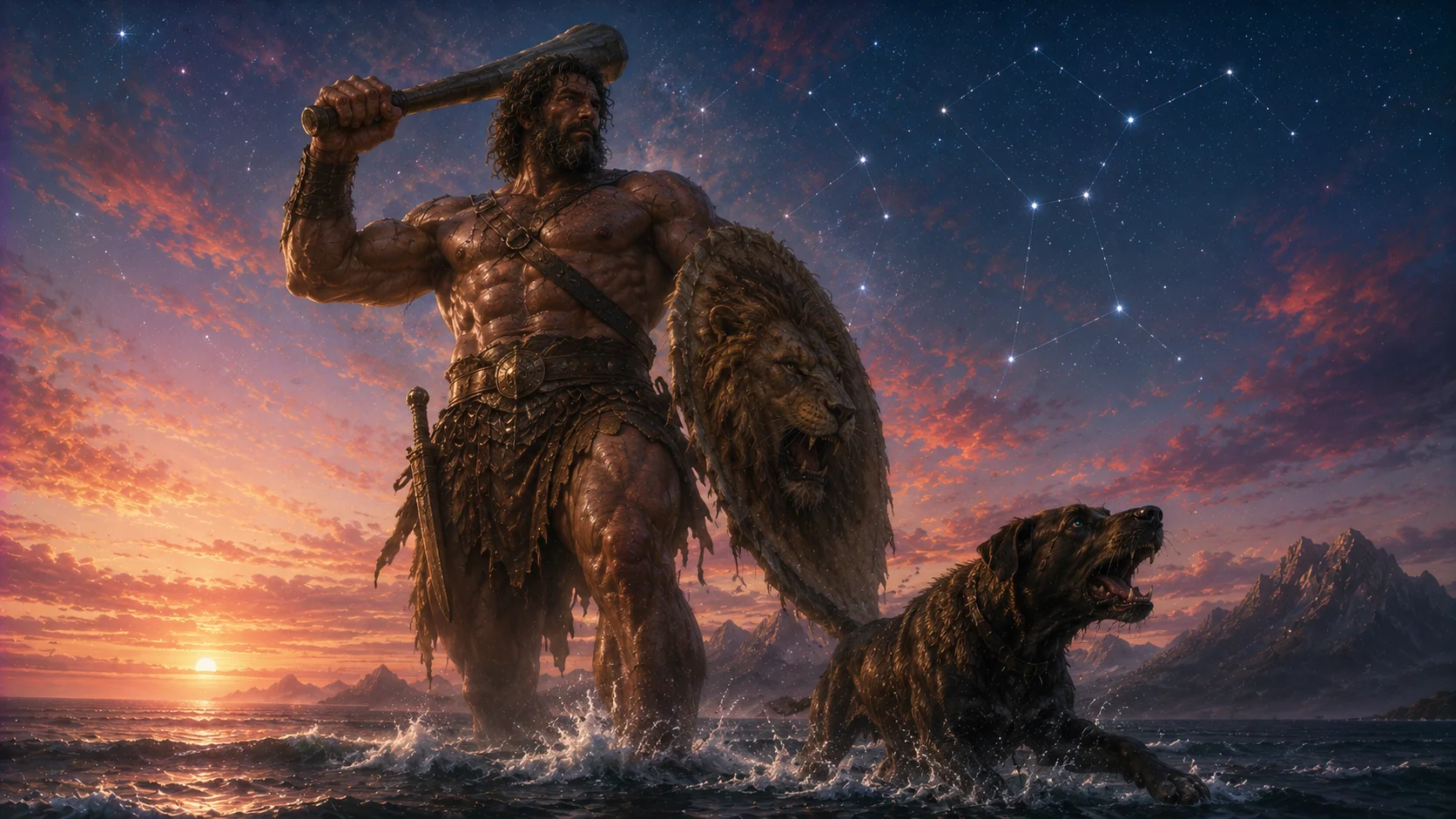
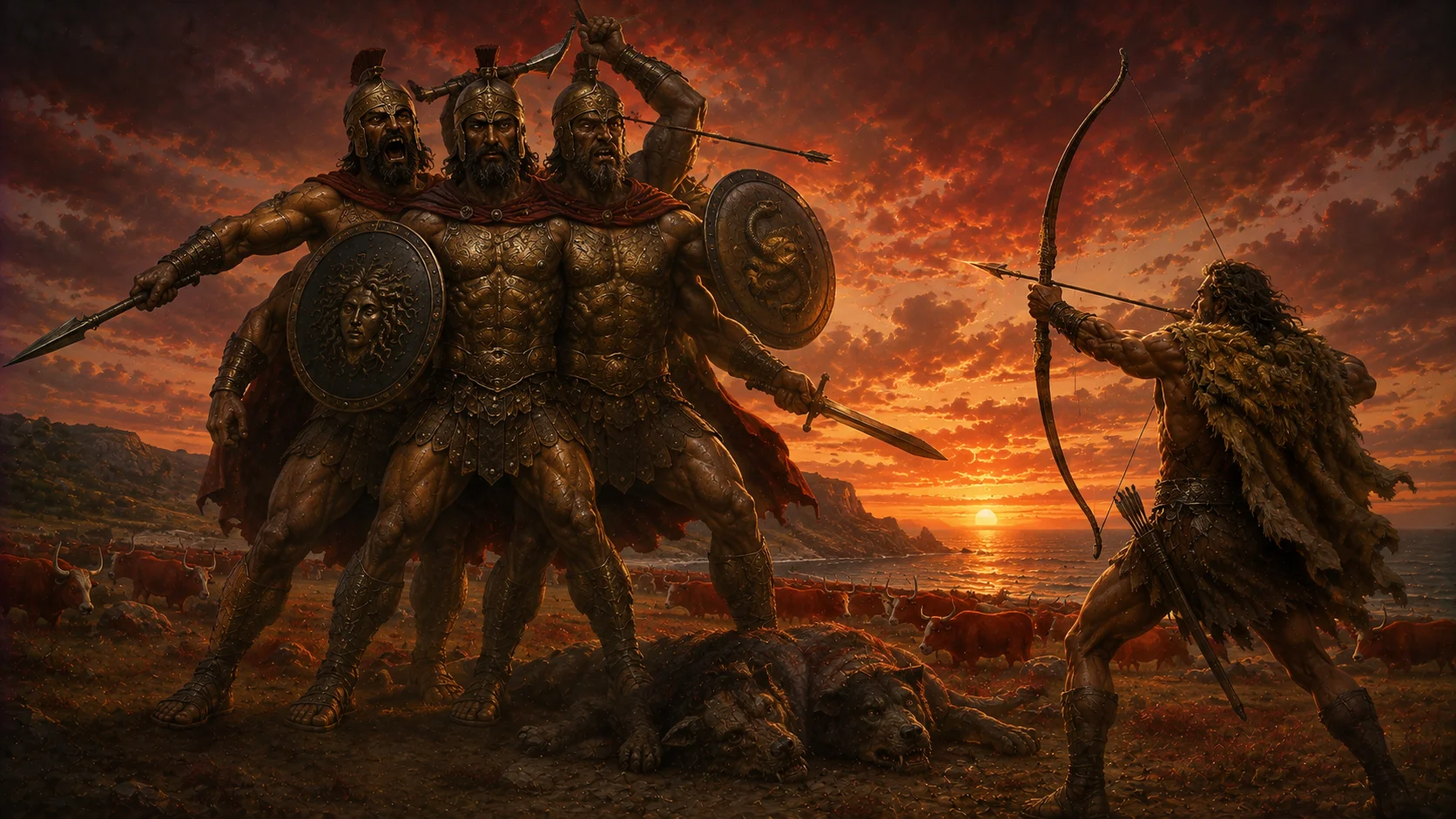
Before his fall, Typhon mated with Echidna, and together they spawned nearly every monster the Greek heroes would ever face: Cerberus, the Hydra, the Chimera, the Sphinx, Orthrus, the Nemean Lion. Typhon is the wellspring of monstrousness itself — the primal threat against which all of Zeus's order, and all of heroism, would forever be defined.
Every volcano that smokes is, to the old imagination, the breath of the monster who almost won.
The Monster Homer Did Not Bother to Explain
Hesiod's Theogony gives Typhon his fullest early telling, but it is not the only archaic poem that knows him. The Iliad reaches for him just once, in a simile about the earth groaning under a marching army — as it groans when Zeus lashes the ground in the land of the Arimoi, "where they say Typhoeus has his bed." No story is told. No explanation is offered. The poet simply assumes his audience already knows who is lying down there and why, which is the surest sign that the monster was old before either poem was fixed in writing.
Hera's Spite: A Rival Birth Story
Gaia and Tartarus are not the only parents the Greeks gave him. The Homeric Hymn to Apollo preserves a stranger, angrier origin. When Zeus produced Athena from his own head without her, Hera was enraged at having been made unnecessary to her own husband's children. She struck the ground with her palm and prayed to Gaia, to Ouranos, and to the Titans beneath the earth for a son of her own — one who would surpass Zeus as thoroughly as Zeus had surpassed Cronus. The child she bore, here called Typhaon, she handed to the she-dragon coiled at Pytho to rear, tying the monster's infancy to the very oracle Apollo would later have to win by killing its guardian. The two traditions were never reconciled. The Greeks simply carried both.
The Stolen Sinews
The duel is usually remembered as a matter of thunderbolts. Apollodorus tells it in full, and the full version is considerably more humiliating for Zeus. Typhon wrenched the sickle out of the god's own hands, cut the sinews from his hands and feet, and carried him — alive, but slack and powerless — to the Corycian Cave in Cilicia. The sinews he hid inside a bearskin, setting the dragon-woman Delphyne to guard them. It was Hermes and the goat-god Aegipan who crept in, stole them back, and fitted them to Zeus's limbs before the decisive battle could be fought at all. Nonnus, writing his enormous Dionysiaca in the fifth century CE, replaces the burglary with a confidence trick: Cadmus, disguised as a herdsman, charms Typhon with pipe-music, then asks for the sinews as strings for his lyre so that he might play something grander still. The monster hands over the means of his own defeat in exchange for a better song.
A Fuller Geography of Defeat
Etna is the last stop, not the only one. In Apollodorus the first clash happens at Mount Kasios, overlooking Syria — the same peak the Ugaritic tablets name as the seat of the storm-god Baal, centuries before any Greek wrote a line about Typhon, which makes the choice of setting look less like coincidence than inheritance. Once his sinews are restored, Zeus pursues the monster to Mount Nysa, where the Fates persuade Typhon to eat the "ephemeral fruits" by promising they will make him stronger; they do the opposite. The chase runs on to Mount Haemus in Thrace, where Typhon tears up whole mountains to hurl back at his pursuer and is wounded badly enough that the range was said to take its name from his blood — haima. Only then is he driven across to Sicily and sealed under Etna. Aeschylus adds one image worth keeping: in Prometheus Bound, Hephaestus sits on the peak above the pinned monster, hammering molten metal — a god at his forge, working on the roof of his enemy's prison.
The Gods in Egypt, and a God Named Set
The flight of the Olympians into Egypt was never idle colour. It was the Greeks' own answer to something that genuinely puzzled them: why Egyptian gods wore the heads of animals. Ovid builds the idea into the Metamorphoses as a catalogue, assigning each fugitive god the creature it became. But the Egyptian connection ran deeper than one night of panic. Greek writers from Herodotus onward identified Typhon outright with Set — god of storms, deserts and disorder, murderer of his brother Osiris. Plutarch's On Isis and Osiris uses "Typhon" as the standing Greek name for Set throughout, treating the Egyptian story of a chaos-god struck down and dismembered as the Egyptian half of a myth the Greeks assumed they already owned.
How to Recognise Him in Stone
Long before poets settled on a hundred dragon heads, Greek artists pictured him quite differently. The archaic pedimental group from the Athenian Acropolis known as the Bluebeard — three bearded male torsos rising from a single mass of coiled serpent bodies, the beards still carrying traces of their original blue paint — is among the figures most often identified as Typhon, though that identification has never been settled. Archaic black-figure painters tend to give him a human torso, wings, and a pair of snake legs, set against a Zeus who strides in with the thunderbolt already raised. It is the later literary tradition that inflates him past the reach of any vase — a monster easier to describe than to draw.
One Story the Ancient World Kept Retelling
Typhon's war belongs to a pattern scholars call the Chaoskampf: a young storm- or sky-god must put down a monstrous, usually serpentine embodiment of disorder before the cosmos can hold its shape. The Hittites told it as the serpent Illuyanka, who beats the Storm-god outright and is undone only by a trick. Ugarit told it as Baal's war against Yam, the Sea. Babylon told it as Marduk splitting Tiamat in half and building the sky and the earth out of her body. Told across that many languages and that many centuries, the shape stops looking Greek at all. Typhon reads less like an invention than an inheritance — the Aegean's own telling of a story its neighbours had been telling under other names for a very long time.
A Name That Outlived the Myth
The Greek word typhon did not only name the monster; it also meant a whirlwind, and Latin borrowed it in that sense. So a real thread does run from the myth to the weather. But the modern English typhoon did not travel down that thread alone. It was pulled into its present shape by two unrelated words for the same violent thing — Arabic ṭūfān, a deluge or storm, and Cantonese tai fung, "great wind" — which arrived from entirely different directions and reinforced a spelling the Greek had already made familiar. How much of the word is genuinely Typhon, and how much is coincidence wearing his letters, is still argued over. Either way, the storms that sink ships are still named, at least in part, after the thing the Greeks buried under a mountain.
The story never needed Typhon to win. It only needed him to almost win — often enough, and vividly enough, that every generation since has kept one eye on the ground.
Sources & traditions
- EncyclopediaWikipedia — Typhon
- TraditionGreek texts, inscriptions and later retellings (Greece)
Myths change from area to area and from time to time. This chronicle follows the most widely told versions; tellings in other villages, regions and eras may differ.