Somewhere beneath the earth, in a country the old poets called the land of the Arimoi, there is a cave that no god visits and few mortals leave. No temple marks it. No priest ever burned an offering at its mouth. And yet almost every monster a Greek hero ever raised a sword against was born inside it, to a single mother waiting in the dark.
Hesiod names her in the Theogony, composed somewhere in the eighth or seventh century BC — the oldest surviving account of her, and the one every later writer borrows from. He does not give her a shrine or a following. He gives her a shape, a mate, and a list of children so long that it reads less like a family tree than a catalogue of everything a hero might have to fight.
Half Maiden, Half Serpent
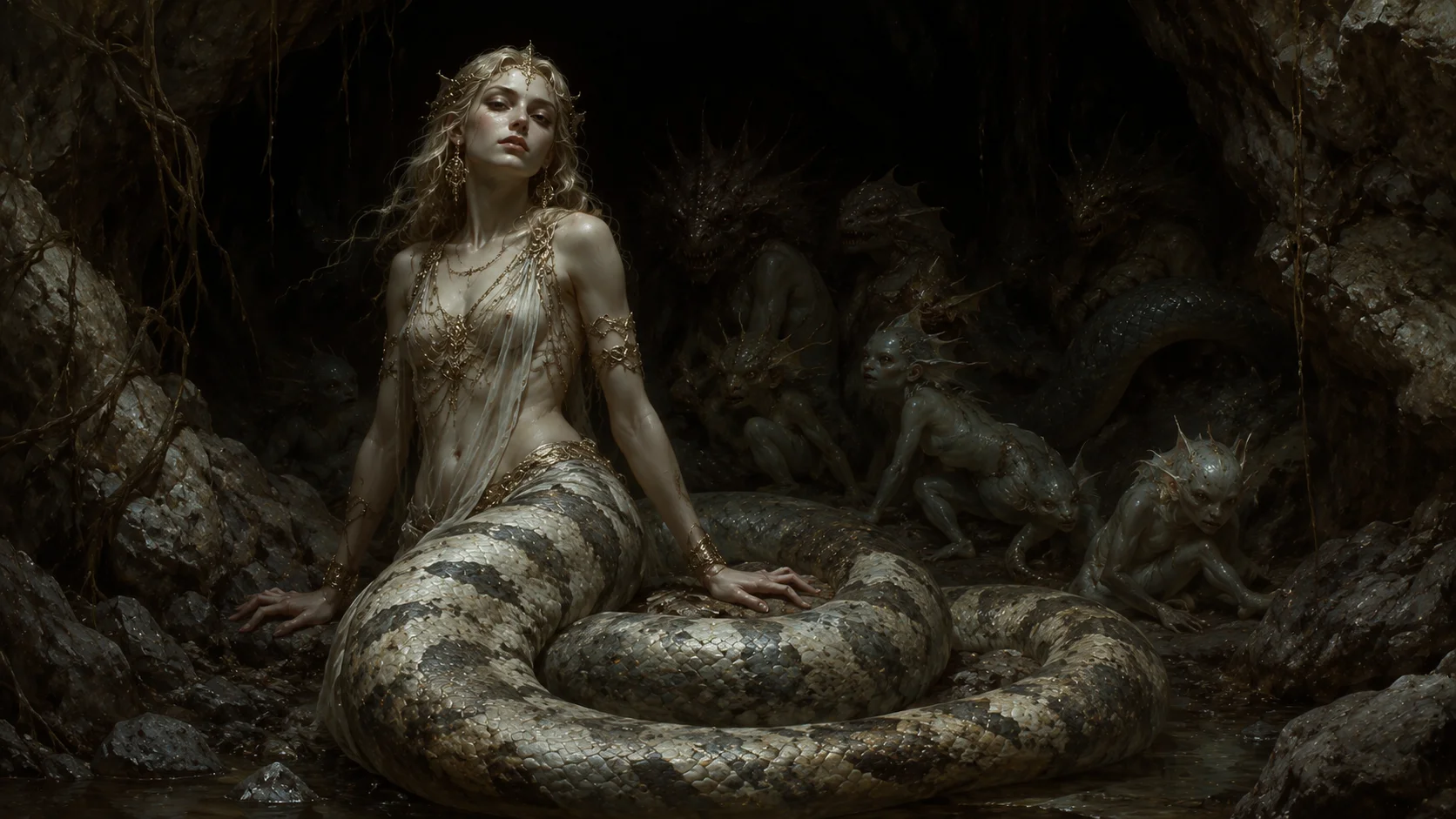
Hesiod's description is exact and strange: above the waist, a nymph with flashing, glancing eyes and fair cheeks; below the waist, a serpent — huge, terrible, its skin speckled, coiling beneath the secret folds of the sacred earth. Two bodies fused into one, and neither half a disguise for the other. She is not a woman who becomes a snake, or a snake wearing a woman's face. She is both, permanently, at once.
She eats raw flesh. Hesiod says so plainly, and later writers repeat it: travellers who wandered near her hidden home did not come back. The poets appointed her a house there — the word Hesiod uses suggests something almost stately, a "glorious" dwelling — far from the gods on Olympus and equally far from the mortals whose paths never should have crossed hers.
And she does not age. Hesiod calls her deathless and ageless for all her days, a being outside the ordinary wearing-down of time that claims everything else. Whatever else is uncertain about Echidna, this one detail is not: in the poem that invented her, she was built to last forever.
Three Fathers, No Agreement
Ask where Echidna came from and Greek tradition gives you not one answer but three, and they do not agree with each other. Hesiod himself offers two possibilities in the same poem: she is the daughter of the ancient sea deities Phorcys and Ceto, or, in an alternative he also records, the daughter of Chrysaor and the naiad Callirhoe. Centuries later, the mythographer Apollodorus gives a third lineage entirely, making her a daughter of Tartarus and Gaia — the abyss and the earth itself.
None of these was ever settled into a single "true" version. The ancient sources simply disagree, and a fair account of Echidna has to leave that disagreement standing rather than pick a winner. What the choice of parentage does, in each case, is tell you what kind of thing she is meant to be: a creature of the deep sea in one telling, a creature of the underworld's own foundations in another.
If the Phorcys-and-Ceto lineage is the one you follow, Echidna gains a genuinely fearsome set of siblings. That same pairing is credited elsewhere with the Gorgons, the Graeae, the dragon Ladon, and the sea-monster Scylla — which would make Echidna not just the mother of monsters but one sister among several, born into a family that produced almost nothing else.
The Storm-Giant's Bride
Whatever her own parentage, Echidna's mate is not in dispute: Typhon, sometimes called Typhoeus, the storm-giant who rose up to challenge Zeus for the rule of heaven itself. Hesiod calls him the most fearsome of all the monsters born to Gaia and Tartarus — a being of a scale and violence that put even the Olympians in danger.
It is a striking pairing on its own terms: the ageless serpent-woman of the hidden cave, and the storm-monster who nearly ended the reign of Zeus. Between them, the two ultimate threats to Olympian order — open, cataclysmic war from Typhon, and slow, endlessly renewing menace from Echidna — met and produced offspring. What came out of that union would occupy heroes for generations.
The Mother of All Monsters
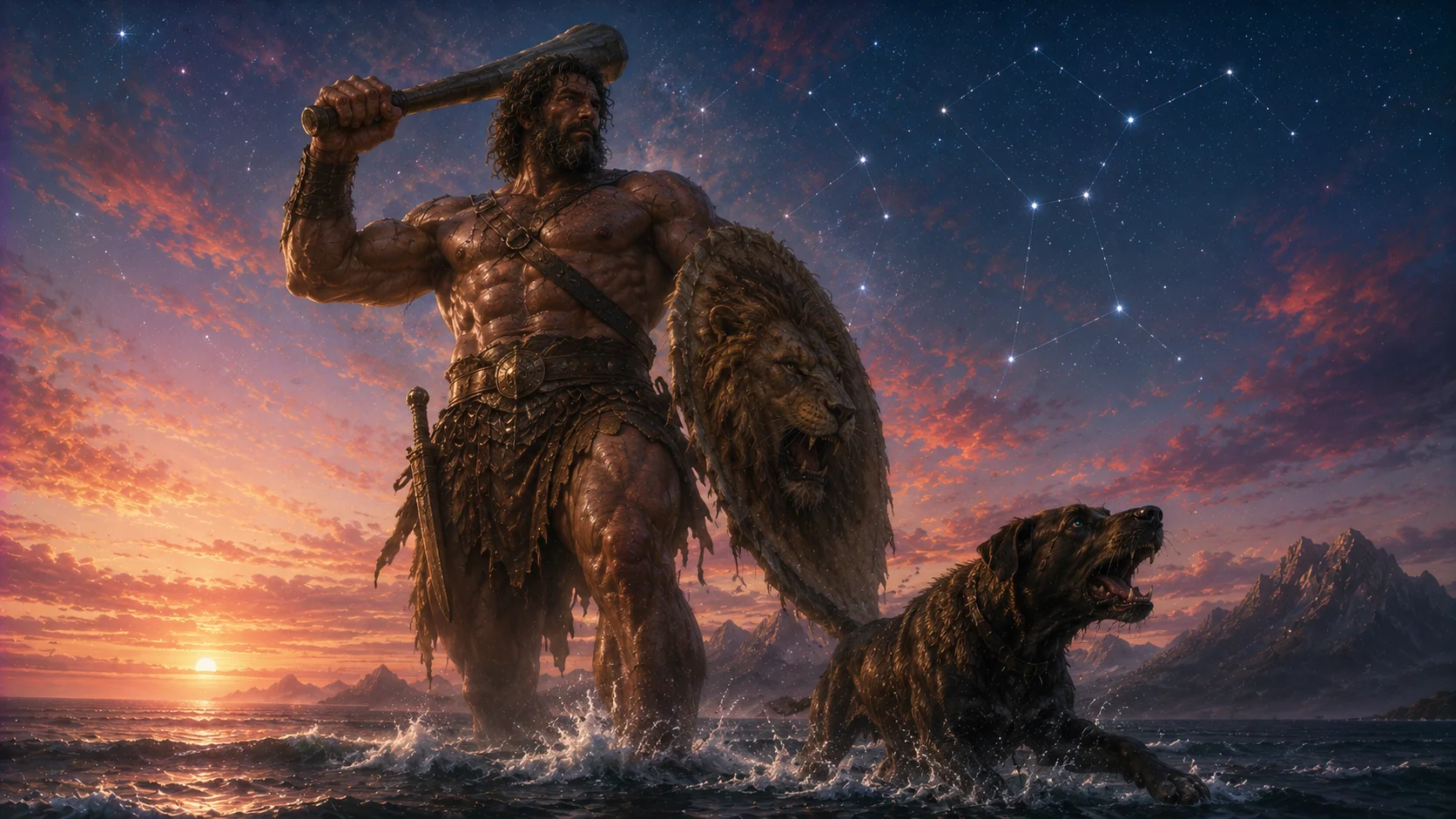
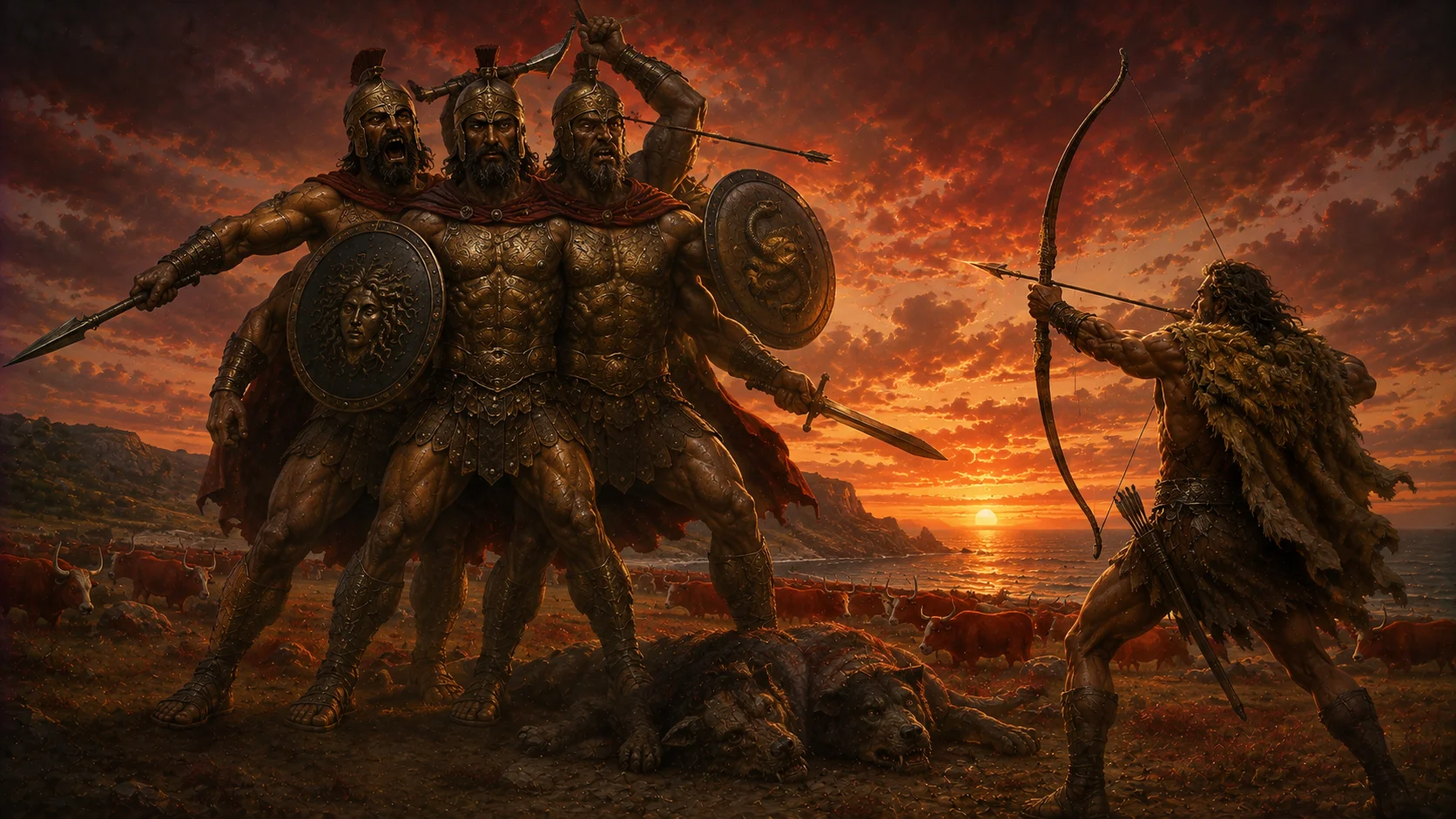
Hesiod's own list of what Echidna bore to Typhon is direct: Orthrus, the two-headed hound; Cerberus, the many-headed dog who guards the dead; the Hydra of Lerna, the serpent whose heads multiplied; and the Chimera, the fire-breathing hybrid of lion, goat, and serpent. Later sources widen the roster further, crediting the union of Echidna and Typhon with the eagle that tormented Prometheus on the Caucasus, the wild Crommyonian Sow, and the dragon that stood guard over the Golden Fleece in Colchis.
No ancient list agrees on a final count, and none should be read as complete — the tradition kept adding to her brood for as long as storytellers needed a new monster to have come from somewhere. What stays constant is the pattern: whenever a Greek hero needed a trial worthy of the name, the poets reached for one of Echidna's children.
- Cerberus, the many-headed hound who guards the dead in the house of Hades
- the Lernaean Hydra, the regenerating serpent of the marsh at Lerna
- the Chimera, lion, goat, and serpent fused into one fire-breathing body
- Orthrus, the two-headed hound
- the Caucasian Eagle, the Crommyonian Sow, and the dragon of Colchis, named in later accounts
Grandchildren, or Children? The Sphinx and the Lion
Two of the most famous monsters in Greek myth — the riddling Sphinx of Thebes and the Nemean Lion — sit in an unsettled place in Echidna's family tree. Some ancient sources describe them as offspring of Orthrus, Echidna's own son, which would make them her grandchildren rather than her children. Other sources place them as direct offspring of Echidna and Typhon. The tradition itself never resolved which it was, and there is no single "correct" chart to draw.
The same uncertainty touches Ladon, the dragon set to guard the golden apples of the Hesperides. In the Typhon lineage he is counted among Echidna's children by the storm-giant. But in the Phorcys-and-Ceto genealogy, Ladon appears instead as Echidna's own sibling. Both traditions exist in the sources; neither cancels the other out. It is worth resisting the urge to flatten Echidna's family into a single tidy diagram — the ancient poets themselves never did.
A Cave in the Land of the Arimoi
Hesiod is specific about where Echidna lived: a cave in the country of the Arimoi, beneath caves of the sacred earth. It is not the underworld. Hesiod does not place her among the dead in the house of Hades — her cave is a hidden pocket of the living earth, sealed off from both gods and mortals, appointed to her the way a house might be appointed to anyone else.
The precise location of "the land of the Arimoi" is not identified in the surviving text. The uncertainty is fitting for a figure who was always meant to be somewhere just past the edge of the known world — near enough that travellers occasionally stumbled on her, far enough that no army or hero ever marched there on purpose.
The Word the Greeks Used For Her
The Greeks had a word for what Echidna was: drakaina, a "she-dragon" or serpent-woman, the female counterpart of drakon. It is a type, not just a name — a category of being distinct from an ordinary monster or an ordinary nymph, fusing the two into something the language needed its own word for. Echidna is that type's most famous example: the drakaina other drakainai are measured against.
Her own identity within that type is anchored by two things and two things only — her genealogy and her cave. Take those away, and "serpent-woman" alone could describe more than one figure in Greek myth, Scylla among her own siblings not least. It is the specific parentage, the specific mate, and the specific hidden house in the land of the Arimoi that make Echidna Echidna, and not simply an instance of the type.
Undying, Except for One Late Story
Hesiod's Echidna is ageless and deathless — a permanent feature of the world, not a character with an ending. But a separate tradition, considerably later and far more thinly attested than Hesiod's poem, tells a different story: that the hundred-eyed giant Argus Panoptes killed her while she slept.
The two accounts do not really compete, because they are not the same kind of claim. Hesiod's "ageless and deathless" is the foundational description, repeated as her defining trait; the Argus story is a later addition, never as firmly rooted, and it sits uneasily against everything the earlier tradition says about her. The honest way to hold both is the way the oldest sources do: Echidna was built to be undying, and one late tale, and only one, imagines otherwise.
A Monster With No Altar
For all the fear she generated across Greek storytelling, no ancient cult of Echidna is attested anywhere — no temple, no priesthood, no festival, no offering left at a shrine in her name. She belongs entirely to poetry and myth-collecting, never to religion. She is not a goddess in the sense that Olympians were goddesses, worshipped and petitioned; she is a narrative engine, a figure whose entire function in the tradition is to have given birth to other, more famous monsters.
That absence is itself worth noting, because it sets her apart from so much of the rest of Greek myth, where gods and monsters alike could often claim a cult site somewhere. Echidna's power was never the kind mortals prayed to. It was the kind they told stories about, safely, from a distance, long after the danger had passed into legend.
Genealogy as Terror
Echidna herself is not recorded fighting any hero. No surviving ancient narrative puts her in personal combat with anyone. That absence is not a gap in the record so much as the entire point of her: her terror was never meant to be enacted directly. It operates entirely through descent — through Cerberus, the Hydra, the Chimera, and the rest of her brood, each one sent out into the world to be the trial, while their mother stayed hidden in her cave and never had to take part herself.
Modern writers have given her a title the ancient sources themselves never used as a formal name: "Mother of All Monsters." It is a fitting summary of her role rather than an ancient cult title Hesiod would have recognised — a description invented after the fact to capture what the genealogy already made obvious. She generated the trials. She never had to take part in them.
Every monster a Greek hero was ever sent to kill had, somewhere behind it, the same shadowed cave in a country no one could quite locate — and the same mother, ageless and waiting, who never had to leave it to be feared.
Why the Mother Outlasts the Monsters
Individually, Echidna's children have overshadowed her in the popular imagination — the Hydra, the Chimera, Cerberus, and the Sphinx are each, on their own, far more recognisable today than the being who bore them. But structurally, she is the more important figure, because she is the reason the roster exists at all. Remove Echidna from Greek myth and the underworld loses its guardian hound, the marsh at Lerna loses its serpent, and Thebes loses its riddling Sphinx.
She was never given a temple because she was never meant to be approached. She was meant to remain exactly where Hesiod placed her nearly three thousand years ago: hidden, ageless, and endlessly capable of producing one more reason for a hero to prove himself. As long as Greek storytelling needed monsters, it needed somewhere for them to have come from — and it kept returning to the same cave, and the same mother, in the land of the Arimoi.
Sources & traditions
- EncyclopediaWikipedia — Echidna (mythology)
- TraditionGreek texts, inscriptions and later retellings (Greece)
Myths change from area to area and from time to time. This chronicle follows the most widely told versions; tellings in other villages, regions and eras may differ.