Geryon — also called Geryones — was a monstrous giant who dwelt on the far western island of Erytheia, at the very edge of the world Ocean. Owner of a magnificent herd of red cattle, he stood as the obstacle of the tenth Labour of Heracles, who was sent to the world's rim to take the herd and, in doing so, to end Geryon's life. Ancient sources do not agree on the exact shape of his body — three heads or three whole bodies joined at the waist — but every account agrees he was reckoned among the most formidable beings a hero could be sent against, and that his death was bought at the furthest reach of the known earth.
Blood of the Gorgon
Geryon's lineage ran back through violence to violence. His father was Chrysaor, who sprang fully formed from the severed neck of the Gorgon Medusa at the moment of her death — brother, in that single terrible birth, to the winged horse Pegasus. His mother was the Oceanid Callirrhoe, a daughter of Ocean herself. In some genealogical strands this makes Geryon a grandson of Poseidon as well, since Medusa had lain with the sea-god before Perseus struck off her head, and it was that union which gave rise to Chrysaor and Pegasus alike. Geryon's descent therefore doubled monstrousness on both sides — a father born from a Gorgon's blood, a mother born of the Ocean's own daughters — and Hesiod's Theogony sets his birth firmly within that lineage, one of the darker branches of the divine family tree that also produced Echidna's brood and the other terrors of the world's edges.
Last updated .
Three Heads, or Three Bodies
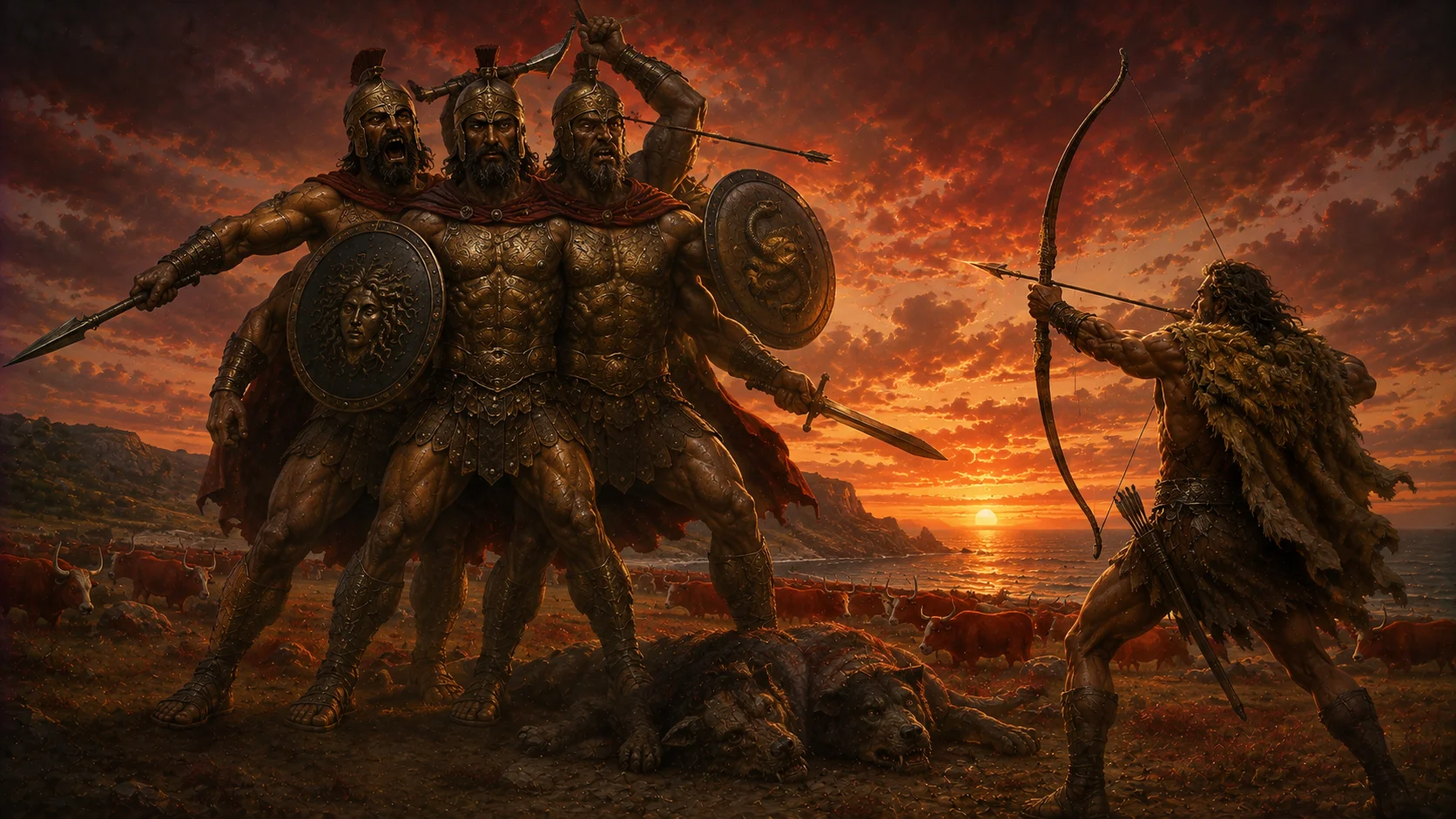
Hesiod calls Geryon tricephalous or tricorporeal, and later tradition never fully settled which. Some sources and depictions show one torso crowned with three heads, arms multiplying to match; others show three complete bodies, each with its own head and limbs, joined together at the waist into a single standing figure. The difference is not a small one — it changes whether Geryon is imagined as a single being with a triple crown of vigilance, or as three men fused into one, capable in principle of moving and striking independently before falling together. Ancient art and ancient poetry did not resolve the question, and it remained one of the open points of the myth: a giant whose very anatomy resisted a single fixed picture, described differently by nearly every hand that told his story.
The Red Island at the World's Rim
Geryon made his home on Erytheia — "the red one" — an island set far in the west, near the edge of the Ocean that the Greeks believed encircled the world. Later geographers, writing well after Hesiod, associated the island with the region of Iberia, specifically the area around Cadiz, but this identification is a later gloss laid onto the older, vaguer story rather than a detail original to it. In the earliest telling Erytheia is less a mapped place than a marker of distance itself — the far shore beyond which a hero could not easily be sent, a red island glowing at the point where the known world gave way to Ocean's edge.
The Herd and Its Guardians
On Erytheia, Geryon kept a herd of cattle famous for their colour — red, like the island itself — and he did not leave them unguarded. A herdsman named Eurytion watched over them by day, and beside him stood Orthrus, a two-headed dog, offspring of Typhon and Echidna and thus brother to the far more famous Cerberus who guarded the gates of the underworld. Between a vigilant herdsman and a two-headed hound bred from the union of the world's most monstrous parents, the herd of Erytheia was about as well defended as any prize in the Heraclean cycle — which was, of course, the point: nothing Eurystheus set before Heracles was meant to be easy.
A Labour Set by Eurystheus
The theft of Geryon's cattle was imposed on Heracles by King Eurystheus as the tenth of his Labours. Unlike hunts for local monsters or captures of nearby beasts, this task required Heracles to leave the familiar geography of Greece entirely and travel to the far western edge of the world — a labour of distance as much as of combat, sending the hero to the very boundary the Greeks believed marked the limit of habitable land.
Death at the Ocean's Edge
Arriving on Erytheia, Heracles first killed the dog Orthrus and then the herdsman Eurytion, clearing the guardians before Geryon himself could be met. When the giant came against him, Heracles killed him as well — in most accounts with an arrow, and in some depictions that arrow is described as passing through all three of his bodies or heads in a single line, felling the triple giant with one shot. It is one of the most vivid single images to survive from the whole cycle of Labours: three bodies threaded by one arrow, brought down together at the world's furthest edge.
The Cattle Driven Home
With Geryon dead, Heracles took the red cattle and began the long return journey across the Mediterranean and Italy. Different regional and local traditions attribute a whole scatter of further adventures and incidents to this stretch of the labour, the route and the specific events varying from source to source. Among the details credited to this journey in some accounts is the founding of the Pillars of Heracles at the Strait of Gibraltar, marking the western limit the hero had reached. Whatever the exact path, the drive home was remembered as an extended, eventful passage in its own right — the labour did not end the moment Geryon fell, but stretched on across the length of the known world as the hero brought his prize back to Eurystheus.
A Fragmentary Pathos: Stesichorus's Geryoneis
The fullest and earliest surviving literary treatment of Geryon's story is not Hesiod's brief genealogical notice but the Geryoneis, a lyric poem by Stesichorus composed in the seventh or sixth century BCE and preserved today only in fragments. It predates and shaped the later prose summaries, such as Apollodorus's, that most readers now encounter first. What survives of Stesichorus's poem treats Geryon with a degree of pathos largely absent from the later, more compressed accounts — a figure defending his own herd rather than a villain awaiting his deserved end. That nuance, present at the root of the tradition, was mostly lost as the story was retold and summarised across the centuries that followed, flattening Geryon into little more than an obstacle in another hero's path.
The Champion at the World's Boundary
Symbolically, the labour represents Heracles's conquest of the far western edge of the known world, extending the hero's reach to the very limits of the earth. It sits alongside the other "edge of the world" labours — most notably the fetching of the Apples of the Hesperides — as part of a pattern in which Heracles's greatest tasks push outward past the borders of ordinary Greek geography into places defined by their distance and strangeness rather than by any city or kingdom. Geryon's death, in this light, is not simply the removal of a monster but a marker of how far a hero's labour could be made to reach: to the sunset itself, and past it.
No Altar, No Cult
Unlike many figures of Greek myth who received local worship or commemorative rites, Geryon is not known to have had any significant independent cult. His presence in the tradition is confined entirely to narrative — he exists as an episode within the Heraclean cycle, principally as the obstacle Heracles must overcome to complete the tenth Labour, rather than as a figure honoured or placated in his own right anywhere in the Greek world.
Reborn as a Beast of Fraud
Geryon's afterlife in later literature took a striking turn far from his Classical origins. In Dante's Inferno, Geryon reappears reimagined as a monstrous, composite winged beast — a figure symbolizing fraud — who carries Dante and Virgil down through the air into the lower circles of Hell. This medieval reworking bears little resemblance to the tricephalous giant of Erytheia beyond the shared name and a general sense of monstrous hybridity; it is a distinct, later invention layered onto the ancient figure rather than a continuation of the Greek story, and it stands as the clearest sign of how far Geryon's name travelled beyond the herd he once guarded at the edge of the Ocean.
At the world's red edge, where the Ocean closes the map, a giant of three bodies kept watch over cattle the colour of his island — until a hero came from the other end of the earth, and a single arrow found all three.