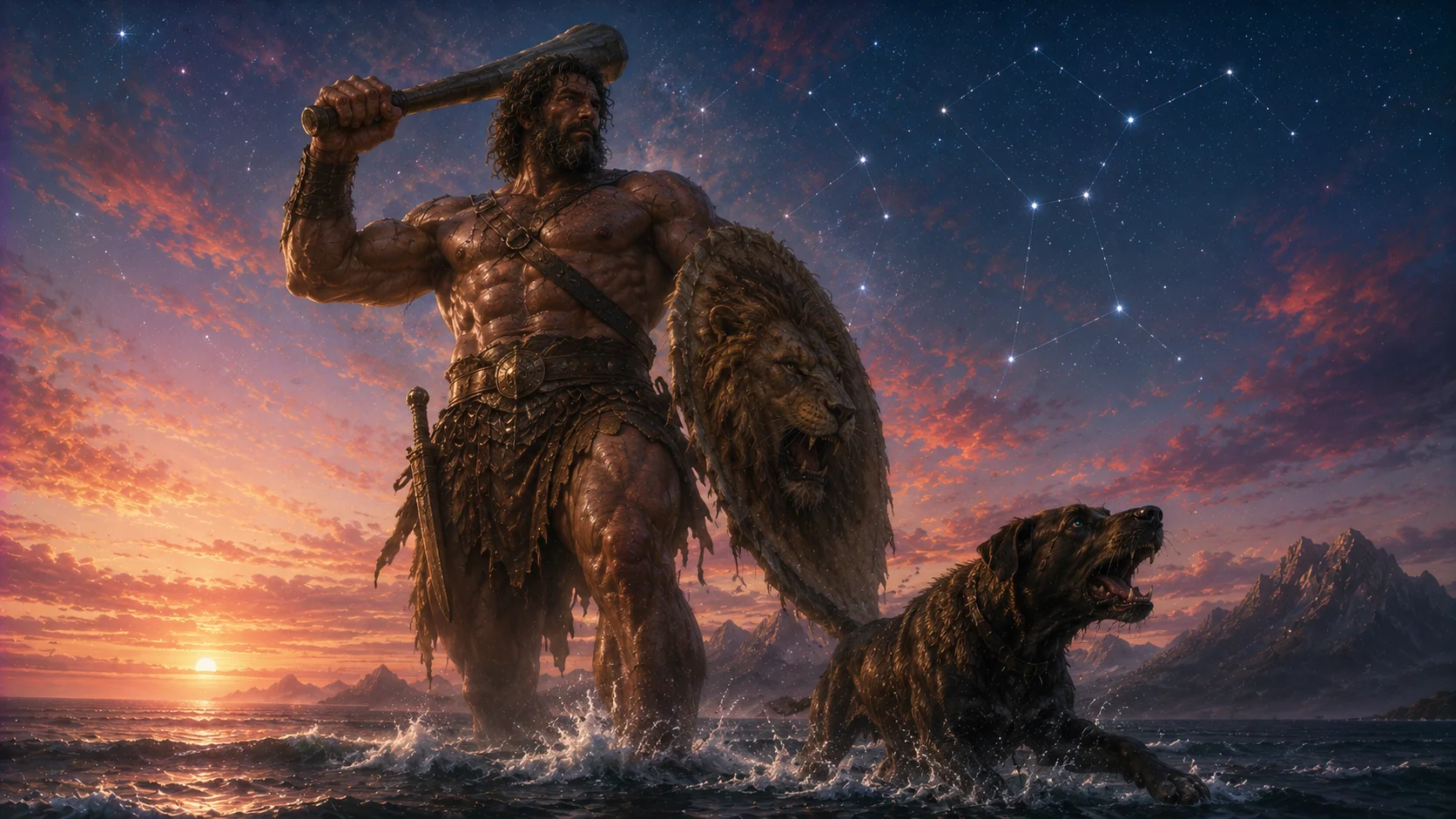
Enceladus was one of the mightiest of the Gigantes — a giant who fought against the gods in the Gigantomachy and was buried, still living, beneath the island of Sicily, where his restless writhing was said to cause the earthquakes and the fiery eruptions of Mount Etna. He is the giant who became a volcano, his struggle beneath the earth felt to this day.
Blood of the Sky Father, Body of the Earth
Enceladus belonged to a race with a violent beginning. Hesiod's Theogony tells that the Gigantes sprang from Gaia, the Earth herself, fertilized by the blood that fell when Uranus, the Sky, was castrated by his own son. From that wound came a brood of earth-born sons, armed and grown, of whom Enceladus was counted one of the greatest. Hesiod names the Giants as a class rather than as individuals with separate careers, and it is in that collective birth — Earth quickened by the blood of mutilated Sky — that Enceladus's nature is fixed from the very start: he is chthonic to his core, a child of the ground with no portion of the sky in him at all.
Last updated .
Kin Only in Origin, Not in Kind
It matters what Enceladus was not. Gaia's other offspring by Uranus — the hundred-armed Hecatoncheires and the one-eyed Cyclopes — belong to wholly separate categories of being, born of the same union but never numbered among the Gigantes. Enceladus's own brotherhood was narrower: giants born specifically for the war they would eventually fight, a war the Cyclopes and Hundred-Handers took no part in as combatants on the giants' side. The distinction is not a technicality inherited from later commentary; it shapes what Enceladus is for — a soldier bred from Earth's grievance against Sky, not a craftsman or a jailer of Titans.
The War Against the Sky's Heirs
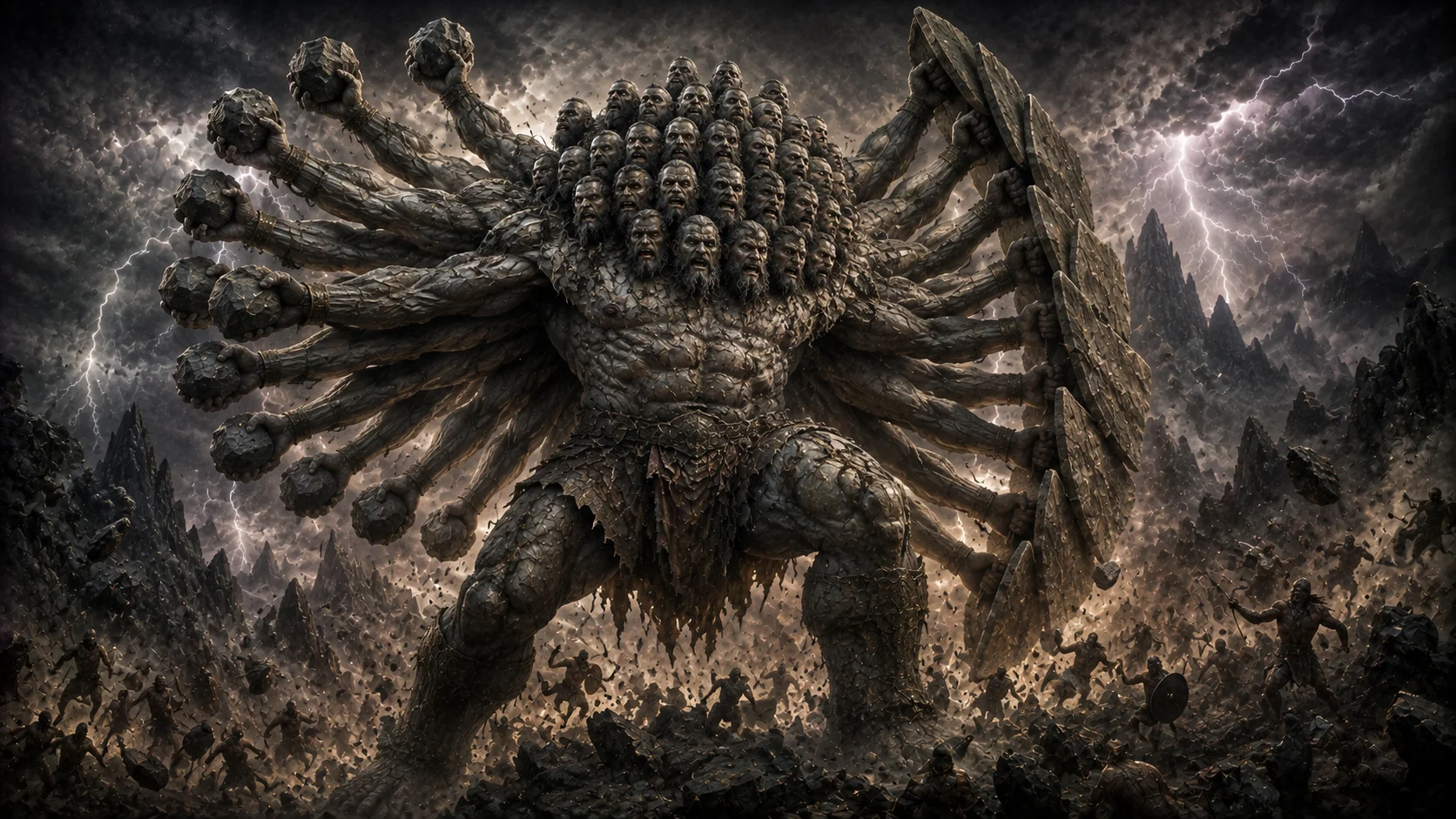
Enceladus is remembered above all for the Gigantomachy, the war the Giants waged against the Olympian gods. Where the earlier Titanomachy had pitted one generation of divine powers against another, the Gigantomachy set the earth-born Giants — Enceladus among their foremost — against the newer cosmic order that Zeus and his kin had only just secured. No single early epic narrative of the battle survives complete; what is known comes in fragments and in later retellings, but the shape of the conflict is constant: Gaia's sons rising against Olympus, and Olympus's gods, one by one, cutting them down.
Athena's Adversary
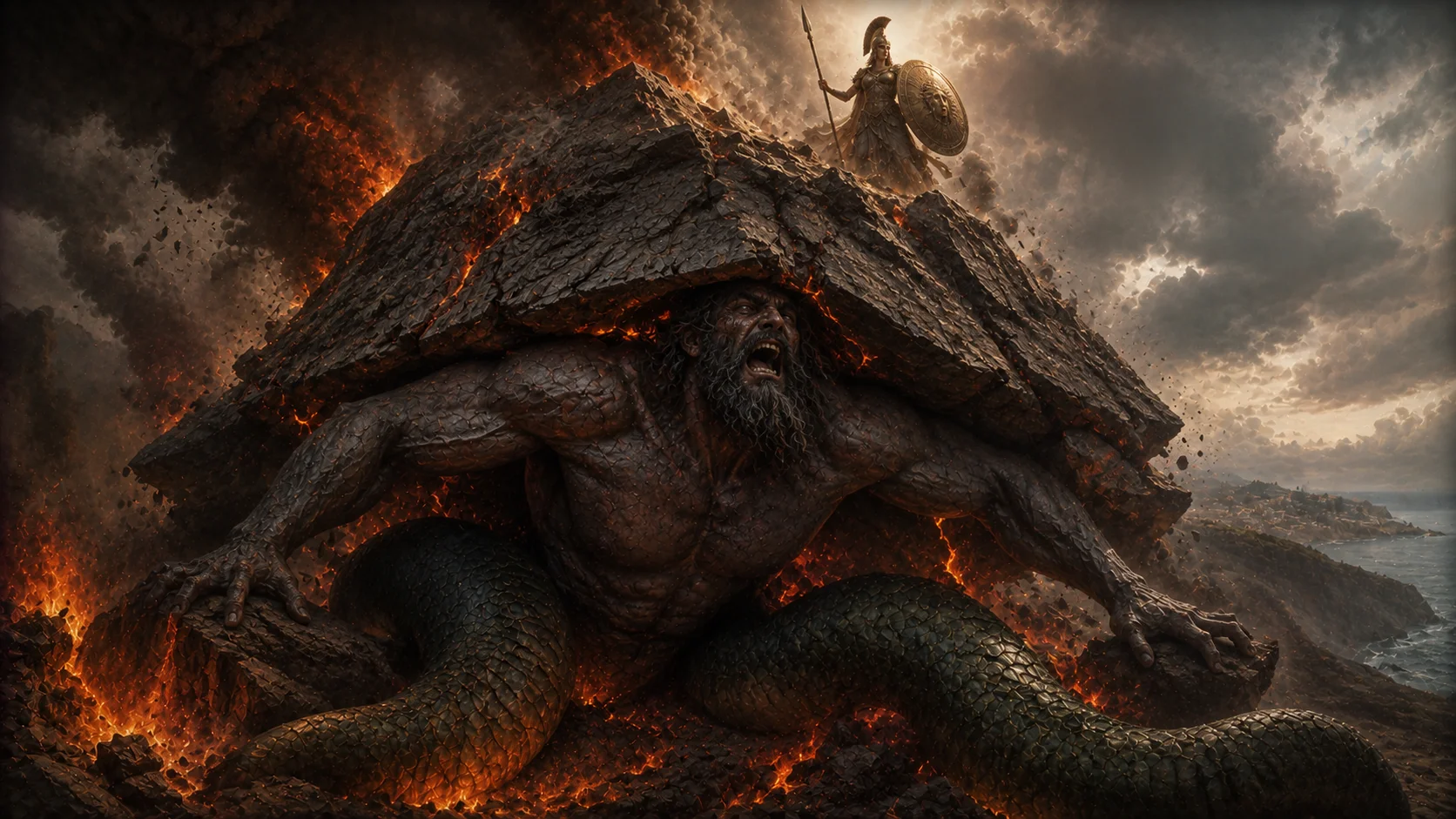
In the fullest surviving account of his fall, preserved by the later mythographer Apollodorus in the Bibliotheca, it is the goddess Athena who meets Enceladus in the battle. When he turned to flee before her, she pursued him across the sea and brought the whole island of Sicily down upon him, crushing him beneath its weight. It was not, in this telling, a killing blow so much as an imprisonment — the giant pinned living under the land rather than ended outright, his war with the gods reduced from a battle to an endless, buried struggle.
A Second Giant Claims the Same Mountain
Ancient sources do not agree among themselves. Alongside the tradition that names Enceladus as the giant beneath Sicily, another and equally old tradition places a different figure, the monster Typhon, under Mount Etna specifically — Typhon's own myth of rebellion and burial running in parallel to the Giants' war rather than as part of it. Which of the two the ancients meant, in any given text or place, is a genuinely disputed point across authors, and no single source resolves it for all the others. Sicily's fire, in other words, had more than one imprisoned claimant in antiquity, and Enceladus's occupancy of that burning ground was a strong tradition rather than a universal one.
Buried Beneath Etna
Trapped alive beneath Sicily, in the tradition that gives him the mountain, Enceladus could never rest. Ancient and later writers alike used his imprisonment to explain the island's violent geology: when the giant shifted his vast bruised body, the ground shook in earthquakes, and the flames of Mount Etna were his fiery breath escaping from below, or the smouldering fire of the god's thunderbolt still lodged in his wounds. Every eruption was read as the imprisoned giant stirring; every tremor, as Enceladus straining, in vain, to break free of the land piled over him.
A Name Without a Second Story
For all his fame as Athena's opponent, Enceladus is oddly thin as an individual in the earliest sources. Hesiod, who gives the Giants their birth, does not single him out with a personal deed or a distinct history of his own; the detailed picture — his duel with Athena, his burial under Sicily specifically — comes chiefly from Apollodorus and the mythographers who wrote centuries after the earliest epic accounts. Beyond the one battle and the one burial, no adventure, no separate exploit, and no personal fate distinct from the war is recorded for him. He is defined almost entirely by how his story ends, not by how it unfolds.
What His Name May Mean
Ancient and modern commentators alike have connected Enceladus's name to the Greek word enkelados, though the precise sense and derivation are not certain even now. No single settled etymology survives to explain what quality or deed the name was meant to capture — whether a description of his fury, his noise, or something else lost to time. The name endures more securely than its meaning.
Carved Into the Goddess Who Defeated Him
Athena's victory over Enceladus became part of how she herself was represented. Scenes of the Gigantomachy appear in her own cultic imagery — on the east metopes of the Parthenon and on the great shield of the Athena Parthenos — carrying the memory of the Giants' defeat onto the goddess's own aegis and armor. Enceladus, as her particular opponent in the fullest surviving version of the war's end, sits at the root of that visual tradition even where he is not named outright in the stone.
A War Painted in Stone
No single early literary work gives the Gigantomachy its fullest telling; that belongs instead to art, and above all to the towering frieze of the Pergamon Altar from the Hellenistic period, where the war of gods and earth-born giants was carved at monumental scale. It is in works like this, rather than in a surviving epic devoted to the subject, that the battle Enceladus fought and lost reaches its most complete ancient depiction.
A Power Without an Altar
Unlike many figures of Greek myth, Enceladus was never the object of cult worship of his own. No shrine, festival, or ritual honored him individually; his significance was entirely mythological and literary, and — where Etna was concerned — etiological, a story told to account for a real and frightening natural phenomenon rather than a god or spirit addressed in prayer. He belonged to explanation, not to religion.
The Restless Prisoner of the Earth
The image of Enceladus, in the tradition that gives him Sicily, is one of the most powerful in Greek myth's explanation of the natural world. Where the Titan Atlas held up the sky and Prometheus was chained to a peak, Enceladus was pinned beneath an entire island — a being so vast and so restless that a mountain's fire and a region's earthquakes were merely the symptoms of his unending struggle. He made the violence of the earth itself into the story of a defeated but undying enemy of the gods.
The Giant Who Reaches the Stars
Enceladus's afterlife extends well beyond antiquity's volcanoes. In 1789 William Herschel gave the giant's name to a newly discovered moon of Saturn, a modern astronomical christening bound to the myth by name alone and unrelated to its ancient content. The giant beneath Sicily's fire and the small icy moon that now carries his name share nothing but the word — yet between them, Enceladus remains a name attached to buried, restless power, on Earth and, now, far beyond it. He embodies the old intuition that the violence of the ground beneath our feet is something alive and imprisoned, a vast power that lost its war against heaven but never, quite, gave up the fight.
Sicily's every earthquake and Etna's every eruption were, to the ancients, the same thing: a buried giant turning in his sleep, still trying to rise — even if not every ancient author agreed it was Enceladus turning there.