She was born without a mother, fully grown and clad in armour, from the splitting of a god's skull — and from that impossible birth onward, Athena was the mind of Olympus made divine. Goddess of wisdom, of strategic war, of crafts and the just cause, she was the Greek ideal of intelligence as a force more powerful than brute strength. Where her half-brother Ares was the madness of battle, Athena was the cold clarity that wins it.
Born of Thought, Not of Womb
Zeus had been warned that the child of the wisdom-titan Metis might overthrow him, so he swallowed Metis whole, pregnant as she was. But the child grew within him — and one day Zeus was seized by a splitting headache so terrible that his skull was cleaved open with an axe to let her out. Hesiod's Theogony preserves this birth: no womb, no infancy, no mother's milk. Out leapt Athena, full-grown, already armed, crying a war shout that shook Olympus. She was, from her first breath, wisdom that arrives ready for the fight.
The Disputed Hand on the Axe
Tradition most often credits Hephaestus, the smith-god, with striking the blow that freed her — a fitting irony, since he later desired her and was refused. Other, rarer accounts name Prometheus instead, the titan who shaped and championed humankind. The sources themselves do not agree, and nothing forces a resolution: what every version keeps constant is the axe, the skull, and the fully armed goddess who steps out of the wound.
Wisdom Armed for War
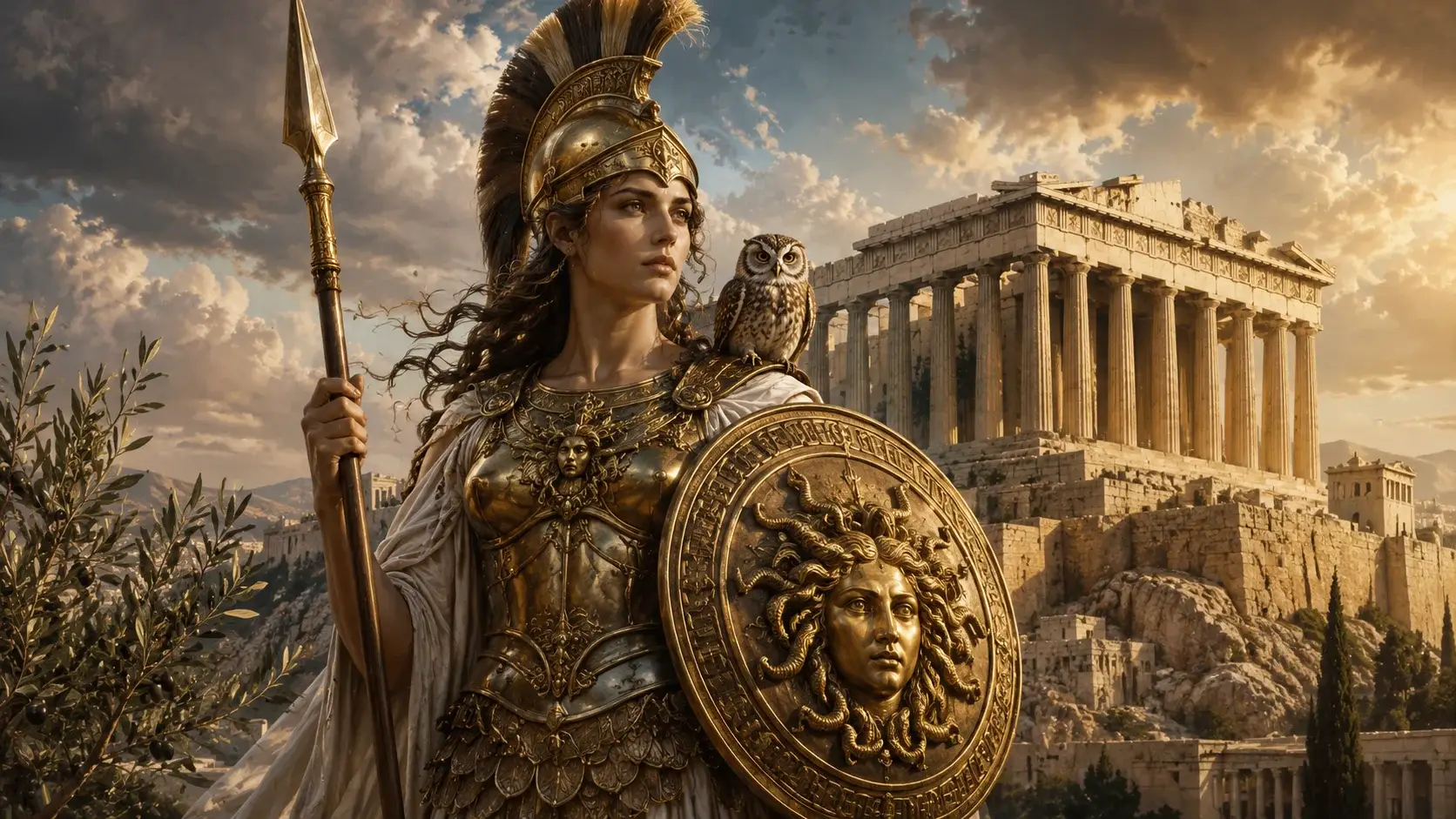
Athena bore the aegis and the spear, but she was no lover of slaughter. She governed the strategy of war — the planning, the discipline, the just cause — as distinct entirely from the chaotic bloodlust her half-brother Ares embodied. Two gods of war stood on Olympus, and the Greeks knew the difference: one was frenzy, the other was calculation. Athena governed the arts of peace as well — weaving, pottery, the olive, the bridle that first tamed the horse. To the Greeks, civilisation itself was Athena's gift, and her epithet Ergane, "of crafts," named that half of her directly.
The City She Won
When she and Poseidon both desired the greatest city of Attica, the people asked each god for a gift. Poseidon struck the ground and produced a gift of the sea — accounts differ on whether it was a saltwater spring or the first horse — while Athena planted the first olive tree: food, oil, wood, and peace in one gift. The people, or their king, chose her, and the city took her name: Athens. The contest is carved into the west pediment of the Parthenon itself, the two gods frozen mid-offering above the city they both wanted. Her great temple still crowns its hill, and its very name — the Parthenon — descends from her epithet Parthenos, the Virgin.
Pallas, the Name She Carried in Grief
Long before she was Athena Parthenos to all of Greece, she was simply a girl sparring with her foster-sister Pallas, a companion of her own childhood. The bout went wrong. Athena's blow landed true and killed her — an accident, but not one grief allowed her to set aside. She took her companion's name onto her own, becoming Pallas Athena, and carved a wooden image in Pallas's likeness: the Palladium, a relic that would carry the dead girl's memory through the rest of Greek myth. The goddess of cool judgment carried, underneath it, a single loss she had caused herself — and she carried it in the most public way imaginable, folding a private sorrow permanently into her own public name. Every worshipper who addressed her afterward as Pallas Athena was, whether they knew it or not, invoking the memory of the friend she killed by accident and refused to let the world forget.
The Shield Made From a Monster
The aegis she bore was no ordinary shield. In most tellings it began as a goatskin breastplate, but after Perseus completed his quest against the Gorgon Medusa, the severed head — turned to stone anything that met its eyes — was set into it. Athena's shield became, from that point on, a weapon that carried a monster's death inside it. Her sacred bird, the small owl that turns its head to see in the dark, was a gentler emblem beside it, but no less hers, and it would go on to outlive the shield itself as the more lasting symbol of her wisdom, long after the fear the Gorgon's face once carried had faded into legend rather than living dread.
A Virgin Goddess, and the Son She Did Not Bear
Athena stood with Artemis and Hestia as one of three virgin goddesses of Olympus, and she held to it fiercely. When Hephaestus, still nursing his desire for her, attempted to force himself upon her, she fought free of him. His seed fell instead to the earth, and from that earth was born Erichthonius — not her son by any natural account, yet a child she took in and raised herself, tying his name permanently to hers and to the city she governed. The episode sat uneasily beside her identity as one of the three eternally virgin goddesses, yet the Athenians told it without embarrassment: it was proof, if anything, that her chastity was hers to defend and defend successfully, and that even an unwanted consequence of another god's failed assault could be turned, by her own choice, into an act of care rather than shame.
The Weaver Who Would Not Yield
A mortal woman named Arachne claimed a skill at the loom to rival the goddess's own, and wove a tapestry — depicting, by the fullest surviving account, the misdeeds of the gods themselves — that matched or surpassed Athena's work. Whether it was the rivalry or the tapestry's subject that provoked her, Athena's answer was transformation: Arachne became the first spider, condemned to spin thread forever instead of cloth. The story survives most completely in the Roman poet Ovid's Metamorphoses, though its roots and its goddess are Greek. Wisdom, in Athena's myths, was never something to be casually rivaled — and the punishment fit the offense with a certain grim precision: the mortal who claimed to weave better than a goddess was made to weave forever, her skill undiminished but her humanity stripped away along with the audience that might once have admired it.
The Guiding Hand Behind the Heroes
Athena's favourite mode of intervention was not the thunderbolt but the whispered plan. She advised Perseus before his hunt for Medusa and gave him a mirrored shield so he could strike the Gorgon without meeting her petrifying gaze directly. She steadied Heracles through several of his labours, appearing at his side when brute strength alone would have failed him. And she was, above every other hero, the patron of Odysseus — his cunning mirrored her own so closely that the Odyssey reads, in long stretches, as one long collaboration between a clever man and the goddess who never stopped watching over him, intervening again and again to see him home. Where Perseus and Heracles received her help in discrete moments — a shield here, a piece of counsel there — Odysseus received something closer to sustained partnership, the goddess of strategy attaching herself to the one mortal whose entire story was a demonstration that intellect could outlast strength, storm, and the patience of the gods themselves.
A Slight Repaid on the Plains of Troy
Her support for the Greeks in the Trojan War was not neutral. In the Judgment of Paris, the Trojan prince had been asked to award a golden apple to the fairest of three goddesses, and chose Aphrodite over Athena and Hera both. Athena did not forget it. Through the Iliad she works for the Greek cause and against Troy, her wisdom bent, this once, by something closer to wounded pride. It is a striking admission built into her own myth: the goddess who elsewhere embodies clear-eyed judgment nursed a decade-long grudge over a beauty contest she lost, and let it shape which side of a ten-year war received her favour.
Promachos, Polias, Nike — A Goddess of Many Faces
No single title held all of Athena. As Promachos she fought in the front rank, defending her city directly. As Polias she was simply "of the city," Athens's own guardian by name. And in her aspect as Athena Nike, victory itself was folded into her worship. Parthenos, Promachos, Polias, Ergane, Nike — each epithet peeled back a different face of the same goddess, wisdom applied to a different task.
The Image That Outlasted the Myth
Inside the Parthenon once stood Phidias's colossal statue of the goddess, worked in gold and ivory — chryselephantine, in the term the Greeks used for that technique — a single image that stood for the whole of Athenian confidence in her protection. When Rome absorbed the Greek pantheon into its own, Athena passed into it as Minerva, wisdom and craft and strategic war carried forward under a new name but scarcely changed in character. Between the Parthenon's marble and the countless later artists who returned to her image, Athena remains one of the most painted, sculpted, and invoked figures to survive from the ancient world — the armored daughter who arrived already whole, and never stopped being the mind the rest of Olympus turned to.
Sources & traditions
- EncyclopediaWikipedia — Athena
- TraditionGreek texts, inscriptions and later retellings (Greece)
Myths change from area to area and from time to time. This chronicle follows the most widely told versions; tellings in other villages, regions and eras may differ.