Perseus was the hero who proved that cleverness and a little divine help could topple even the most terrifying monster. Sent on a quest designed to kill him, he beheaded the Gorgon Medusa, rescued a princess from a sea-monster, and founded a dynasty — all without the brute strength of a Heracles. He is the hero of wits, gifts, and nerve, called Gorgophonos, "Gorgon-slayer," for the single deed that defined him, and closely tied in cult and image to the two gods who made that deed possible: Athena and Hermes.
A Shower of Gold in a Locked Tower
The trouble began with an oracle. King Acrisius of Argos was warned that a son born to his daughter Danaë would one day kill him. Rather than risk marrying her off, he locked her away where no man could reach her. It was not enough to thwart a god. Zeus came to Danaë as a shower of golden light, and from that union she bore a son: Perseus. Acrisius, learning of the birth, refused to believe the child's father was divine and saw only a grandson who might fulfill the prophecy after all. The account is attested by Apollodorus and echoed across many later retellings, the founding image — gold falling into a sealed chamber — becoming as famous as anything Perseus later did with sword or shield.
Cast Adrift, Taken In
Unwilling to kill his own daughter and grandson outright — and so invite a curse — Acrisius sealed Danaë and the infant Perseus into a wooden chest and set them adrift on the sea. The chest was not their tomb. It washed ashore on the island of Seriphos, where a fisherman named Dictys found it, opened it, and took the mother and child into his home. Perseus grew to manhood on Seriphos under Dictys's care, the prophecy that had frightened a king reduced, for the moment, to nothing more than a story half-remembered on a distant island. Apollodorus records this whole passage — the chest, the sea, the fisherman's household — as the hinge on which the rest of Perseus's life turns.
A King's Convenient Errand
Dictys had a brother: Polydectes, king of Seriphos. Polydectes wanted Danaë for himself, and a grown son standing between them was an obstacle he intended to remove. He announced a wedding — not his marriage to Danaë, but a pretext — and asked his subjects for gifts befitting the occasion. Perseus, with nothing else to offer and everything to prove, promised whatever Polydectes named. The king named the head of the Gorgon Medusa, a task no man was expected to return from. It was exactly the point: a wedding gift chosen because it was, in effect, a sentence of death dressed up as an honor.
Gifts From Gods Who Do Not Forget Their Own
Perseus was not without allies. Athena and Hermes, the gods most closely tied to him in cult and image alike, moved to equip him for what a mortal alone could not survive. Hermes lent winged sandals to carry him across the world. Athena provided a bronze shield polished to a mirror's shine — the instrument, not the weapon, of the deed to come. Further gifts awaited elsewhere: the cap of invisibility belonging to Hades, and a pouch called the kibisis, both held by nymphs whose location was a closely guarded secret, known only to three other beings entirely.
Wringing a Secret from the Grey Sisters
The secret belonged to the Graeae, three sisters born grey-haired, who shared a single eye and a single tooth between them, passing each from hand to hand as they needed it. Perseus found them and, in the instant the eye changed hands, seized it — and refused to return it until they told him where the nymphs could be found. Blind and cornered, the Graeae gave up what they guarded. From the nymphs, Perseus received the cap of invisibility and the kibisis to carry his gruesome prize, completing the arsenal Athena and Hermes had begun. Every piece of it — sandals, shield, cap, pouch — would matter before the day of the beheading was done; none was decoration, and the myth is careful to account for each one's use.
The Gaze No Mortal Could Meet
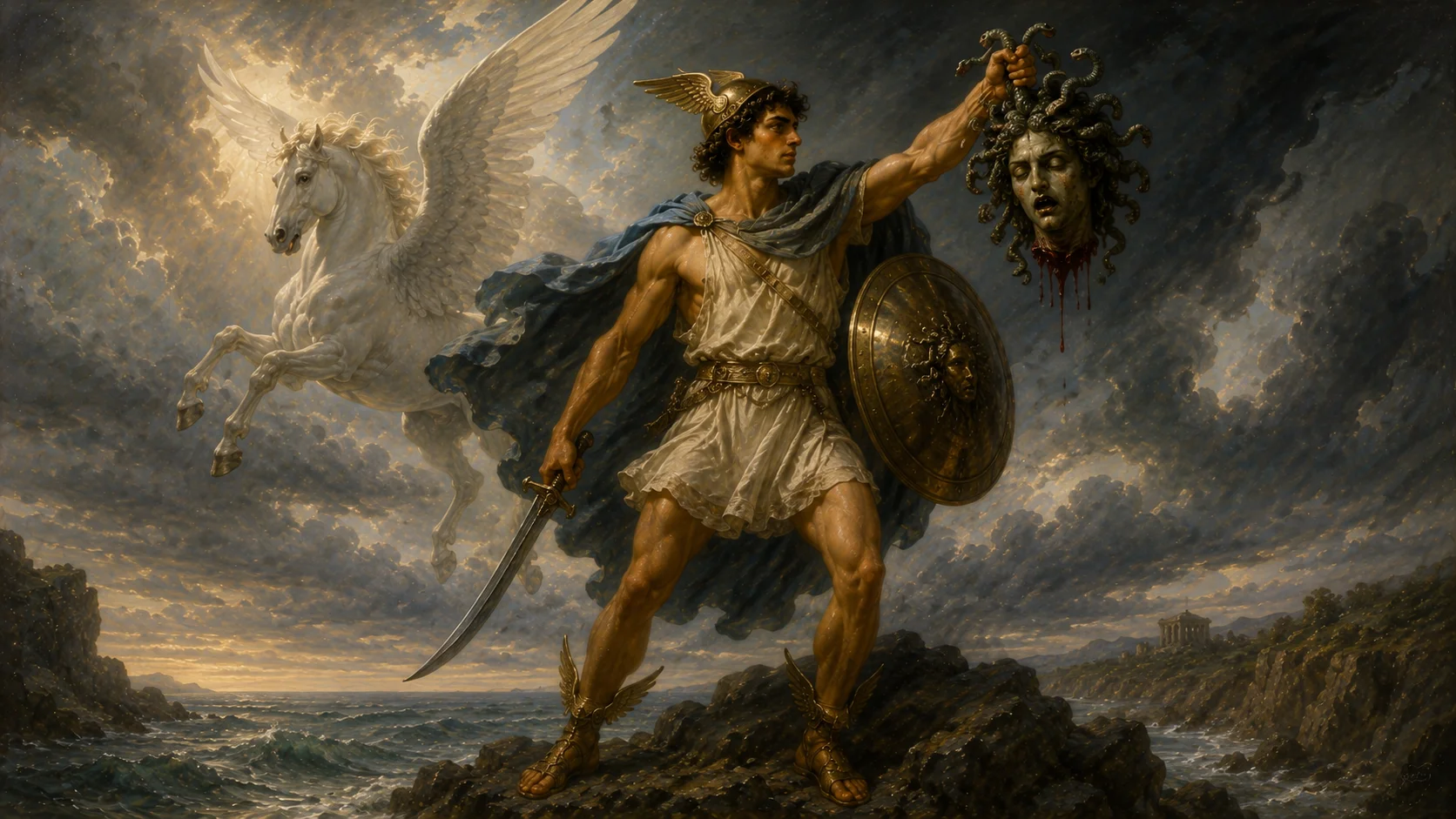
Medusa's stare turned flesh to stone at a glance — a fact that made a direct approach a death sentence. Perseus never risked it. Flying to her lair on winged sandals, invisible beneath Hades' cap, he watched her only as a reflection in Athena's polished shield, and by that reflection guided his blow. He struck off her head without ever meeting her eyes, sealed it in the kibisis, and left before her sisters could avenge her. The whole sequence — approach, reflection, strike, flight — is the moment later art would return to again and again, the instant where wit rather than strength decided the outcome.
What the Gorgon's Blood Set Free
Medusa's death was not an ending but a beginning for two others. From her severed neck sprang Pegasus, the winged horse, and Chrysaor, both fathered by Poseidon, who had lain with her. Chrysaor would go on to father the three-bodied Geryon, carrying Medusa's blood forward into a wider lineage of monsters and heroes alike — a single violent moment at the root of stories far beyond Perseus's own. Perseus himself had no further part in what sprang from that neck; the moment belongs to Medusa and Poseidon, but it is Perseus's blade that opens it, and the wider mythological genealogy remembers his stroke as the origin point all the same.
A Princess Chained to the Rock
Flying home with his prize, Perseus passed over a coastline where a girl stood chained to a sea rock, offered up as sacrifice. Her name was Andromeda, and her fate traced back to her mother Cassiopeia's boast — that she surpassed even the Nereids in beauty, an insult Poseidon answered by sending a sea-monster, Cetus, to ravage the coast until the princess herself was given up to it. Perseus killed the monster and freed her, and where Polydectes had sent him toward death, this unplanned meeting gave him a wife instead. He married Andromeda, and their line would run for generations — down, eventually, to Heracles himself, through their son Electryon and daughter Alcmene. Apollodorus records the rescue and marriage plainly; later hands, Euripides in tragedy and Ovid in verse, gave the same rock and the same chains their fullest, most dramatic telling.
A Homecoming Written in Stone
Perseus returned to Seriphos to find his mother sheltering from Polydectes still, the king's intentions toward her unchanged. He needed no blade this time. Producing Medusa's head, its power undimmed by death, Perseus turned Polydectes and his court to stone where they stood, ending the threat that had sent him away in the first place. Dictys, the fisherman who had raised him, was left to rule in his brother's place. Having no further use for the Gorgon's head, Perseus gave it to Athena, who mounted it on her aegis, where it remained a mark of the goddess's own power — the same shield that had once let Perseus look at Medusa safely now carrying Medusa's face outward, turned against Athena's enemies instead of his own.
The Discus That Found Its Mark
Acrisius had not forgotten the prophecy either, and word of his grandson's return sent him fleeing Argos rather than face what an oracle had long ago promised. He found no safety in flight. At athletic games held at Larissa, Perseus competed — some accounts specify the discus throw — and the throw went astray, striking and killing a spectator who turned out to be Acrisius himself, in the city he had run to rather than the one he had fled. The prophecy that had set the entire chain of events in motion, from the locked tower to the wooden chest to the Gorgon's head, closed exactly where it had been aimed from the start, and by the hand that had least intended it.
A Throne Traded for a Clear Conscience
Killing his grandfather, however unintended, left Perseus unwilling to take the throne of Argos that was now his by right. He arranged an exchange instead, trading his claim to Argos with a kinsman, Megapenthes, and taking Megapenthes' holdings in return. Tradition — recorded by Pausanias among others — credits him, in the land he took up, with founding the city of Mycenae, a city whose name would echo through Greek legend long after Perseus's own story had ended, home to the dynasty that descended from him.
A Line That Runs to Heracles
Perseus and Andromeda's marriage did more than end a monster's threat. Their descendants formed the Perseid dynasty, and through their son Electryon and daughter Alcmene, that line reached its most famous member: Heracles, whose mother Alcmene made Perseus his great-grandfather. The Gorgon-slayer's blood ran, by that reckoning, through the single most celebrated hero of the age that followed him — a quiet inheritance beside the loud one of stone monsters and severed heads, but no less part of what made Perseus matter to the generations that told his story afterward.
A Name Written Among the Stars
Perseus's story outlasted the age that told it. Renaissance and later Western art returned again and again to his defining moments — the Gorgon's severed head and the rescue of a chained princess — from Cellini's bronze Perseus holding Medusa's head aloft to Titian's and Rubens's paintings of Perseus and Andromeda. His name endures more literally still overhead: the constellation Perseus and the Perseid meteor shower both carry it, a hero who once feared no reflection now scattered permanently across the night sky he was said to join.
He won not by being the strongest, but by being the cleverest — and by never once looking the horror in the eye.
Sources & traditions
- EncyclopediaWikipedia — Perseus
- TraditionGreek texts, inscriptions and later retellings (Greece)
Myths change from area to area and from time to time. This chronicle follows the most widely told versions; tellings in other villages, regions and eras may differ.