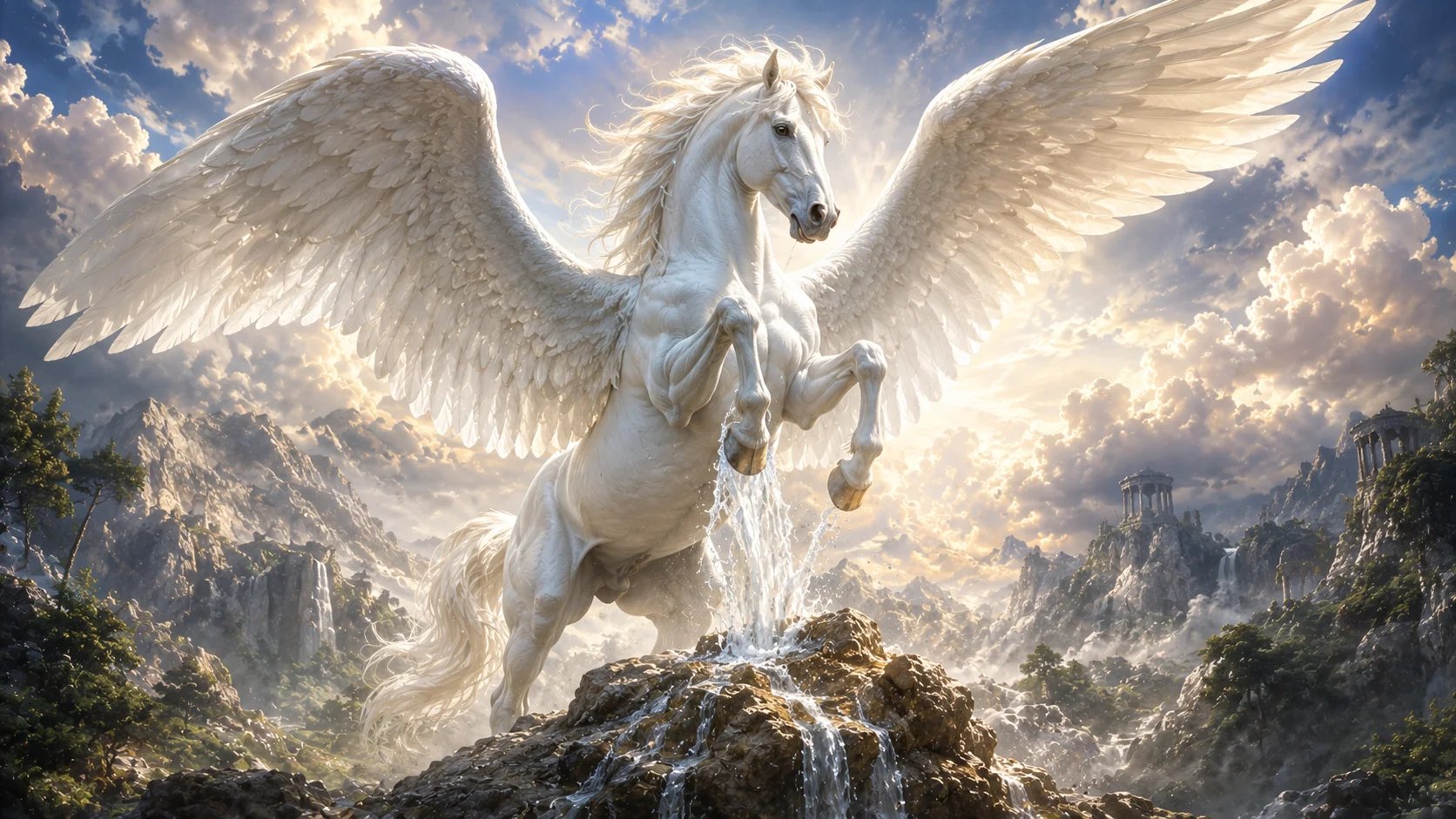
Of all the creatures of Greek myth, none has captured the imagination so completely as Pegasus, the magnificent winged horse — pure white, swift as the wind, born from the blood of a monster yet utterly noble. He is the eternal image of inspiration taking flight, and he has galloped through three thousand years of art, poetry and dream.
Born from the Gorgon's Blood
Pegasus had a startling birth: when the hero Perseus beheaded the Gorgon Medusa, the winged horse sprang forth from her severed neck (or from her blood mingling with the sea-foam), along with his brother, the giant Chrysaor. His father was Poseidon, god of horses and the sea. Thus beauty and flight were born from horror — a deeply Greek idea.
The Hero's Steed
The wild winged horse was tamed by the hero Bellerophon, who caught him at the spring Peirene with a golden bridle given by Athena. Together they accomplished the impossible: from Pegasus's back, Bellerophon slew the fire-breathing Chimera from the air. But when Bellerophon grew arrogant and tried to ride Pegasus up to Olympus, Zeus sent a gadfly to sting the horse; Pegasus threw his presumptuous rider, who fell to ruin — while Pegasus flew on to the heavens.
The Spring of the Muses
Wherever Pegasus struck his hoof, a spring of water burst forth. The most famous, Hippocrene (“the horse's fountain”) on Mount Helicon, became sacred to the Muses — and to drink from it was to be filled with poetic inspiration. This is why Pegasus became, forever after, the emblem of poetry and the creative imagination itself.
The Horse Among the Stars
His journey ended in glory: Zeus took Pegasus into his service to carry his thunderbolts, and finally set him among the stars as the constellation Pegasus, where he gallops still. From monstrous blood to the heavens, the winged horse remains the purest symbol we have of the spirit that rises — of inspiration, freedom, and flight.
Wherever his hoof struck the earth, poetry sprang up — which is why the imagination has worn his wings ever since.
The Bridle That Arrived in a Dream
Pindar, composing for a Corinthian victor in 464 BC, tells how the golden bridle actually reached Bellerophon's hands, and the detail changes the shape of the whole story. Unable to master the winged horse, Bellerophon went to the seer Polyidus, who told him to sleep the night on the altar of Athena. The goddess came to him in the dark holding a band of gold, called it a charm for the horse, and told him to sacrifice a bull to his father Poseidon, tamer of horses. Bellerophon woke and the bridle was lying beside him — dreamed, and yet solid. He made the sacrifice, raised an altar to Athena of the Horses, and only then went down to Peirene, where Pegasus took the bit without a struggle. The version insists on something the rest of the myth only implies: no mortal masters this horse by strength or cunning. He is given, not caught.
Beyond the Chimera: The Trials of Lycia
Killing the Chimera was only the first task set to Bellerophon, and he had never asked to be tested at all. He arrived in Lycia carrying a sealed tablet from King Proetus of Tiryns, who wanted him dead but would not break the laws of hospitality by doing it himself — the folded tablet, addressed to Proetus's father-in-law Iobates, asked for the execution of the man delivering it. A message that condemns its own bearer is still called a Bellerophontic letter. Iobates, bound by the same hospitality, sent him against the Chimera instead and expected the monster to settle the matter. When Bellerophon came back alive the king tried again: first the Solymi, then the Amazons, and finally an ambush of the best fighting men in Lycia, hidden along his road. He survived all of it. Homer, who tells the sequence in the Iliad, never mentions a winged horse at all; it is Hesiod and Pindar who put Pegasus beneath him, Pindar crediting the horse with the Amazons and the Solymi as well as the Chimera, struck down from the cold empty air. Iobates gave up at last, handed over his daughter Philonoe and half his royal honours, and the Chimera turns out never to have been the real trial. The trial was surviving a king's cowardice.
A Brother's Darker Road
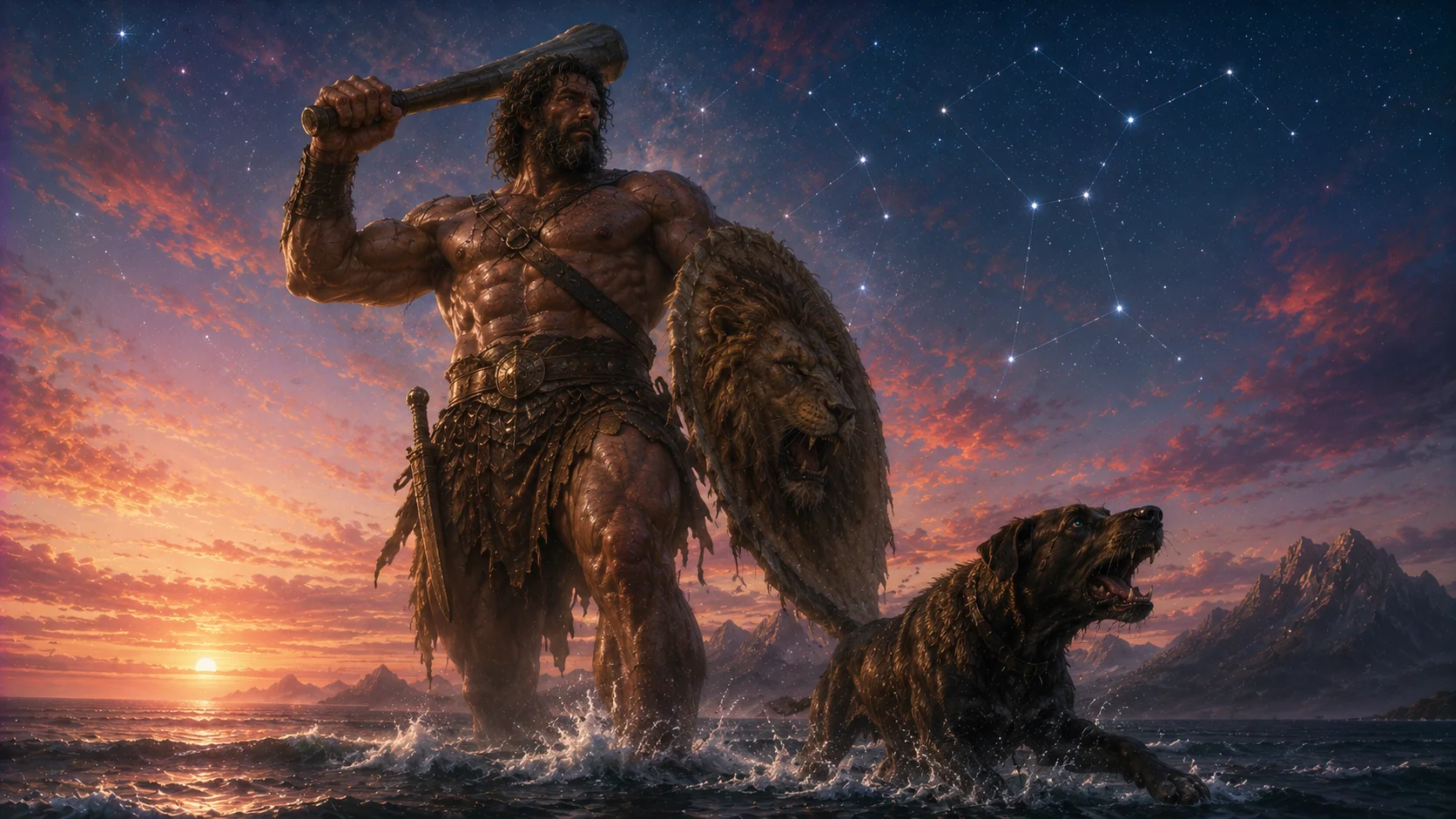
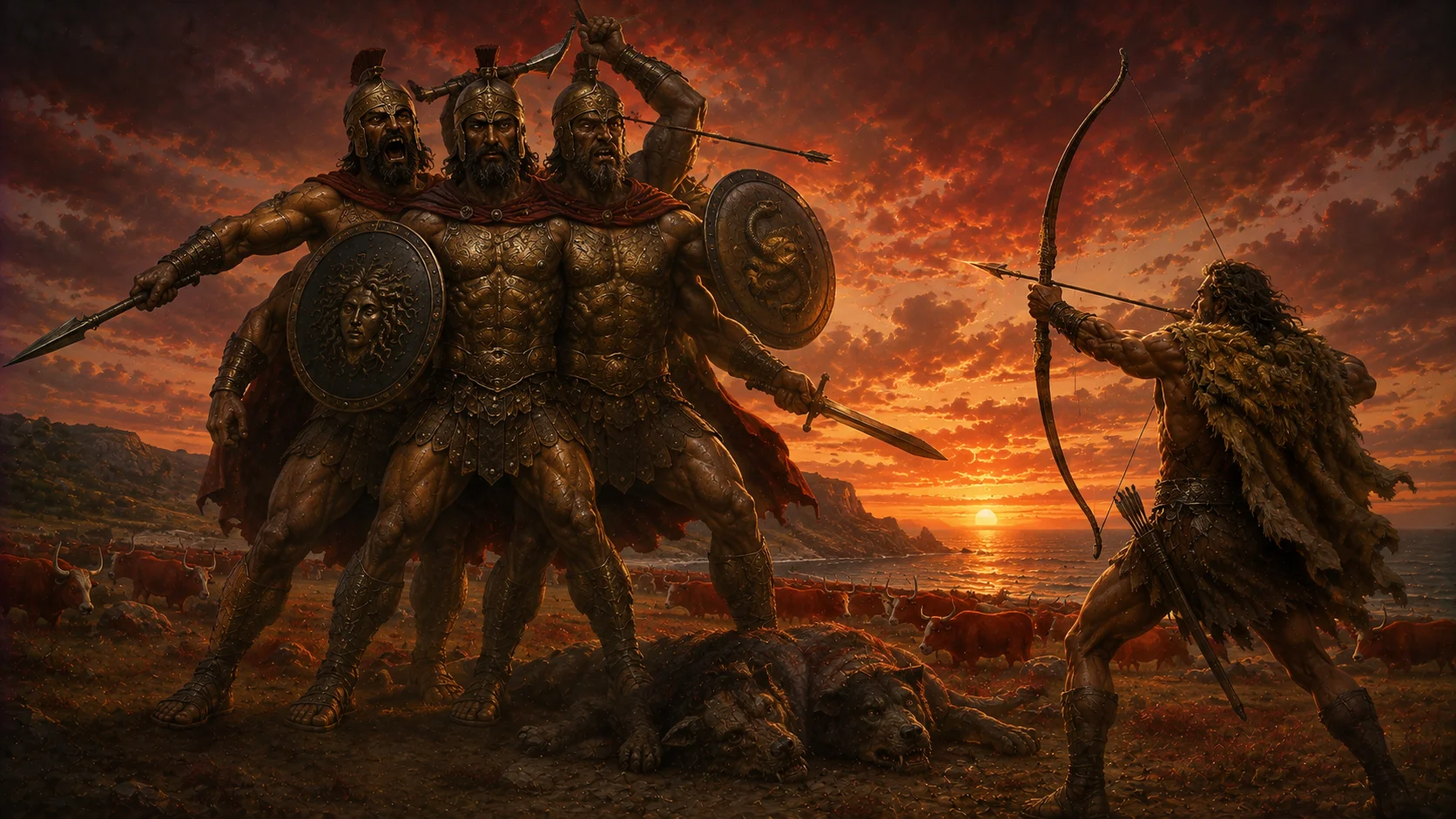
Pegasus did not come out of Medusa alone. Chrysaor — the name means “golden sword,” and Hesiod says he sprang out holding one — leapt from the same wound in the same instant. But where Pegasus rose toward gods and poetry, his brother's line stayed low and monstrous. Chrysaor fathered Geryon on Callirhoe, a daughter of Oceanus: a giant with three bodies who kept a herd of red cattle on Erytheia, an island at the western edge of the world. Stealing that herd became the tenth labour of Heracles, who brought Geryon down with a single arrow — poisoned, in Stesichorus's telling, with the blood of the Hydra, so that the dying giant bent aside like a poppy shedding its petals. Two brothers, one origin, one instant: the elder becomes the emblem of inspiration itself, the younger fathers a monster that has to be destroyed. Greek storytellers never explained why one road went up and the other down.
The Winged Horse on Silver
Bellerophon was no outsider. Homer makes him a grandson of Sisyphus, the cunning king of Corinth, and no city claimed Pegasus more fiercely than Corinth did. From the sixth century BC the Corinthians stamped their silver staters with the winged horse — Pegasus in flight on one face, helmeted Athena on the other — so consistently that the coins were nicknamed simply colts, poloi, across the Greek-speaking world. Where Corinthian ships and colonists went, the colts went with them: Leucas, Ambracia and Anactorium struck their own, and so did Syracuse, Corinth's most successful western colony, in enormous numbers from the mid-fourth century BC, when the Corinthian general Timoleon sailed to put Sicily back in order. A myth about flight became, quite literally, a currency — carried up the Adriatic and across to Sicily on the strength of a story about a local boy and a horse at a local spring.
Half a Horse in the Sky
The constellation is stranger than most people notice. Ancient astronomers drew Pegasus as only the front half of a horse — head, neck, forelegs — with no hindquarters at all, as though he were plunging out of the sky rather than standing in it. For most of astronomical history he also had to share a star with his neighbour. The point at the north-eastern corner of the Great Square of Pegasus marked the horse's navel; its name, Alpheratz, comes from the Arabic for exactly that. But the same star was the head of Andromeda, chained beside him. Aratus, around 270 BC, called it a joint star belonging to both figures at once, and Bayer's atlas of 1603 lettered it twice over, Alpha Andromedae and Delta Pegasi. Only when the International Astronomical Union fixed permanent constellation boundaries in 1930 was the sharing ended and the star handed to Andromeda alone. The Great Square remains the easiest landmark of the autumn sky: four modest stars tracing the body of a horse who was never given legs to land on.
From Corinthian Clay to a Bridge in Normandy
The image outran the story almost at once. Corinthian potters were painting Bellerophon on Pegasus against the Chimera by the middle of the seventh century BC, on a perfume flask found at Thebes and now in Boston. Around 580 BC the temple of Artemis on Corfu set the Gorgon at the centre of its west pediment with Chrysaor and Pegasus flanking her — children carved beside their mother so that no viewer could mistake who she was. That appetite never really stopped. In 1942 Britain's airborne forces took Bellerophon mounted on Pegasus as their badge, light blue on maroon, designed by Major Edward Seago after a suggestion from Daphne du Maurier; two years later glider troops wearing it seized the canal bridge at Bénouville in the opening minutes of D-Day, and it has been Pegasus Bridge ever since — a Greek horse renaming a piece of Normandy. The same silhouette sold petrol for most of the twentieth century as the flying red horse of Magnolia and then Mobil, one of which has been turning in neon above downtown Dallas since 1934. It carried Hercules through Disney's 1997 film. It still turns up wherever a story needs a shorthand for wildness made airborne and lent, briefly, to somebody.
Why the Story Refuses to Stay on the Ground
What survives, in the end, is the horse and not the rider. Bellerophon has everything a Greek hero is supposed to have — royal blood, nerve, cleverness, the favour of a goddess, a borrowed bridle — and every one of those advantages is part of what ruins him. Pegasus has none of that apparatus. He has wings, and wings do not get proud. That is very likely why the retellings let the horse go free while the man is remembered chiefly as a warning: Pegasus never wanted the throne of the gods, only the air he was already born to, and a creature whose entire ambition is flight has nowhere left to fall from. The myth punishes wanting the sky. It has never once punished belonging to it.
Sources & traditions
- EncyclopediaWikipedia — Pegasus
- TraditionGreek texts, inscriptions and later retellings (Greece)
Myths change from area to area and from time to time. This chronicle follows the most widely told versions; tellings in other villages, regions and eras may differ.