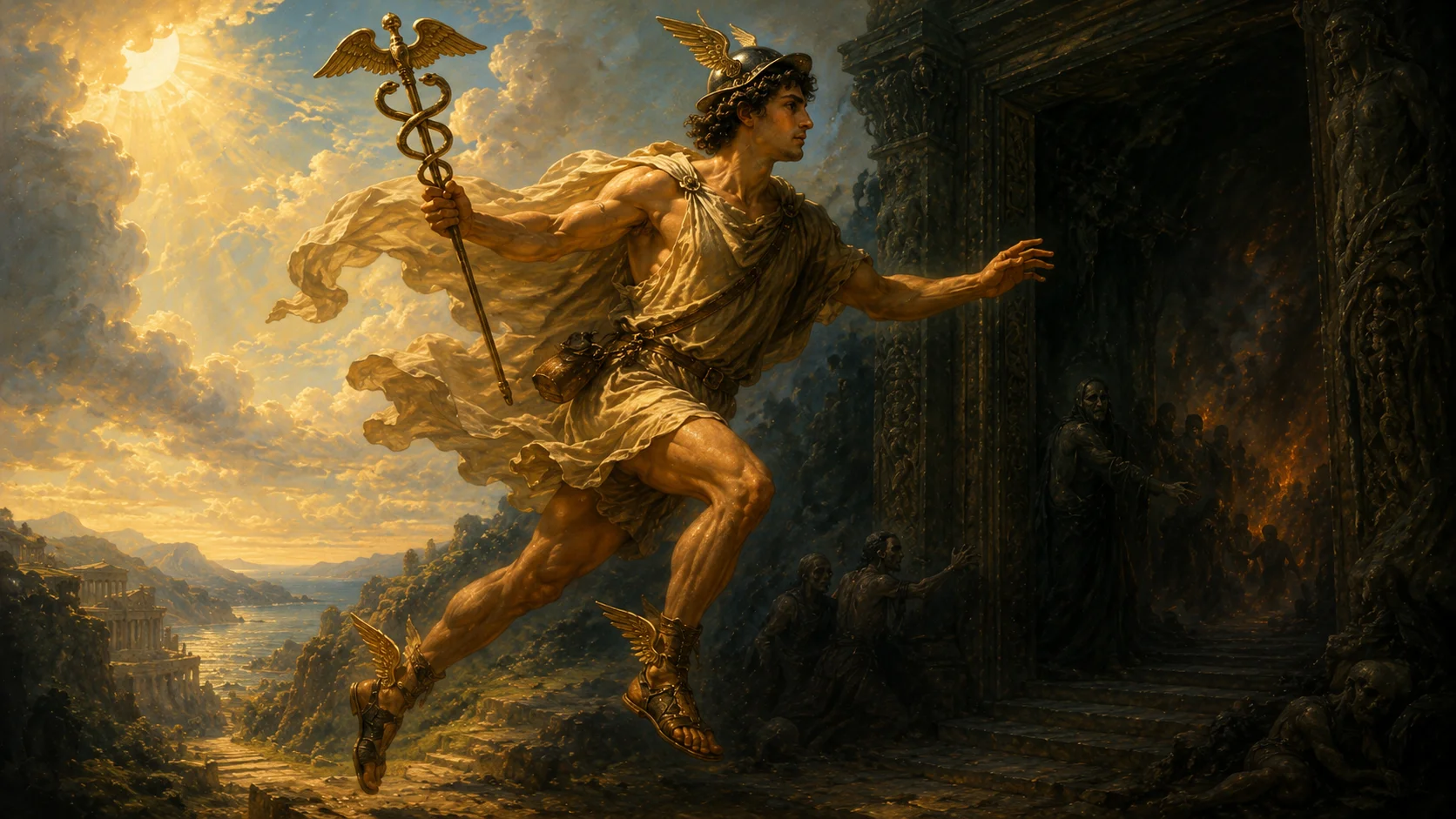
Quick of foot and quicker of mind, Hermes was the god who could go anywhere — up to Olympus, across the mortal world, and down into the land of the dead — and come back grinning. Messenger of the gods, patron of travellers, merchants, thieves and tricksters, guide of souls to the underworld, he was the divine principle of movement and the crosser of every boundary. No door, no border, no law quite held him.
The Thief in the Cradle
Hermes announced himself with mischief. On the very day he was born, the infant god slipped from his crib, found the cattle of his half-brother Apollo, and stole fifty of them — driving them backward so their tracks would mislead, and inventing sandals to hide his own. When Apollo caught him, Hermes charmed his way out by inventing the lyre from a tortoise shell and giving it to him. So began the career of the cleverest god: thief, inventor, and irresistible negotiator, all before his first nap.
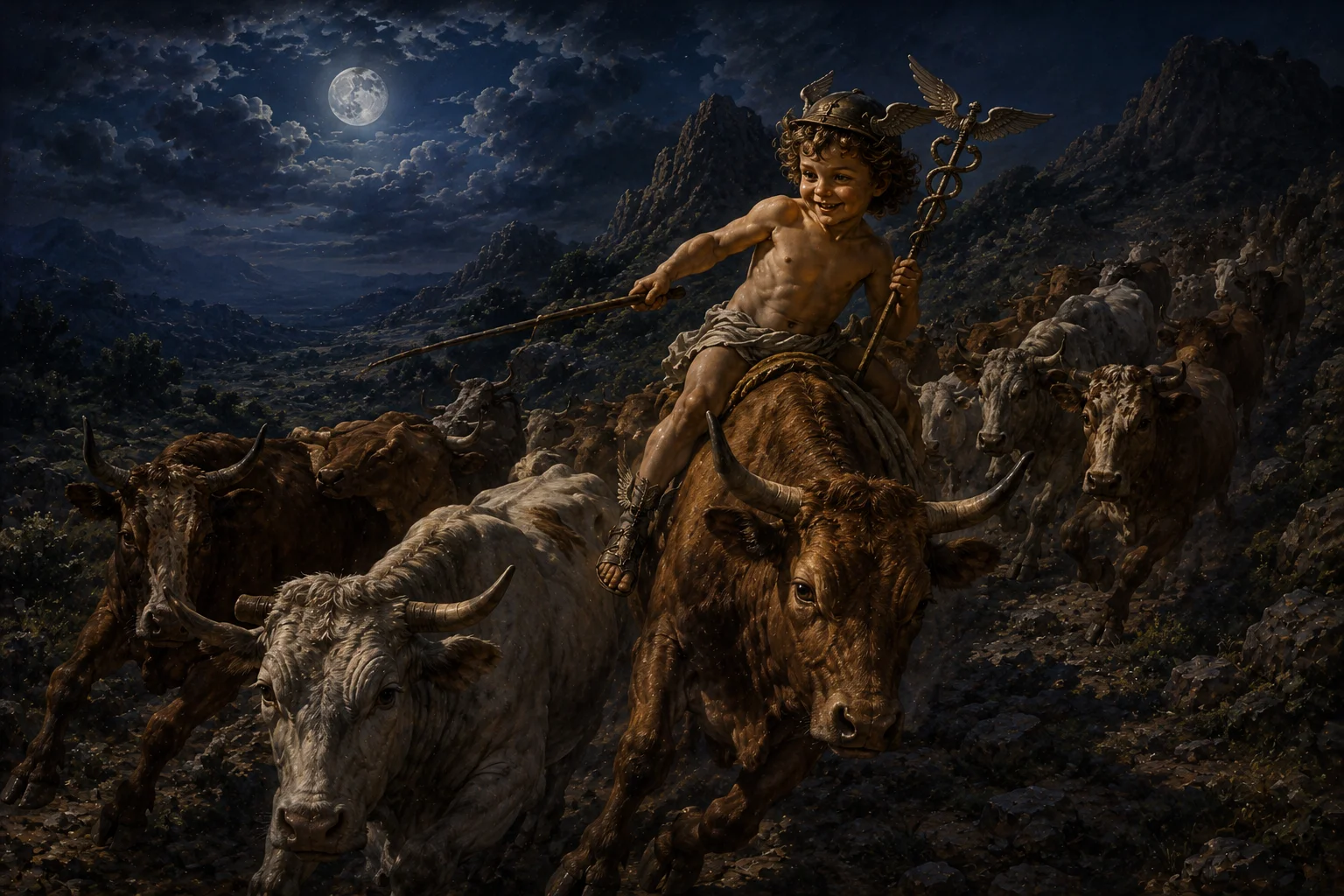
The Messenger and the Winged Sandals
With his winged sandals (talaria), his traveller's hat, and his herald's staff the caduceus, Hermes carried the will of Zeus between worlds faster than thought. He was the god of roads and crossroads, of heralds and diplomacy, of commerce and the marketplace — and, fittingly, of the thieves who worked them.
Guide of Souls
Alone among the Olympians, Hermes moved freely into the realm of the dead. As Psychopompos, the guide of souls, he led the newly dead down to Hades' kingdom — the one bright, swift figure in that grey place. It was Hermes who escorted Persephone back up to her grieving mother each spring. He was the bridge between the living and the dead, the only god equally at home in both.
God of the In-Between
Everything Hermes governed lived on a threshold: the road between cities, the deal between strangers, the line between truth and trickery, the passage between life and death. He is the god of all the spaces between — and that is why, of all the Olympians, he is the one who never stops moving.
The Greeks set stone pillars called herms at their crossroads and doorways — markers of the god who guards every threshold and speeds every journey.
Before Olympus: The God in the Heap of Stones
Hermes is older than the Greek alphabet. Among the Linear B tablets baked hard in the fire that destroyed the palace at Pylos, scribes of the Bronze Age recorded offerings to e-ma-a2 — Hermahas, an early form of his name — some five centuries before Homer. He is one of a small handful of Olympians who can be shown, in writing, to have been worshipped by the Mycenaeans. Whatever else he became, he was already there.
What he was then is harder to see, and the likeliest answer is the least glamorous one. The Greeks themselves connected his name to herma, a heap of stones — the cairn a traveller piles at a roadside, a field edge, a grave. Modern philologists argue over whether the derivation is real or a native guess after the fact, but the association runs through his entire cult regardless. Long before Hermes had winged sandals, he was the pile of rocks that told you where you were, and that somebody had passed this way before you. Every later thing he governs — roads, borders, contracts, the passage of the dead — grows out of that one humble function: marking a boundary, and making it safe to cross.
His birthplace, in the tradition the Greeks kept, is not Olympus but Arcadia: a shadowy cave on Mount Kyllene, where the Pleiad Maia, daughter of Atlas, bore him in secret. Arcadia was the Greek backcountry, the region other Greeks thought of as rustic and archaic. It is a fitting home for a god whose earliest job was to keep herds safe on hard ground.
The Herms, and the Night Athens Lost Its Nerve
The herm was one of the strangest objects in the Greek street, and one of the most ordinary. It was a squared stone pillar — no arms, no legs, no modelled body — topped with a bearded head and carrying, halfway down the shaft, an erect phallus. They stood by the thousand: at crossroads, at boundary stones, at gymnasium gates, and above all outside front doors, where the pillar's blunt sexual force was not obscenity but armour. It was there to turn away harm, the way a gargoyle is. Athenians walked past them daily, touched them, oiled them, laid garlands on them without a second thought.
Which is why what happened in 415 BC unhinged the city. On a single night, shortly before the great fleet was to sail for Sicily, persons unknown went through Athens and hacked the faces off the herms — most of them in the city, Thucydides says, in the space of that one darkness. The scale of it, and the coordination it implied, convinced the Assembly that this was no drunken prank but a conspiracy against the democracy itself, an omen deliberately manufactured on the eve of the most ambitious expedition Athens had ever launched. The investigation that followed swallowed Alcibiades, the expedition's most brilliant commander, who was recalled to stand trial and instead defected to Sparta. The Sicilian expedition ended in total catastrophe and began the unravelling of Athenian power.
No one was ever satisfactorily convicted, and Thucydides admits the truth was never established. What the episode records is something more interesting than a whodunnit: the sheer weight a whole city placed on the god of the doorway. Mutilate the marker at the threshold and you have not vandalised a statue — you have cut the protection off every house in Athens at once.
Argeiphontes: The Hundred Eyes
One of Hermes' oldest epithets, already formulaic in Homer, is Argeiphontes. The Greeks read it as slayer of Argos, and told the story to match.
Zeus had taken the priestess Io, and to hide her from Hera turned her into a white heifer. Hera, unfooled, asked for the heifer as a gift and set over her Argos Panoptes — Argos the All-Seeing, a herdsman covered in a hundred eyes, of which only a pair ever slept at once. No thief could take that cow. Zeus sent the one being who could.
Hermes did not fight him. He came as a wandering herdsman, sat down beside him, played the reed pipe, and talked — a long, dull, unhurried story, told until one pair of eyes after another closed, and the last pair finally gave in. Then he killed him. Hera gathered the eyes and set them in the tail of her peacock, where they have watched ever since.
It is a perfect Hermes myth, and worth setting beside the tale of the stolen cattle, because it says the same thing in a darker key: the god of speech defeats the unsleeping watchman not with force but with boredom. Eloquence, in his hands, is a weapon. Whether the epithet actually means "Argos-slayer" is doubtful — the word may be far older, and its true sense lost — but the Greeks heard it that way, and built one of their best stories inside it.
The Errands That Turned the World
Because Hermes is a messenger, he arrives at the hinge of other gods' stories, and the hinge usually turns on him. A short list of what he was sent to do is effectively a list of the moments Greek myth would not survive without him.
- He walks the aged king Priam through the sleeping Greek camp, disguised as a young follower of Achilles, so that a father can kneel to his son's killer and beg for the body — the scene that brings the Iliad to its close.
- He meets Odysseus on Circe's island and hands him moly, the black-rooted, milk-white-flowered herb that no mortal can dig, the only defence against her drugs. And it is Hermes who is sent across the sea to Calypso, carrying the order that finally releases Odysseus to go home.
- He leads Hera, Athena and Aphrodite up Mount Ida to a shepherd boy named Paris and tells him to choose. Everything that follows — the abduction, the fleet, the ten years, the burning city — follows from that walk.
- He prises Ares out of the bronze jar in which the giant brothers called the Aloadae had sealed him for thirteen months, half-dead and humiliated.
- He carries the infant Dionysus out of the fire of his mother's death to be raised in secret, and equips Perseus for the Gorgon's cave.
- When Typhon cuts the sinews out of Zeus and hides them in a cave under the guard of a she-dragon, leaving the king of the gods a boneless heap, it is Hermes — with the goat-god Aegipan — who steals them back and fits the ruler of the universe together again.
Notice what none of these are. He never wins a duel, never founds a city, never takes a throne. His power is access — he can reach the place and the person no one else can reach — and access, in the end, decides more than force does.
The Children of a God Who Never Married
Hermes is the rare major Olympian with no wife the tradition settles on, and a long list of children who inherit exactly the traits you would expect.
Pan, goat-legged and goat-horned, god of the wild pasture and of the sudden irrational terror that still bears his name, is his son by an Arcadian nymph — a birth so alarming that his mother fled from him and Hermes carried the laughing infant up to Olympus himself. Hermaphroditus, his child by Aphrodite, is the boy whose body was fused with that of the water-nymph Salmacis into a single being of both sexes — a story that put his name into the dictionaries of Europe. Autolycus, given by his father the gift of thieving without ever being caught, becomes the grandfather of Odysseus, which is the mythographers' quiet way of explaining where the most cunning man in Greek literature got his mind. Eudorus leads a company of Myrmidons at Troy. Abderus, loved by Heracles, is torn apart by the man-eating mares of Diomedes, and the city of Abdera is founded over his grave.
And then there is Myrtilus, the charioteer, whose story poisons a dynasty. Bribed to sabotage his master's chariot so that Pelops could win a bride, he was thrown into the sea for his trouble and cursed the house of Pelops as he drowned. From that curse descend Atreus, Agamemnon, Orestes — the whole blood-soaked machinery of Greek tragedy. Hermes' son sets it running.
How Ordinary People Actually Used Him
Hermes was not primarily a god you read about; he was a god you dealt with, several times a day, in small practical ways.
He presided over the agora as Hermes Agoraios, patron of the market where prices were haggled and oaths sworn over goods — and he was equally the patron of the sharp practice that happens there, which the Greeks found funny rather than contradictory. He owned the wrestling ground: gymnasia and palaestrae across the Greek world were dedicated to Hermes alongside Heracles, ringed with herms, and at the Hermaia festivals the boys sacrificed and competed under a rule that tells you how seriously the day was taken — a law cited as Solon's forbade the gymnasiarch to let any grown man in at all. For one day the place was entirely theirs. On Crete the inversion went further still, and masters waited at table on their slaves.
A windfall — money found in the road, an unexpected stroke of luck — was a hermaion, a thing of Hermes. His name sat inside the ordinary vocabulary of good fortune, which is not something you can say of Zeus.
His darker face had its own cult title. As Hermes Chthonios, the underworld Hermes, he received offerings for the dead: on Chytroi, the last day of the Athenian Anthesteria, households boiled a pot of mixed grains and pulses for the departed, and no living person tasted it. His name is also among the commonest on the lead curse tablets buried in graves and wells across the Greek world — folded strips of lead asking Hermes the Binder to hold down a rival's tongue, a lawsuit, a lover. The same god who guides souls kindly downward could be asked to drag a living enemy's luck after them. He was never a safe god. He was a useful one.
At Tanagra in Boeotia he was worshipped as Kriophoros, the Ram-Bearer, in memory of a plague he was said to have turned back by carrying a ram around the city walls; each year, Pausanias reports, the handsomest youth in the town repeated the circuit with a lamb across his shoulders. The statue type — a calm young man carrying a sheep on his shoulders — long outlived the god, and early Christian artists reached for exactly that figure when they needed an image of the Good Shepherd.
How to Recognise Him
In Archaic art Hermes is a mature, heavily bearded man in a long tunic: dignified, closer to the roadside stone than to the boy of later imagination. Over the fifth century BC he sheds decades. By the Classical period he is the beardless athlete of the gymnasium, and it is that version the modern world inherited.
What is striking about his equipment is that every piece is a working object rather than an ornament. The petasos is a wide-brimmed hat for walking in sun and rain. The chlamys is a short cloak pinned at one shoulder so both arms stay free. And the staff is properly a kerykeion, latinised as caduceus — a rod topped by two snakes twisted into a figure of eight, and a diplomatic passport rather than a medical instrument. It marked its bearer as inviolable: a herald who could walk into an enemy camp and out again.
The single-snake rod of healing belongs to Asclepius, and the swap of one for the other on medical badges is not an ancient muddle but a recent and traceable blunder. When the United States Army Medical Corps adopted its insignia in 1902, the officer who proposed it took the wrong staff. The mistake was noticed within about fifteen years by the Surgeon General's own librarian, who recorded it and changed nothing, by which time it had begun spreading across American medicine. It is still spreading.
The most famous surviving image of him is the marble Hermes with the Infant Dionysus from the sanctuary at Olympia, credited by Pausanias to Praxiteles: the messenger paused mid-errand, leaning on a tree, dangling something — the lost right hand probably held a bunch of grapes — just out of reach of the baby god on his arm. It is the whole character in one pose. Even carrying out the will of Zeus, he is teasing somebody.
Mercury, Wodan, Thoth
Rome's Mercury is not simply Hermes renamed. His name is built on merx and mercari, goods and trading, and his oldest temple on the Aventine was dedicated together with the guild of merchants. At the Mercuralia in mid-May the traders of Rome drew water from his spring outside the Porta Capena, sprinkled their own heads and their entire stock with it, and asked — with a frankness that is almost admirable — that their past perjuries be forgiven and their future ones go unpunished. The Greek god's thieving wit arrives in Rome as commercial pragmatism.
The name then travelled further than the god. When Caesar described the religion of Gaul he wrote that the Gauls honoured "Mercury" above all other gods — meaning some Gaulish deity of roads, trade and craft whose real name he did not record, and whom modern scholars most often identify with Lugus. Germanic peoples in turn matched Mercury to Wodan, another restless, disguised, word-loving traveller between worlds. That double equation is why the midweek day is mercredi in French and miércoles in Spanish, from dies Mercurii — and Wednesday, Woden's day, in English. Two different god-names, one weekday, one very old idea about who governs the middle of things.
In Egypt the Greeks looked at Thoth — ibis-headed god of writing, reckoning, magic and the judgement of the dead — and saw Hermes so plainly that they renamed his ancient cult city Hermopolis. That identification would have the longest consequences of all.
Thrice-Greatest: The Longest Afterlife of Any Greek God
Out of Greco-Roman Egypt came a body of philosophical and magical writings attributed to Hermes Trismegistus — Hermes the Thrice-Greatest — a fusion of Hermes and Thoth imagined as an ancient sage rather than a god: teacher of astrology, alchemy, and the soul's ascent through the spheres. The Corpus Hermeticum and its companion texts were taken, for well over a thousand years, to be genuinely primeval, older than Moses.
When a manuscript of them reached Florence in the fifteenth century, Cosimo de' Medici had Marsilio Ficino set aside his translation of Plato and do the Hermetica first — that is how important they seemed. Renaissance magic, Renaissance alchemy and a great deal of early modern natural philosophy grew in that soil. Only in the seventeenth century did close analysis of their language demonstrate that the texts were written in the early centuries AD, not in the age of the pharaohs, and the spell broke. The vocabulary did not. Hermetic still means secret and sealed; a hermetically sealed jar is named, at several removes, after a god who could open anything.
His Roman name did even better. Mercury is the swiftest planet, the liquid metal that will not stay still, and the adjective mercurial for a temperament that changes before you can name it. The Greeks also heard him in hermēneus, the interpreter — the root of hermeneutics, the discipline of getting meaning across a gap. Whether that etymology is sound is disputed; that the connection felt obvious to them is not.
Why He Never Goes Away
Every culture has gods for the things it fears and the things it wants. Hermes answers a stranger question: not what lies on either side of a boundary, but the unnerving fact that boundaries can be crossed at all.
The tricksters who resemble him elsewhere — Loki in the north, Anansi in West Africa, Coyote on the plains, Eshu at the crossroads of Yorubaland — are not borrowings from Greece but independent answers to the same problem. Every society draws lines: between mine and yours, sacred and common, inside and outside, living and dead. And every society knows, uneasily, that those lines are held in place by nothing more solid than agreement. Somebody has to personify the crossing. Better that it be a god you can leave a stone for at the roadside than a force with no name.
That is why Hermes is simultaneously the patron of merchants and of the men who rob them, of solemn heralds and of liars, of safe journeys and of the last journey of all. He is not two-faced by accident. He is the acknowledgement, built into the pantheon, that the same skill which lets a message reach you is the skill that lets a stranger through your door — and that we cannot have the first without risking the second. Three thousand years on, we still hand our messages to something quick and clever that goes everywhere and belongs nowhere, and we still hope it is on our side.
Sources & traditions
- EncyclopediaWikipedia — Hermes
- TraditionGreek texts, inscriptions and later retellings (Greece)
Myths change from area to area and from time to time. This chronicle follows the most widely told versions; tellings in other villages, regions and eras may differ.