Heracles — known to the Romans as Hercules — was the greatest hero of Greek myth: the strongest man who ever lived, a son of Zeus whose superhuman might was matched only by the superhuman suffering the gods heaped upon him. His life is the supreme story of strength turned to atonement, of a man who did monstrous wrong and spent the rest of his days making it right, one impossible deed at a time.
The Son of Zeus and the Hatred of Hera
Born to the mortal woman Alcmene and to Zeus, Heracles earned the undying hatred of Hera before he could even walk — she sent two serpents to his cradle, and the infant strangled them with his bare hands. His very name (“glory of Hera”) was an irony: the goddess would torment him his whole life.
The Madness and the Labours
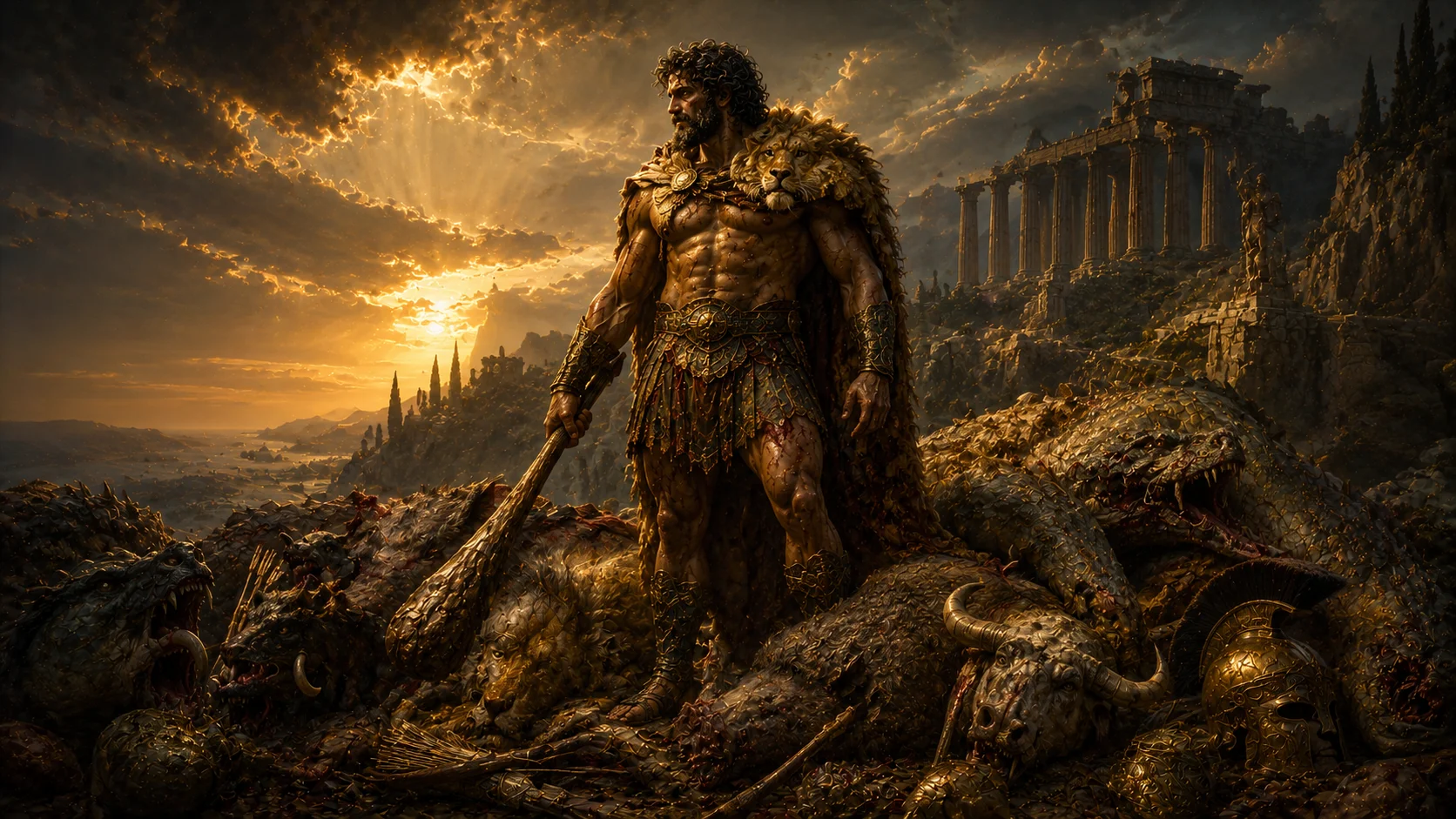
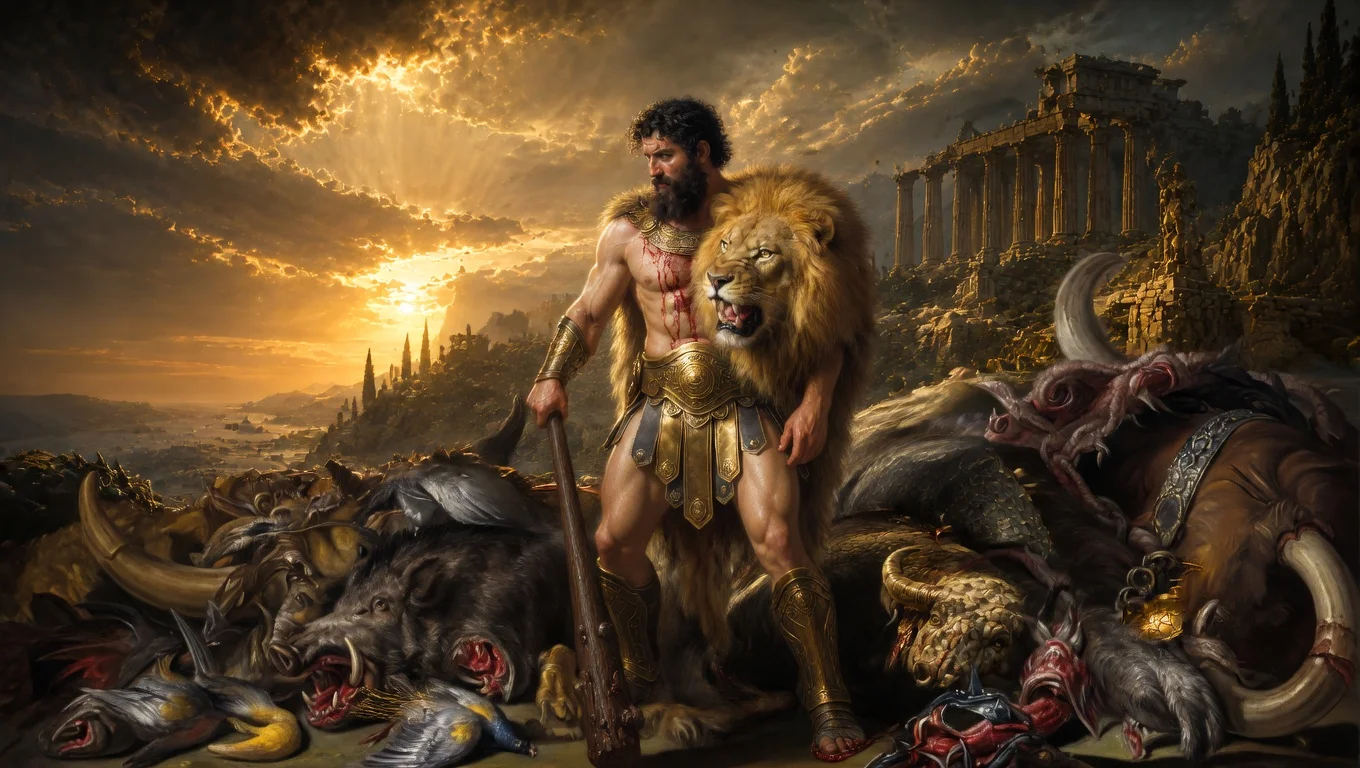
Hera's cruellest stroke was to strike Heracles with a fit of madness in which he killed his own wife and children. Horror-stricken and seeking purification, he submitted himself to his cousin King Eurystheus, who set him the Twelve Labours — a series of seemingly impossible tasks meant to destroy him. He strangled the invulnerable Nemean Lion, burned away the Hydra's heads, captured monstrous beasts, cleaned the Augean stables in a day, fetched the golden apples of the Hesperides, and finally dragged Cerberus himself up from the dead. Each labour was both a wonder and a penance.
The Poisoned Robe
His death came, fittingly, from the poison of one of his own victims. The dying centaur Nessus tricked Heracles's wife Deianira into keeping his blood as a “love charm”; when she smeared it on a robe for her husband, the Hydra-venom in it burned his flesh beyond bearing. In agony, Heracles built his own funeral pyre and was consumed — but Zeus raised his immortal part to Olympus, where he was at last reconciled with Hera and made a god.
The Hero of Atonement
Heracles endures because he is the most human of heroes: not a flawless paragon but a man of terrible strength who did terrible things, and whose greatness lay in the endless, painful labour of setting them right. He became a god not by being perfect, but by never ceasing to atone.
The Greeks worshipped him as both hero and god — the only mortal whose suffering earned him a seat on Olympus.
Thebes, the Twin, and the Boy Who Killed His Music Teacher
He was not born alone. Alcmene bore twins — Heracles to Zeus, and Iphicles to her mortal husband Amphitryon — and the Greeks never tired of the arithmetic of that cradle. When the serpents came, one baby screamed and one baby squeezed, and the whole tragedy of Heracles is already there in the difference: a household containing something that is not quite a member of it.
His education went badly. He was handed to a roster of specialists — Amphitryon taught him the chariot, Autolycus wrestling, Eurytus the bow, Castor how to fight in armour — but the lyre defeated him, and when his music master Linus struck him for a wrong note the boy hit back with the instrument and killed him. Amphitryon sent him out to the cattle on Mount Cithaeron, which is what you do with a child who cannot be corrected and cannot be contained. There, at eighteen, he killed his first lion, and there he began the habit that would define him — solving a problem by breaking it.
The Thebans knew him first as a liberator rather than a monster-slayer. Their city paid tribute to Erginus of the Minyans until Heracles cut the ears and noses off the tribute-collectors and broke Orchomenus in the field; King Creon gave him his daughter Megara in gratitude. That marriage is the one the madness destroyed. The Greek audience always heard the story with that irony intact: the reward for saving a city was the family he would later slaughter in it.
Ten Labours That Became Twelve
The number twelve is not original, and the way it grew is more interesting than the tidy list. The Delphic oracle sentenced Heracles to serve Eurystheus and set the count at ten. Eurystheus then disqualified two of them on technicalities worthy of a tax inspector: the Hydra did not count because Iolaus had held the torch, and the Augean stables did not count because Heracles had asked Augeas for payment. Two more were added, and the debt was settled at twelve.
The earliest surviving canon fixed in stone is architectural rather than literary: the twelve metopes of the Temple of Zeus at Olympia, carved in the fifth century BC, six over the front porch and six over the back. Before that, poets and painters chose freely, and vases show deeds that never made the official roll at all. What the sculpted twelve gave the Greek world was a shape — and the shape is a map.
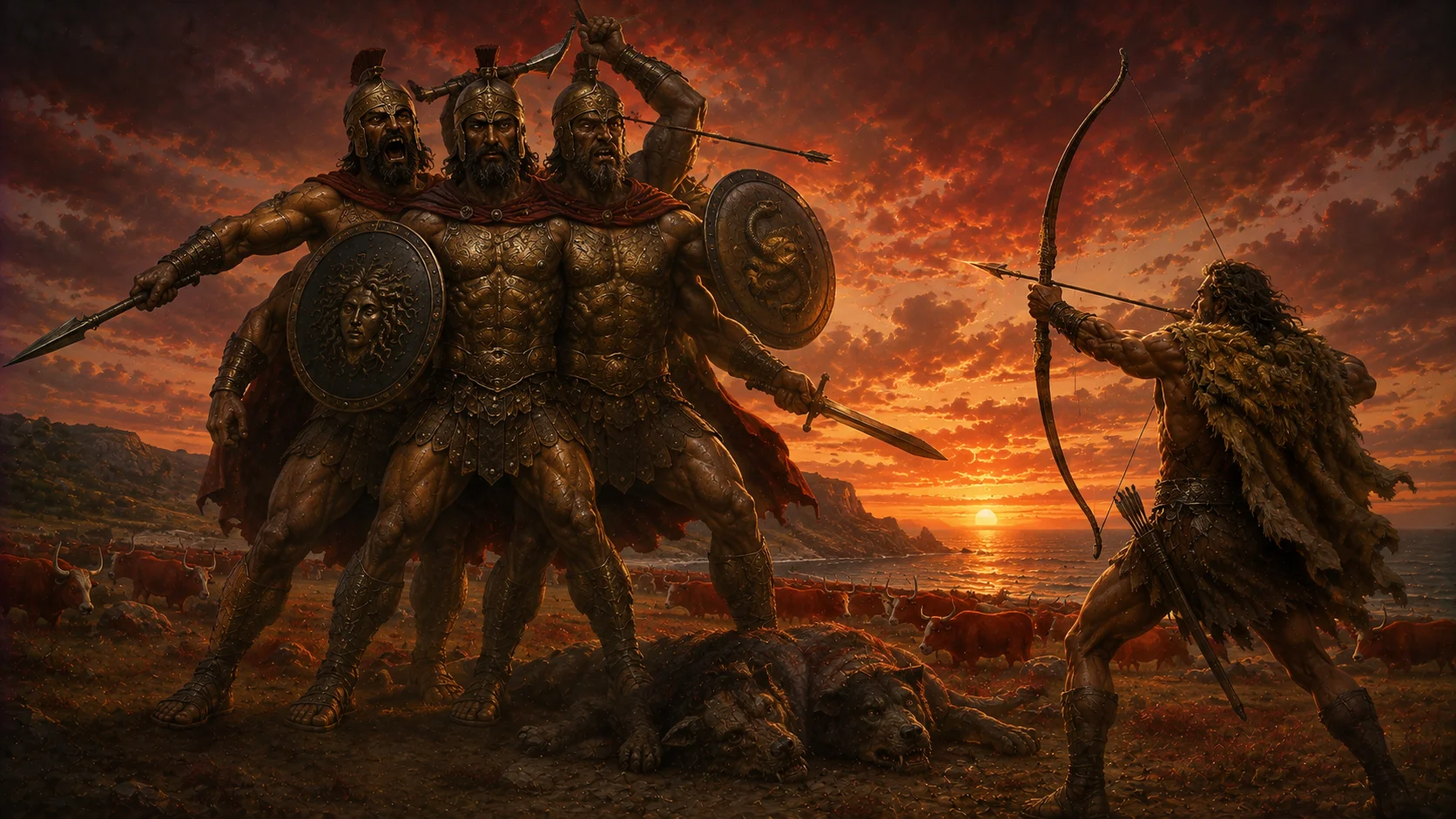
The early labours are local: a lion, a water-snake, a hind, a boar, some filthy stables, all within a few days’ walk of Tiryns. Then the world widens. Crete, Thrace, the Black Sea coast of the Amazons. Then it leaves the world entirely — Geryon in the far west beyond the sunset, the golden apples at the edge of the map where Atlas holds up the sky, and finally Cerberus, which is not a place at all. Read in order, the Twelve Labours are the Greek imagination walking outward from its own back garden until it runs out of earth and has to go underground.
The Parerga: Everything He Did on the Way
The deeds Heracles committed in the margins of his sentence have a name of their own: the parerga, the side-work. These are often the better stories.
- In Libya he wrestled Antaeus, son of Earth, who grew stronger every time he was thrown down — so Heracles lifted him off the ground and crushed him in the air, one of the few myths in which the hero wins by thinking.
- In Egypt he was bound for the altar of Busiris, a king who sacrificed foreign visitors, and burst his bonds on the spot.
- In the Caucasus he shot the eagle and freed Prometheus, ending the longest punishment in Greek myth almost in passing.
- At Pherae he lay in wait for Death himself at the tomb of Alcestis and wrestled her back from him — Euripides staged it, and gave the scene to a Heracles who arrives drunk and cheerful at a house in mourning because nobody has told him whose funeral it is.
- At Troy he killed the sea-monster sent against Hesione, was cheated of his fee by King Laomedon, and sacked the city a generation before Agamemnon ever saw it — sparing the boy Podarces, who was ransomed by his sister and grew up under a new name, Priam.
- At Delphi he tried to carry off the sacred tripod when the Pythia refused to answer him, and Apollo fought his own half-brother for it until Zeus parted them with a thunderbolt — a scene Athenian vase-painters adored.
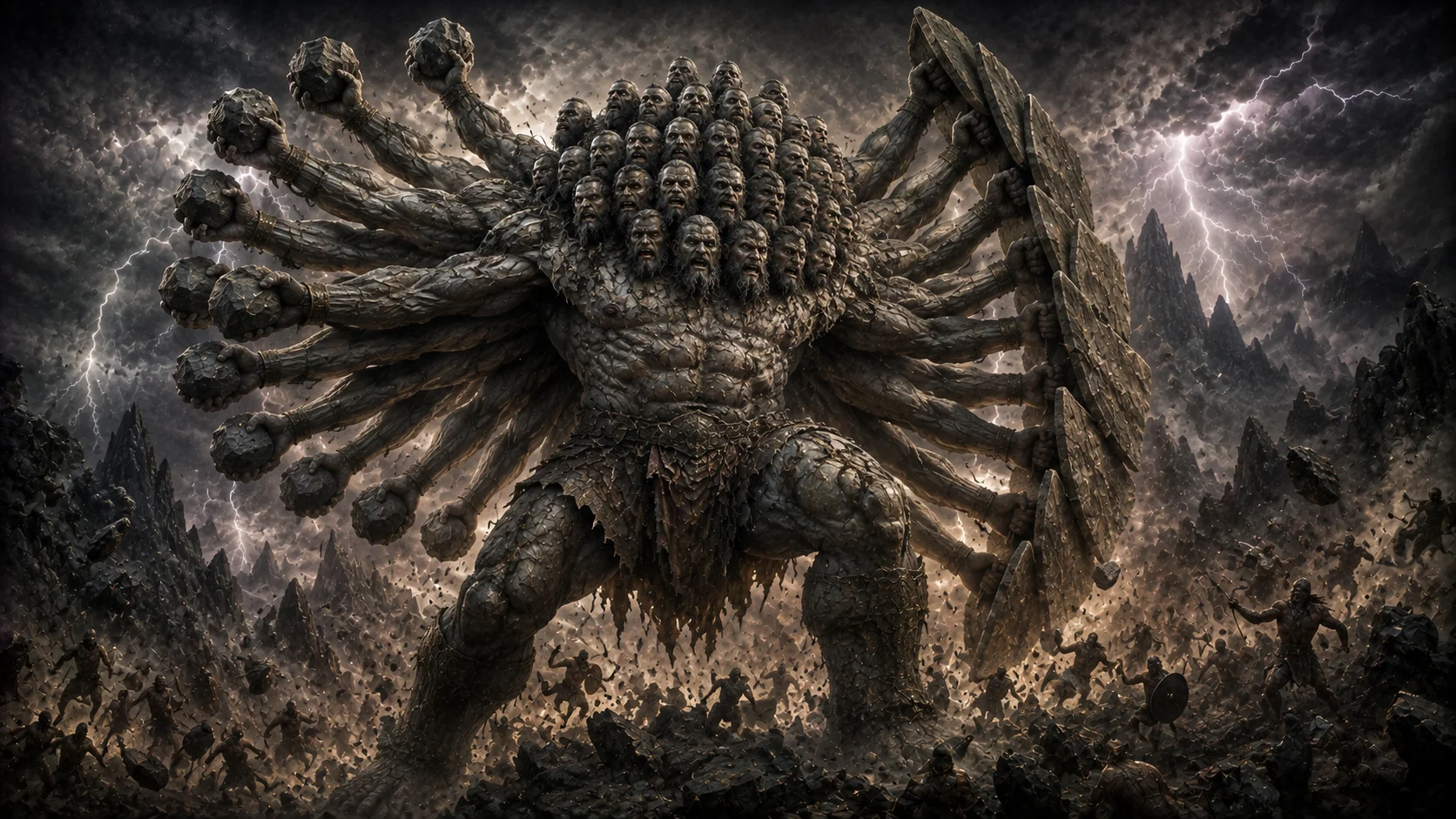
And when the Giants rose against Olympus, prophecy held that the gods could not win without a mortal ally. They needed him. It is the single most revealing fact about Heracles: the pantheon that spent his whole life tormenting him could not save itself without him.
Three Years in a Woman’s Clothes
The Labours were not his only penance. After he threw Iphitus from the walls of Tiryns — by treachery, in the version Sophocles tells, with no madness to excuse it — he fell sick, and the oracle told him to be sold, literally auctioned, with the price paid to the dead man’s father. The buyer was Omphale, queen of Lydia, and for three years the strongest man alive belonged to a woman.
The later tradition made the humiliation total: Omphale wears the lion skin and carries the club, while Heracles sits among her maids in soft Lydian dress, working wool. Roman painters and poets could not leave the image alone. It survives because it is the exact inversion of everything he is, and because a culture that made a god out of male strength enjoyed, once in a while, watching that strength handed a spindle.
Hero and God at the Same Time
Greek religion drew a line between gods and heroes — schematic, not always observed in practice, but real. Gods received sacrifice on a raised altar, in daylight, and the worshippers ate the meat. Heroes received it low down, often at dusk, the offering burned entire and shared with no one, because a hero is a powerful dead man and the dead are fed downwards. Heracles is the figure who most conspicuously got both.
Herodotus chased the question as far as Tyre and then to Thasos, and came back convinced that the Greeks who maintained two sanctuaries — sacrificing at one to an immortal Heracles under the name Olympian, and at the other to a hero — were the ones doing it correctly. Pausanias records that the men of Marathon claimed to have been the first Greeks to honour him as a god at all. And Homer had already caught the paradox in a single astonishing passage: in the eleventh book of the Odyssey, Odysseus meets Heracles among the dead — and the poem stops to explain that this is only his phantom, since he himself is feasting with the immortals. The strongest hero is the only one who is in two places at once.
In ordinary life he was closer to hand than most Olympians. Hot springs across the Greek world were called his baths and held sacred to him. Gymnasia and wrestling-grounds were under his patronage, so every Greek boy who trained sweated under his image. He carried the title Alexikakos, “averter of evil”, and householders wrote a formula over the door: the son of Zeus, Heracles the glorious victor, dwells here — let nothing evil enter. That is not the hero of tragedy. That is a bouncer on the threshold, and it is probably how most Greeks actually thought about him.
The Bloodline: How Half of Greece Claimed Him
No Greek figure has more descendants, and the reason is political. The Heraclidae were driven out of the Peloponnese after his death; his son Hyllus tried to force the return and was killed in single combat for it, and only in the third generation did his descendants come back and take the country, dividing Argos, Messenia and Lacedaemon among themselves by lot. Historically this is the story the Dorian-speaking Greeks told about their own arrival. Mythically it meant that whole dynasties held their thrones by inheritance from Heracles.
Both royal houses of Sparta traced themselves to him. The Argead kings of Macedon claimed descent through the Heraclid Temenus of Argos, which is why Alexander’s coinage shows a young Heracles in the lion skin whose face, many have argued ever since, drifts steadily towards the conqueror’s own. Herodotus even reports a Heraclid dynasty ruling in Lydia for twenty-two generations before Gyges took the throne. Elsewhere the line is more scattered — Telephus, born to the priestess Auge and later king in Mysia; and the fifty sons the fifty daughters of Thespius bore him, in an episode the sources compress into seven nights or stretch across fifty depending on who is counting, and which says a great deal about how the Greeks understood heroic virility. Claiming Heracles as an ancestor was, for centuries, the most useful genealogical move available in the Mediterranean.
Melqart, Hercle, Hercules
He also travelled better than any other Greek god. Phoenician sailors identified him with Melqart, the city-god of Tyre, and Herodotus went to Tyre himself to see that temple; the priests there dated it some 2,300 years back, and he came away convinced Heracles was far older than the Greek stories allowed. The colonial world followed: the strait between Spain and Morocco became the Pillars of Heracles, the gateposts of the known world, and Spain carries those pillars on its coat of arms to this day.
The Etruscans took him as Hercle and made him something the Greeks never quite did. A famous bronze mirror from Volterra shows the bearded, fully grown hero kneeling to be suckled by the goddess Uni, with an inscription saying this is how Hercle became her son — adoption into godhood by divine milk, and an adult adoption at that. The Greek versions of the nursing story keep him an infant, tricked to Hera’s breast, the spilled milk becoming the Milky Way. Rome received him partly through the Etruscans, and gave him a cult older than most of the city. At the Ara Maxima in the cattle market by the Tiber, where Hercules was said to have killed the fire-breathing thief Cacus and recovered Geryon’s stolen herd, merchants and generals paid him a tenth of their profits and their plunder, feasted on the meat, and kept women out of the rite. Romans swore by him constantly — mehercule — in the way of a god you deal with rather than fear. Later emperors saw the advantage. Commodus had himself portrayed with the lion skin over his head and the club in his hand, styled Hercules Romanus, and the marble survives to show how ridiculous and how serious that was.
How to Recognise Him
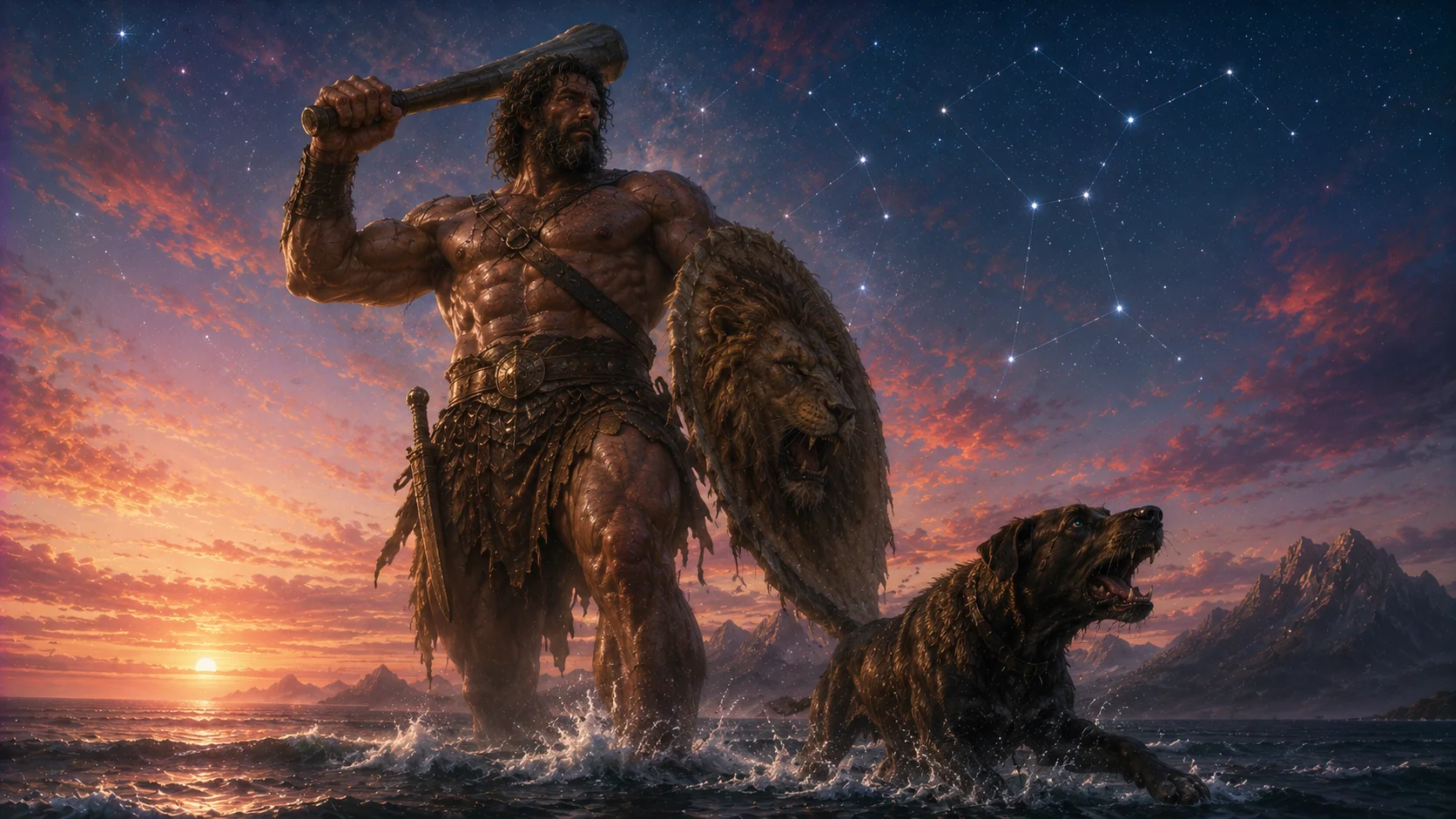
Three attributes, and you rarely need more than one. The lion skin, worn with the beast’s upper jaw pulled over the skull like a helmet and the forepaws knotted at the chest. The club, deliberately crude — a torn-up tree, not a smith’s weapon, marking him as the hero who fights with whatever the world gives him. And the bow and quiver, which archaic art favours and which carry the Hydra’s venom that eventually kills him.
In archaic and classical Greek art he is usually bearded, thick-necked, heavy in the thigh. Later Hellenistic sculpture pushed the muscle into something almost monstrous, and the most influential surviving image — the colossal Farnese Hercules, a Roman marble after a fourth-century BC bronze type — shows him exhausted, leaning his whole weight on the club, the golden apples of the Hesperides hidden in the hand behind his back. It is a statue of a man who has just finished and is not enjoying it. Look up on a summer night and he is there too: the constellation the Greeks simply called Engonasin, the Kneeler, a nameless figure down on one knee that later writers settled on identifying as him.
The Crossroads, the Cynics, and the Screen
Because he was a man who chose his suffering, philosophers claimed him early. The sophist Prodicus told a parable, preserved in Xenophon, of the young Heracles meeting two women at a fork in the road — one offering ease and pleasure, the other offering toil and honour — and choosing the hard path. The Choice of Heracles became one of the most painted subjects in Europe two thousand years later. The Cynics took him as their patron outright, wandering, ragged, club in hand, needing nothing; the Stoics read the Labours as endurance made visible. Lucian described a Gallic Heracles who led willing crowds by fine chains running from his tongue to their ears, and the Renaissance seized on that image as the emblem of eloquence — strength that persuades instead of striking. Florence put him on its civic seal.
The modern afterlife is louder and less philosophical. Italian cinema built an entire genre on him in the late 1950s, launching the muscleman peplum boom and a long line of imported bodybuilders. Disney turned the family-murdering penitent into a wide-eyed teenager in 1997, and it worked because the outline — misfit strength, impossible tasks, earned divinity — survives almost any retelling. Video games have swung back the other way: the Hercules of God of War is a resentful bruiser with a grievance against his own half-brother, closer to the sullen, dangerous figure the Greeks actually wrote.
Why the Strongest Man Is the Saddest Story
Sophocles wrote a whole tragedy about him in which the hero barely appears until the end — the Women of Trachis belongs to Deianira, who is waiting at home, has no power at all, and destroys him by trying to keep him. Euripides did something even sharper: he moved the madness so that it falls after the Labours are done. His Heracles comes home triumphant, the work finished, the debt paid — and then, at the moment of peace, the violence he has been aiming outward all his life turns and lands on his own children. There is no cosmic bargain in that version, no ledger being balanced. There is only a man who cannot put the weapon down.
That is why the story outlasted its own religion. Every culture has to decide what to do with the people it trains to be dangerous, and Heracles is that question in one body. He is useful precisely because he is excessive, and he is unbearable for the same reason; the city needs him at the gate and cannot have him at the table. The Greeks solved it in the only way available to them — they made him a god, sent him upstairs, and gave him Hera’s daughter Hebe to marry so that the hatred that shaped him could finally stop. It is a happy ending only if you do not look at the pyre it required.
Sources & traditions
- EncyclopediaWikipedia — Heracles
- TraditionGreek texts, inscriptions and later retellings (Greece)
Myths change from area to area and from time to time. This chronicle follows the most widely told versions; tellings in other villages, regions and eras may differ.