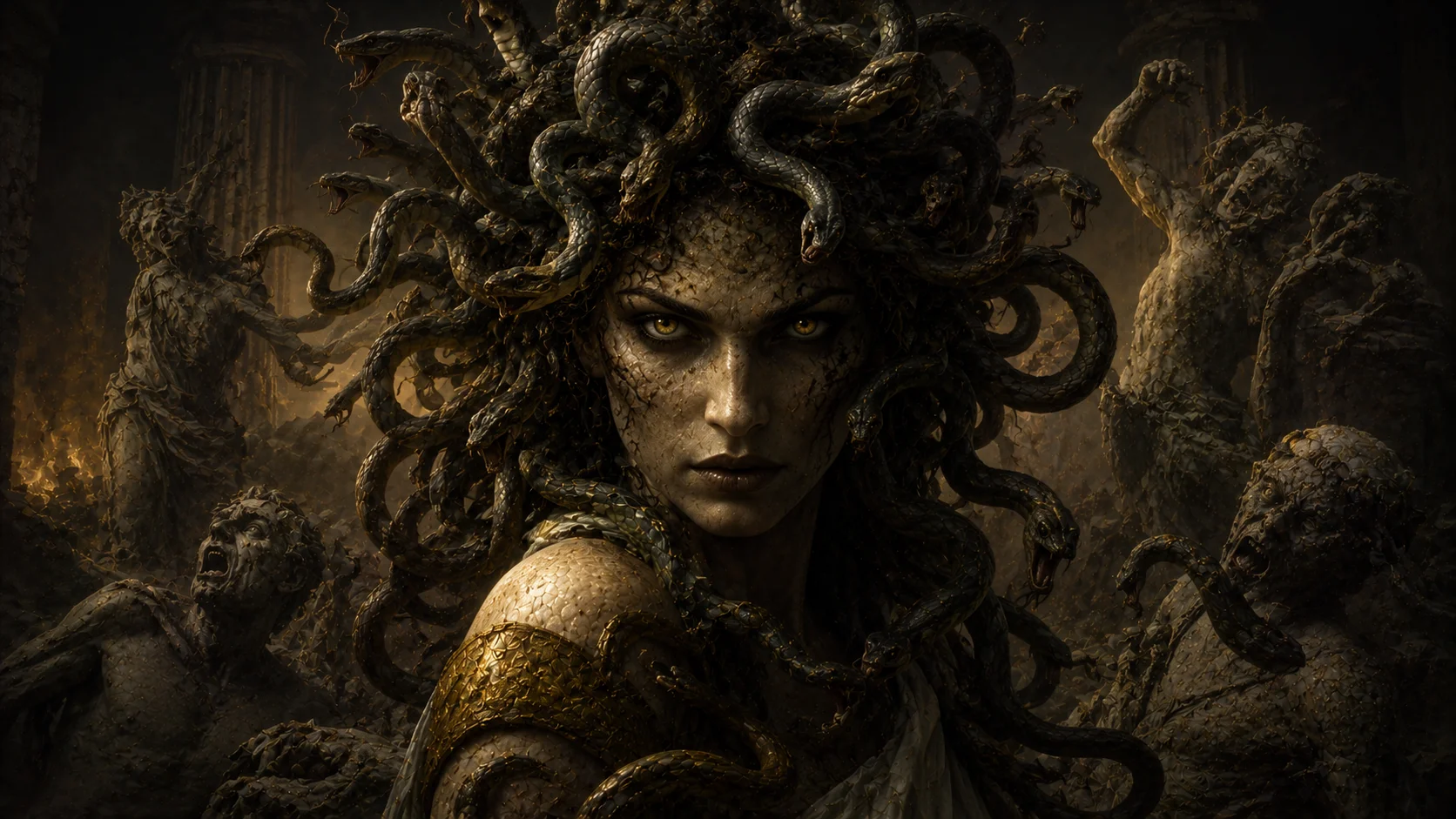
Medusa is the monster whose face you must never look upon — the snake-haired Gorgon whose gaze turned the living to stone. But she is also one of myth's most tragic figures, a victim before she was a monster, and her story has become, in modern times, a symbol of injustice as much as of horror.
The Gorgon
Medusa was one of three Gorgon sisters, but unlike the immortal Stheno and Euryale, she alone was mortal. In the most famous version, she was once a beautiful maiden — a priestess of Athena — whose hair was her glory. After she was violated by Poseidon in Athena's own temple, the goddess, unable or unwilling to punish a fellow Olympian, turned her wrath on the victim: Medusa's hair became a nest of writhing serpents, and her gaze was cursed to turn any who met it to stone. Beauty transformed into a weapon of horror.
The Hero and the Mirror
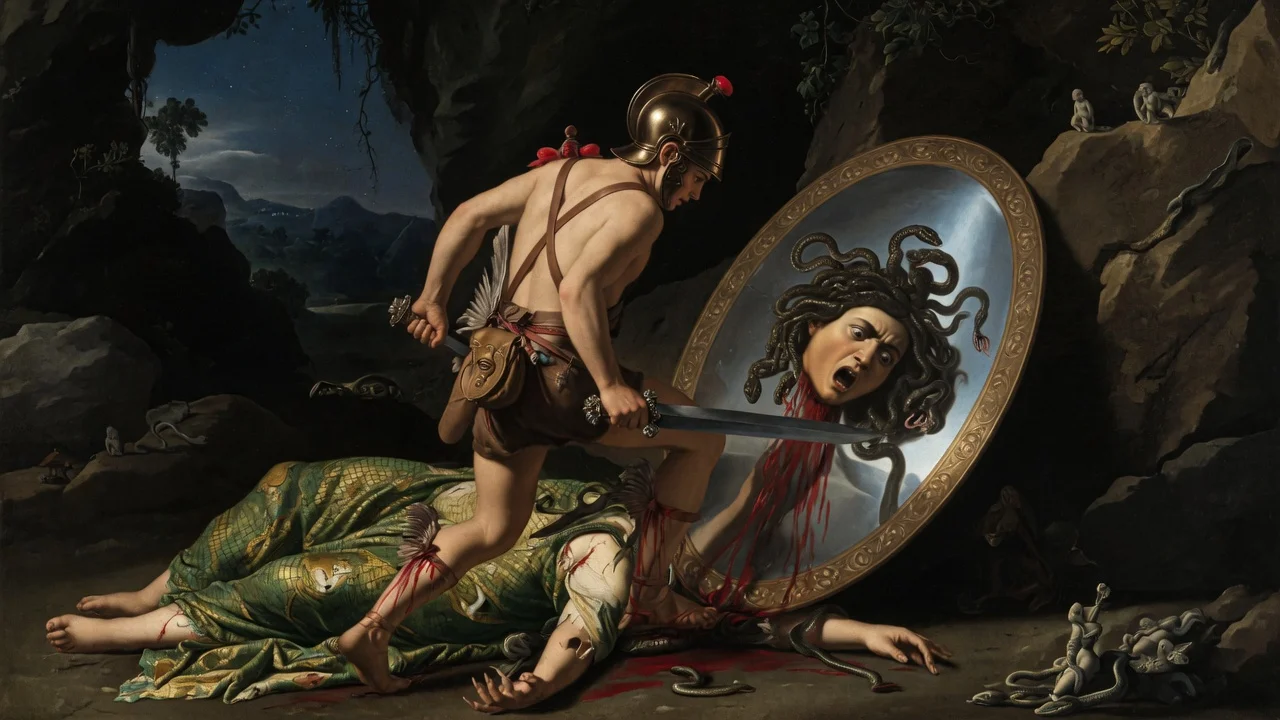
The hero Perseus was sent to bring back her head — a task meant to kill him. But with gifts from the gods — winged sandals, a cap of invisibility, an adamantine sickle, and a polished bronze shield from Athena — he succeeded. The key was the shield: rather than look at Medusa directly, Perseus watched her reflection in the mirror-bright bronze, and so beheaded her without meeting her petrifying eyes. From her severed neck sprang the winged horse Pegasus and the giant Chrysaor, the children she had conceived by Poseidon.
The Head That Kept Its Power
Even in death Medusa's gaze remained deadly. Perseus used her severed head as a weapon — turning the sea-monster Cetus and the tyrant Polydectes to stone — before giving it to Athena, who set it upon her shield, the Gorgoneion, as a ward against all evil. The face too terrible to look at became the ultimate protection.
Once a warning against monstrous women, Medusa is now as often read as the woman punished for a crime done to her — the victim the world chose to call a monster.
Older Than Her Own Story
Strip away the beautiful priestess, the temple and the curse — none of it belongs to the oldest layer of the myth. Hesiod's Theogony, composed centuries before Ovid wrote a line, gives Medusa no biography at all. She is simply one of the daughters of the sea-god Phorcys and his sister Ceto, and she lives, in Hesiod's account, beyond glorious Ocean at the edge toward night, where the clear-voiced Hesperides are — a place at the seam between the ordinary world and something far older. Homer knows her only as a device: a Gorgon glares from the centre of Agamemnon's shield in the Iliad, grim-faced and ringed by Terror and Rout, and another stares out from Athena's aegis, dread stitched onto armour rather than worn by a person with a past. In the Odyssey, Odysseus turns and runs from the land of the dead for fear that Persephone might send up after him “the Gorgon head of some dread monster” — Homer does not name Medusa, and does not need to. In every one of these earliest mentions the Gorgon is a force, not a face with a history. The human tragedy came later, and it came from Rome.
The Monster Before the Muse
Walk into an Archaic Greek temple built before Athens's golden age and the Gorgon staring down from the pediment is neither tragic nor beautiful. She is deliberately hideous: a broad, grinning mask with tusks at the corners of her mouth, a lolling tongue, sometimes a beard, and huge round eyes built to fix on the viewer from every angle at once. This is the Gorgoneion in its oldest form, and it had been glaring out of temple gables, drinking cups, coins and shields for six centuries and more before anyone wrote of a violated priestess. Its whole purpose was to repel by being repellent, a cousin of the evil-eye charm — ugliness set to fight ugliness. Only in the Classical period does Greek art begin to soften her toward sorrow rather than terror, and the fullest surviving account of the curse — the version this article opens with — belongs to the Roman poet Ovid, writing in the Metamorphoses some seven hundred years after Homer. The Medusa most readers find sympathetic is a late literary reworking laid over a far older and far crueller Greek mask.
Kin of the Deep
Medusa's family tree reads like a catalogue of everything the Greeks feared about the sea. Her parents, Phorcys and Ceto, were primordial marine powers, and her siblings besides the two immortal Gorgons were the Graeae — grey-haired sisters born already old, passing a single eye and a single tooth between them — and, in Hesiod's reckoning, the serpent coiled around the golden apples at the western end of the world. This was never an isolated curse visited on one unlucky woman. It was a whole lineage of dread reaching back toward the birth of the world, which raises the question the myth never answers: in a family of deathless horrors, why is exactly one of them able to die?
What the Quest Left Out
The beheading takes all the attention, but Perseus could not have reached Medusa without a stranger errand first. To find her he had to ambush the Graeae and seize the one eye they passed between them, refusing to hand it back until they told him where to find the nymphs — and it is the nymphs, not the Olympians, who supply most of the equipment the story otherwise takes for granted. Among it is the piece nobody remembers: the kibisis, a satchel whose entire job was to carry a head that could still kill through the weave. Then there is Atlas. In Ovid's telling, Perseus asks the Titan for shelter in the far west, is refused, and holds the face up to him; Atlas hardens where he stands, his hair and beard becoming forests, his shoulders and hands the ridges of the range that still carries his name across North Africa. It is an episode the older tradition cannot accommodate — there, Atlas is alive generations later, still holding up the sky, when Heracles arrives to bargain with him — and it shows how freely the head's power was borrowed once it existed. It never needed to be raised in battle. An unwelcome guest and a bad answer were enough to end a Titan.
A Gorgon Made Historical
Not every ancient writer left the Gorgons in the realm of monsters. The historian Diodorus Siculus preserves a rationalised tradition in which they were once a real people: a warlike nation of women near Lake Tritonis in Libya, neighbours and rivals of the Libyan Amazons, who beat them in battle under the Amazon queen Myrina. In this version the Gorgons recover their strength and are subdued a second time by Perseus — Medusa is simply the queen who happened to be ruling when he arrived — before being wiped out altogether by Heracles, who is said to have thought it wrong for women to rule nations at all. Nothing petrifies anyone. Take the magic out and what remains is a war of conquest against women who governed and fought, justified on the grounds that they governed and fought.
A Face to Guard the Door
Long before she was attached to a single story, the Gorgon's face was doing practical work all round the Mediterranean:
- Potters stamped it into the floor of wine cups, so a drinker met its glare at the bottom of the bowl.
- Armourers hammered it onto bronze shield-bosses, so an enemy's last sight might be something more frightening than the soldier behind it.
- Mints struck it as a coin type from Neapolis in Macedonia and Parion in Mysia to Etruscan Populonia, where it stared out of the silver for generations.
- Roof-makers moulded it into antefixes — the upright tiles that cap the ends of the roof rows — so temple eaves were fringed with faces glaring outward at whatever might approach.
The logic held everywhere it appeared: nothing malevolent would willingly look upon something more terrible than itself. So the most terrible face anyone could imagine became the safest thing a household, a temple or an army could own — protection by sheer excess of horror.
Every Age Recarves Her
The image never stopped travelling, and each age reshaped the face to suit itself. Classical Greek sculptors began the softening, and the best-known survivor is the Medusa Rondanini in Munich's Glyptothek: a Roman copy of a fifth-century original thought to have come from the shield of Phidias's Athena Parthenos. Her expression is calm, nearly serene, wings folded into her hair and only a slack knot of snakes left to say what she is — the shift from monster to mourner already underway in marble long before Ovid put it into words. A thousand years and more later the pendulum swung back: in mid-sixteenth-century Florence the sculptor Benvenuto Cellini cast a triumphant bronze Perseus holding the dripping head aloft for his Medici patron, and it stands today in the Loggia dei Lanzi on the city's main square — a prince's warning about the price of defiance, staged with a woman's severed head as the trophy. Then, in October 2020, the composition was deliberately inverted: Luciano Garbati's bronze Medusa With the Head of Perseus stood for six months in a small park in Lower Manhattan, facing the criminal courthouse where the Harvey Weinstein trial had been held earlier that year. Even fashion keeps her working — the house of Versace built its entire brand mark on the Gorgon's head, betting on the oldest thing about her: that once you have looked, you cannot look away.
Sources & traditions
- EncyclopediaWikipedia — Medusa
- TraditionGreek texts, inscriptions and later retellings (Greece)
Myths change from area to area and from time to time. This chronicle follows the most widely told versions; tellings in other villages, regions and eras may differ.