The Hecatoncheires were three monstrous giants of the primordial world, each possessing a hundred hands and fifty heads — beings of such overwhelming power that they decided the outcome of the war between the gods and the Titans. Their name means simply the “Hundred-Handed Ones,” and they were among the very first and mightiest children of the cosmos.
The Hundred-Handed Ones
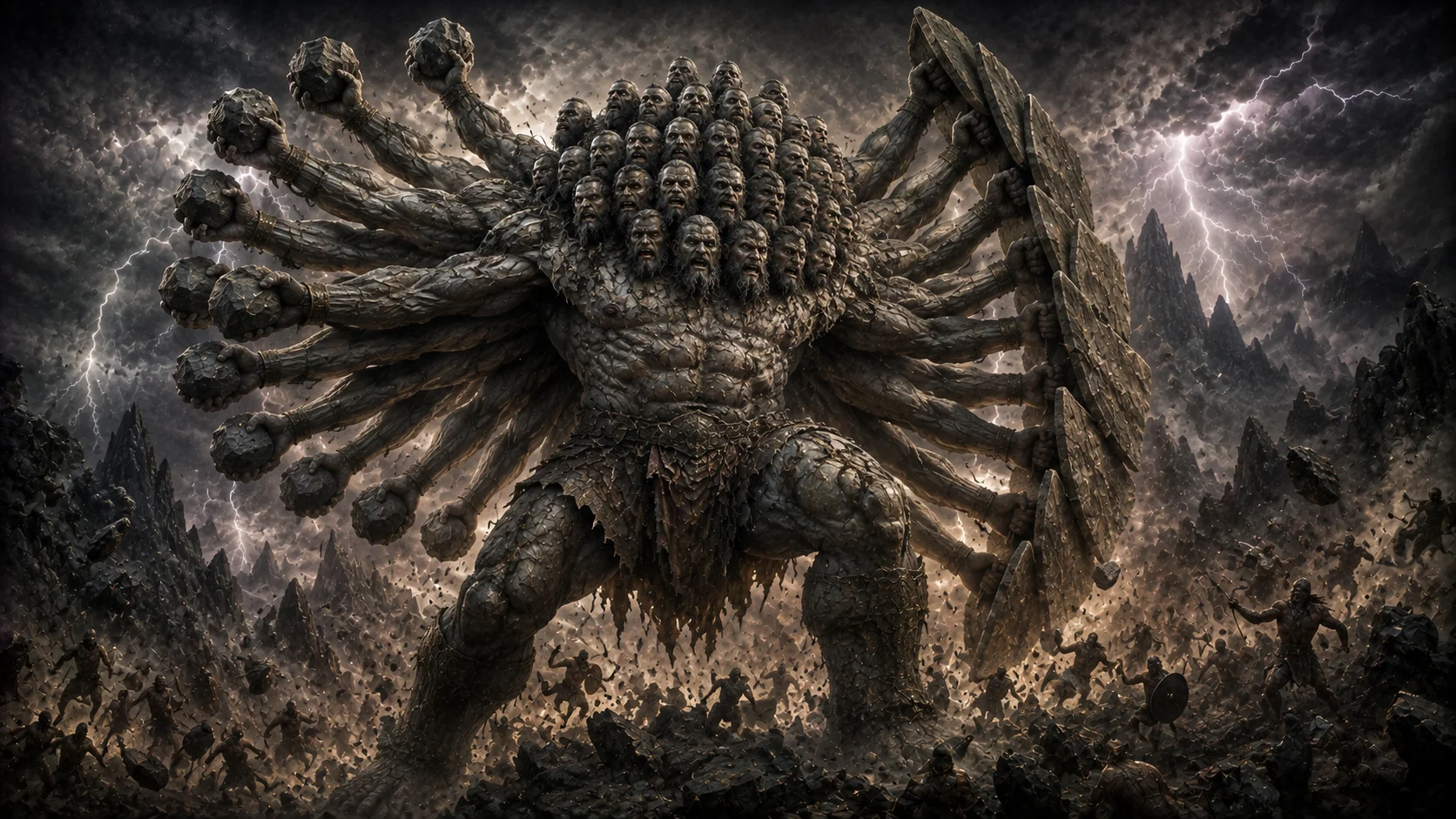
The three Hecatoncheires — Briareus (also called Aegaeon), Cottus and Gyges — were children of Uranus (Sky) and Gaia (Earth), born among the very first generation of beings, brothers to the Cyclopes and the Titans. Each had a hundred mighty arms and fifty heads, making them the strongest and most terrifying of all Gaia's children — living engines of force, able to hurl a hundred boulders at once. They embodied the raw, immeasurable power of the primal earth, beyond all reckoning or restraint.
Last updated .
Imprisoned in Tartarus
Their father Uranus, fearing and loathing these monstrous sons, imprisoned them deep within the earth (in Tartarus), causing Gaia great pain — one of the wrongs that set in motion the overthrow of Uranus by his son Cronus. But Cronus, once he ruled, kept the Hecatoncheires imprisoned still, for he too feared their power. So they languished in the dark beneath the world through the long reign of the Titans, a power held in chains.
The Turning of the Titanomachy
When Zeus rose against the Titans in the great war called the Titanomachy, the struggle dragged on for ten years with neither side prevailing. On the advice of Gaia, Zeus descended to Tartarus and freed the Hecatoncheires (and the Cyclopes), restoring their strength with nectar and ambrosia and winning them as allies. The hundred-handed giants then entered the war with devastating effect: they tore up whole mountains and hurled three hundred boulders at a time, burying the Titans under an avalanche of rock. Their intervention broke the Titans' resistance and won Zeus the victory. Afterward, the Hecatoncheires were set as the eternal guards of Tartarus, watching over the very Titans they had helped to defeat.
The Power That Decided the War
The Hecatoncheires endure as the ultimate image of overwhelming primal force — the hundred-handed giants whose strength was so great that whichever side they joined was bound to win. They embody the mythic theme of the terrible power held in reserve, the chained might that, once unleashed, settles everything — and the wisdom of Zeus in freeing what his predecessors had only feared.
For ten years gods and Titans fought to a standstill — until a hundred hands began to throw mountains, and the war was over.
The Other Rescue: Briareus and the Binding of Zeus
Homer tells a story that Hesiod never mentions at all. In the first book of the Iliad, the sea-nymph Thetis reminds Zeus of a day when his own family turned on him — Hera, Poseidon and Athena moved to bind him and meant to keep him that way. Thetis broke the plot by summoning the one being on Olympus none of them dared face: the hundred-handed giant. The poem notes, almost in passing, that the gods call him Briareus while men call him Aegaeon, and that he is greater in strength than his own father. He sat down beside Zeus in his glory, and the conspirators lost their nerve and left their king unbound.
It is a strange scene to find outside Hesiod's ordered universe of Titanomachy and Tartarus. Here Briareus acts alone, summoned not by Zeus's strategy but by a goddess's quick thinking, and he is a rescuer of Zeus rather than a weapon against the Titans. Ancient readers puzzled over that throwaway line about a father he surpassed in strength: Hesiod makes Briareus a son of Uranus, so which father does Homer have in mind? Ancient commentators took it for Poseidon, and other strands of Greek tradition pull the same way, making Aegaeon a child of Pontus — the sea itself — rather than of the sky. Behind the single figure Hesiod tidied into a trio of earth-born brothers, there seem to have stood older and looser traditions in which Briareus had a separate life as a power of the sea.
A Son-in-Law of the Sea
Hesiod himself seems to know that other life. Immediately after posting the three brothers at the gates of Tartarus as its trusted guards, the Theogony adds a line belonging to a wholly different kind of story: Poseidon took Briareus as his son-in-law and gave him his daughter Cymopolea to wed. It is one sentence, and no story survives to fill it out — no wedding, no children, nothing of their life together afterwards. But the detail matters. It is the only moment in Hesiod at which one of the Hecatoncheires steps out of the role of weapon and prison-guard and into an ordinary mythic relationship: a wife, a father-in-law, a place in the sea's family tree as well as the sky's. Cottus and Gyges are given no equivalent anywhere in the surviving tradition. Only Briareus, doubly named and half-adopted by the sea, appears to have had a life beyond Tartarus's gate.
Not the Gigantes
The Hecatoncheires are routinely confused with a different family of giants born of the same mother, and the confusion is old enough to be worth untangling on its own terms. The Gigantes — the Giants properly so called — sprang from Gaia when the blood of the castrated Uranus fell upon her; they belong to a later act of the cosmic story, and they rose in the Gigantomachy, storming Olympus itself against the order Zeus had already won. The Hecatoncheires belong to the generation before, born of Uranus and Gaia's union rather than of his mutilation, and they fought on the opposite side of history: not against the new gods but for them, breaking the Titans so that Zeus's order could come to exist at all. One family of giants is the crisis the Olympians survived; the other is the force that let them win the crisis before it.
Art keeps the two apart in its own way. The Gigantomachy became one of Greek art's great subjects — carved around the Siphnian Treasury at Delphi, fought again across the great frieze of the Pergamon Altar, painted on pot after pot. The hundred-handed brothers left almost no such trail. Fifty heads and a hundred arms are far easier to say than to draw, and they remained, for the most part, creatures of poetry.
Aegaeon Turned Against Olympus
Roman poetry keeps the hundred hands and switches the side they fight on. In the Aeneid, Virgil reaches for hundred-handed Aegaeon to measure Aeneas at the height of his battle fury — a hundred arms, a hundred hands, fire breaking from fifty mouths and fifty breasts, fifty shields clashing at once and fifty swords drawn, and all of it thrown not for Jove but against his thunderbolts. It is the reverse of the story Hesiod tells, in which Briareus is loosed from Tartarus precisely to save the sky-god's throne. The reversal was not Virgil's own invention: a lost Greek epic of the war against the Titans, known now only through fragments and later summaries, is reported to have made Aegaeon a son of Pontus who fought on the Titans' side. Both versions were available to a Roman poet, and by his day the many-armed shape had become shorthand for overwhelming violence — a figure either army could borrow.
Held in Hell's Deepest Ring
The figure survived into Christian Europe by the road almost every classical monster took — through Dante. In the Inferno, Virgil leads the pilgrim to the well at the centre of Hell, ringed by giants sunk from the navel down so that only their upper halves rise above the rim. The pilgrim asks to be shown “the immeasurable Briareus,” and is refused: the giant stands far off across the ring, Virgil tells him, bound as Ephialtes is bound and fiercer of face. Two thousand years after Hesiod, a hundred-handed giant is still what a poet reaches for when the effect required is monstrous, chained and enormous beyond safe description — and still a being nobody is permitted to see standing free.
Homer gave him a second name and a rescue to perform; Hesiod gave him a wife and a single line of life beyond the war; Virgil turned him against the god he had once saved. Three poets, three uses for the same hundred hands — and in none of them does the giant himself say a word.